Why hammerheads school
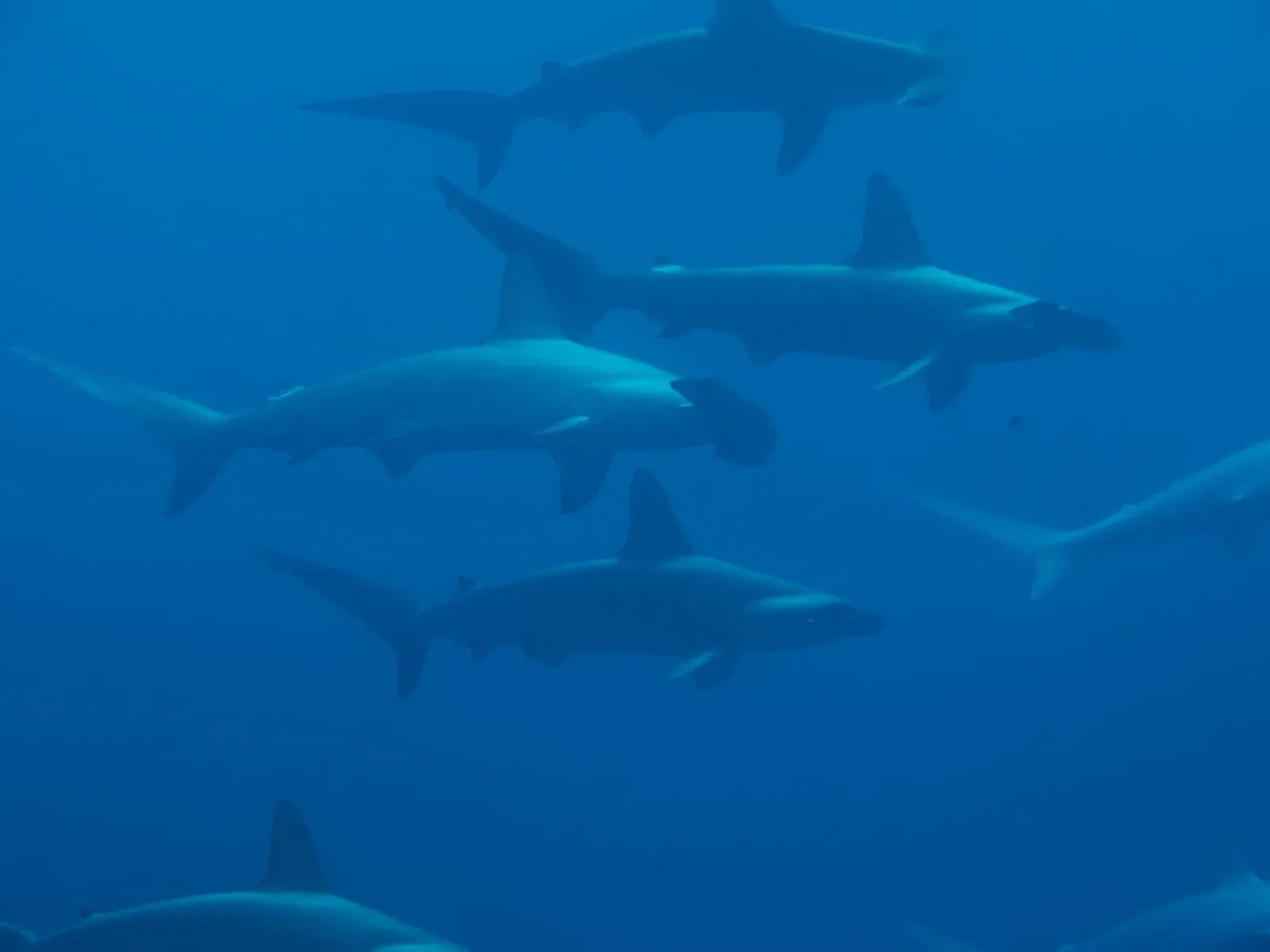
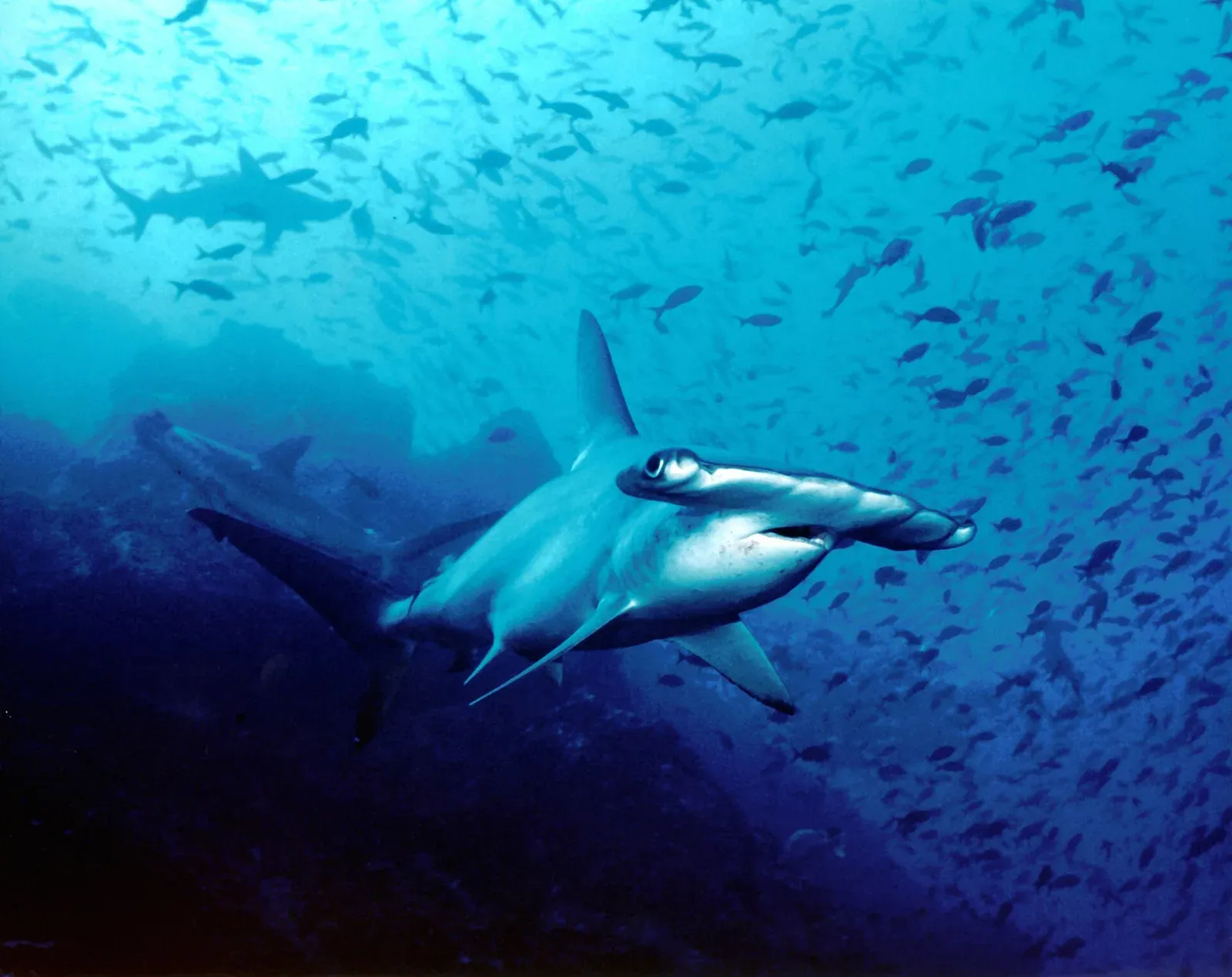
Two hammerheads matter to divers. The scalloped hammerhead is the one that schools: by day, dozens or hundreds gather around seamounts and island slopes, holding in cool water below the thermocline, and at night they scatter to hunt. The great hammerhead is bigger, reaches four metres or more, and is nearly always alone; the encounters with it are shallow, on sand, and often baited. Both are heavily fished for their fins, and the scalloped hammerhead is assessed as critically endangered, which is one reason the places that still hold schools are worth protecting with your money.
The schools have habits you can plan around. They favour isolated rock in open ocean with current running over it, they sit deep when the surface layer is warm, and they come closest to the reef at cleaning stations, where small fish pick their skin, and at first light. Almost every site below is a seamount, a pinnacle or the outside corner of a reef, almost every dive begins with a negative descent into current, and the good months are the months when the water column and the current line up.
Where and when
The matrix is the guide in one picture: each row is a site, each column a month, and the cell colour is the season rating from that site’s own page. Read across for the trip you can take, down for the month you can travel.
| Site | Jan | Feb | Mar | Apr | May | Jun | Jul | Aug | Sep | Oct | Nov | Dec |
|---|---|---|---|---|---|---|---|---|---|---|---|---|
| Darwin's ArchGalápagos | Good | Good | Good | Good | Good | Prime | Prime | Prime | Prime | Prime | Prime | Good |
| Bajo AlcyoneCocos Island | Good | Good | Good | Good | Good | Prime | Prime | Prime | Prime | Prime | Prime | Good |
| Roca PartidaRevillagigedo (Socorro) | Prime | Prime | Prime | Good | Fair | Off-season | Off-season | Off-season | Off-season | Off-season | Fair | Good |
| El Bajo SeamountSea of Cortez | Fair | Fair | Fair | Good | Good | Prime | Prime | Prime | Prime | Prime | Good | Fair |
| Hammerhead Site (South Bimini)Bimini | Prime | Prime | Prime | Good | Off-season | Off-season | Off-season | Off-season | Off-season | Off-season | Good | Prime |
| Daedalus ReefBrothers & Daedalus | Off-season | Off-season | Fair | Good | Prime | Prime | Good | Fair | Prime | Prime | Good | Off-season |
| Angarosh ReefSudanese Red Sea | Fair | Fair | Good | Prime | Prime | Good | Fair | Fair | Good | Prime | Prime | Fair |
| Jackson ReefSharm El Sheikh | Fair | Fair | Good | Good | Prime | Prime | Prime | Prime | Prime | Prime | Good | Fair |
| PinnaclesPonta do Ouro | Good | Good | Good | Good | Good | Good | Prime | Prime | Prime | Prime | Good | Good |
| Northern PinnacleProtea Banks | Good | Prime | Prime | Prime | Good | Good | Prime | Prime | Prime | Good | Fair | Fair |
| El BajónEl Hierro | Good | Good | Good | Good | Good | Prime | Prime | Prime | Prime | Prime | Good | Good |
| Rasdhoo MadivaruAri & Rasdhoo Atolls | Prime | Prime | Prime | Prime | Fair | Good | Good | Good | Good | Good | Fair | Prime |
| The PointLayang-Layang | Off-season | Off-season | Prime | Prime | Prime | Good | Good | Good | Off-season | Off-season | Off-season | Off-season |
| Batu GilaTogian Islands | Fair | Fair | Good | Prime | Prime | Prime | Prime | Prime | Good | Good | Fair | Fair |
| Mikomoto-shimaMikomoto & Nakagi | Off-season | Off-season | Off-season | Fair | Good | Good | Prime | Prime | Prime | Prime | Good | Off-season |
| Blue CornerPalau | Prime | Prime | Prime | Good | Good | Fair | Fair | Fair | Fair | Good | Good | Prime |
| North HornOsprey Reef | Off-season | Off-season | Fair | Good | Good | Good | Good | Good | Prime | Prime | Prime | Good |
| Tiputa PassRangiroa | Prime | Prime | Prime | Prime | Good | Good | Good | Good | Good | Good | Good | Prime |
| Tuheiava PassTikehau | Good | Good | Good | Prime | Prime | Prime | Prime | Prime | Prime | Prime | Good | Good |
| FarikedeFuvahmulah | Prime | Prime | Prime | Prime | Good | Good | Good | Good | Good | Fair | Fair | Prime |
A rough calendar falls out of it. From June to November the eastern Pacific is at its best: the Galápagos, Cocos and La Paz all peak in the northern summer and autumn, and El Hierro in the Atlantic runs on the same calendar. From December to March the action moves to Socorro, Bimini, Palau, Rangiroa and the Maldives. The Red Sea has two windows, May–June and September–October, at the offshore reefs. And the coast of southern Africa, Japan and the Coral Triangle fill the gaps with sites that work in March to May and July to October.
Eastern Pacific: Galápagos, Cocos, Socorro and La Paz
This is where the great schools are. At Darwin's Arch divers drop onto a rocky plateau off Darwin Island and hold position between 18 and 24 m (80 ft) while scalloped hammerheads and Galápagos sharks stream past the blue edge; from July, whale sharks join them. The current is strong and the technique is simple: stay low on the rock and do not swim against it. The rock arch that gave the site its name collapsed in 2021, but the diving is unchanged.
Bajo Alcyone off Cocos Island is the purest version of a hammerhead dive: a seamount whose summit sits at 25 m, reached by a fast negative descent, after which you wedge into the rock and wait while the school fills your field of view. Dirty Rock and the arch at Dos Amigos Grande are the other Cocos sites the sharks use. Both islands are liveaboard-only, ten days at sea, and rated for advanced divers because of the current and the open-ocean pickups.
Mexico offers two very different seasons. Roca Partida is a bare rock in open ocean, small enough to swim around in one dive, with sharks on every side from November to March. And in the Sea of Cortez, El Bajo is a set of three peaks topping out between 16 and 25 m with nothing showing at the surface, where schools of up to a hundred scalloped hammerheads have been recorded in the northern summer, and it is reached by day boat from La Paz.
The Atlantic: Bimini and El Hierro
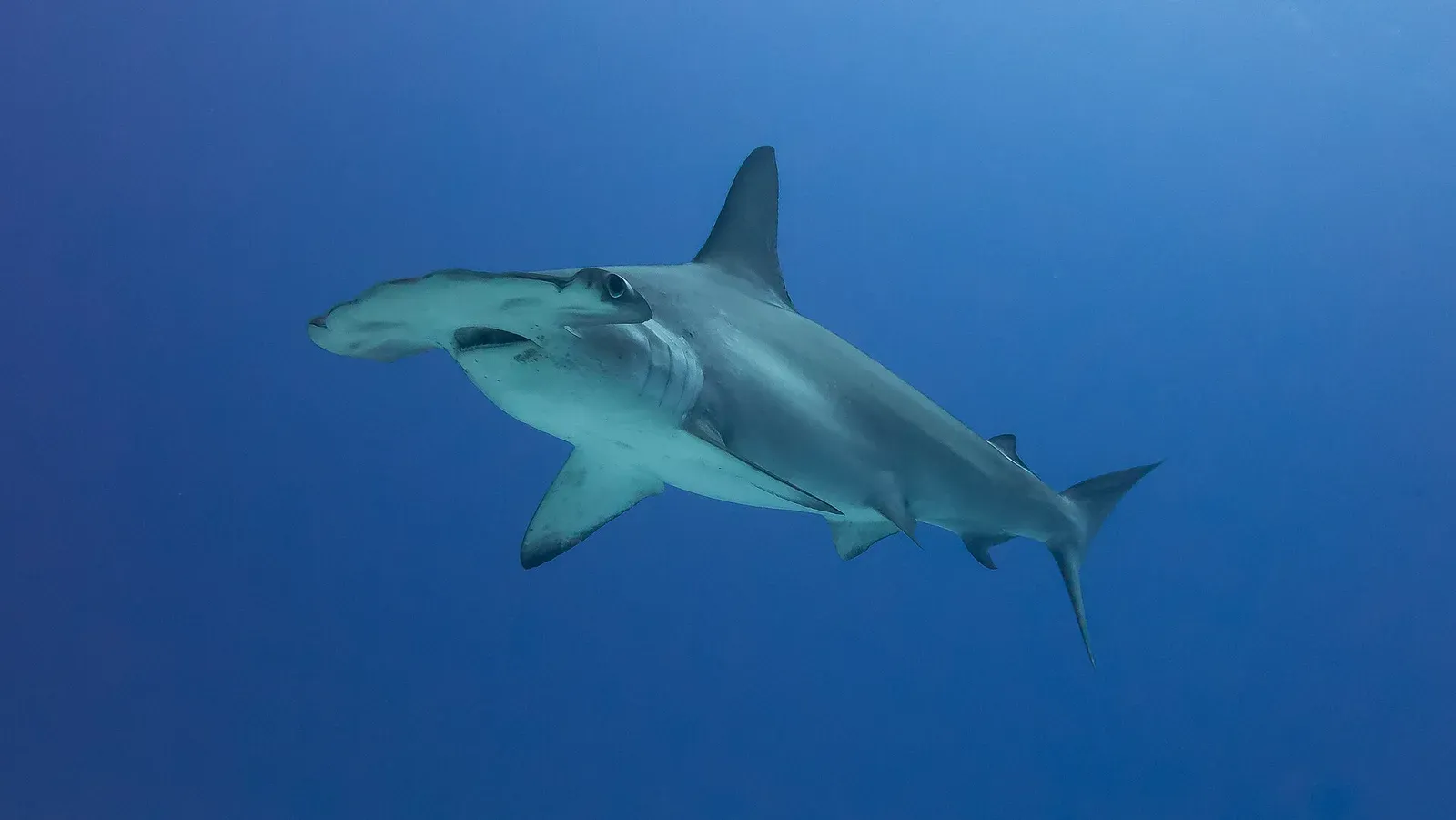
Bimini is the exception to everything above. The sharks are great hammerheads, not scalloped; the dive is on open sand at 6 m, not a seamount at 30; and the season is winter, roughly December to March, when operators run a dedicated baited encounter that is close to guaranteed. It is a long, stationary dive in winter water, so the risk is cold rather than depth. Off the Canary Islands, El Bajón is a submarine volcano whose peaks rise to 8 m and whose seaward face falls to 80; the current that runs on almost every dive is what brings the pelagics through from June to November.
Red Sea and Indian Ocean
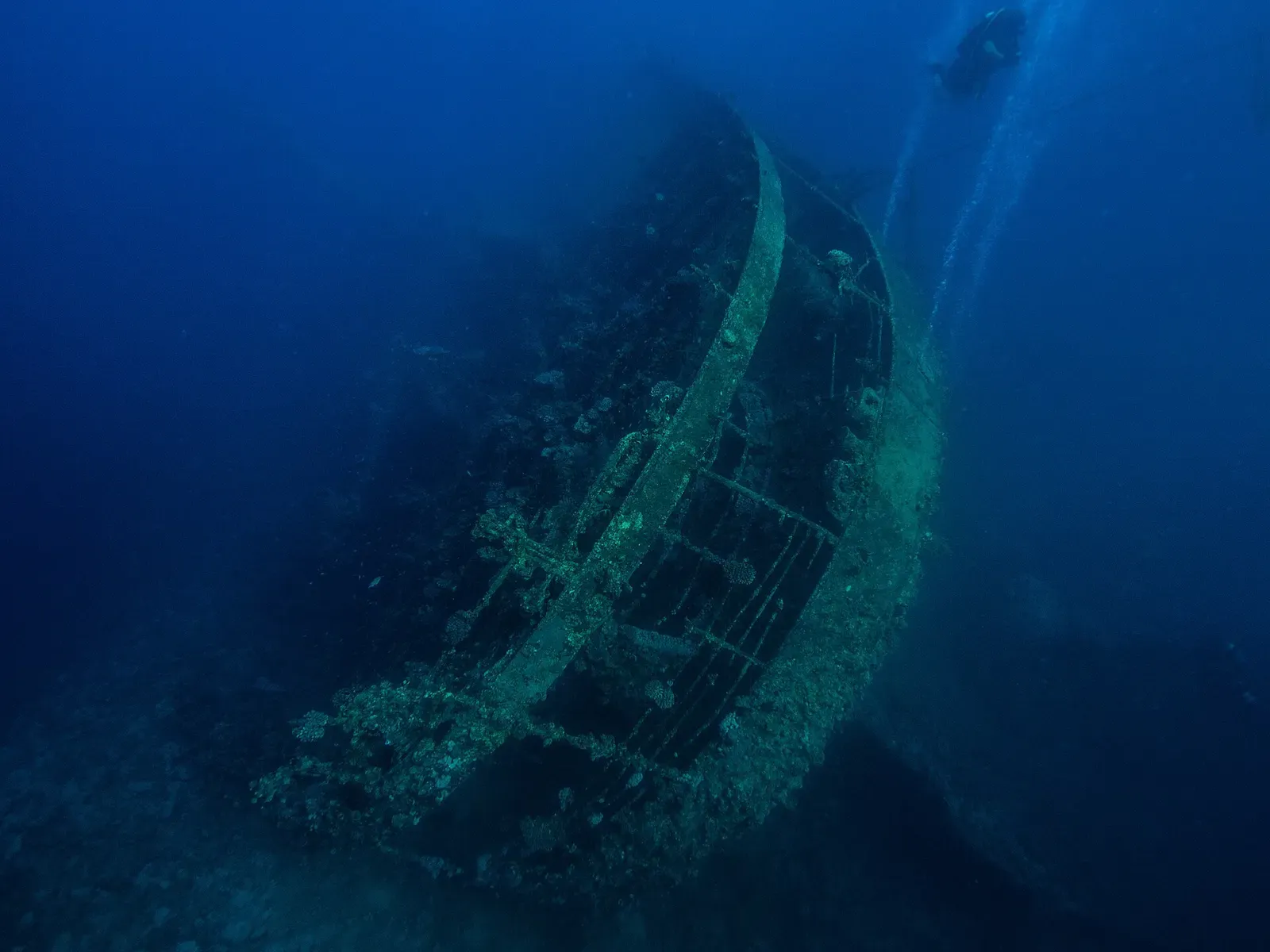
The Egyptian offshore reefs are the Red Sea’s hammerhead grounds, and they are liveaboard territory. Daedalus Reef is a lone seamount 100 km off Marsa Alam, rising from 450 m of water under a lighthouse; scalloped hammerheads gather along its walls in early summer and again in September and October, and Little Brother adds great hammerheads that rise from the deep for a look and drop away again. In Sudan, Angarosh Reef is a pinnacle whose name means Mother of Sharks, with plateaus stepping down to 45 m and current strong enough to hold hammerheads and tigers; Sanganeb Atoll next door has them at 45 m on the Red Sea’s only atoll. Further out, Habili Ali at St John’s holds grey reef sharks and hammerheads off an exposed pinnacle, and Djibouti’s Sept Frères pair hammerheads with mantas on current-swept pinnacles near Bab el-Mandeb. The one day-boat option is Jackson Reef in the Straits of Tiran, where scalloped hammerheads appear off the back of the reef between July and September.
The Maldives has a resident school. At Rasdhoo Madivaru the hammerheads are there all year, and the dive for them is made off the outer wall at first light, dropping over 30 m into open water in current that can be very strong. Far to the south, Farikede is a short, powerful drift over a plateau where hammerheads, threshers, oceanic mantas and mola mola have all come up out of the blue.
Southern Africa’s sites are deep. Pinnacles in Mozambique tops out at 28 m and bottoms at 42, and the dive is a hover above the rock followed by a slow ascent watching the blue; the operator asks for an Advanced certification. Northern Pinnacle in South Africa has a reef top at 32 m, current that decides the direction of the dive on the day, and schools of hammerheads along the northern reef in spring and summer.
Asia and the Pacific
Layang-Layang is a Malaysian atoll in the South China Sea where the reef edge drops into 2,000 m of water, and The Point is dived by leaving the reef at 25 to 40 m and watching open water for the scalloped hammerhead schools that patrol in April and May. Indonesia’s Batu Gila is a ridge between 28 and 42 m at the extreme northern point of a long reef, and the Togians’ best odds on a school. At South Point they are rare and deep, passing at 40 m and beyond.
Japan is the surprise. Mikomoto-shima is a bare rock south of the Izu Peninsula sitting squarely in the Kuroshio, and from summer into autumn scalloped hammerheads gather there in schools that Japanese accounts put in the hundreds. The current is fierce and the dive is a drift; swimming against it is not an option.
Palau’s Blue Corner and Australia’s North Horn are shark dives first and hammerhead dives second: the reliable animals are grey reef and silvertip sharks, with hammerheads passing in the cooler months. French Polynesia runs the other way. Tiputa Pass and Tuheiava Pass are lagoon passes drifted on the incoming tide, and the hammerheads there are great hammerheads, present in the austral summer among the grey reef sharks that fill the channel by the hundred.
| Site | Depth | Level | Best months |
|---|---|---|---|
| Darwin's Arch Galápagos · Ecuador | 18–24 m | Advanced | Jun–Nov |
| Bajo Alcyone Cocos Island · Costa Rica | to 25 m | Advanced | Jun–Nov |
| Roca Partida Revillagigedo (Socorro) · Mexico | to 40 m | Advanced | Jan–Mar |
| El Bajo Seamount Sea of Cortez · Mexico | 16–25 m | Advanced | Jun–Oct |
| Hammerhead Site (South Bimini) Bimini · Bahamas | to 6 m | Advanced | Dec–Mar |
| El Bajón El Hierro · Spain | 18–40 m | Advanced | Jun–Oct |
| Daedalus Reef Brothers & Daedalus · Egypt | 10–40 m | Advanced | May–Jun |
| Angarosh Reef Sudanese Red Sea · Sudan | 10–40 m | Advanced | Apr–May |
| Jackson Reef Sharm El Sheikh · Egypt | 5–30 m | Advanced | May–Oct |
| Rasdhoo Madivaru Ari & Rasdhoo Atolls · Maldives | to 30 m | Advanced | Dec–Apr |
| Farikede Fuvahmulah · Maldives | to 30 m | Advanced | Dec–Apr |
| Pinnacles Ponta do Ouro · Mozambique | 28–42 m | Advanced | Jul–Oct |
| Northern Pinnacle Protea Banks · South Africa | 32–40 m | Advanced | Feb–Apr |
| The Point Layang-Layang · Malaysia | 25–40 m | Advanced | Mar–May |
| Batu Gila Togian Islands · Indonesia | 28–42 m | Advanced | Apr–Aug |
| Mikomoto-shima Mikomoto & Nakagi · Japan | to 35 m | Advanced | Jul–Oct |
| Blue Corner Palau · Palau | 8–30 m | Advanced | Dec–Mar |
| North Horn Osprey Reef · Australia | 10–25 m | Advanced | Sep–Nov |
| Tiputa Pass Rangiroa · French Polynesia | to 35 m | Advanced | Dec–Apr |
| Tuheiava Pass Tikehau · French Polynesia | to 30 m | Intermediate | Apr–Oct |
How to dive with them
Hammerhead dives fail for the same three reasons everywhere, and none of them is bad luck.
Depth. The schools hold below the thermocline, which at Cocos, Layang-Layang or Protea Banks can mean 30 m and 5 °C colder than the surface. Bottom time at that depth is short, the sharks are usually deeper than the plan, and every one of these sites is easy to overshoot. Agree a turn depth on the boat and check your computer far more often than you would on a reef.
Current. Current is why the sharks are there, and it is also why most of these sites are rated advanced. The technique is the same from Darwin to Daedalus: negative descent, get onto the rock, stay low and hold position rather than swim. Carry a surface marker buoy and expect to be picked up in open water.
Noise and bubbles. Hammerheads are shy of divers. Groups that hang quietly at the ledge see schools; groups that chase see tails. On baited great hammerhead dives at Bimini, the rule is the opposite of chasing: keep hands and camera in close and let the shark decide the distance.