Africa · Zimbabwe
Chinhoyi Caves
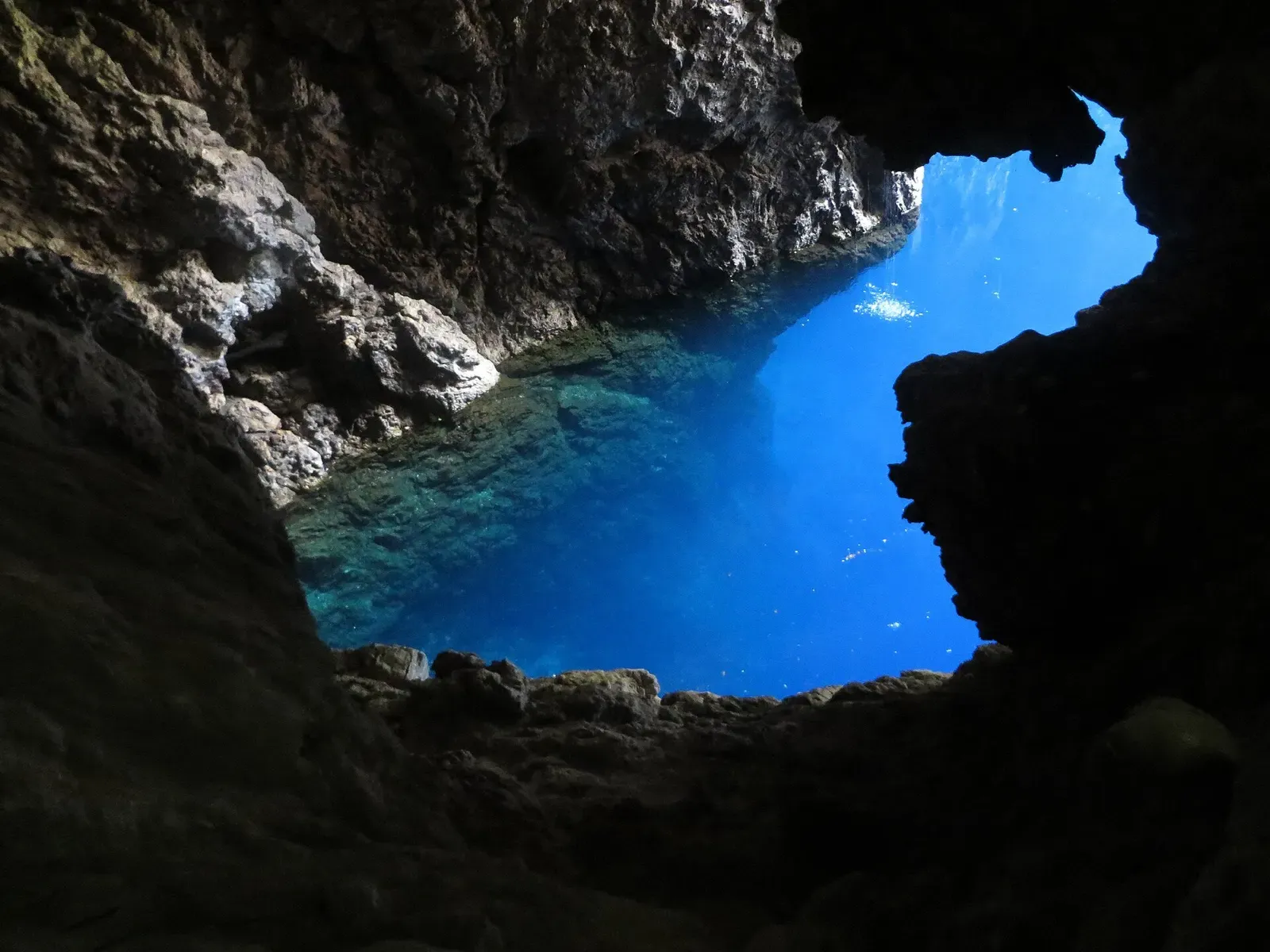
A cobalt-blue sinkhole lake dived past 100 m in constant 22 °C water
Photo: Suesen · CC BY-SA 3.0
Chinhoyi Caves is a national park of dolomite caverns north-west of Harare, built around Chirorodziva, the Sleeping Pool: a cobalt-blue cave lake reached by walking down into a collapsed sinkhole called the Wonder Hole. The water holds a constant 22–24 °C with no thermocline, visibility commonly runs 30 to 50 m, and technical divers have taken it past 100 m without settling on a true floor. Diving is arranged only through Zimbabwe-registered dive clubs, which makes this the only well-known freshwater dive destination in southern Africa outside Lake Malawi.
About diving in Chinhoyi Caves
The caves sit in a small national park of dolomite riddled with sinkholes, about 9 km outside the town of Chinhoyi and roughly two hours by road from Harare. They were declared a national park in 1955 and added as a Ramsar wetland in 2013, and they are described as the most extensive cave system in Zimbabwe that the public can enter. Above ground the park is modest, a few hectares of bush around the sinkholes with a campsite and a motel; the caves themselves, reached down cut steps through the collapsed roof of the Wonder Hole, are the entire attraction.
The pool's Shona name, Chirorodziva, means Pool of the Fallen, and it recalls an 1830s raid in which Angoni raiders passing through the district killed local people and threw their bodies into the water; the caves were also used by local people sheltering from later Ndebele raids. Frederick Courtney Selous gave the first published description of the caves in 1888, when they were still known as the Sinoia Caves, and the name has stuck in some older accounts and maps alongside the modern Chinhoyi.
Diving here has a long record. Divers first went below the surface in January 1959, reaching about 93 m that same year, and a further survey in 1961 mapped the passages around the pool. A trimix dive over December 1968 and January 1969 reached a silt floor at about 104 m, and a US Navy dive team is reported to have gone to 135 m in 1992; the true bottom of the shaft is still not agreed on. Alongside Lake Malawi, it is one of the only two well-known places to dive fresh water in southern Africa, and the only one built around a single deep cave rather than an open lake.
When to dive Chinhoyi Caves
| Jan | Feb | Mar | Apr | May | Jun | Jul | Aug | Sep | Oct | Nov | Dec |
|---|---|---|---|---|---|---|---|---|---|---|---|
| Fair | Fair | Fair | Good | Good | Good | Good | Prime | Prime | Prime | Prime | Fair |
The pool stays a constant 22–24 °C all year; ratings track visibility, best in the Aug–Nov dry season and reduced when Dec–Mar rains cloud the entrance.
Dive types & marine life
There is little to see beyond the geology. The pool itself holds small crustaceans, insect larvae, snails, frogs and introduced goldfish, and a crocodile once placed in the pool by a game warden was later removed. Vervet monkeys, baboons and bushpigs are more likely to be seen in the bush around the sinkholes than anything in the water.
- Freshwater
- Cave & cavern
Notable dive sites in Chinhoyi Caves
Cave & cavern
A guano-floored side pool linked underwater to the main Sleeping Pool shaft
Cave & cavern
A sinkhole lake dived down a scree slope into a shaft that goes past 100 m
Wonder Hole
Collapsed-roof sinkhole; steps drop about 45 m to the pool. Viewed on foot, not dived.
Dark Cave
Gallery of stalactites overlooking the pool, used as the dive-control point. Reached on foot.
Blind Cave
Chamber reached only via a submerged passage from Bat Cave; found by early cave-diving surveys.
Getting there
Harare is the usual base, with the caves about 116 km north-west by road on the A1 towards Chirundu, then 9 km off the highway on a signposted turn. The park charges a small entrance fee, higher for foreign visitors, plus a fee per camera. There is no on-site dive centre; Scuba World and Dive Wild Zimbabwe, both based in Harare, run trips for club members.
Photos from Chinhoyi Caves
Suesen · CC BY-SA 3.0
Suesen · CC BY-SA 3.0
Photo credits
- Intensely blue water seen through a dark limestone cave opening by Suesen, CC BY-SA 3.0, via Wikimedia Commons
- Deep blue sinkhole pool enclosed by limestone walls and green vegetation by Suesen, CC BY-SA 3.0, via Wikimedia Commons
- Dark cave entrance in a reddish limestone cliff surrounded by trees by Suesen, CC BY-SA 3.0, via Wikimedia Commons
In The Logbook
- Diving at altitude: why the rules changeBody & health · 7 min read
- Freshwater diving: lakes, springs and quarriesFreshwater · 15 min read
Similar destinations

Close to a thousand endemic cichlid species over granite boulder slopes

Ragged-tooth sharks hang in mid-water over the offshore reefs each summer

Ragged-tooth sharks pack Cathedral cave through the southern winter.


East Africa's last viable dugong population, in a 1971 national park