The light is not the problem
Ask a diver why the visibility was bad and the answer usually involves the light: an overcast day, a deep dive, the shade of the wall. It is a reasonable guess and mostly wrong. You do not see a rock at 20 metres because the rock is bright. You see it because it is a different brightness from the water around it. Visibility is a question of contrast, and contrast is a ratio. Double the daylight and you double the rock and the water behind it together, and the ratio does not move.
That is the first thing the physics says. Optical oceanographers call it the law of contrast reduction, and much of what is known about it underwater came out of Seibert Duntley’s Visibility Laboratory at Scripps in the two decades before 1963. Look along a horizontal line through uniform water and two things happen to a dark target. The light coming from it is stripped away with distance, and water between you and the target glows with light scattered into your line of sight. That glow is the same water-light you see all around the target, so the target fades into it. The apparent contrast of the target falls off exponentially with distance, at a rate set by one property of the water: its beam attenuation, written c. Illumination is not in the formula. At some distance the contrast drops below the smallest difference your eye can pick out, and the target is gone. That distance is the visibility.
The eye’s limit is its threshold contrast. For a black target viewed horizontally in daylight, the working figure is about 2 per cent. So the sighting range is the distance over which the water cuts a target’s contrast to one fiftieth. In a single colour of light that is ln 50 ÷ c, or about 3.9 divided by the attenuation. The rule is Koschmieder’s law, worked out for haze and fog in the air and carried into the sea unchanged.
It also explains the most counterintuitive thing about diving torches. In daylight, a torch does not give you more distance. The beam lights the particles in front of you as well as the target, and that glow is laid over everything behind it like a veil. Underwater photographers call it backscatter and spend real money to keep their strobes from producing it. A torch is essential for colour, and at night it is the only light you have. It still does not push the edge of the view outward on a bright day.
Two ways to lose a photon
Beam attenuation has two parts, and the difference between them is the heart of this article. Light travelling through water can be absorbed, turned into heat and gone, or scattered, bounced off its path by a water molecule or a particle. The coefficient is the sum: c = a + b, absorption plus scattering.
The blue guide was all about absorption. Water swallows red light within a few metres and blue light hardly at all, which is why the empty ocean is blue and why your red fins turn brown at depth. The green guide added life, and chlorophyll’s absorption closed the blue end of the window. Both of those guides were about how deep the light goes. This one is about how far you can see across, and the villain changes. A photon that is absorbed leaves the view dark. A photon that is scattered does something worse: it keeps travelling, lands somewhere it did not come from, and adds to the veil.
When we run the numbers for the wavelength the water is clearest to, the one that carries the last of your contrast, scattering is about three quarters of the loss in open-ocean water. It rises to nearly nine tenths in a thick bloom. Absorption decides what colour the distance fades to. Scattering decides how soon it fades.
The ladder, 248 metres to one

Embed this diagram
<figure>
  <img src="https://reefwander.com/og/diagrams/sighting-ladder.svg" alt="How far you can see a dark target, sideways, in eight waters. Pure seawater gives 248 m; a tenth of a milligram of chlorophyll per cubic metre, a rich reef, brings it to 32; a thick bloom to 1.4." loading="lazy">
  <figcaption>Diagram by Reefwander, licensed under CC BY 4.0.</figcaption>
</figure>
This is the model the whole article rests on, and it uses nothing that was fitted to divers’ reports. Absorption is Pope and Fry’s measurement for pure water, extended with Morel and Maritorena’s bio-optical model for the ocean. That model takes one number, the chlorophyll concentration, and returns how a typical sea at that concentration attenuates each colour. Scattering is Morel’s figure for the water molecules themselves, plus Morel and Maritorena’s term for particles. We add the two, colour by colour, then ask how far a black target stays above the eye’s 2 per cent threshold. The contrast is weighted across the spectrum by the eye’s sensitivity and by the colour of the water behind the target.
With nothing in the water but water, the answer is 248 metres. That is the ceiling of the sea, and no diver has ever seen it, because there is no such ocean. The emptiest real water on Earth, the subtropical gyres at a hundredth of a milligram of chlorophyll per cubic metre, is already down to 84 m. Clear tropical water gives 43 m. A rich reef at 0.1 mg/m³ gives 32 m. A temperate shelf gives 14, a green coast 7, a bloom under 3 and a thick bloom 1.4. The Ocean Optics Web Book, working from the same kind of model, puts the clearest ocean water at under 100 m. Nothing in our calculation was fitted to what divers see, and it still lands in the right range for each kind of water.
The top of that ladder has a lesson in it about method. The easy approach is to average the water’s attenuation over the colours the eye is most sensitive to and divide once. For pure seawater that gives 44 metres, not 248. The shortcut fails because the real contrast survives longest in the deep blue, where pure water is clearest. The green and yellow that dominate the average are gone long before the blue is. In a bloom the shortcut and the full calculation agree, because every colour is spent within a couple of metres. In clear water the long-lived blue is the whole story.
One warning about the bottom of the ladder. Morel and Maritorena’s model is a Case 1 model: it assumes everything in the water, the cells, their debris and the dissolved yellow substance they shed, rises and falls with the phytoplankton. That holds over a reef or out in the blue. It is false in a harbour, an estuary or a tidal sound, where the load is river silt and stirred-up bottom that answers to nobody’s chlorophyll. The last three rungs read “as if every particle were plankton”. Real coastal water reaches those ranges by other routes, and we come back to them below.
Why every page says thirty metres
The rich-reef rung is worth a second look. A tenth of a milligram of chlorophyll per cubic metre, far too little to tint the water, is enough to take the range from the ceiling to about 30 m. The chlorophyll number is a stand-in: it is the easy-to-measure marker for the whole Case 1 mix of cells, debris and dissolved colour that travels with it. That mix is the commonest sea a diver ever gets into. It is why so many dive-site descriptions, in brochures and on this site, land somewhere between 20 and 40 metres.
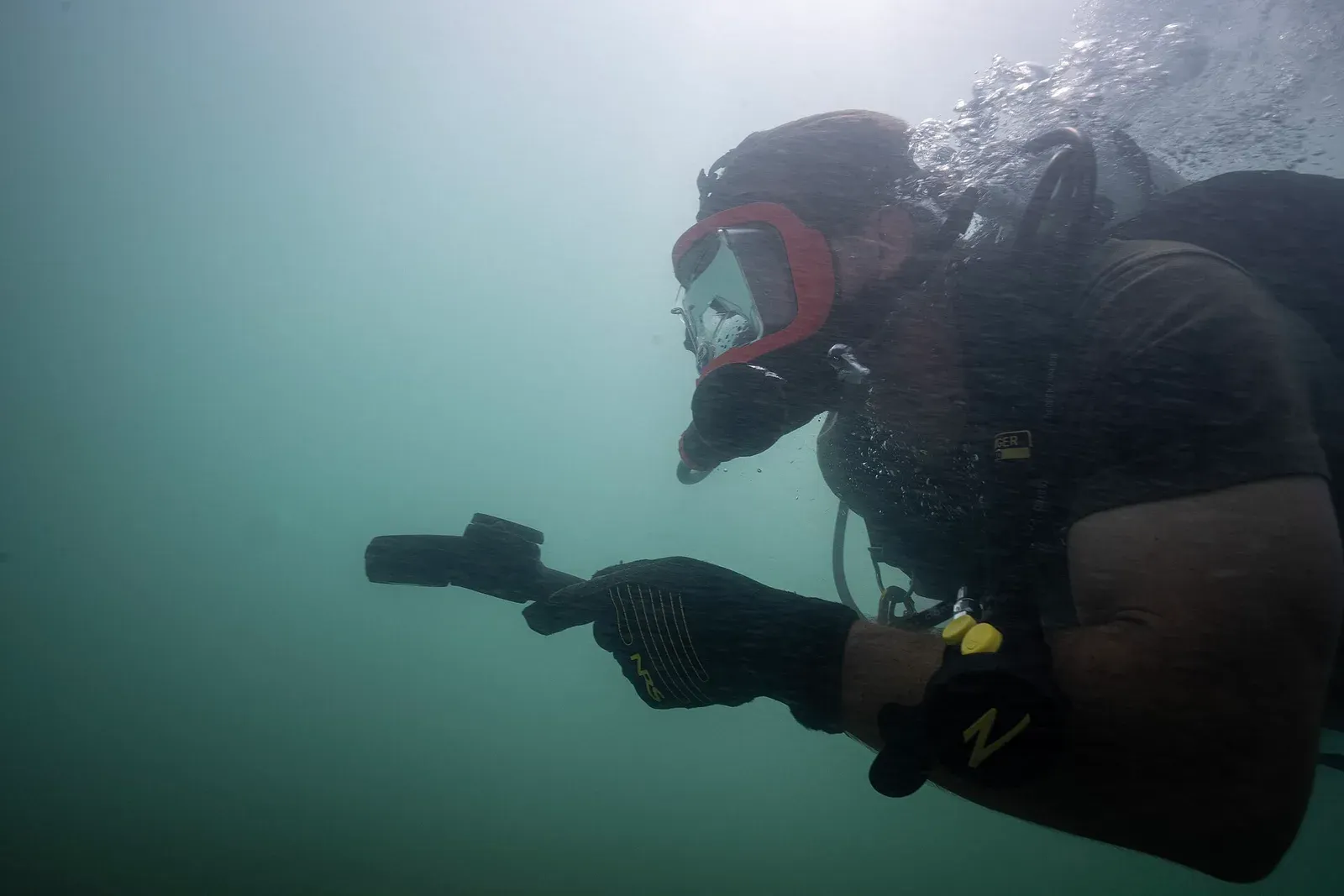
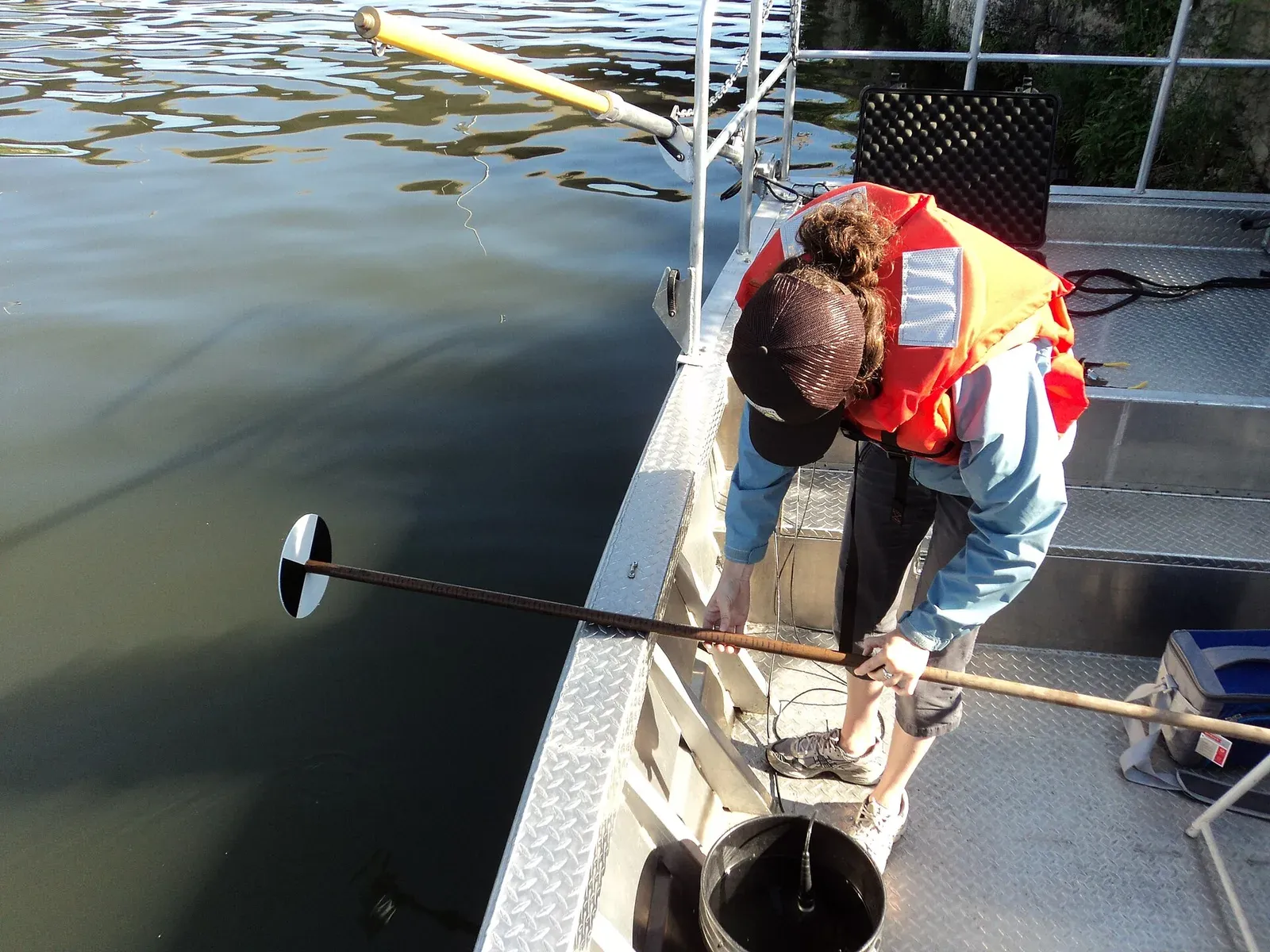
It is also worth knowing what those published numbers are. A visibility figure on a dive-site page is almost never an instrument reading. It is a range assembled from what divers and guides remember seeing, which is why nearly every one is a round number and why the honest way to show one is as a range with a season behind it. The instrument that does exist measures something else. A Secchi disk is a white or black-and-white plate lowered on a line until it disappears, and the depth at which it vanishes is a vertical measurement. The classical theory ties it to how fast the daylight fades with depth as well as to the beam attenuation. A 2015 revision by Zhongping Lee and colleagues goes further and ties it to the daylight term alone. Either way it is not the horizontal sighting range a diver means by “viz”, and plenty of figures online are one quantity wearing the other’s name.
The dial that moves in the shade

Embed this diagram
<figure>
  <img src="https://reefwander.com/og/diagrams/contrast-threshold.svg" alt="The same water, read by different eyes. Sighting range against the contrast the eye needs: clear tropical water gives 43 m to a daylit eye and 33 in the shade, and a grey fish in the shade over a reef fades at 14, less than half the reef’s daylight figure." loading="lazy">
  <figcaption>Diagram by Reefwander, licensed under CC BY 4.0.</figcaption>
</figure>
If brightness cancels out of the contrast, why does the same reef look murkier in the shadow of a wall, or at dusk, or at 30 metres on a grey day? Because the light does move one thing: your threshold. The eye’s ability to pick out a faint difference is best in bright light and for large targets. In the 1940s H. Richard Blackwell mapped the threshold against target size and background brightness, from 90,000 observations by seven observers, and the threshold climbs as the light fades and as the target shrinks. The water between you and the reef is the same. The eye reading it is not.
Move the threshold and the range moves with it. Clear tropical water that gives 43 m at the daylight threshold of 2 per cent gives 51 m to a perfect eye at 1 per cent, and 33 m at 5 per cent, which is about where shade, a small target or a tired eye puts you. The target’s own contrast matters in exactly the same way. A black target has all the contrast there is. A grey fish against grey-blue water starts with perhaps a third of that, and a pale target with 40 per cent of a black one’s contrast in daylight is the same calculation as a black target in the shade. Put a grey fish in the shade over a rich reef and the 32 metres of the reef rung becomes 14. That is how “30 m of viz” turns into less than half of that on the same dive, and nothing about the water changed.
This half of the story does not contradict the first. The water sets the curve. Your eye and the thing you are looking at set where on the curve you are standing.
When the sunlight outlasts the view
Because sighting range depends on c and the depth of the daylight depends on something else, the two come apart, and the gap between them grows as the water fills. Sunlight going down cares mostly about absorption. Particles scatter mostly forwards, by small angles, so a scattered photon usually keeps heading down and still counts as light at depth. The same photon is lost to an image, because it no longer comes from where it seems to.
The green guide computed the depth of the sunlit zone, where 1 per cent of the surface daylight is left, for the same ladder of waters. Set that beside the sighting range and the ratio climbs: the sunlit zone is 1.5 times the sighting range in gyre water, 2.7 times over a reef and 7.4 times in a thick bloom. In a bloom at 10 mg/m³ there is still daylight at 17 metres, and you can see about 3.
That divergence is the reason divers blame the light and are wrong. In a bloom it is bright all around you, and you still cannot see your buddy’s fins. The water is not short of light. It is full of scatterers, and each one is lit.
Rain, rivers and the blurred metre
“Why is the visibility bad after rain?” has three answers, and they work on different timescales.
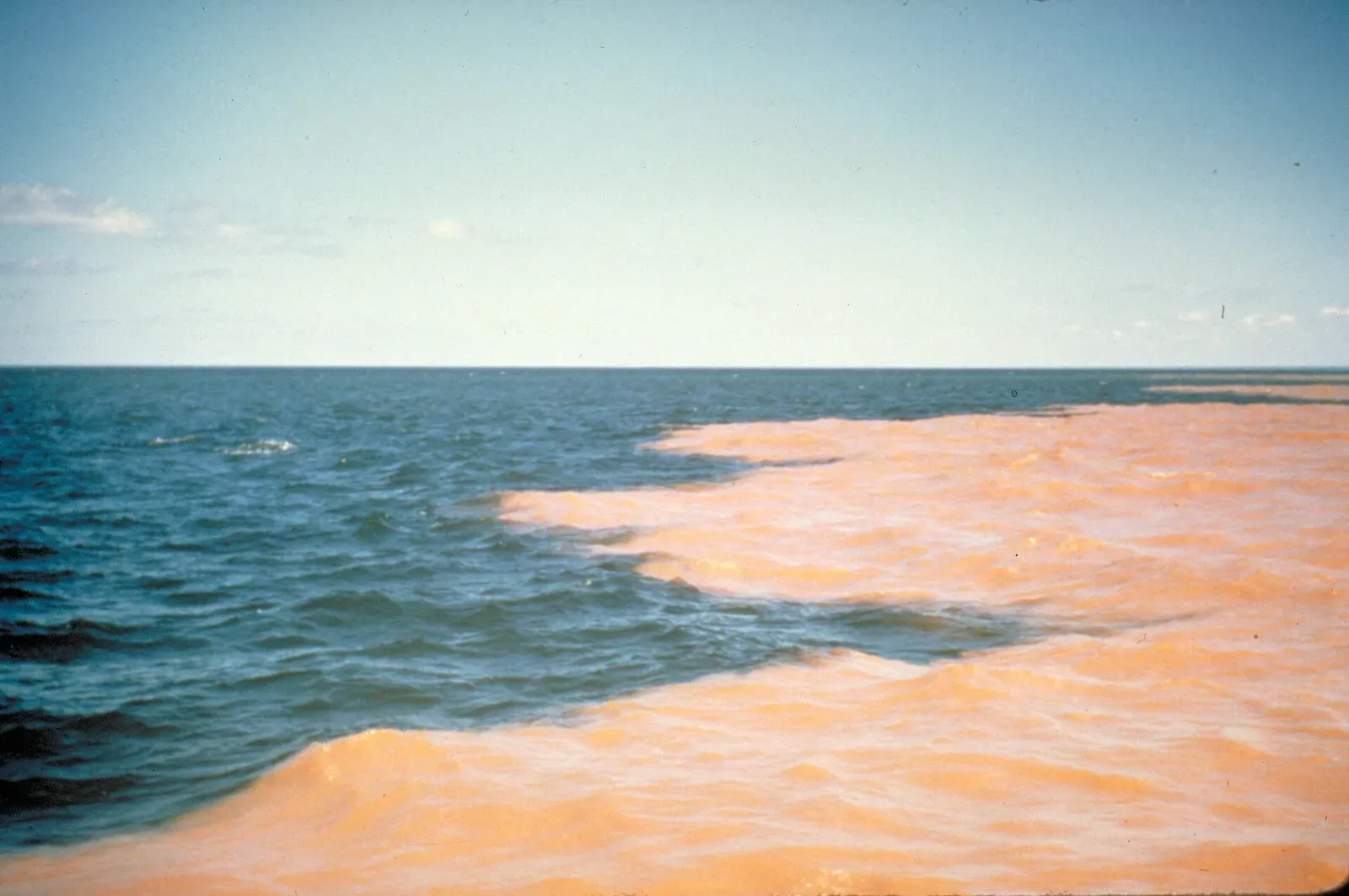
The first is sediment, and it is immediate. Rain washes soil off the land and rivers carry it out, and a plume of fine mineral particles is about the most effective scatterer there is. This is the Case 2 water the ladder cannot model, and it arrives as a front with an edge. Our records for inland water say it plainly. In the Yucatán cenotes, summer downpours can cloud the shallow ones for a day or two. At Bonito, heavy rain from November to February can cloud the rivers and close them for a day or two after storms. At the Chinhoyi Caves the visibility is best in the dry season and reduced when the rains cloud the entrance.
The second is fertiliser, and it takes longer. Runoff carries nutrients, nutrients feed plankton, and a few days later the water climbs the ladder by its own chlorophyll. That is Case 1 again, and the ladder applies. The seasonal version is familiar to temperate divers. Our Puget Sound record gives October to March as the clearest months, once the plankton dies back, and says summer blooms can cut the visibility to a few metres. In Zeeland winter is coldest and clearest. Monterey clears in the autumn after the summer upwelling.
The third is dissolved colour, the tea of tannin and decayed vegetation. It absorbs rather than scatters, and absorbs hardest in the blue: the green guide’s model has it doubling every 50 nanometres toward the blue end. Stained water can therefore be dark without being especially murky. At Milford Sound a freshwater layer from a few centimetres to 10 metres thick sits on the sea, and the site record describes it as dark and blurred where it meets the salt water, with clearer water below.
The blur at that boundary is a fourth effect, and not attenuation at all. Where fresh water lies over salt, and especially where fins have stirred the two together, the changing refractive index bends light unevenly, like looking through wrinkled glass. Nothing is absorbed or scattered, and the view still dissolves. The layered sea covers haloclines properly. The practical point is that the blur resets once you are through into uniform water.
Where the water has nothing left to carry
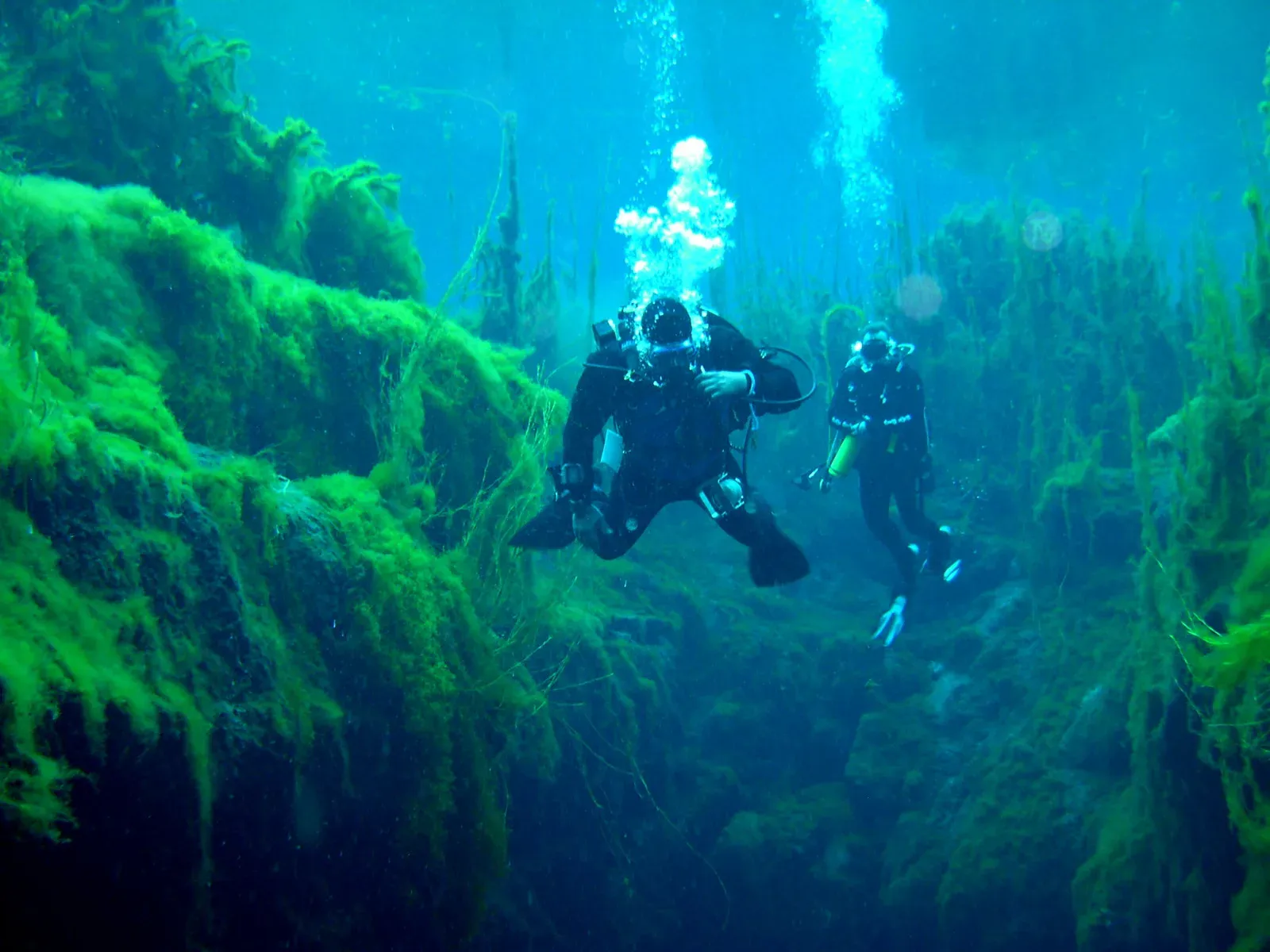
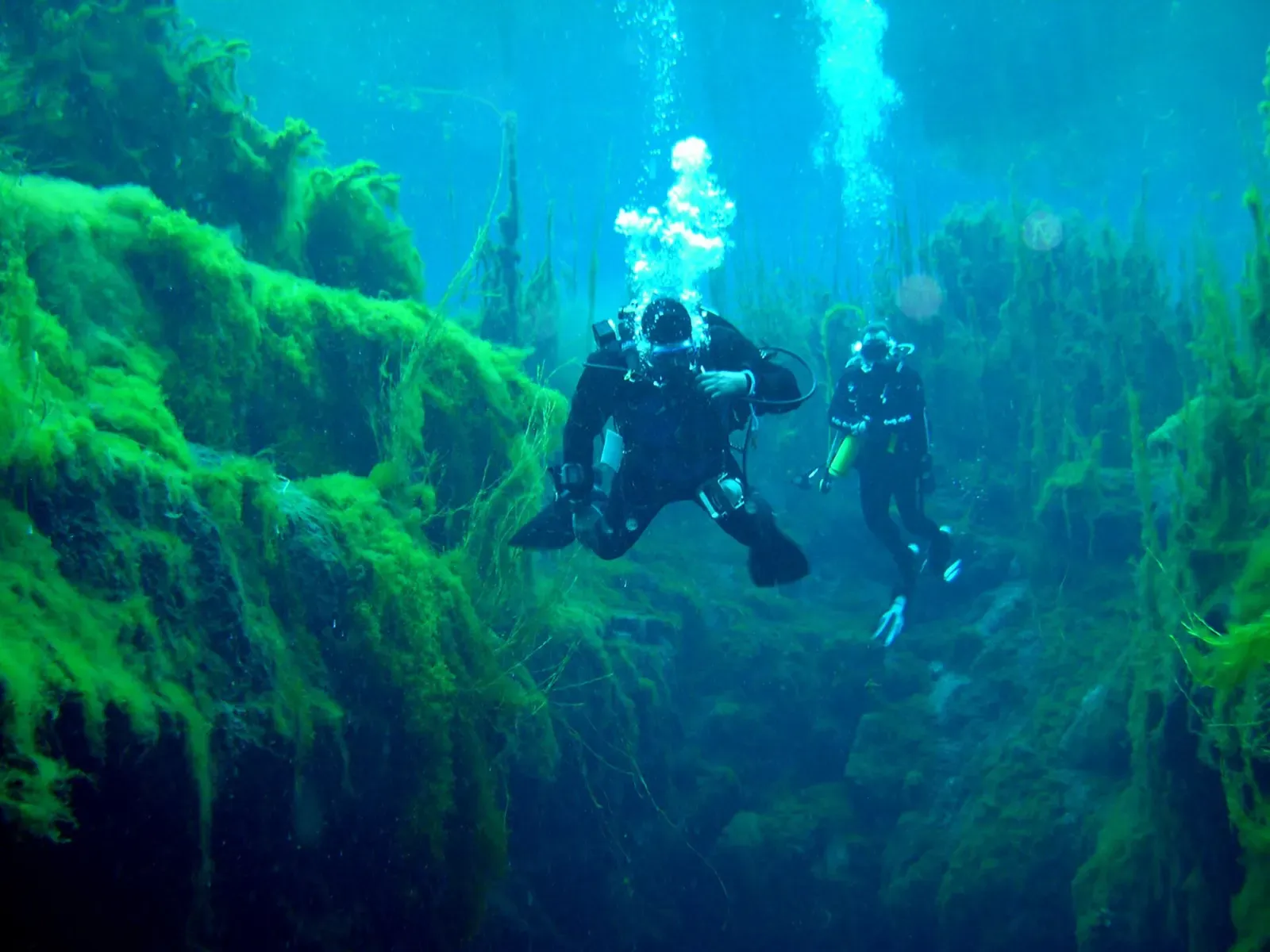
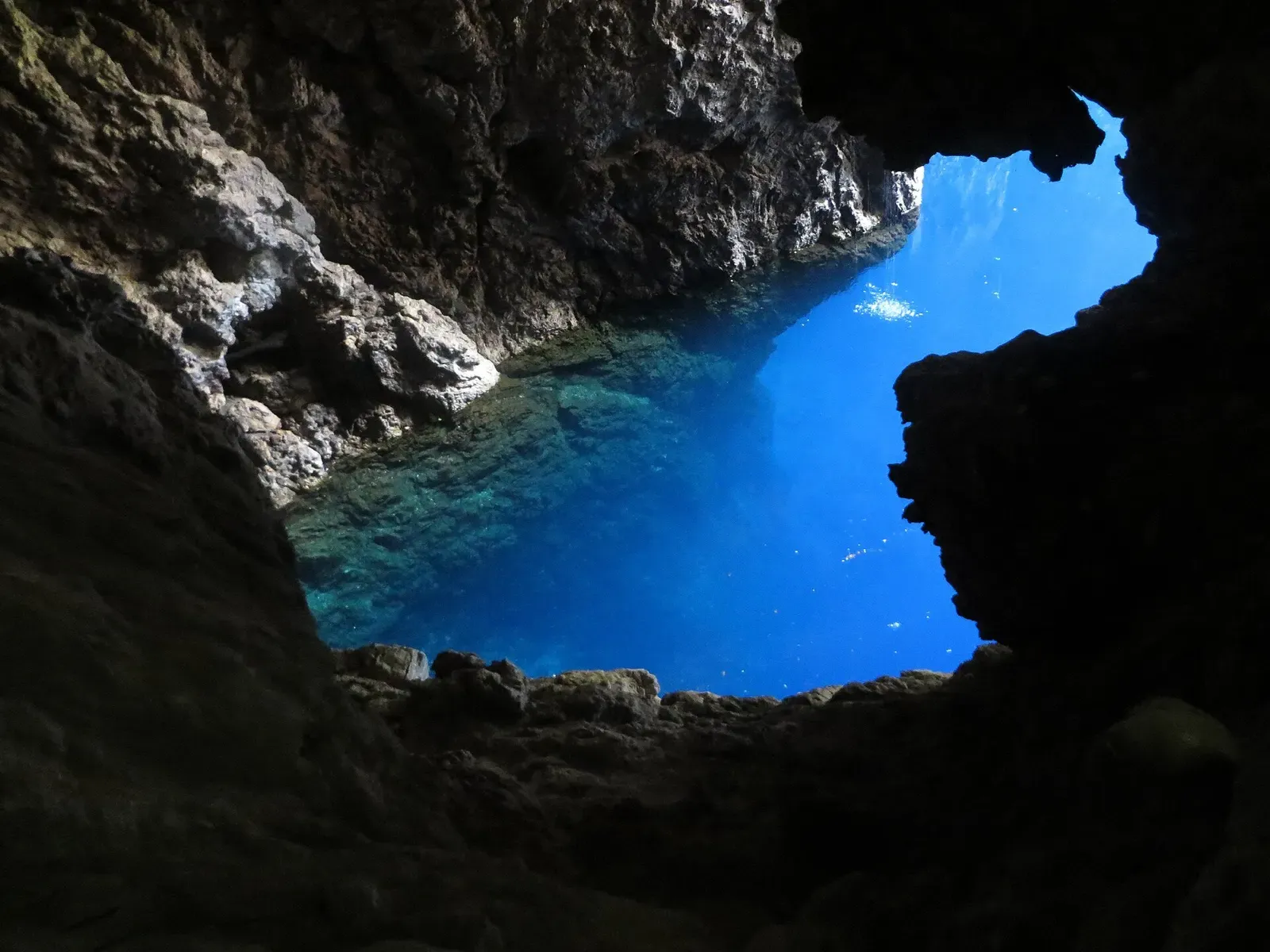
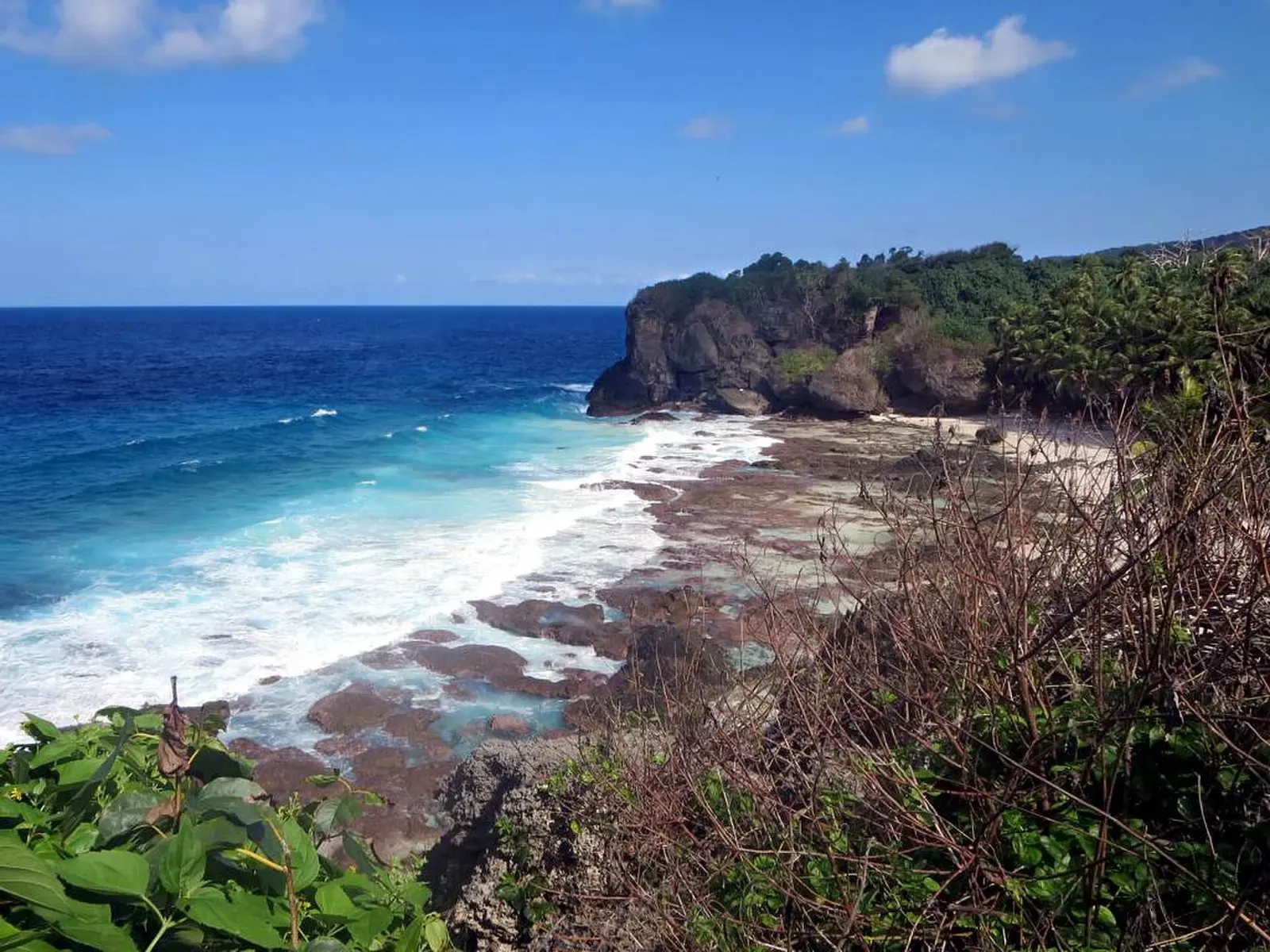
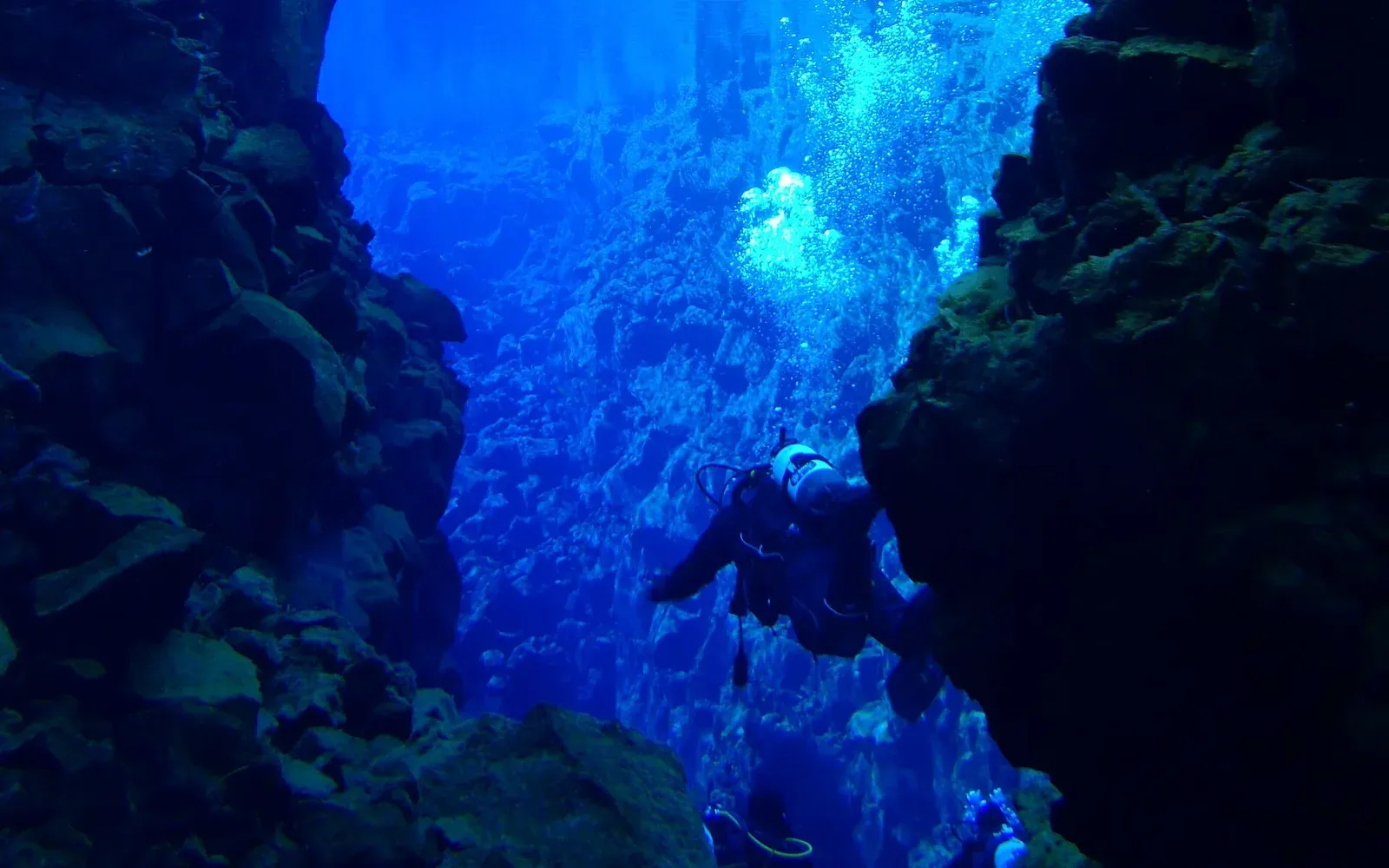
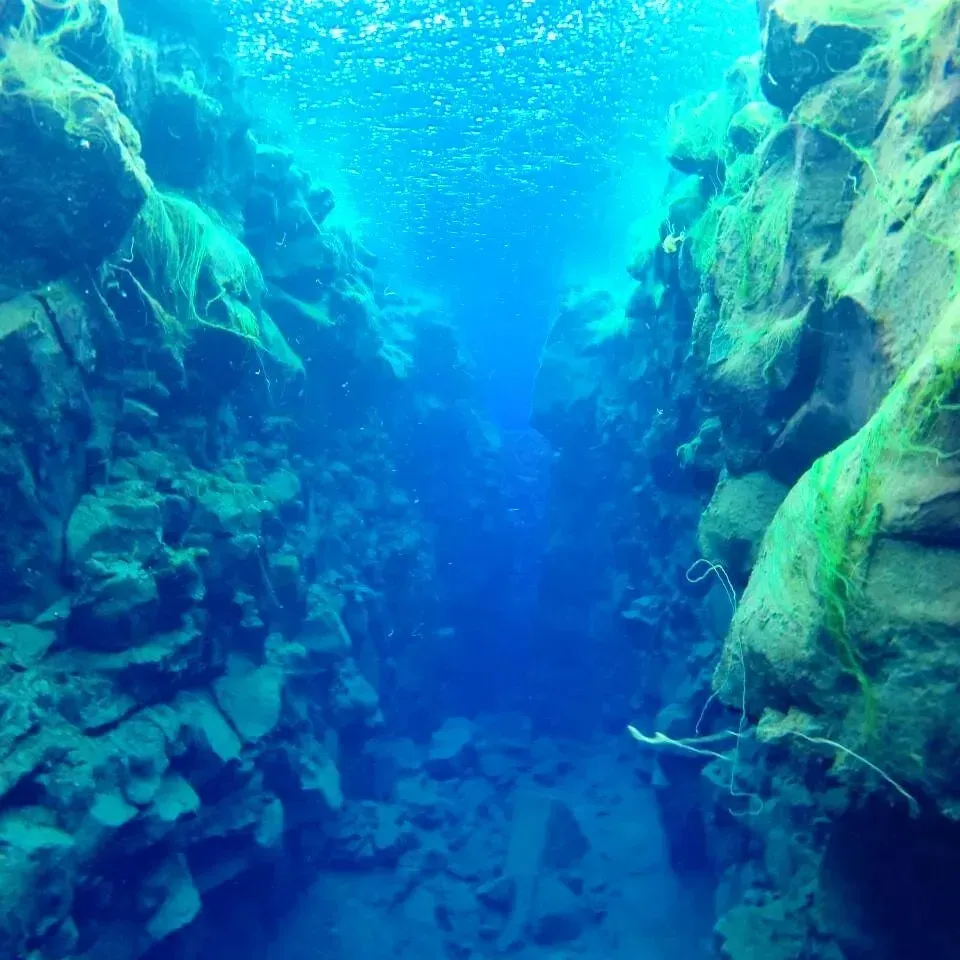
If visibility is the absence of stuff, the clearest diving on Earth should be water that has had no chance to pick any up, and it is. Our area records say the mechanism outright. Silfra is fed by glacial meltwater filtered through porous lava for decades before it resurfaces. Niue is a raised coral atoll with no rivers and no runoff. The sinkholes of Mount Gambier — Limestone Coast are spring- or aquifer-fed, and the Kilsby Sinkhole record describes its water as fresh and colourless, with none of the tannin or algal bloom that colours many sinkholes. Groundwater spends years in the dark, so nothing can grow in it, and it has been filtered through rock on the way.
The table sets those places beside coasts and shelves where rivers, tides and plankton keep the water full. Depths and levels come from the site records. The numbers to compare are not visibility figures but the reasons behind them.
| Site | Depth | Level | Best months |
|---|---|---|---|
| Silfra Cathedral Silfra · Iceland | to 18 m | Intermediate | May–Sep |
| Piccaninnie Ponds Mount Gambier · Australia | 10–36.5 m | Intermediate | Dec–Aug |
| Kilsby Sinkhole Mount Gambier · Australia | 6–40 m | Intermediate | Dec–Aug |
| Gran Cenote Riviera Maya Cenotes · Mexico | to 10 m | Intermediate | Year-round |
| Lagoa Misteriosa Bonito · Brazil | to 40 m | Advanced | Apr–Aug |
| Sleeping Pool Chinhoyi Caves · Zimbabwe | to 20 m | Advanced | Aug–Nov |
| Chimney Niue · Niue | 5–30 m | Advanced | Jul–Sep |
| Perpendicular Wall Christmas Island · Australia | to 30 m | Advanced | Oct–Dec |
| The Grotto Saipan & Tinian · Northern Mariana Islands | 5–18 m | Advanced | Dec–May |
| Den Osse Zeeland · Netherlands | to 30 m | Intermediate | Apr–Jun |
| USS San Diego Long Island Wreck Valley · United States | 20–34 m | Advanced | Jul–Sep |
| Point Lobos — Whalers Cove Monterey Bay · United States | 9–21 m | Intermediate | Sep–Nov |
| Miller's Point Cape Peninsula Kelp Forests · South Africa | to 8 m | Intermediate | Nov–Jun |
| Keystone Jetty Puget Sound · United States | to 21 m | Advanced | Oct–Feb |
| SMS König Scapa Flow · United Kingdom | 25–40 m | Advanced | Sep–Oct |
| Milford Sound (Piopiotahi) Fiordland · New Zealand | to 40 m | Advanced | Dec–Feb |
At the top, the Cathedral at Silfra is about 100 metres long, and its record says you can see from the entrance to the far end. Lagoa Misteriosa is clear enough that divers at 40 metres can still make out the trees around the rim. The Sleeping Pool is rarely under 30 metres. Out at sea, islands with no rivers do the same job: Perpendicular Wall drops into blue off the flank of a seamount, and the Grotto has the best water Saipan has to offer.
At the other end, the Den Osse record logs visibility between 3 and 6 metres across the year. USS San Diego lies in the rich, sediment-stirred shelf water off Long Island. The kelp coasts, Whalers Cove and Miller’s Point, sit in upwelling water that is green because it is fertile. Keystone Jetty and SMS König are dived in cold, tidal, plankton-rich northern water. None of those are bad dives. The water is full because it is feeding something, and the green guide is about exactly that trade.
The optics of empty water, and why a torch fixes colour, are in why the sea is blue. What plankton does to the light, and why the fullest water is where the animals are, is in why some seas are green. The blur bands and fresh lids are in the layered sea, and the clearest water of all is in freshwater diving and cenotes and caverns.