
East Asia · Japan
Mikomoto & Nakagi
Mainland Japan's only reliable schooling hammerhead dive
Photo: Ka23 13 · CC BY-SA 4.0
Mikomoto is a bare rock with a lighthouse nine kilometres off the tip of the Izu Peninsula, sitting directly in the Kuroshio. From summer into late autumn, scalloped hammerheads school along its walls in numbers that make it the only reliable hammerhead dive in mainland Japan, and the shop that pioneered it gave the site its English shorthand. The current is the price: three knots is normal, divers hook in or swim hard, and trips are cancelled more often than they run.
About diving in Mikomoto & Nakagi
The day starts with a call at the harbour, Shimoda or Nakagi depending on the shop, made on the morning after the skipper has read swell and wind, which is why divers who travel for this book several days rather than one. If it goes, the boat crosses open water to the rock and briefs underway, and everyone drops together on a single count. There is no easing into the site and no catching up: being slow off the ladder means missing it, and the group is spread across the blue within a minute of leaving the surface.
The dive is less swimming than holding on. You descend hard onto rock, tuck into the lee of a ridge and stay low out of the worst of the flow, gloved hands on bare stone or a hook set where the rock allows it. Depth stays moderate because the interest is in the water column rather than the bottom, and most of the dive is spent facing out into open water instead of down at the reef. When the flow is up, runtimes are short and the ascent is made in midwater with the boat tracking you.
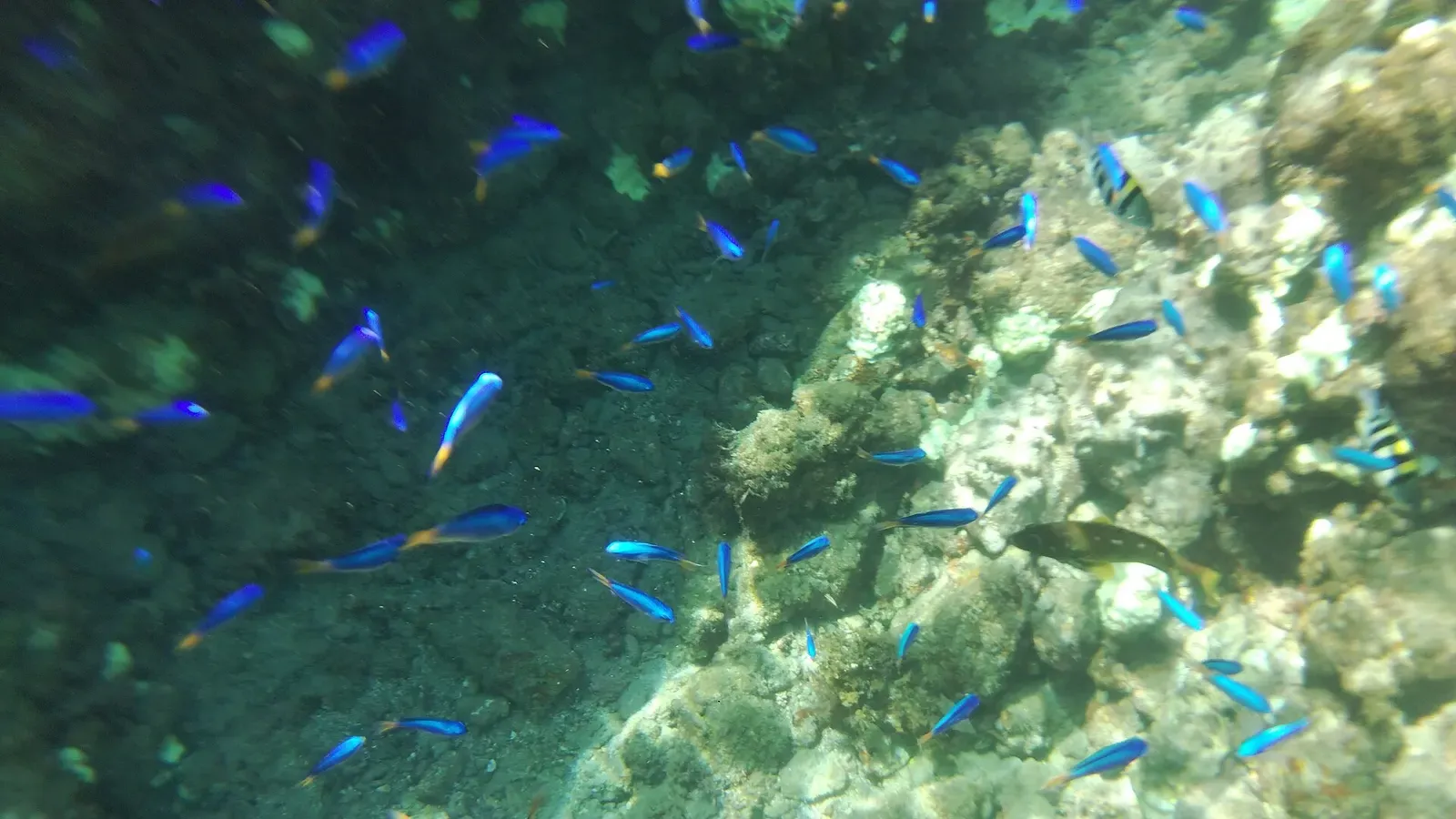
The hammerheads come and go on their own terms. They pass in loose groups above and to seaward, sometimes on and off for an entire dive, sometimes as one column that crosses once and is gone. Around them the rock holds jacks, barracuda and dense schools of smaller fish, and something larger moving through on the current is always possible. Divers who fixate on the sharks tend to miss most of what is actually there.
Fitness counts here as much as logged dives: you will fin against water that does not let up, and holding a stop in midwater with nothing to hold onto is the skill that decides whether the day is enjoyable. Plan gas for the work rather than the depth. Early and late in the run the water heads toward 16°C and a hood or drysuit earns its place. When the rock is off, the same shops fall back to the sheltered coves and beaches of the southern Izu coast, unhurried diving worth planning in rather than treating as a consolation.
Best time to dive Mikomoto & Nakagi
| Jan | Feb | Mar | Apr | May | Jun | Jul | Aug | Sep | Oct | Nov | Dec | |
|---|---|---|---|---|---|---|---|---|---|---|---|---|
| Season | Off-season | Off-season | Off-season | Fair | Good | Good | Prime | Prime | Prime | Prime | Good | Off-season |
| Sea surface | 17°C63°F | 17°C63°F | 17°C63°F | 17°C63°F | 20°C68°F | 22°C72°F | 25°C77°F | 27°C81°F | 27°C81°F | 24°C75°F | 22°C72°F | 19°C66°F |
| Daytime high | 17°C63°F | 17°C63°F | 18°C64°F | 20°C68°F | 22°C72°F | 25°C77°F | 28°C82°F | 29°C84°F | 28°C82°F | 26°C79°F | 23°C73°F | 20°C68°F |
| Rain | 67 mm2.6 in | 102 mm4.0 in | 182 mm7.2 in | 238 mm9.4 in | 283 mm11.1 in | 338 mm13.3 in | 316 mm12.4 in | 218 mm8.6 in | 295 mm11.6 in | 247 mm9.7 in | 122 mm4.8 in | 78 mm3.1 in |
| Jan | Feb | Mar | Apr | May | Jun |
|---|---|---|---|---|---|
| Off-season | Off-season | Off-season | Fair | Good | Good |
| Sea surface | |||||
| 17°C63°F | 17°C63°F | 17°C63°F | 17°C63°F | 20°C68°F | 22°C72°F |
| Daytime high | |||||
| 17°C63°F | 17°C63°F | 18°C64°F | 20°C68°F | 22°C72°F | 25°C77°F |
| Rain | |||||
| 67 mm2.6 in | 102 mm4.0 in | 182 mm7.2 in | 238 mm9.4 in | 283 mm11.1 in | 338 mm13.3 in |
| Jul | Aug | Sep | Oct | Nov | Dec |
|---|---|---|---|---|---|
| Prime | Prime | Prime | Prime | Good | Off-season |
| Sea surface | |||||
| 25°C77°F | 27°C81°F | 27°C81°F | 24°C75°F | 22°C72°F | 19°C66°F |
| Daytime high | |||||
| 28°C82°F | 29°C84°F | 28°C82°F | 26°C79°F | 23°C73°F | 20°C68°F |
| Rain | |||||
| 316 mm12.4 in | 218 mm8.6 in | 295 mm11.6 in | 247 mm9.7 in | 122 mm4.8 in | 78 mm3.1 in |
2011–2025 averages. Sea surface: NOAA Coral Reef Watch, measured at the surface, so deeper water can run colder. Daytime high and rain: NASA POWER.
The island's operator recommends June–October for hammerheads, when the sea is most settled; winter northerlies stop the boats, and swell cancels trips in any month.
Best months: July, August, September, October
Mikomoto water temperature and weather by month
The sea surface runs from 17 °C (63 °F) in February to 27 °C (81 °F) in August. It is 24 °C (75 °F) or warmer from July to October. Most rain falls from April to October, peaking at about 340 mm (13 in) in June; it stays largely dry from November to February. Daytime highs reach 29 °C (84 °F) in August and drop to 17 °C (63 °F) in January. The coldest water here is about 16 °C (61 °F), so pack a 7 mm suit with a hood, or a semi-dry.
Dive types & marine life
Scalloped hammerheads school from early summer into autumn, with June to October the stretch the island's own operator recommends, though it has met them in every month of recent years. Jacks, barracuda and tuna hold around the rock whenever boats run, turtles show up regularly, and mola mola are an occasional cool-water sighting at either end of the season.
- Pelagic & blue water
- Drift
- Reef
- Seamount
- Hammerheads
- Reef sharks
- Trevally & jacks
- Barracuda
- Tuna
- Sea turtles
- Reef fish swarms
- Mola mola
Best dive sites in Mikomoto & Nakagi
The outer drop-off holds the coral, and it is the advanced end
Schooling scalloped hammerheads in the Kuroshio
Kanaeba
Mikomoto's main pinnacle, hooked into and worked against the current.
Tatadohama
Shimoda beach used for check dives and training when Mikomoto is closed.
How to get to Mikomoto & Nakagi
Shimoda is the usual base, reached from Tokyo by the Odoriko limited express straight through to Izukyu-Shimoda, or by Shinkansen to Atami and local trains down the peninsula. Nakagi, the nearer port to the rock, is another half-hour or so by road. Everything is day-boat, and shops expect flexibility about which day you dive, so book beds for longer than the diving itself.
Dive videos
Mikomoto | A sea of tense (Mikomoto Hammers Documentary) · KIRIN SEKITO on YouTube
The Island of Hammerhead Sharks | Scuba Diving in JAPAN · KIRIN SEKITO on YouTube
Photo credits
- The bare rock and lighthouse of Mikomoto-shima rising from open water off Izu. by Ka23 13, CC BY-SA 4.0, via Wikimedia Commons
Embed
Run a dive centre, club or blog? Embed this map of 5 dive sites near Mikomoto on your own page.
In The Logbook
- When is slack water? Tides for diversOcean science · 7 min read
- Sunfish diving: where and when to see a molaBig animals · 11 min read
- When and where to dive with hammerheadsBig animals · 16 min read
Similar destinations
East Asia
Kozushima
Japan
Dense fish schools over volcanic caves and walls, a short hop from Tokyo
East Asia
Izu Ōshima
Japan
Hammerhead schools at sunrise, reached from a volcanic beach
East Asia
Kume Island
Japan
Manta cleaning walls shallow enough for beginners, visited almost all year.


Winter hammerhead schools stack over pinnacles beside the disputed sunken Monument.