
East Asia · Japan
Miyako-jima
Limestone arches and chambers with light shafts through the roof
Photo: Raita Futo · CC BY 2.0
Miyako-jima is a raised limestone island with no rivers to silt its water, and the rock has been drilled through by rain and sea into the most elaborate cavern topography in Japan. Antonio Gaudí is a rock formation of arches and spires named for what it resembles; the Devil's Palace is a chain of chambers connected by tunnels big enough to swim in threes. Light shafts through the holes in the roof are what people come for, and the water is clear enough to carry them.
About diving in Miyako-jima
Nearly all of it is boat diving, and the schedule is set by wind and sun together. Day boats run two or three tanks out of the harbours around Hirara and the bridged islands, and because the cavern mouths face every direction, crews shift to whichever coast is in the lee that morning. The clock matters as much: the beams only land properly when the sun is high, so the marquee dives get slotted mid-morning to early afternoon and reef sites fill the ends of the day.
The terrain is a maze rather than a reef face. Tunnels run clean through the rock, chimneys climb from chamber roofs toward the shallows, and holes and arches link one space to the next, so a dive is often a sequence of enclosures with open blue between them. Most of the named formations sit between 10 and 30 m, shallow enough for long dives, but swell keeps pushing through the narrower passages well after the surface has calmed. Away from the limestone, the outer reefs and the shallow Yabiji complex north of Ikema offer hard-coral gardens and drift diving instead.
Not every dive is overhead, and the mix is what makes a week here work. Guides ration the biggest systems, saving them for flat days and filling the rest with reef, wall and current sites, and the shorter holes serve as a gauge of how a diver handles a ceiling before a longer traverse gets offered. April to June and October are the windows when the exposed coasts open up reliably; winter north winds and the typhoon months close them on and off, so a trip built around the caverns wants spare days in it.
It rewards divers who are steady in the water and enjoy terrain over species lists. Anyone with a wide lens and reasonable trim gets the most from it, and photographers working with natural light have a great deal to play with. Those who dislike overhead environments can still fill a trip on the coral and drift sites, though they would be paying for the island's main draw without using it, and divers who prefer hunting small subjects are better served elsewhere in the archipelago.
Best time to dive Miyako-jima
| Jan | Feb | Mar | Apr | May | Jun | Jul | Aug | Sep | Oct | Nov | Dec | |
|---|---|---|---|---|---|---|---|---|---|---|---|---|
| Season | Fair | Fair | Good | Prime | Prime | Prime | Good | Good | Fair | Prime | Good | Fair |
| Sea surface | 23°C73°F | 23°C73°F | 23°C73°F | 24°C75°F | 26°C79°F | 28°C82°F | 29°C84°F | 30°C86°F | 29°C84°F | 28°C82°F | 26°C79°F | 25°C77°F |
| Daytime high | 24°C75°F | 24°C75°F | 24°C75°F | 26°C79°F | 28°C82°F | 30°C86°F | 30°C86°F | 30°C86°F | 30°C86°F | 29°C84°F | 27°C81°F | 25°C77°F |
| Rain | 70 mm2.8 in | 53 mm2.1 in | 74 mm2.9 in | 113 mm4.4 in | 195 mm7.7 in | 188 mm7.4 in | 130 mm5.1 in | 194 mm7.6 in | 161 mm6.3 in | 120 mm4.7 in | 97 mm3.8 in | 83 mm3.3 in |
| Jan | Feb | Mar | Apr | May | Jun |
|---|---|---|---|---|---|
| Fair | Fair | Good | Prime | Prime | Prime |
| Sea surface | |||||
| 23°C73°F | 23°C73°F | 23°C73°F | 24°C75°F | 26°C79°F | 28°C82°F |
| Daytime high | |||||
| 24°C75°F | 24°C75°F | 24°C75°F | 26°C79°F | 28°C82°F | 30°C86°F |
| Rain | |||||
| 70 mm2.8 in | 53 mm2.1 in | 74 mm2.9 in | 113 mm4.4 in | 195 mm7.7 in | 188 mm7.4 in |
| Jul | Aug | Sep | Oct | Nov | Dec |
|---|---|---|---|---|---|
| Good | Good | Fair | Prime | Good | Fair |
| Sea surface | |||||
| 29°C84°F | 30°C86°F | 29°C84°F | 28°C82°F | 26°C79°F | 25°C77°F |
| Daytime high | |||||
| 30°C86°F | 30°C86°F | 30°C86°F | 29°C84°F | 27°C81°F | 25°C77°F |
| Rain | |||||
| 130 mm5.1 in | 194 mm7.6 in | 161 mm6.3 in | 120 mm4.7 in | 97 mm3.8 in | 83 mm3.3 in |
2011–2025 averages. Sea surface: NOAA Coral Reef Watch, measured at the surface, so deeper water can run colder. Daytime high and rain: NASA POWER.
Apr–Jun and October are the best windows; typhoons disrupt Jul–Sep and winter north winds close the exposed cavern sites.
Best months: April, May, June, October
Miyako-jima water temperature and weather by month
The sea surface runs from 23 °C (73 °F) in February to 30 °C (86 °F) in August. It is 24 °C (75 °F) or warmer from April to December. Most rain falls from May to September, peaking at about 200 mm (7.9 in) in May; January and February are the driest. Daytime highs reach 30 °C (86 °F) in July and drop to 24 °C (75 °F) in February. The coldest water here is about 22 °C (72 °F), so pack a 5 mm suit.
Dive types & marine life
Turtles are on the reef in every month, and whitetip reef sharks sometimes lie up under ledges and inside the wider chambers. Napoleon wrasse and schooling reef fish work the outer edges where tunnels exit into open water, most reliably in the calm April-to-June and October windows. Nudibranchs, octopus and small crustaceans hold on the shaded cavern walls year-round.
- Cave & cavern
- Reef
- Wall
- Drift
- Coral garden
- Sea turtles
- Reef fish swarms
- Nudibranchs
- Macro critters
- Reef sharks
- Napoleon wrasse
- Pristine corals
- Octopus & cuttlefish
Best dive sites in Miyako-jima
Cave & cavern
Layered arches and a smiley-face hole at 30 m
Cave & cavern
A cross-shaped crack at 5 m, seen from the chamber below
Cave & cavern
Blue light falling through the ceiling of the main hall
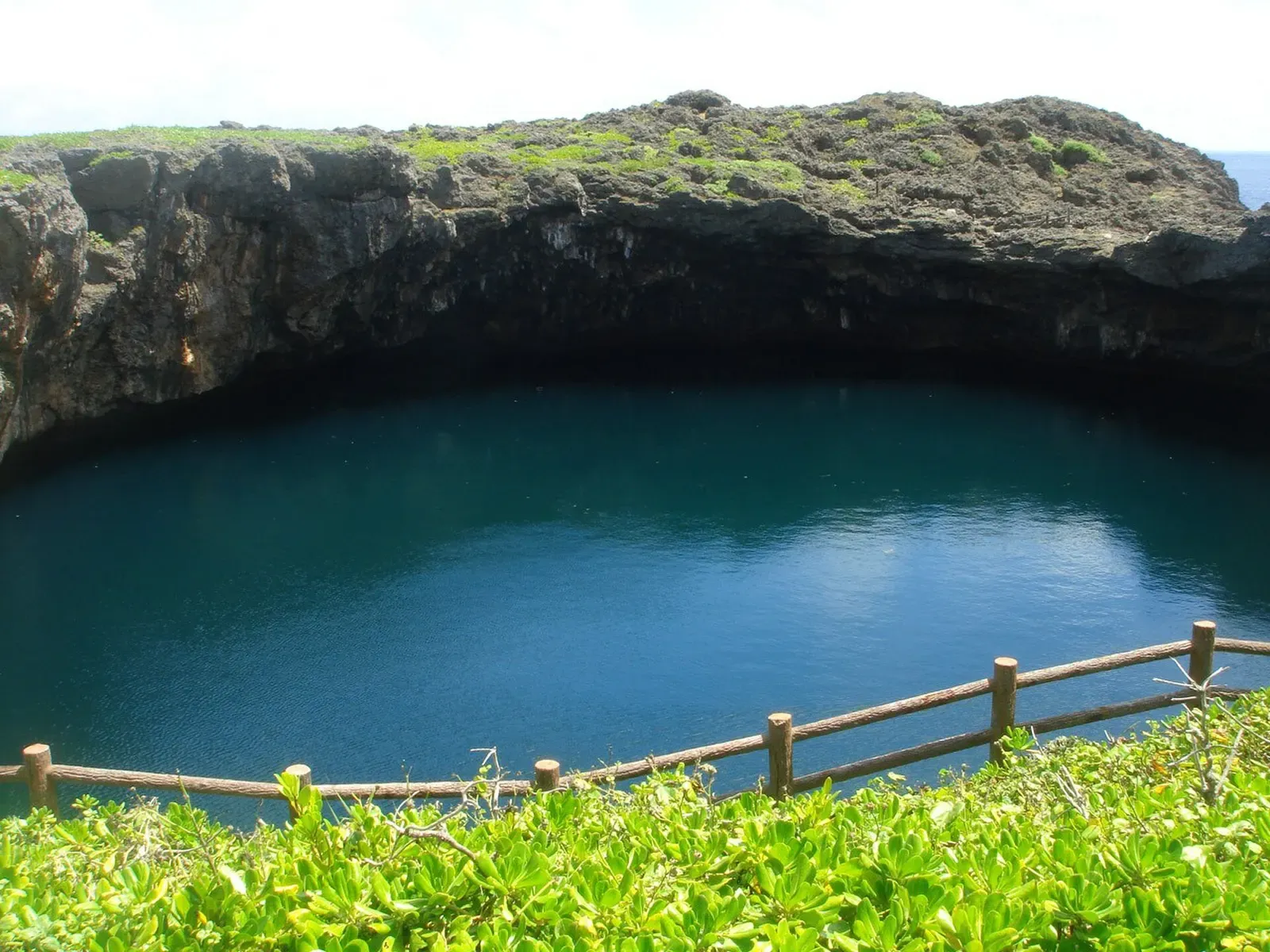
Swim in from the sea and surface inside an inland pond
Cave & cavern
Two arches, two heart-shaped openings, a dark cave below
Mini Grotto
Shallow cavern in 10 m with strong light beams, good for beginners.
How to get to Miyako-jima
Flying is the only practical way in. Miyako Airport takes services from Naha and mainland Japan, and Shimojishima, on the neighbouring island, handles a few routes too. Hirara is the usual base, and a rental car helps since the bridges to Irabu, Ikema and Kurima carry no toll. Cavern diving is almost entirely from day boats.
Photos from Miyako-jima
690 Noda · CC BY 3.0
Dive videos
アントニオガウディ【宮古島ダイビングポイント】 - Miyako island diving site · Totty / scuba diving on YouTube
【DIVING IN JAPAN!!】5 Dive sites in Miyakojima (Okinawa) - 宮古島(沖縄) - · DiverLounge on YouTube
Photo credits
- Turquoise lagoon and distant bridge seen from the Ryugujo observation deck on Miyako-jima by Raita Futo, CC BY 2.0, via Wikimedia Commons
- Kurima Bridge arcing over deep blue water between Miyako-jima and Kurima Island by 690 Noda, CC BY 3.0, via Wikimedia Commons
Embed
Run a dive centre, club or blog? Embed this map of 5 dive sites near Miyako-jima on your own page.
In The Logbook
- What are thermoclines and haloclines?Ocean science · 8 min read
- What is a blue hole, and what's down there?Caves & caverns · 13 min read
- Cavern and cenote diving without cave trainingCaves & caverns · 8 min read
Similar destinations

Protected soft coral forests on volcanic rock off southern Jeju
East Asia
Amami Ōshima
Japan
Pufferfish sculpt two-metre geometric nests into the sand at 25 m

Shore-entry coral slopes at the warm southern tip of Taiwan

.jpg)

Kerama Blue visibility over coral gardens with turtles on nearly every dive.