Scapa Flow · United Kingdom · Wreck
SMS König
Salvage-opened battleship with an engine room worth the dive
Photo: Ian Balcombe · CC BY-SA 2.0
König led the German line at Jutland and was scuttled with the rest of the interned fleet on 21 June 1919. She lies nearly overturned east of Cava under roughly 25 m of water, with the seabed at 38 to 40 m depending on the source, and salvage crews left her extensively broken up, opening areas that stay hidden on the other two battleships.
Also known as SMS Konig.
Where it is and how deep
58.8867° N, 3.1534° WPublished position for this site.
Site maps published elsewhere
The dive
König lies nearly overturned in 38 to 40 m on the sandy floor east of Cava, and she is the most broken of the three battleships. Salvage crews blew several holes through her superstructure to reach non-ferrous metal, and while the damage is obvious, it is also what makes the dive: those openings expose parts of a König-class hull that stay sealed on Markgraf and Kronprinz.
The engine room is the piece to see, and Scapa Flow Wrecks reckons it worth a dive on its own for how much of its machinery is still in place. Around it the wreck is extensively broken up rather than legible, so most divers work one section at a time with a torch and come back for the rest. There is roughly 25 m of water over the highest steel, and the depth builds as you work down the flanks to the sand.
The wreck
- Vessel
- SMS König
- Type
- König-class battleship
- Length
- 175.4 m (575 ft)
- Built
- 1913
- Sunk
- 1919
- Cause
- Scuttled on Rear Admiral Ludwig von Reuter's order to prevent British seizure
- Lies
- Nearly overturned on a sandy floor east of Cava, in 38 to 40 m
König was the lead ship of her class and led the German line at the Battle of Jutland, where she took ten heavy and five or six medium-calibre hits; one officer and 44 men were killed. Launched on 1 March 1913, she was interned at Scapa Flow and scuttled with the rest of the fleet on 21 June 1919 on Rear Admiral Ludwig von Reuter's order. Salvage crews later worked her hard for non-ferrous metal, and the wreck was designated a maritime scheduled ancient monument on 23 May 2001.
Marine life and season
The sources we used don't single out particular species here.
| Jan | Feb | Mar | Apr | May | Jun | Jul | Aug | Sep | Oct | Nov | Dec |
|---|---|---|---|---|---|---|---|---|---|---|---|
| Off-season | Off-season | Fair | Good | Good | Good | Good | Good | Prime | Prime | Fair | Off-season |
Season follows Scapa Flow: Boats run from Easter to early November, and visibility improves in autumn once the plankton dies back.
Know before you go
- The hull is extensively broken up and salvage holes lead inside; penetration on a wreck this dark and this deep needs a line, a torch and the training to use both.
Dive videos
Diving the wreck of SMS Konig - battleship, Scapa Flow · Rod Macdonald on YouTube
SMS Konig, battleship wreck dive, Scapa Flow · James Hartley on YouTube
Questions divers ask
Why is the König so broken up?+
Salvage teams worked the wreck for non-ferrous metal and dynamited holes through her superstructure to get at it. The damage is considerable, but it also opens up areas that remain hidden on the other battleships in the Flow.
How deep is the SMS König?+
Sources put the seabed at 38 m or 40 m, with roughly 25 m of water over the highest part of the hull. Either way it is a deep, dark dive that needs cold-water and depth experience.
Sources
- SMS König — Wikipedia
- Diving in the United Kingdom — Wikivoyage
- SMS König — Scapa Flow Wrecks
- Wrecks and Obstructions within UK EEZ — UK Hydrographic Office, ADMIRALTY Marine Data Portal
Photo credits
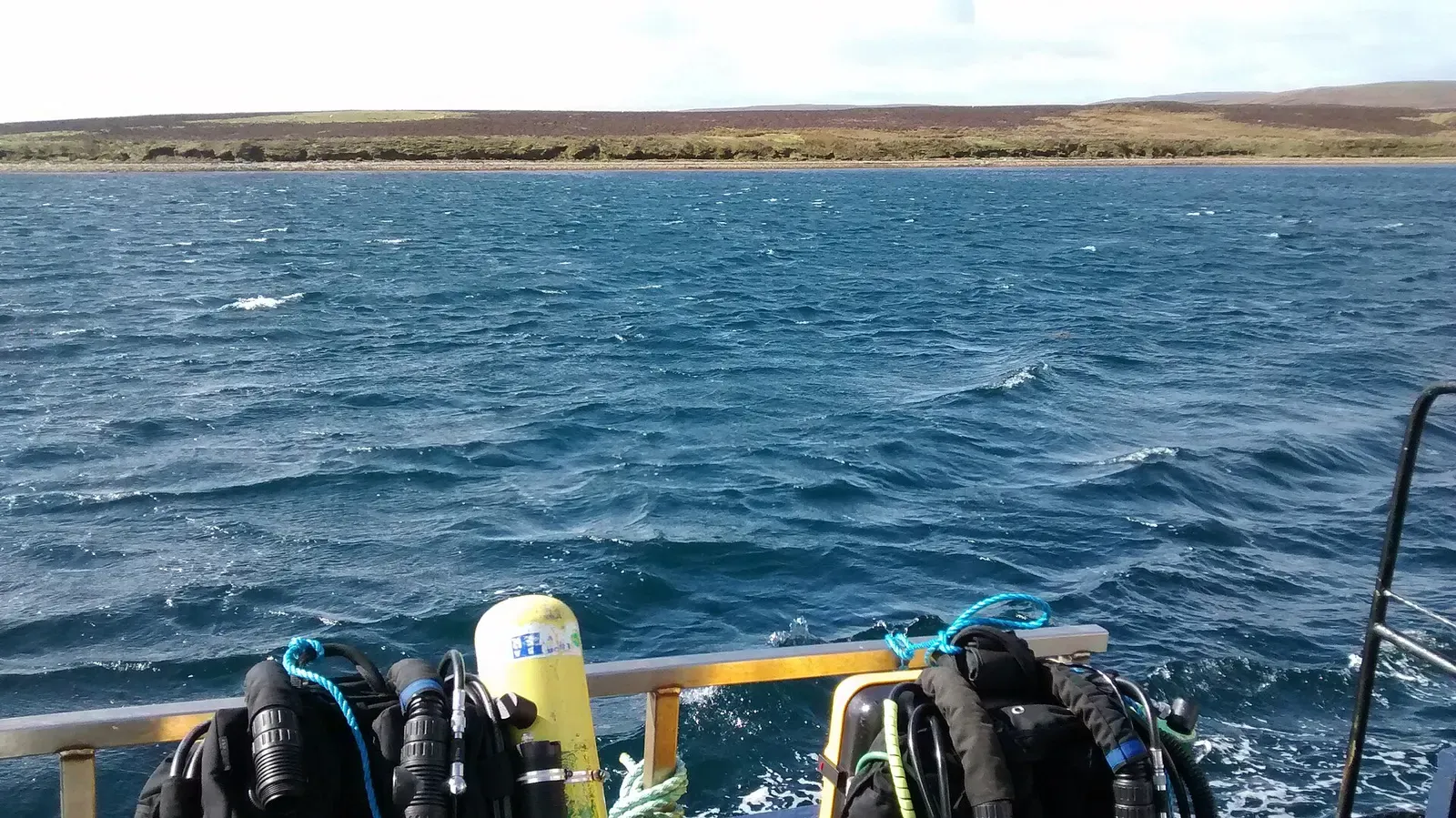
- Scuba tanks racked on a dive boat's rail as it crosses Scapa Flow near Rysa Little, land astern. by Ian Balcombe, CC BY-SA 2.0, via Wikimedia Commons
In The Logbook
- How far you can see underwaterOcean science · 12 min read
- Cold-water diving: is it worth the drysuit?Cold water · 8 min read
- Deep wreck diving: where recreational stopsWrecks · 8 min read
More dive sites in Scapa Flow
Bow at 25 m, stern at 38 m, lying on an incline
Wreck
Armoured control tower and stem both still standing
Bow, stern and rudders of an upturned 1913 dreadnought
Similar dives elsewhere
Five wrecks and a scatter of dinghies on one dive
Wreck
Birkenfels
Belgian North Sea · Belgium
A virtually intact ore carrier lying flat on the bottom far off the Belgian coast
A 1918 torpedo loss at 36 to 38 m on clean sand

A wartime wreck at 40 m with boxes of anti-aircraft heads at the bows