Atlantic · Spain
Tarifa & the Strait of Gibraltar
A tidal strait ring around Isla de Tarifa, with wrecks and migrating tuna
Tarifa sits at the southern tip of continental Europe, and the diving is a ring of sites around Isla de las Palomas inside the Strait of Gibraltar Natural Park. Boats leave the town port for walls, rock corridors and sand: La Garita at 3–13 m, La Pared on the island wall at 5–19 m, La Piscina at 10–25 m with drift potential, Las Gorgonias on sand at 19–32 m. The wrecks run deeper still, the 19th-century steamship San Andrés at 25–40 m among them, and bluefin tuna cross the strait in late spring.
About diving in Tarifa & the Strait of Gibraltar
The diving is one island. Both centres found here work out of Tarifa town and the port beside it, and the day is a short boat run to Isla de las Palomas, the island that carries almost every named site on its Atlantic or Mediterranean face. Puerto Fenicio, on the island's Atlantic side, can also be entered from the beach. Plans follow the tide: currents in the strait are strong and change through the day, and the funnel of coastal massifs on both sides makes wind strong enough to stop boat work.
Underneath is rock, not coral. Las Calles stacks rock corridors, wall and sand into routes between 8 and 18 m, La Pared is a straight wall run of 5–19 m with lobster, moray and snapper in the cracks, and El placer del macro is a field of overhangs at 5–15 m carrying benthic growth, nudibranchs and schools of salema. Three wrecks sit on the sand around the island: the San Andrés at 25–40 m with groupers and congers in its holes, Las Calderas at 14–25 m with three boilers still recognisable, and Las Gorgonias at 19–32 m. Some points have no park buoy, so the boat anchors.
It suits divers who are comfortable with tide planning and want an Atlantic-Mediterranean junction rather than a reef, with wrecks in a compact area and pelagic traffic overhead. The island sits inside the Strait of Gibraltar Natural Park, which moors many of the sites on its own buoys, and Andalucía has protected its underwater archaeological ground as cultural heritage since 2009. Divers after warm, clear water and calm conditions should look to the Canaries, where El Cabrón and Lanzarote offer rock-and-wreck diving without the strait's currents and wind.
When to dive Tarifa & the Strait of Gibraltar
| Jan | Feb | Mar | Apr | May | Jun | Jul | Aug | Sep | Oct | Nov | Dec |
|---|---|---|---|---|---|---|---|---|---|---|---|
| Fair | Fair | Fair | Fair | Good | Good | Good | Prime | Prime | Prime | Fair | Fair |
August to October holds the warmest water; visibility does not track it, and the strait's funnelled Levante and Poniente winds can stop boats in any month.
Dive types & marine life
La Piscina is where the most turtles have been sighted, groupers and conger eels hold in the San Andrés wreck, and lobsters, morays and snappers sit in the cracks at La Pared. Bluefin tuna cross the strait to spawn in May and June and return west in July and August. Pilot whales, orcas and dolphins are resident in the park, but those are surface sightings rather than dive plans.
- Reef
- Wall
- Wreck
- Drift
- Pelagic & blue water
- Night
- Sea turtles
- Groupers
- Tuna
- Macro critters
- Reef fish swarms
Notable dive sites in Tarifa & the Strait of Gibraltar
Reef
A grotto rock at 5–14 m that shelters lobsters and rays
Wall
Sand pools at 8 m under a wall worked from 15 up to 9 m
Wreck
Three boilers still standing in an early-1900s wreck at 8–20 m
Wreck
A steamer on its side under gorgonian growth, at 18–31 m
Wreck
An upright steamer at 28 m with rudder and propeller visible
Wreck
An 1856 steamship broken across the bottom from 22 m to 30 m
Reef
Shore-accessible rock from 0 to 18 m over a Phoenician port
Roman grinding stones and amphorae at the foot of a 40 m point
Anchors from several centuries along a 14–35 m rock run
El placer del macro
Rocky walls and overhangs at 5–15 m, thick with benthic life, nudibranchs and schools of salema.
El Boquete / La Pared
La Pared is a wall dive of 5–19 m; El Boquete a hole through the island wall that reaches the surface.
El Avión
Southern tip of the island platform, 20–50 m; free descent in current, expert level only.
Getting there
Gibraltar airport is 35 minutes away by road, Jerez de la Frontera an hour, Málaga about ninety minutes. Buses run in from Algeciras in 45 minutes and Cádiz in an hour and a half. Both dive centres are in Tarifa town or the port itself, which is also the terminal for the fast ferry to Tangier.
Photos from Tarifa & the Strait of Gibraltar
Pablo Forcén Soler (Forcy) · Public domain
Łukasz Ciesielski - Guma89 · CC BY-SA 4.0
Photo credits
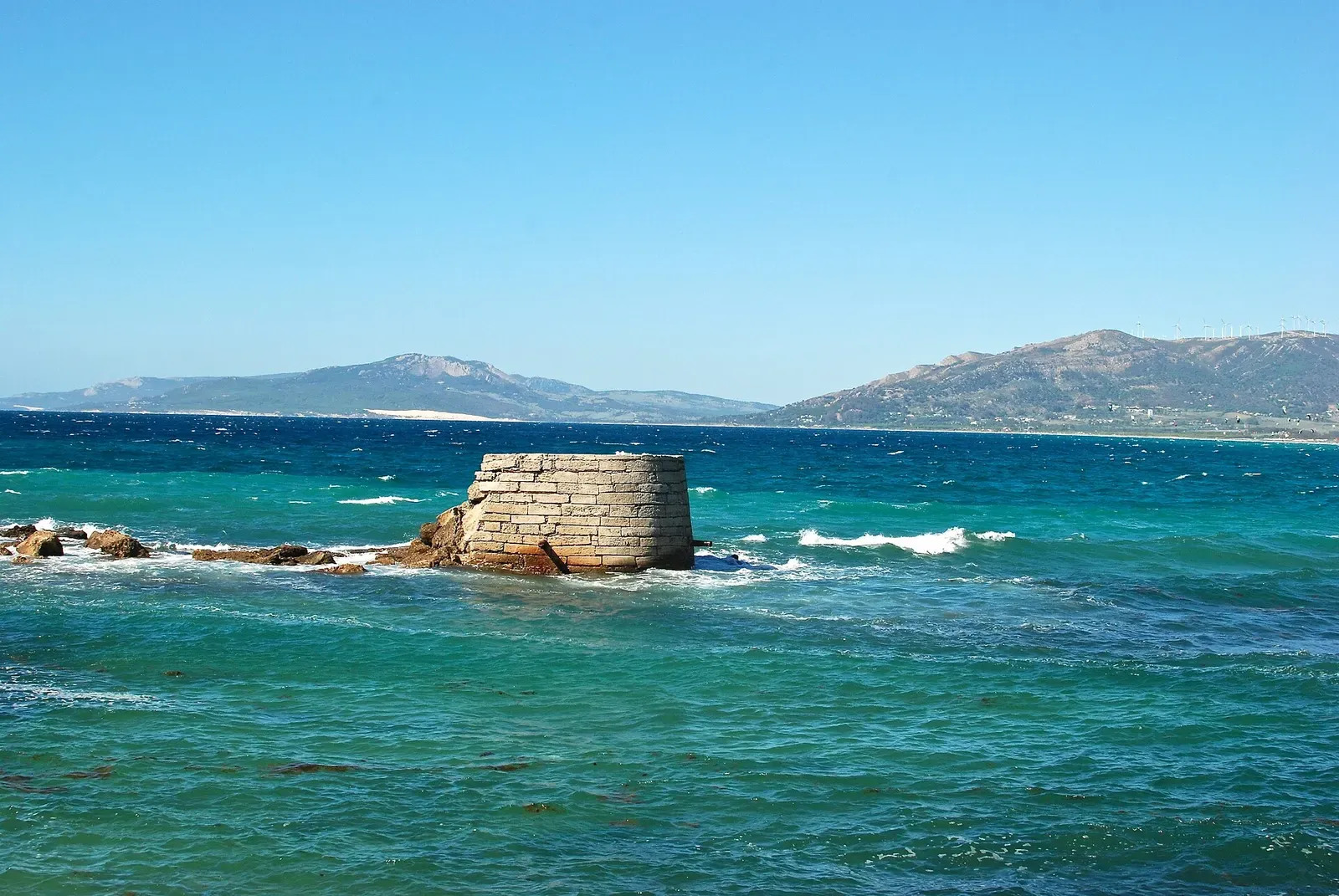
- A stone military outpost stands in turquoise water off Isla de las Palomas, with hills across the strait beyond. by Karan Jain from Washington, DC, USA, CC BY-SA 2.0, via Wikimedia Commons
- Rocky breakwater above a turquoise beach curving toward Tarifa's town and hills. by Pablo Forcén Soler (Forcy), Public domain, via Wikimedia Commons
- Wide golden-hour view of Tarifa town and its castle seen across the beach from Cape Punta Tarifa. by Łukasz Ciesielski - Guma89, CC BY-SA 4.0, via Wikimedia Commons
Similar destinations
A 1.5 km volcanic reef stepping from 7 m to past 40 m off Caleta de Fuste

Around three hundred charted wrecks, most of them shallower than 20 m


.jpg)

Adult male and female whale sharks gather together, seen nowhere else
Atlantic
Tenerife
Spain
Black sand and lava arches metres from shore, with resident pilot whales