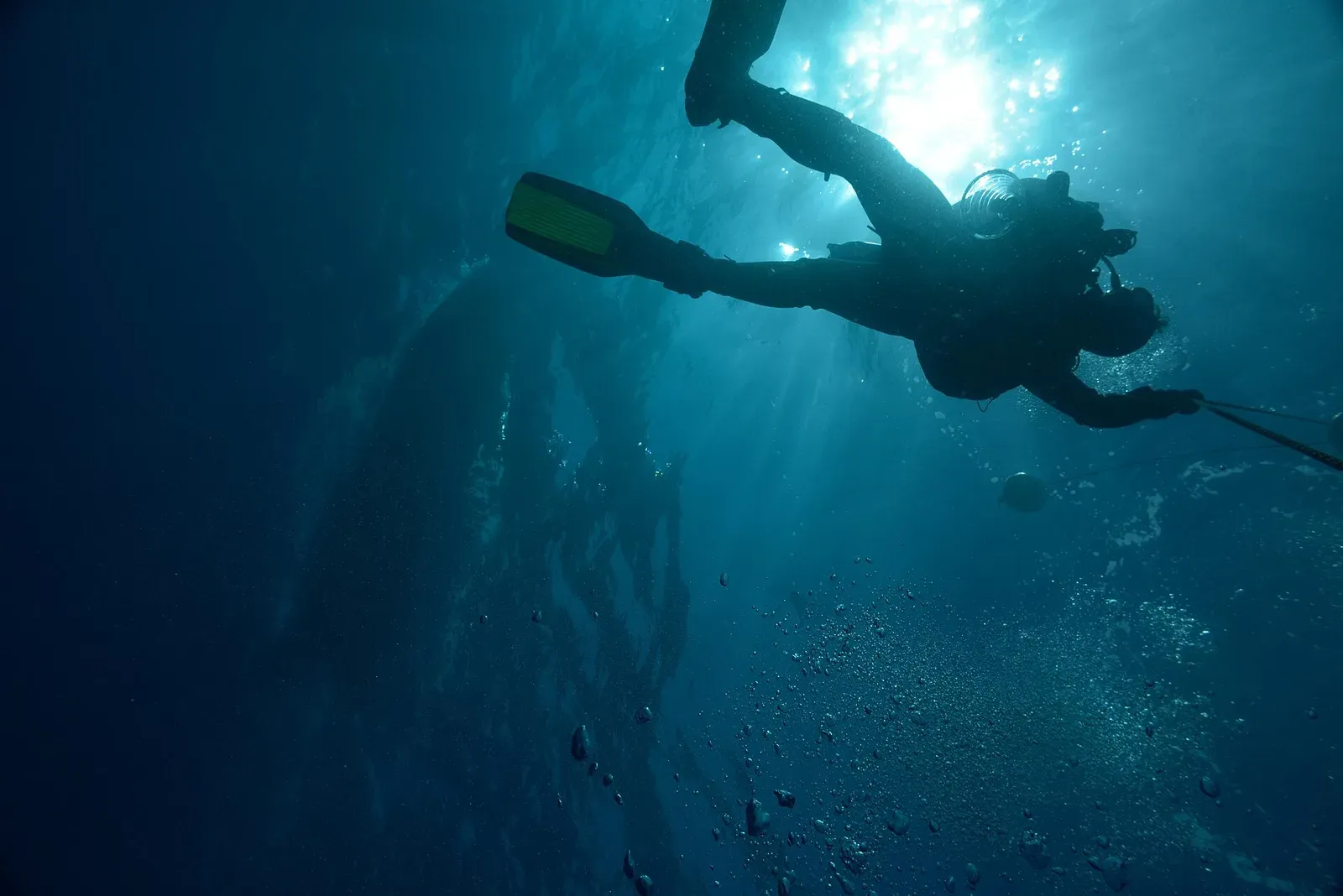
The sea is not reflecting the sky
The sky is blue because air scatters short wavelengths more than long ones. The sea is blue for an entirely different reason, and a much simpler one: water absorbs red light. The oxygen–hydrogen bonds in the molecule vibrate at frequencies whose overtones land in the visible red, so the deeper into the red you go, the more of the light the water simply takes. Blue and blue-green it lets through almost untouched.
Put the measured numbers on a chart and the asymmetry is enormous.
Water is at its most transparent around 420 nanometres, in the violet-blue, where a metre of it absorbs less than half a per cent of the light passing through. At 700 nanometres, the deep red end of what your eye can see, the same metre takes 46 per cent. That is a factor of about 140 between the colour water keeps and the colour water eats, and every bit of blue in the ocean, in the deep end of a white-tiled pool and in the heart of a glacier is that curve doing its work.
It also means the ocean’s blue is not a surface phenomenon you can look past. It is a property of the volume between you and whatever you are looking at, and it applies to the light going down as well as the light coming back to your eye.
What that does to a colour
Which is why colour underwater is not dimmed so much as edited. Light from the surface travels down to the reef, bounces, and travels back to you, and the water charges a toll on both journeys — heavily in the red, hardly at all in the blue.
Run that arithmetic per wavelength and convert the surviving spectrum properly into colour, and you can compute exactly what a given object looks like at a given depth.
The top block is what actually reaches your eye. A red object is already a muddy brown at 5 m (15 ft). By 20 m it is a dark, near-black smudge you would struggle to name, and it is not “dark red” — the red is not there at all. Yellow lasts longer, going olive and then green. White, which is every colour at once, becomes cyan and then a flat mid-blue, because blue is all that is left of it.
The lower block is the same light with the brightness pushed back up — which is exactly what a camera does when it opens up, and roughly what your eye does as it adapts. It restores the level and it cannot restore the colour: by 30 m every patch has collapsed into some version of blue-green, and the difference between the red object and the blue one is close to nothing. This is why underwater photographs taken on ambient light look flat and grey-blue however carefully you expose them. The information the picture needs stopped existing several metres above the subject.
How deep each colour gets
The other way to read the same physics is to ask how far each colour gets before there is effectively none of it left.
Take one per cent as the threshold. Deep red is finished within about 7 metres of clear water. Orange is gone by 21 m, yellow-green hangs on to nearly 80, and blue is still going hundreds of metres down — which is why the sunlit zone of the open ocean, where enough light survives to grow anything, runs to roughly 200 m.
That, roughly, is the diver’s rule of thumb: red at 5 m, orange at 10, yellow at 20, green at 30. Our numbers are a little more generous than the rule because they are computed for pure water — absorption plus the faint scattering the molecules themselves do, and nothing else — which is the best the ocean can manage. Real seawater always has something in it. Coastal water carries dissolved organic matter and plankton that absorb hard in the blue, which is why the North Sea is green-brown while the middle of an ocean gyre is nearly violet. In green water, the colour that survives longest is not blue at all — and the whole grid above shifts with it.
Why a torch fixes it and a bigger camera does not
Once you see colour loss as a path length rather than a depth, the fix is obvious: shorten the path.
A torch or strobe held a metre from its subject means the light travels one metre out and one metre back — two metres of water in total, regardless of how deep you are. Two metres still costs you: about 29 per cent of the deep red survives it, and half of the red at 650 nanometres. But that is a subject which is recognisably red rather than one which is black, and it is the last column of the grid above.
Take the same strobe two metres further back and the arithmetic turns. At four metres from the subject the light has made an eight-metre round trip, which leaves 0.7 per cent of the deep red and 6 per cent at 650 nm — nothing you can photograph. This is the whole reason photographers repeat get closer, then get closer again. It is not composition advice; it is the only variable in the equation you control.
Halving the distance to your subject does far more for a picture than any upgrade to the camera, and a wide-angle lens close enough to touch the reef beats a longer lens twice as far away every time.
The other tools are partial answers. A red filter does not add red, it removes blue, so what is left has a better balance and less of everything; it works in the band between about 5 and 20 m and fails below that, where there is no red left to rebalance. White balance in the camera, or in RAW afterwards, does the same job digitally and hits the same wall: multiplying a channel that recorded nothing gives you amplified noise, which is why deep ambient-light shots go grainy and magenta when you push them. And shooting upwards works because the light coming down through the water above your subject has taken the shortest available path from the surface.
Any of that is worth more than another two stops of camera. Colour underwater is a lighting problem with a distance in it, and always was.
What it does to everything else
The same filter is at work on the animals. A red fish at 30 m is not a red fish; it is a black one, which is why so many creatures that live below the reef crest are red, and why the deep sea is full of scarlet shrimp and crimson cephalopods that are, where they live, effectively invisible. The pygmy seahorses and soft corals in our muck diving guide are lurid on a photograph and drab to the naked eye at depth. Both versions are true.
It works on blood, too. Cut yourself at 20 m and the blood is green — a fact that surprises divers and makes complete sense once you have seen the grid above.
And it changes the character of whole dives. The famous walls — Bloody Bay, Peleliu — are blue-on-blue by 30 m and the colour arrives only where somebody is carrying it. Cenotes and caves work the other way: pitch dark, so everything you see is lit from a metre away, and the colours are surface colours. And the cathedral effect at Dos Ojos or the Cathedral in Crete, where a shaft of daylight lands in the dark, is the same physics staged: a short, clean path of light in a place where there is otherwise none.
Where the light is the dive
Some sites are chosen for what the water does to light: the clearest water there is, the blue that swallows everything, and the handful of places where a beam of daylight lands somewhere dark.
| Site | Depth | Level | Best months |
|---|---|---|---|
| Rainbow River Crystal River · United States | 2–7 m | Beginner | Nov–Feb |
| Kilsby Sinkhole Mount Gambier · Australia | 6–40 m | Intermediate | May–Aug |
| Lagoa Misteriosa Bonito · Brazil | to 40 m | Advanced | Apr–Aug |
| Dos Ojos Riviera Maya Cenotes · Mexico | 5–7 m | Intermediate | Nov–Apr |
| The Cathedral Crete · Greece | 14–21 m | Intermediate | Jun–Oct |
| Buracona Cabo Verde · Cabo Verde | to 28 m | Advanced | Apr–Jun |
| Molokini Crater Maui, Molokini & Lānaʻi · United States | 6–15 m | Beginner | Dec–Mar |
| Butler Bay Wrecks St. Croix · U.S. Virgin Islands | 5–24 m | Intermediate | Dec–May |
| Police Pier Lembeh Strait · Indonesia | 8–15 m | Intermediate | May–Oct |
| Rainbow Passage Rainbow Reef & Namena · Fiji | to 20 m | Intermediate | Jun–Oct |
| Bloody Bay Wall Little Cayman · Cayman Islands | 5.5–30.5 m | Intermediate | Dec–Apr |
| Big Wall Mnemba Atoll · Tanzania | 18–50 m | Advanced | Oct–Feb |
| Peleliu Wall Palau · Palau | 10–30 m | Advanced | Dec–Mar |
| The Point Layang-Layang · Malaysia | 25–40 m | Advanced | Mar–May |
| Big Brother Island Brothers & Daedalus · Egypt | 10–35 m | Advanced | May–Jun |
| Hin Daeng Wall Hin Daeng & Hin Muang · Thailand | 25–40 m | Advanced | Dec–Apr |


