
Riviera Maya Cenotes · Mexico · Cenote · Cave & cavern · Freshwater
Dos Ojos
Cavern circuits at 5 to 7 m in 25 °C water year-round
Photo: diego_cue · CC BY-SA 3.0
Two flooded sinkholes in the jungle north of Tulum, opening onto the shallow end of one of the longest surveyed cave systems on the peninsula: 82 km of passage mapped since exploration began in 1987. Divers see the daylight part of it, on guided cavern circuits between the two entrance pools. It is a long, flat dive where the work is buoyancy and light discipline rather than depth.
Also known as Sistema Dos Ojos.
Where it is and how deep
20.3247° N, 87.3919° WPublished position for this site.
The dive
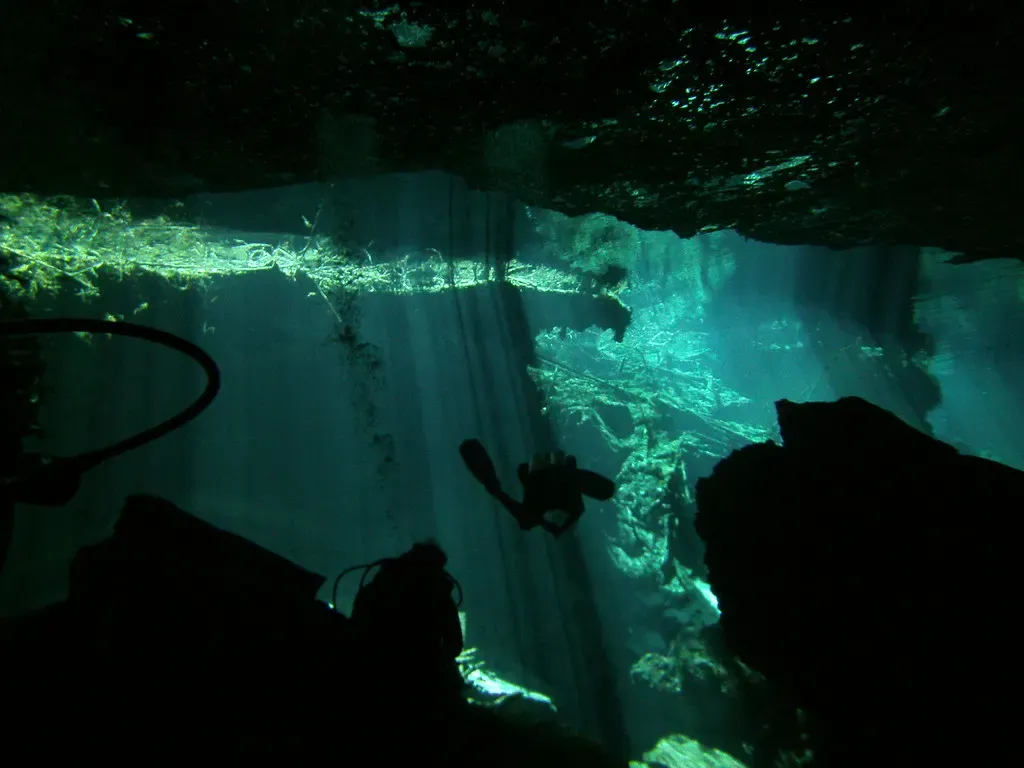
Kit goes down to the water between the two entrance pools, and the dive starts as a slow drop into water that sits at 25 °C all year. Most of the cavern route runs at 5 to 7 m, close under the ceiling, and the deepest water near the Dos Ojos cenotes themselves is only about 10 m, so the profile is nearly flat and a tank lasts a long time.
You follow the guide's line out and back inside the daylight zone, with the entrance glow behind you the whole way. Beyond that line the system keeps going — 82 km of it surveyed — and its deepest known point, a 119.1 m shaft at The Pit some 1,500 m in from the main entrance, was reached by cave explorers in 1996 rather than on any cavern dive. Buoyancy is the whole job: one fin stroke into the ceiling or the silt closes the view for everyone behind you.
Background
Exploration of Dos Ojos began in 1987 and still continues. The surveyed extent of the system stands at 82 km, and it holds the deepest known cave passage in Quintana Roo — 119.1 m, at The Pit, found in 1996 by explorers who came some 1,500 m in from the main entrance. In 2018 a link was reported between the Dos Ojos system and the neighbouring Sistema Sac Actun, then given as 263 km long, joining the two into one.
Marine life and season
The sources we used don't single out particular species here.
| Jan | Feb | Mar | Apr | May | Jun | Jul | Aug | Sep | Oct | Nov | Dec |
|---|---|---|---|---|---|---|---|---|---|---|---|
| Good | Good | Good | Good | Good | Good | Good | Good | Good | Good | Good | Good |
Season follows Riviera Maya Cenotes: Cenote water temperature holds steady all year; Dos Ojos gets busier in the December–April peak season while most other cenotes stay quiet.
Know before you go
- The park takes a hundred or more visitors a day, so expect snorkellers above you in the entrance pools and keep the group tight where the lines converge.
- Everything past the daylight zone is full cave. The permanent cavern line is the limit for a guided dive, and going beyond it needs cave training, redundant gas and lights.
Photos from Dos Ojos
dronepicr · CC BY 2.0
Diego Delso · CC BY-SA 4.0
Wilfred_Hdez · CC BY 2.0
Dive videos
Dos Ojos Cenote Exploration | Best Diving Spot in Mexico · Absolute Adventure Mexico on YouTube
Cave Diving Dos Ojos Cenote | Barbie Line and The Bat Cave Dive Sites · On Todays Adventure on YouTube
Questions divers ask
How deep is the Dos Ojos cavern dive?+
The majority of cavern dives run at 5 to 7 m, and the deepest water near the Dos Ojos cenotes is about 10 m. The 119.1 m passage in the same system is a cave dive far from the entrance, not part of the guided route.
Do I need a cave certification to dive Dos Ojos?+
No. Guided cavern dives stay inside the daylight zone on a permanent line, which an Open Water diver can do with a cavern guide. Going past that line into the cave system needs full cave certification.
Sources
- Sistema Dos Ojos — Wikipedia
- Sistema Sac Actun — Wikipedia
- Tulum — Wikivoyage
Photo credits
- Sunlit turquoise pool inside a limestone cave, seen from a rocky ledge at Cenote Dos Ojos. by diego_cue, CC BY-SA 3.0, via Wikimedia Commons
- A diver swims through a submerged cavern as sunbeams pierce the water from openings above. by dronepicr, CC BY 2.0, via Wikimedia Commons
- Close-up of pale flowstone and draped mineral formations inside the Dos Ojos cave system. by Diego Delso, CC BY-SA 4.0, via Wikimedia Commons
- Underwater view of jagged white stalactites hanging from a cave ceiling, reflected in still water. by Wilfred_Hdez, CC BY 2.0, via Openverse
In The Logbook
- Why is the sea blue? Water filters out redOcean science · 7 min read
- Freshwater diving: lakes, springs and quarriesFreshwater · 15 min read
- Cavern and cenote diving without cave trainingCaves & caverns · 8 min read
More dive sites in Riviera Maya Cenotes
A sulphide cloud you can put a hand through, at 27 m
A mangrove channel dive with no overhead at all
Lily pads on the surface, decorated cavern underneath
Jump through the roof or take the ladder beside it
An air dome you can surface in, under two levels of stalactites
Cenote
Where cave divers found three prehistoric skeletons
Cenote
A crossing to the neighbouring Rainbow Cenote
Cenote
Nine metres of clear water used for course skills
Similar dives elsewhere
Taíno artefacts in place in a 9 m freshwater cave
Cave & cavern
Dan's Cave
South Abaco Blue Holes · Bahamas
Cascade Room entrance leads to crystal rooms with names like Fangorn Forest
Cave & cavern
Ralph's Cave
South Abaco Blue Holes · Bahamas
Formations 13,000 to 350,000 years old inside a deep, roller-coaster passage

.jpg)

A guano-floored side pool linked underwater to the main Sleeping Pool shaft