Two different laws, and one of them is not about your ears
Every dive course teaches Boyle’s law and then, in the same breath, uses it to explain ears. Half of that is right.
Boyle governs anything flexible: the air in your mask, the gas in your suit, the lungs of a freediver. Take one of those to 10 m and it keeps half its volume. Take it to 20 and it is down to a third; to 40, a fifth. Because pressure rises in equal steps but volume falls in shrinking ones, the change is violently front-loaded.
Nearly two thirds of all the squeeze a 40-metre dive will ever apply to a flexible air space has already happened by the time you pass 10 m. It is why your mask bites into your face in the shallows and then leaves you alone, why a drysuit needs most of its gas early, and why buoyancy is at its twitchiest just under the surface.
Your middle ear is not on that list. It is a rigid cavity — a couple of millilitres of air in bone, sealed behind the eardrum, with one narrow door: the Eustachian tube, running down to the back of your nose. A rigid box does not shrink. What happens instead is that the pressure outside rises while the pressure inside does not, and the membrane between them takes the difference. What the eardrum feels is not a ratio. It is a straightforward pressure difference, and it builds at the same rate — about 0.1 bar, or 75 mmHg, for every metre — whether you are at 2 m or 42.
What the eardrum actually feels
Ear and sinus barotrauma is the most common injury in diving, reported in something between 10 and 30 per cent of divers, and studies that actually look inside people’s ears afterwards have found rates ranging from 4 to over 80 per cent depending on who is counted. It is not an exotic risk. It is the standard one.
The clinical literature reports the thresholds in millimetres of mercury. Converted into metres of descent — the unit you experience them in — the numbers are startling.
Twenty centimetres. That is the point, about 15 mmHg, beyond which the tube stops opening on its own and something has to be done deliberately. Eighty centimetres of unequalised descent produces the 60 mmHg difference reported to cause discomfort. At around 1.3 m you are at 100 mmHg, the bottom of the range at which eardrums are reported to perforate; by 6.7 m you are at 500 mmHg, the top of it. And somewhere in between — StatPearls puts it at about ten feet of seawater, three metres — the difference itself holds the tube shut, so the harder you blow the less it works.
Three metres is nothing. It is a slow breath. It is the distance you sink while you are looking for your buddy, or checking a camera, or the descent you make in one gentle exhale off a shot line. This is the whole reason equalisation is taught as a compulsive habit rather than a response to pain: by the time it hurts, you are already most of the way through the safety margin, and if you keep going the tool you would use to fix it has stopped working.
Why it is fiddly at three metres and effortless at thirty
Here is the part that Boyle does explain, and it is the reason experienced divers report their ears “opening up” once they are deep.
To equalise, you have to push enough gas up the Eustachian tube to raise the pressure in that rigid cavity. The pressure you must add is the same 0.1 bar per metre at any depth. But the volume of gas that represents, measured at the pressure you are breathing, is not: near the surface the gas is thin, so filling the gap takes a relatively large puff; at 40 m (130 ft) the gas is five times denser, and the same job takes a fifth as much of it.
So a descent is hardest exactly where beginners are told it should be easiest. In the top ten metres you are moving through the steepest part of the volume curve, you are usually still positively buoyant and correcting, and the tube has the most work to do per metre. Below 20 m most people find their ears go quiet — not because the ear has toughened up, but because each metre now costs the tube almost nothing.
The techniques, in the order worth learning them
Valsalva — pinch the nose and blow gently against it — is what everybody is taught, and it is the crudest. It works by brute pressure in the nasopharynx, it fails once the tube is locked shut, and done hard it can drive pressure the wrong way into the inner ear. DAN’s wording is the right wording: the key is gently.
Toynbee — pinch the nose and swallow — uses the muscles that open the tube rather than pressure. It is gentler, it works on the way up as well as down, and it is a useful second option when Valsalva is not moving anything.
Frenzel — close the glottis and use the tongue as a piston against the back of the nose — is the technique worth actually practising. It isolates the equalising effort from your chest, so it works when your lungs are compressed, it can be done every second or two without effort, and it is what every competent freediver uses. It takes a few sessions to learn on dry land and it changes descents permanently.
Voluntary tubal opening (BTV) — consciously contracting the muscles that open the tube, the sensation you get at the start of a yawn — is the one everyone envies. Some people have it naturally; the rest can sometimes learn it. It produces no pressure at all, which makes it the safest of the lot.
Beyond those, Lowry and Edmonds combine the others (blow and swallow; jaw forward and blow), and freedivers use the mouthfill, holding a charge of gas above the closed glottis to keep equalising when the lungs have nothing left to give.
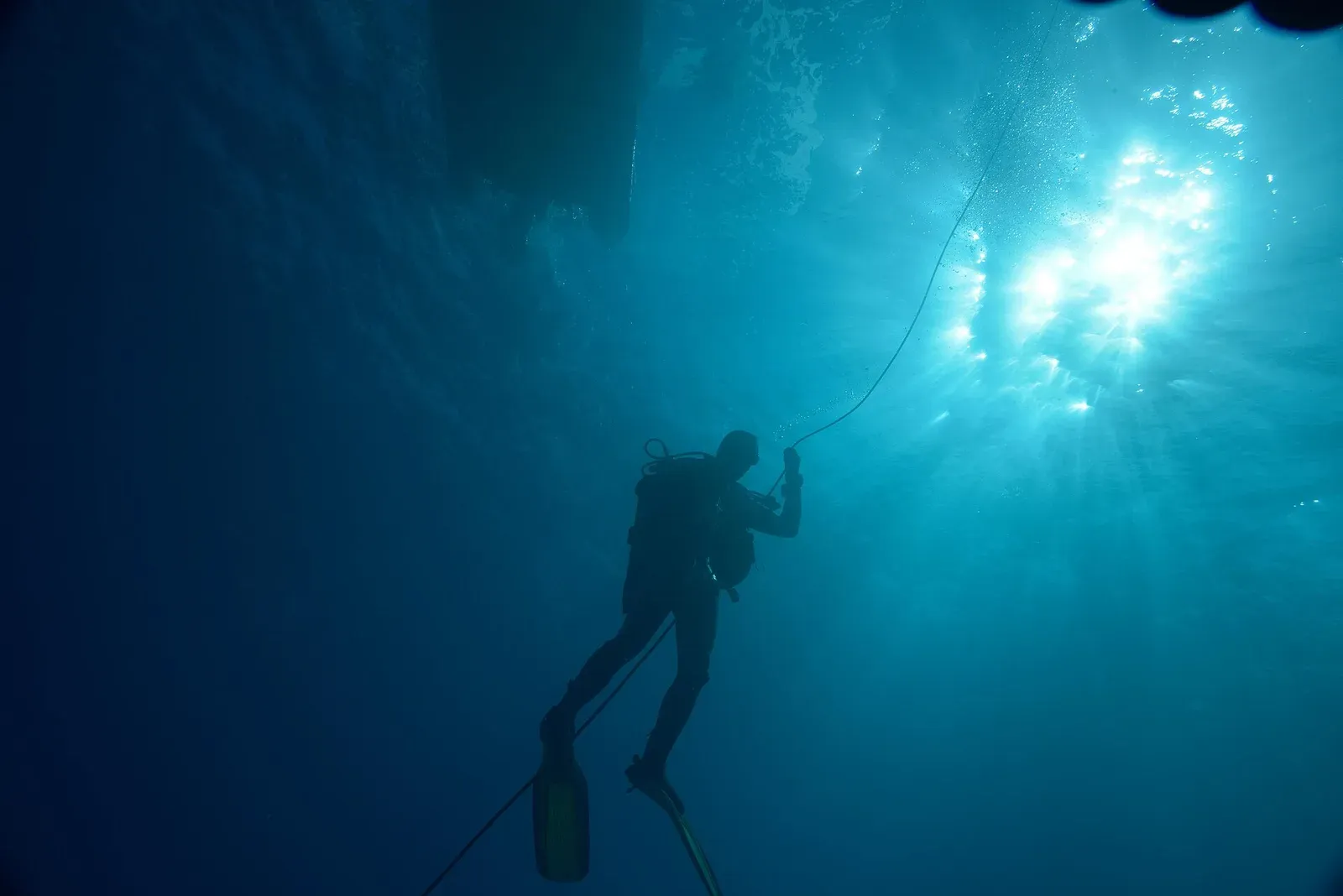
Whichever you use, the mechanics of the descent matter as much as the technique. Equalise on the surface before you leave it, and then every metre or so on the way down, before you feel anything at all. Go down feet first where you can: middle-ear equalisation works best head-up, and the horizontal head-down drop off a boat is the least forgiving way to enter the water. Use a line if there is one, so the descent rate is a decision rather than a consequence. And if an ear will not clear, stop, go back up a metre or two until the pressure releases, and try again — that ascent is not a failure, it is the only thing that unlocks a tube the difference is holding closed.
When it goes wrong, and how wrong
Ear injuries are graded by what an ENT sees on the drum afterwards. The modified Teed scale runs from grade 0 — symptoms with a normal-looking eardrum — through redness, then scattered bleeding into the membrane, then a dark bulging drum with blood behind it, to grade 5: a perforation with blood in the canal. Most diving cases sit at the bottom of that scale, clear up in days to weeks, and cost nothing worse than a few days out of the water.
Three complications deserve their own names.
A reverse block is the same problem running backwards. Gas expanding in a middle ear that cannot vent — usually because of congestion, sometimes because a decongestant has worn off mid-dive — leaves you unable to go up without pain. The answer is patience: descend slightly, wait, use Toynbee, and come up as slowly as your gas allows.
Alternobaric vertigo happens when one ear clears and the other does not. The two vestibular systems are suddenly reporting different things and the world spins. It is unnerving and usually brief, resolving as soon as the stubborn ear equalises, but underwater a spinning diver is a diver who needs to hold on to something and stop ascending.
Inner ear barotrauma is the serious one. Force enough pressure into the middle ear — the classic mechanism is a violent Valsalva against a blocked tube — and it can be transmitted to the delicate windows between middle and inner ear, tearing a membrane or opening a perilymph fistula. The symptoms are hearing loss, tinnitus and persistent vertigo, and they look very like inner-ear decompression sickness, which is why any diver with those symptoms after a dive needs a doctor with diving experience rather than a guess. Recovery is not guaranteed.
The prevention is dull and effective. Do not dive congested — if you cannot clear on land, you will not clear at 3 m, and the risk is not only failing to equalise but the reverse block on the way back. Decongestants have some evidence behind them for reducing barotrauma and remain genuinely controversial in diving medicine, mainly because of what happens when one wears off at depth. Descend slowly, clear constantly, and accept the dive you do not get: an ear that will not clear today is a lost dive, and an ear you force is a lost season.
Descents that give you time, and descents that do not
Some dives let you take the first ten metres at whatever rate your ears want. Others start with a backwards roll into moving water where the plan is to get down fast and hold on. Both are in our data, and it is worth knowing which one you are booking.
| Site | Depth | Current | Level | Best months |
|---|---|---|---|---|
| Frederiksted Pier St. Croix · U.S. Virgin Islands | to 7 m | Mild | Beginner | Dec–May |
| Ginama-an Dauin · Philippines | to 20 m | Mild | Beginner | Apr–May |
| USAT Liberty Wreck Tulamben · Indonesia | 5–30 m | Mild | Intermediate | May–Oct |
| Police Pier Lembeh Strait · Indonesia | 8–15 m | Mild | Intermediate | May–Oct |
| Something Special Bonaire · Caribbean Netherlands | to 35 m | Mild | Intermediate | Dec–Apr |
| 1000 Steps Bonaire · Caribbean Netherlands | to 40 m | Mild | Advanced | Dec–Apr |
| Blue Corner Palau · Palau | 8–30 m | Strong | Advanced | Dec–Mar |
| Batu Bolong Komodo · Indonesia | 10–25 m | Strong | Advanced | Jun–Oct |
| Castle Rock Komodo · Indonesia | 10–25 m | Strong | Advanced | Jun–Oct |
| Barracuda Point Sipadan · Malaysia | 10–22 m | Strong | Advanced | Mar–Sep |
| Big Brother Island Brothers & Daedalus · Egypt | 10–35 m | Strong | Advanced | May–Jun |
| Bajo Alcyone Cocos Island · Costa Rica | to 25 m | Strong | Advanced | Jun–Nov |
| Northern Pinnacle Protea Banks · South Africa | 32–40 m | Strong | Advanced | Feb–Apr |


