
Banda Islands · Indonesia · Wall · Reef
Pulau Keraka
Giant, honeycomb and snowflake morays in one small islet's wall.
Area photo: WiDi · CC BY-SA 4.0
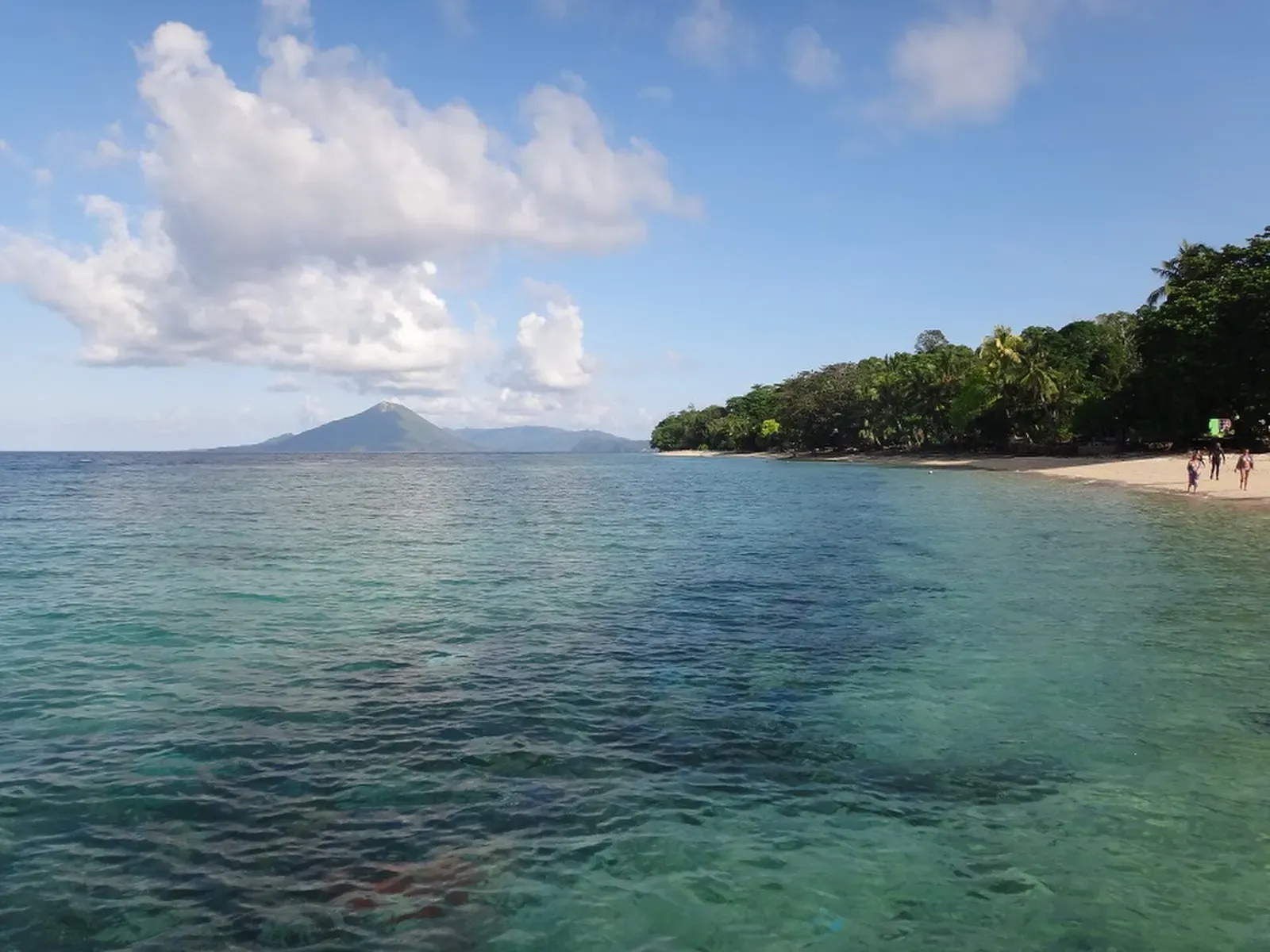
Pulau Keraka - Crab Island - is a small rock islet at the northern entranceway to the Banda Neira strait, easily identified by its small lighthouse. The dive is shallow, bottoming out at about 20 m on sand, and tends not to be subject to current as much as the other sites, which makes it the usual opener for a Banda liveaboard week.
Also known as Crab Island, Pulau Karaka.
Where it is and how deep
4.4700° S, 129.9200° EApproximate position — the dashed circle shows where the site lies; your operator's briefing has the mooring.
The dive
The dive usually begins on the south side with a drop down a near vertical wall blanketed in sea squirts in blue and yellow. At about 20 metres the wall gives way to a sandy sloping bottom, with big bommies standing among the sand patches, and that is as deep as the site goes. Divers generally leave the wall to their left shoulders as they make their way round the southern tip of the island heading north.
Yellow snappers and a small resident school of chevron barracuda are usually present along the wall, and some of the larger moray eel species have made their homes here - giant, honeycomb and snowflake morays. On the sand there are colonies of garden eels, and titan triggerfish patrol the same ground. Little current and a 20 m maximum make this an easy and pleasant start to a trip in the Banda Islands.
Marine life and season
- Barracuda
| Jan | Feb | Mar | Apr | May | Jun | Jul | Aug | Sep | Oct | Nov | Dec |
|---|---|---|---|---|---|---|---|---|---|---|---|
| Fair | Fair | Good | Good | Good | Fair | Fair | Fair | Good | Prime | Prime | Fair |
Season follows Banda Islands: October–April is the main liveaboard transit season; hammerhead and mobula sightings at seamounts are seasonal, not guaranteed.
Questions divers ask
How deep is Pulau Keraka?+
The wall runs down to about 20 metres, where it gives way to a sandy slope with bommies. That is the deepest part of the site, so it works as a relaxed, relatively shallow dive.
Sources
- Banda Islands Dive Sites — Dive The World
- Îles Banda — Wikipedia (French)
- Dive Sites — Dive Bluemotion
More dive sites in Banda Islands
Wall
Scorpionfish, blackspotted morays and orang-utan crabs on the face.
Pinnacle
Big pelagics turn up on the pinnacles when the current runs.
Wall
A wide step at 30 m before the wall falls away again.
Seamount
Fusiliers roll down the slope thick enough to block the view.
Hard coral grown over lava that reached the sea in 1988.
Wall
A gorgonian-hung wall off the island that nutmeg made famous.
Wall
A 6 m almond-shaped swim-through at 26-30 metres.
Mobula rays pass in formations up to 25 strong.
Similar dives elsewhere

Predators along the wall, and a crevasse to 40 m as current shelter

A small wall from 12 m onto black coral sand at 20 to 30 m
Gorgonians, overhangs, and turtles of both local species


Shoals of dogtooth tuna on a wall that drops to 2,000 m