Africa · Mozambique
Ponta do Ouro
A resident bottlenose dolphin pod makes for near-daily encounters.
Photo: Derek Keats · CC BY 2.0
Ponta do Ouro sits just north of the South African border on Mozambique's Elephant Coast, home to a large resident pod of bottlenose dolphins that divers and snorkelers encounter almost daily. Pinnacles, the area's signature reef, delivers unbaited encounters with several shark species, while Atlantis, a 300 m reef at 38-47 m, is reserved for advanced and deep-qualified divers. Whale sharks and migrating humpback whales pass through during the austral winter and spring.
About diving in Ponta do Ouro
The diving runs off the beach in the middle of the village. Boats are dragged down to the water and driven out through the shore break with everyone braced on the pontoons, and the reefs lie close inshore, so transits are short. Sites are worked as a string running north and south of the launch point, and the skipper picks by the conditions that morning. Two dives with a break on the sand between them is the standard morning, and the boat comes back in bow-first onto the beach.
The reef is fossilised dune sandstone rather than living coral rock: long ridges running parallel to the shore, undercut ledges, overhangs and gullies, with soft coral, sponge and clouds of goldies over the top. Sites sort cleanly by depth. The shallow inshore reefs are gentle and hold the densest small-fish life, the mid-depth ridges along the sand line take most of the day-to-day diving, and the offshore reefs drop past 30 m, where gas planning buys only a short window on the bottom.
Dolphin encounters happen on snorkel rather than scuba, and on the animals' terms. The boat finds the pod, swimmers slip in quietly ahead of them, and the pod decides whether to stay or carry on. The coast here lies inside a partial marine reserve proclaimed in 2009, and licensed operators work to a code of conduct governing how boats and swimmers approach; the same animals turn up often enough that researchers have catalogued individuals from photographs. Some mornings it simply does not come off.
On the deeper reefs the routine is to settle low against the ridge and watch the open water off its edge, since the larger animals tend to pass along the drop rather than over the reef top. That means short bottom times, planned ascents and, on the deepest sites, paperwork the centre will actually ask to see. The village is a self-catering one of camps, lodges and a few shops, and the diving sets the shape of the day. Anyone after sheltered water and easy shore entries will not find them here.
Best time to dive Ponta do Ouro
| Jan | Feb | Mar | Apr | May | Jun | Jul | Aug | Sep | Oct | Nov | Dec | |
|---|---|---|---|---|---|---|---|---|---|---|---|---|
| Season | Good | Good | Good | Good | Good | Good | Prime | Prime | Prime | Prime | Good | Good |
| Sea surface | 27°C81°F | 28°C82°F | 27°C81°F | 26°C79°F | 25°C77°F | 24°C75°F | 23°C73°F | 22°C72°F | 23°C73°F | 23°C73°F | 25°C77°F | 26°C79°F |
| Daytime high | 28°C82°F | 28°C82°F | 28°C82°F | 27°C81°F | 26°C79°F | 25°C77°F | 25°C77°F | 24°C75°F | 25°C77°F | 25°C77°F | 26°C79°F | 27°C81°F |
| Rain | 169 mm6.7 in | 165 mm6.5 in | 134 mm5.3 in | 71 mm2.8 in | 38 mm1.5 in | 20 mm0.8 in | 23 mm0.9 in | 18 mm0.7 in | 53 mm2.1 in | 73 mm2.9 in | 104 mm4.1 in | 170 mm6.7 in |
| Jan | Feb | Mar | Apr | May | Jun |
|---|---|---|---|---|---|
| Good | Good | Good | Good | Good | Good |
| Sea surface | |||||
| 27°C81°F | 28°C82°F | 27°C81°F | 26°C79°F | 25°C77°F | 24°C75°F |
| Daytime high | |||||
| 28°C82°F | 28°C82°F | 28°C82°F | 27°C81°F | 26°C79°F | 25°C77°F |
| Rain | |||||
| 169 mm6.7 in | 165 mm6.5 in | 134 mm5.3 in | 71 mm2.8 in | 38 mm1.5 in | 20 mm0.8 in |
| Jul | Aug | Sep | Oct | Nov | Dec |
|---|---|---|---|---|---|
| Prime | Prime | Prime | Prime | Good | Good |
| Sea surface | |||||
| 23°C73°F | 22°C72°F | 23°C73°F | 23°C73°F | 25°C77°F | 26°C79°F |
| Daytime high | |||||
| 25°C77°F | 24°C75°F | 25°C77°F | 25°C77°F | 26°C79°F | 27°C81°F |
| Rain | |||||
| 23 mm0.9 in | 18 mm0.7 in | 53 mm2.1 in | 73 mm2.9 in | 104 mm4.1 in | 170 mm6.7 in |
2011–2025 averages. Sea surface: NOAA Coral Reef Watch, measured at the surface, so deeper water can run colder. Daytime high and rain: NASA POWER.
Resident dolphins are seen year-round; shark activity at Pinnacles and whale migration peak July-October.
Best months: July, August, September, October
Ponta do Ouro water temperature and weather by month
The sea surface runs from 22 °C (72 °F) in August to 28 °C (82 °F) in February. It is 24 °C (75 °F) or warmer from November to June. Most rain falls from November to March, peaking at about 170 mm (6.7 in) in December; it stays largely dry from May to August. Daytime highs reach 28 °C (82 °F) in February and drop to 24 °C (75 °F) in August. The coldest water here is about 21 °C (70 °F), so pack a 5 mm suit.
Dive types & marine life
The bottlenose pod is the year-round constant, with turtles, rays and reef fish on the ridges beside it. Shark activity on the deeper reefs, whale sharks and migrating humpbacks all lift the odds from July to October, the prime stretch, while loggerhead and leatherback turtles nest along this coast through the austral summer.
- Reef
- Drift
- Pelagic & blue water
- Dolphins
- Whale sharks
- Whales
- Sea turtles
- Reef sharks
- Manta rays
Best dive sites in Ponta do Ouro
Reef
Bass, basslets and garden eels on a 20 m reef
Reef
Marbled electric rays on a 10 to 14 m reef
Reef
Frogfish, ribbon eels and mantis shrimp at 16 m
Reef
Octopus, potato bass and moray eels on a shallow reef
Reef
A 21 to 24 m ledge with nudibranchs and passing game fish
Reef
Game fish over a reef averaging 25 m
Reef
Hammerheads and Zambezi sharks off a reef edge in open water
Reef
A small swim-through with hawkfish and pipefish on the rock
Reef
Overhangs and arches on a shallow fossil-dune reef
Reef
Frogfish, morays and rays on a 20 m reef
Atlantis
300 m reef at 38-47 m, for advanced or deep-qualified divers only.
How to get to Ponta do Ouro
Almost everyone arrives overland: north from South Africa through the Kosi Bay border post, where the last stretch has long been a sand track best driven in 4x4, or south from Maputo, a run shortened since the bridge across Maputo Bay opened. The village is walkable, with camps, lodges and dive centres above the beach.
Photos from Ponta do Ouro
Hein waschefort · CC BY-SA 3.0
Derek Keats · CC BY 2.0
Georgina Jones · CC BY-SA 4.0
Georgina Jones · CC BY-SA 4.0
Dive videos
Scuba Diving Mozambique, Ponta do Ouro · Salty Travels on YouTube
Ponta do Ouro, Mozambique - Blowing Bubbles Diving · Kris N Chris Henry on YouTube
Photo credits
- Dawn breaks in pink and orange over the beach at Ponta do Ouro, Mozambique. by Hein waschefort, CC BY-SA 3.0, via Openverse
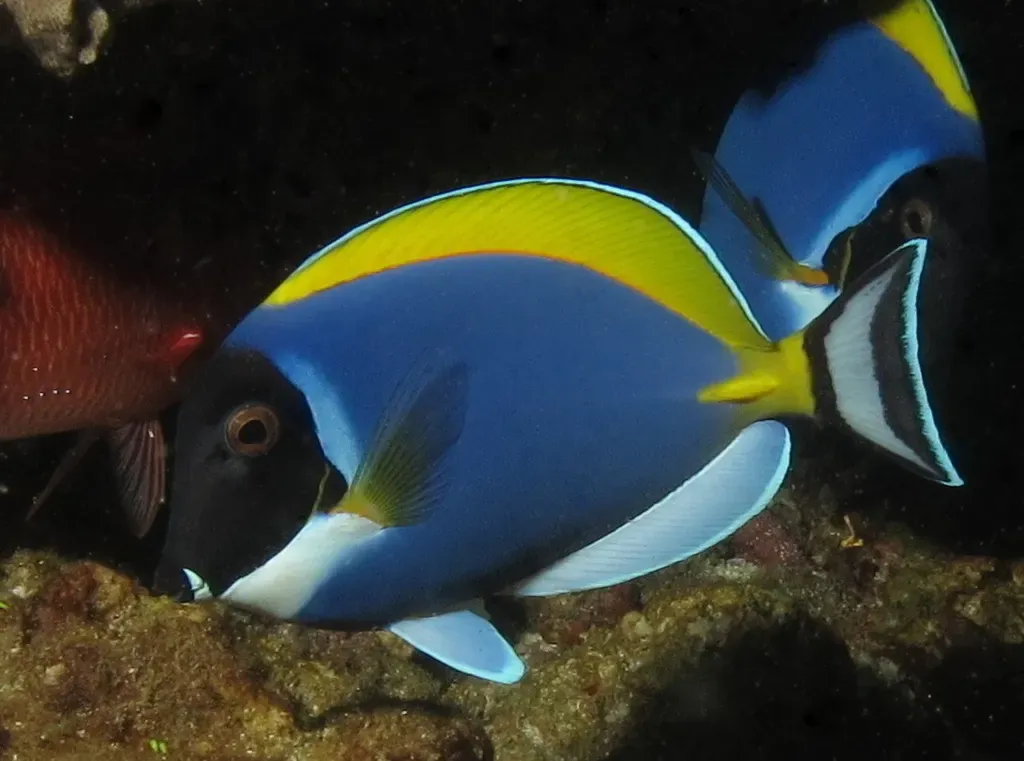
- A powder blue tang swims over the reef at Ponta do Ouro, Mozambique. by Derek Keats, CC BY 2.0, via Openverse
- A speckled grouper rests beneath an orange sponge-covered overhang at Ponta do Ouro. by Derek Keats, CC BY 2.0, via Openverse
- A yellow and blue striped nudibranch crawls over sand near Ponta do Ouro. by Georgina Jones, CC BY-SA 4.0, via Wikimedia Commons
- A spindle-shaped Volva volva sea snail rests on the sandy seabed near Ponta do Ouro. by Georgina Jones, CC BY-SA 4.0, via Wikimedia Commons
Embed
Run a dive centre, club or blog? Embed this map of 1 dive sites near Ponta do Ouro on your own page.
In The Logbook
- Nudibranchs: species, habits and where to diveMacro & muck · 13 min read
- Where to dive with tiger, bull and white sharksBig animals · 14 min read
- Why is 1.4 bar the oxygen limit in diving?Body & health · 13 min read
- Gas density: why deep air gets hard to breatheBody & health · 8 min read
- When and where to dive with hammerheadsBig animals · 16 min read
Similar destinations

East Africa's last viable dugong population, in a 1971 national park

Thousands of green turtles nest on one protected stretch of coast

Tidal gaps flush an 800 m channel past sheer coral walls


Manta cleaning stations on the reefs and whale sharks at the surface all year