One multiplication deep
The entire subject fits in one line of arithmetic. The partial pressure of oxygen — pO2, the number all the limits are written against — is the fraction of oxygen in your mix multiplied by the ambient pressure. Air is 21 per cent oxygen, so at the surface you are breathing oxygen at about 0.21 bar. At 40 metres (130 feet), five atmospheres, the same air delivers it at 1.05 bar — five times the dose, from the same cylinder, without changing anything but your depth.
That multiplication is why oxygen, the gas you cannot live without, becomes a convulsive poison underwater: pressure turns a fraction into a dose. Run the line out and air crosses the 1.4 bar working limit at 56.5 metres and the 1.6 bar contingency limit at 66.1. Invert it and you get the maximum operating depth formula every nitrox course teaches — the depth at which a given mix reaches a chosen ceiling.
Two things are worth reading off that chart before going further. First, on air the oxygen limit is nowhere near the depths recreational divers visit — it sits sixteen metres below the 40 metre limit, which is set by narcosis and gas density instead, as we laid out in gas density and why 30 metres is the line. Those are three separate mechanisms that happen to crowd into the same stretch of water, and on air the oxygen one loses the race. Second, look at the pure oxygen line: it starts above 1 bar before you get wet, and crosses 1.4 at less than four metres. The mix technical divers decompress on is out of limits by the bottom of a swimming pool, which is why the oxygen stage stays clipped off and untouched until the 6 metre stop.
A note on conventions, because the manuals will quarrel with the second decimal: NOAA works in feet of seawater at 33 per atmosphere, which puts air’s 1.6 bar depth near 66.6 metres, and the classroom shortcut of calling the surface exactly one bar gives 66.2; our figures use the same conventions as the rest of these guides and land at 66.1, within half a metre of both. Nothing that follows turns on the difference.
The two depths written on the cylinder
Divide the two ceilings by your oxygen fraction and every mix acquires a pair of depths. EAN32 reaches 1.4 bar at 33.6 metres and 1.6 at 39.9. EAN36 reaches them at 28.8 and 34.3 — NOAA’s own worked example puts the second figure at 113 feet of seawater, 34.4 metres, the same sum in the other convention. EAN50, the standard decompression gas, is done at 17.9 and 21.9 metres, which is why the switch to it traditionally happens at 21. And pure oxygen’s whole working range is shallower than a safety stop.
The band between the two lines is the part divers misread. The gap between 33.6 and 39.9 metres on EAN32 is not five spare metres for chasing a turtle. Both numbers came from the same table; the shallower one is the plan, and the deeper one is the amount of error the plan can absorb. Divers Alert Network puts it in traffic lights: at or below 1.4 is the green-light region, 1.4 to 1.6 is yellow, and above 1.6 — in DAN’s words — “is the ‘red light’ area. Recreational divers should not exceed this level.”
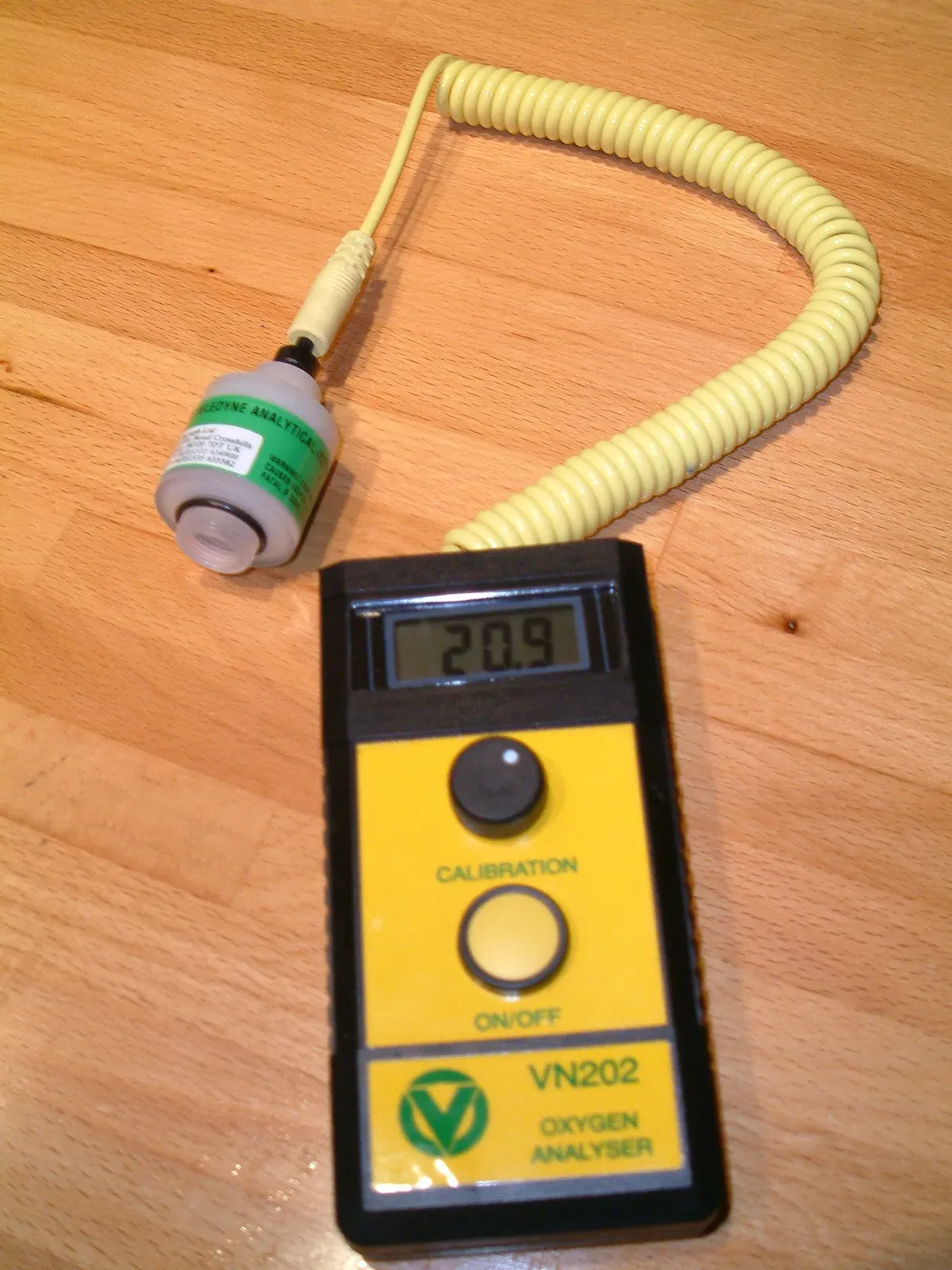
The other thing the ladder should make obvious is how much the answer depends on knowing your fraction. The difference between EAN32 and EAN36 is seven metres of working depth; the difference between the 32 you asked for and the 50 per cent bailout fill you picked up by mistake is the difference between a dive and an emergency. Hence the ritual that our breathing-gas guide treats as non-negotiable: analyse the fill yourself, write the mix and its maximum operating depth on the tape, and treat the label as part of the regulator.
A dose, not a threshold
Depth alone does not finish the story, because oxygen toxicity is a function of time as well as pressure. The reference here is a fifteen-row table published in the NOAA Diving Manual — the limits every agency’s oxygen tracking is kept against. At 1.4 bar, NOAA allows a single exposure of 150 minutes, and 180 minutes in any 24 hours. At 1.6 the single-exposure allowance is 45 minutes. In between, the fall is not smooth: 1.5 bar still gets 120 minutes, and then the last tenth of a bar takes two thirds of what remains.
The bookkeeping against that table is what your dive computer is doing when it shows a CNS percentage, and NOAA’s manual walks through it: 75 minutes at 1.4 bar, half the 150-minute allowance, runs the clock to 50 per cent; add 60 minutes at 1.3, a third of that level’s 180, and you are at 83 per cent. Minutes spent divided by minutes allowed, summed across the dive. The manual notes that these limits “are sometimes referred to as the ‘oxygen clock’”, crediting the coinage to a 1988 paper by Hamilton — which is where the name on your computer screen comes from.
Two honest caveats travel with the table, both from NOAA itself. The technique of summing and interpolating exposures has, in the manual’s own words, “no specific laboratory validation of this technique… it appears to work in practice” — the clock is careful bookkeeping over sparse data, not a law of physiology. And there is no validated recovery curve at all: what NOAA publishes for coming back down is a set of hard rules — at least 90 minutes on the surface between dives that reach the 45-minute maximum at 1.6, at least 2 hours at a normal pO2 after reaching a single-exposure limit, at least 12 hours after reaching a 24-hour limit. If your computer draws you a smoothly decaying CNS figure between dives, the shape of that decay is the manufacturer’s own choice, not something out of the manual.
Two thousand dives in search of a warning sign
The table has a history, and it starts with a war. Paul Bert described oxygen convulsions in 1878; J. Lorrain Smith found the slower lung injury from milder pressures in 1899. But the numbers divers use descend from December 1941, when Italian frogmen on oxygen rebreathers mined HMS Queen Elizabeth and HMS Valiant in Alexandria harbour. The Royal Navy needed its own attack divers immediately, and needed to know how deep a man could safely swim on pure oxygen. Kenneth Donald, medical officer of the Admiralty’s experimental diving unit, spent 1942 to 1945 finding out, across some two thousand experimental exposures on volunteers.
What Donald found is the reason the modern limits look the way they do. Not a threshold — a scatter. “The most important finding in this large series of exposures,” he wrote, “was that the symptoms of oxygen poisoning vary enormously in different people and in the same person during different exposures. No list of warning signs or symptoms can be given that would ensure a safe and timely cessation to the exposure.” The same diver who tolerated a pressure comfortably one week convulsed at it the next. Among the symptom episodes in his resting underwater trials, six in ten were lip twitching, fewer than one in ten were convulsions — and the convulsions frequently arrived with no warning at all. His conclusion for pure-oxygen swimming was a safe depth of 7.6 metres, the shallowest his unit tested; the divers of the era, who called an oxygen hit “getting a Pete” after an imagined monster at the bottom of the test tank, would have agreed it was not a thing to negotiate with.
Modern training compresses the symptom list into the mnemonic CONVENTID — convulsion; visual disturbance; ear ringing; nausea; tingling or twitching, especially of face and lips; irritability or euphoria; dizziness — and NOAA appends the caveat that matters more than the list: the symptoms “may come in any order”, and a convulsion is just as likely to occur without any warning.
Why 1.4, exactly
Between Donald and your nitrox card sit fifty years of committees, and the paper trail is unusually candid. The US Navy’s first working limits, drawn up by Lanphier in 1954, were — by the account in Acott’s history — built on “educated guessing”, previous experience, and an arbitrary 25 per cent margin, with Donald’s wartime data largely ignored. A 1993 statistical re-analysis by Harabin and Survanshi at the Navy Experimental Diving Unit finally put numbers on the scatter: a threshold for any CNS symptom near 1.3 bar, and for convulsions near 1.7. These are not planning figures; they are estimates of where the cliff actually is, and they are why the working limits sit where they sit — 1.4 and 1.6 are chosen standing-back distances from 1.7, not measurements of it.
When PADI’s Diving Science and Technology arm set the limits for recreational enriched air in the mid-1990s, its staff published the reasoning. “1.4 bar is the recommended maximum,” wrote Richardson and Shreeves in 1996, “because it keeps you well within established oxygen limits appropriate for recreational diving. Planning a dive within 1.4 bar PO2 also provides a margin for error.” And of the ceiling above it: “The contingency PO2 limit is 1.6 bar. PADI discourages planning dives with a partial pressure this high because there is no room for error… Divers at work have had oxygen toxicity convulsions near 1.6 bar while at work.” On the exposure times, DSAT adopted the NOAA limits over the older, stricter Navy single-exposure numbers — on the advice of its medical consultant, and with Donald’s own blessing of NOAA’s figures over limits he considered arbitrary — then added its own cap on the daily total.
It is worth noticing how the number has moved. Donald’s wartime recommendation for combat swimmers on pure oxygen was 7.6 metres — about 1.8 bar. The US Navy still permits trained combat swimmers 1.7 bar for hours at a time; DAN’s page notes drily that “a depth excursion of only 5 feet (1.5 meters) puts a diver in a range where convulsions have occurred”. For everyone not swimming towards a battleship, the recommendation has ratcheted down to 1.4 for the working phase of a dive and 1.6 for decompression stops. Nor are the tables fossils: after oxygen toxicity symptoms appeared on six of 405 logged helium-oxygen dives in the late 1990s, the Navy revised its schedules in 2000 and published new tables the following year. These are living, adjusted standards — margin-of-error engineering, periodically re-margined.
The dive that spends the clock
To see what the bookkeeping looks like when it matters, run it through the kind of dive where the oxygen clock is the substance of the morning briefing: 25 minutes at 50 metres on trimix 18/45, decompression on EAN50 from 21 metres and on pure oxygen at 6.
The shape is the lesson. The bottom phase — the deepest part of the dive, the part that feels dangerous — runs the clock at a lazy few tenths of a per cent a minute, because 18 per cent oxygen at 50 metres is only 1.08 bar. Reaching, touring and leaving the wreck costs 18 per cent of the allowance. Then the deco gases arrive: EAN50 at 21 metres sits at 1.56 bar, where the allowance is 78 minutes, and the oxygen stop at 6 metres sits right at the table’s last row, where it is 45. The oxygen phase — fifteen minutes hanging in warm shallow water within sight of the boat, plus the short ascent after it — costs 35 per cent, nearly twice the whole excursion to the bottom, and the dive surfaces with 53 per cent of the clock spent. This is why technical divers speak of oxygen exposure as a budget for the decompression, not the dive, and why on wrecks like the USS Arkansas the charters run a dedicated bar at the stop depth for exactly this phase of the day.
USS Arkansas (BB-33) at Bikini Atoll · FinnborgBraga on YouTube
The other ledger
CNS toxicity has a slower sibling. Breathe oxygen above about half a bar for long enough — hours to days rather than minutes — and it inflames the lungs instead of the brain: the effect Lorrain Smith found in 1899, tracked today in oxygen tolerance units. The accounting is a power formula from Hamilton’s Repex work: one OTU per minute at 1.0 bar, 1.9 per minute at 1.6, nothing below the 0.5 bar threshold. The allowance is roughly 850 units for a single day’s exposure, falling to 300 a day for exposures that run for two weeks.
For a recreational diver this ledger is close to irrelevant, and the sources say so plainly. NOAA: tracking OTUs “is not of great importance when the dives are of a no-stop nature”; it earns its keep on multi-day, long-exposure operations. The 2000 DAN nitrox workshop put it as a flat recommendation: for recreational diving, there is no need to track whole-body oxygen exposure at all. Even our worked wreck dive above — deep, staged, oxygen-decompressed — costs about 81 OTUs, a tenth of a first day’s allowance. It is a liveaboard-week and expedition problem, which is precisely where dive computers quietly track it for you.
The state of the science has moved since these tables were set, without replacing them. Arieli’s 2019 re-analysis argues the classic linear bookkeeping does not fit the modern data and proposes a power-law index in its place, with recovery from CNS exposure beginning only below about 1.2 to 1.3 bar. None of that has displaced the NOAA table in a single dive planner we know of — which is itself the honest summary of this whole subject: the practice runs years ahead of the validation, protected by the width of its margins.
What to do with the number
The oxygen clock asks almost nothing of a recreational diver day to day, which is exactly why it is worth understanding before the day it does.
Know both of your depths before you splash. Fraction into ceiling, twice: 1.4 for the plan, 1.6 for the margin. Write them down. On EAN32, rounding down the way planners do, call them 33 and 39 metres; if the dive plan flirts with the first one, the plan — not your discipline at depth — is the thing to fix. The 30-to-40-metre sites where this stops being theoretical are the ones our density guide already walks through: Black Hills off Utila, the Pinnacles at Ponta do Ouro, El Bajón, the stalactites of the Great Blue Hole at 40.
Treat 1.4 to 1.6 as the skid, not the road. The band exists so that a moment’s inattention is an incident report and not a funeral. Planning to use it converts your margin for error into a plan with no margin for error.
Let the clock be boring. A two-dive nitrox day within MODs rarely troubles 30 per cent, and the computer does the sum continuously. The moment it stops being boring — third and fourth dives near MOD, a deco course, a week of them — is the moment to start reading the CNS field on the surface, between dives, and not just underwater.
Respect the asymmetry of the symptoms. Donald’s finding has not been overturned in eighty years: there is no reliable warning, and the one certainty is that a convulsion at depth kills by drowning. The margin is not there to be spent. It is the entire safety system.
Where the clock is the briefing
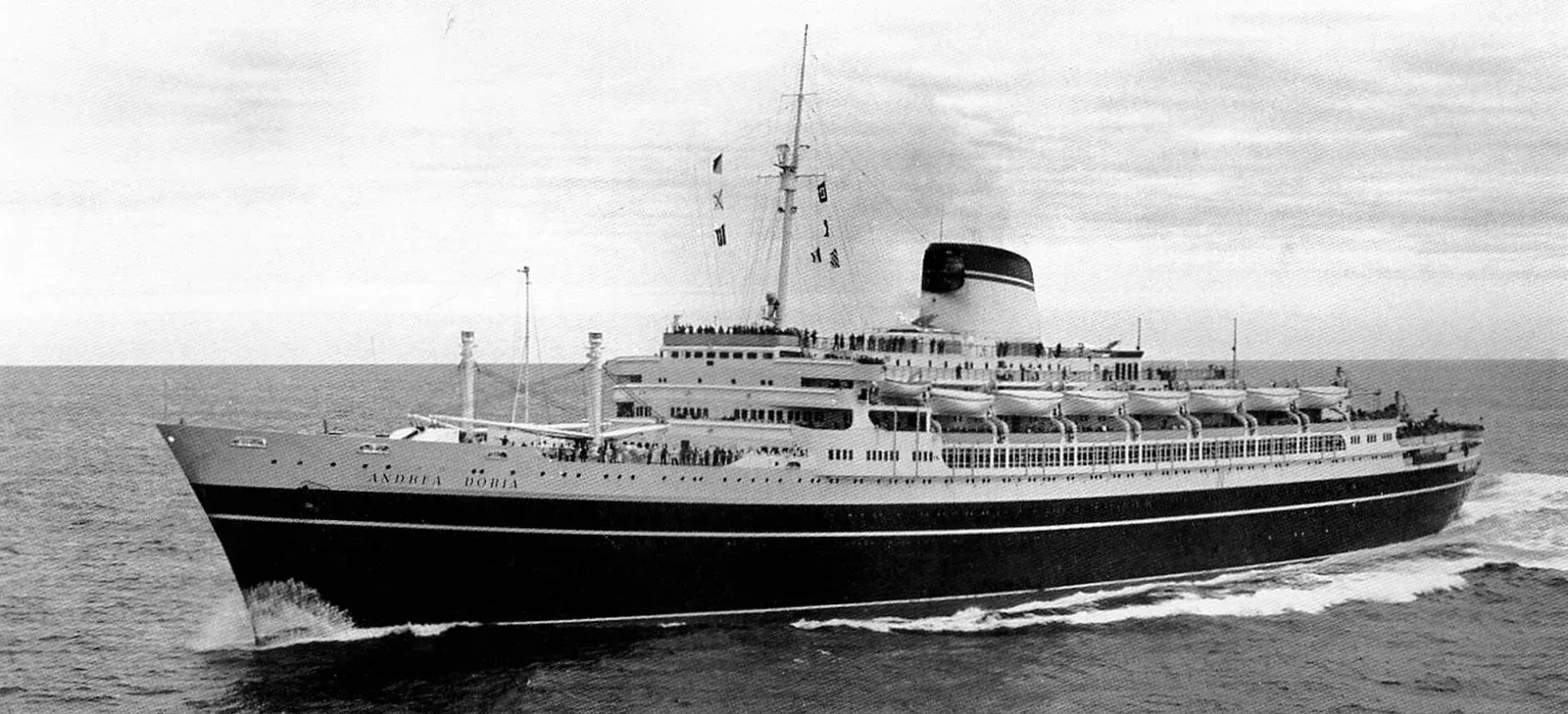
These are the staged-decompression wrecks in our data where everything above is the working language of the boat: mixed gas on the bottom, MODs taped to the stages, and an oxygen bar or drifting stop where the clock spends fastest. The list is led by the Andrea Doria, where a diver died of oxygen poisoning in 1993 — this guide’s subject, written into a wreck’s history.
| Site | Depth | Level | Best months |
|---|---|---|---|
| SS Andrea Doria Long Island Wreck Valley · United States | 58–73 m | Advanced | Jul–Sep |
| USS Arkansas Bikini Atoll · Marshall Islands | to 55 m | Advanced | Apr–Nov |
| HMS Triumph Gallipoli · Turkey | to 73 m | Advanced | Jun–Sep |
| HMS Irresistible Gallipoli · Turkey | to 65 m | Advanced | Jun–Sep |
| HMS Audacious Malin Head · Ireland | 58–68 m | Advanced | Jun–Aug |
| SS Justicia Malin Head · Ireland | to 70 m | Advanced | Jun–Aug |
| SMS Szent István Premuda · Croatia | to 66 m | Advanced | Jun–Sep |
| HMS Hermes Trincomalee & Kalpitiya · Sri Lanka | to 53 m | Advanced | Apr–Aug |
| San Francisco Maru Chuuk Lagoon · Micronesia | 27–64 m | Advanced | Nov–May |
| USS John Penn Iron Bottom Sound · Solomon Islands | 35–60 m | Advanced | Apr–Jun |
The decision of whether a wreck like these belongs in your diving yet is the subject of deep wrecks and where recreational diving stops. The gases themselves — what EAN50 and trimix 18/45 are for, and what they cost — are in air, nitrox, trimix and every other gas. The two other ceilings that stop air divers long before oxygen does are in gas density and why 30 metres is the line, and the machine keeping all of these ledgers at once is explained in how your dive computer decides.