
Coral Triangle · Indonesia
Ambon
The endemic psychedelic frogfish lives on Ambon's harbour slopes
Photo: Truite agile · CC BY-SA 4.0
Ambon Bay is a working harbour with a rubbish-strewn black-sand bottom, and it is one of the two or three best macro sites on earth. The psychedelic frogfish, a species found nowhere else, was described from these slopes in 2009; rhinopias, ornate ghost pipefish, blue-ringed octopus and every kind of shrimp turn up on a single dive at Laha. Outside the bay the water clears and Pintu Kota's limestone arch gives the island its one conventional postcard dive.
About diving in Ambon
Diving here is unglamorous and close to base. Small resorts and centres sit along the bay, the run to most sites is a few minutes in an open boat, and several can be walked into off the beach. Dives are long, slow and shallow, spent hovering over a patch of sand while a guide works the ground ahead of you, and three or four a day, one of them at dusk or after dark, is a normal week without ever leaving the inlet or seeing much reef.
The bottom does the sorting. Ambon Bay is a long inlet that nearly cuts the island in two, and the slopes along its shore at Laha shelve away in fine dark sand and settled debris, where almost everything worth finding is either hiding in the junk or imitating it. That is why the guide matters more than the certification card. Towards the mouth and outside it the water clears, hard coral appears and the terrain turns to slope, wall and rock. The two kinds of diving are a short boat ride apart and feel like different countries.
Finding things is procedural rather than lucky. Guides work known patches, mark animals in the morning and go back to them later, and the same individual rhinopias or frogfish can often be relocated for days on end. That is what makes the place work for photographers: long bottom times in shallow water, subjects that stay put, and nothing to chase. It also means booking one guide for the whole week tends to pay off more than rotating through a centre's roster.
Ambon also doubles as a turnaround port. Banda Sea liveaboards start and finish in the harbour, and their crossing windows, roughly March-April and September-November, fall in the bay's better months, so many divers bolt two or three days of sand diving onto a longer charter. That works well. What does not work is arriving expecting reef: anyone who wants scenery, big animals or clear water will spend the week wondering what they are supposed to be looking at.
Best time to dive Ambon
| Jan | Feb | Mar | Apr | May | Jun | Jul | Aug | Sep | Oct | Nov | Dec | |
|---|---|---|---|---|---|---|---|---|---|---|---|---|
| Season | Good | Good | Prime | Prime | Fair | Fair | Fair | Fair | Good | Prime | Prime | Good |
| Sea surface | 30°C86°F | 29°C84°F | 30°C86°F | 30°C86°F | 29°C84°F | 28°C82°F | 27°C81°F | 27°C81°F | 27°C81°F | 28°C82°F | 29°C84°F | 30°C86°F |
| Daytime high | 30°C86°F | 30°C86°F | 30°C86°F | 30°C86°F | 30°C86°F | 29°C84°F | 28°C82°F | 27°C81°F | 28°C82°F | 30°C86°F | 31°C88°F | 31°C88°F |
| Rain | 166 mm6.5 in | 143 mm5.6 in | 183 mm7.2 in | 235 mm9.3 in | 391 mm15.4 in | 408 mm16.1 in | 465 mm18.3 in | 298 mm11.7 in | 218 mm8.6 in | 127 mm5.0 in | 116 mm4.6 in | 167 mm6.6 in |
| Jan | Feb | Mar | Apr | May | Jun |
|---|---|---|---|---|---|
| Good | Good | Prime | Prime | Fair | Fair |
| Sea surface | |||||
| 30°C86°F | 29°C84°F | 30°C86°F | 30°C86°F | 29°C84°F | 28°C82°F |
| Daytime high | |||||
| 30°C86°F | 30°C86°F | 30°C86°F | 30°C86°F | 30°C86°F | 29°C84°F |
| Rain | |||||
| 166 mm6.5 in | 143 mm5.6 in | 183 mm7.2 in | 235 mm9.3 in | 391 mm15.4 in | 408 mm16.1 in |
| Jul | Aug | Sep | Oct | Nov | Dec |
|---|---|---|---|---|---|
| Fair | Fair | Good | Prime | Prime | Good |
| Sea surface | |||||
| 27°C81°F | 27°C81°F | 27°C81°F | 28°C82°F | 29°C84°F | 30°C86°F |
| Daytime high | |||||
| 28°C82°F | 27°C81°F | 28°C82°F | 30°C86°F | 31°C88°F | 31°C88°F |
| Rain | |||||
| 465 mm18.3 in | 298 mm11.7 in | 218 mm8.6 in | 127 mm5.0 in | 116 mm4.6 in | 167 mm6.6 in |
2011–2025 averages. Sea surface: NOAA Coral Reef Watch, measured at the surface, so deeper water can run colder. Daytime high and rain: NASA POWER.
Oct–Apr is the main season; June to August brings wind and rain that make the outer sites rough, though the bay stays divable.
Best months: March, April, October, November
Ambon water temperature and weather by month
The sea surface runs from 27 °C (81 °F) in August to 30 °C (86 °F) in April. Most rain falls from May to August, peaking at about 470 mm (19 in) in July; October and November are the driest. Daytime highs reach 31 °C (88 °F) in November and drop to 27 °C (81 °F) in August. The coldest water here is about 27 °C (81 °F), so pack a 3 mm, or even a 2 mm, suit.
Dive types & marine life
Almost nothing in the bay is seasonal: nudibranchs, shrimp, juvenile oddities and several frogfish species are on the sand whenever the water is workable. It is at its best after dark, when squid, cuttlefish and hunting octopus come out, and mandarinfish gather at dusk over shallow rubble. The clearer outer sites, their reef fish and their pygmy seahorses want the calmer Oct-Apr stretch.
- Muck & macro
- Reef
- Wall
- Night
- Cave & cavern
- Frogfish
- Macro critters
- Nudibranchs
- Octopus & cuttlefish
- Pygmy seahorses
- Mandarinfish
- Reef fish swarms
- Squid
Best dive sites in Ambon
Cave & cavern
A skylight hole lights the chamber at 12 metres
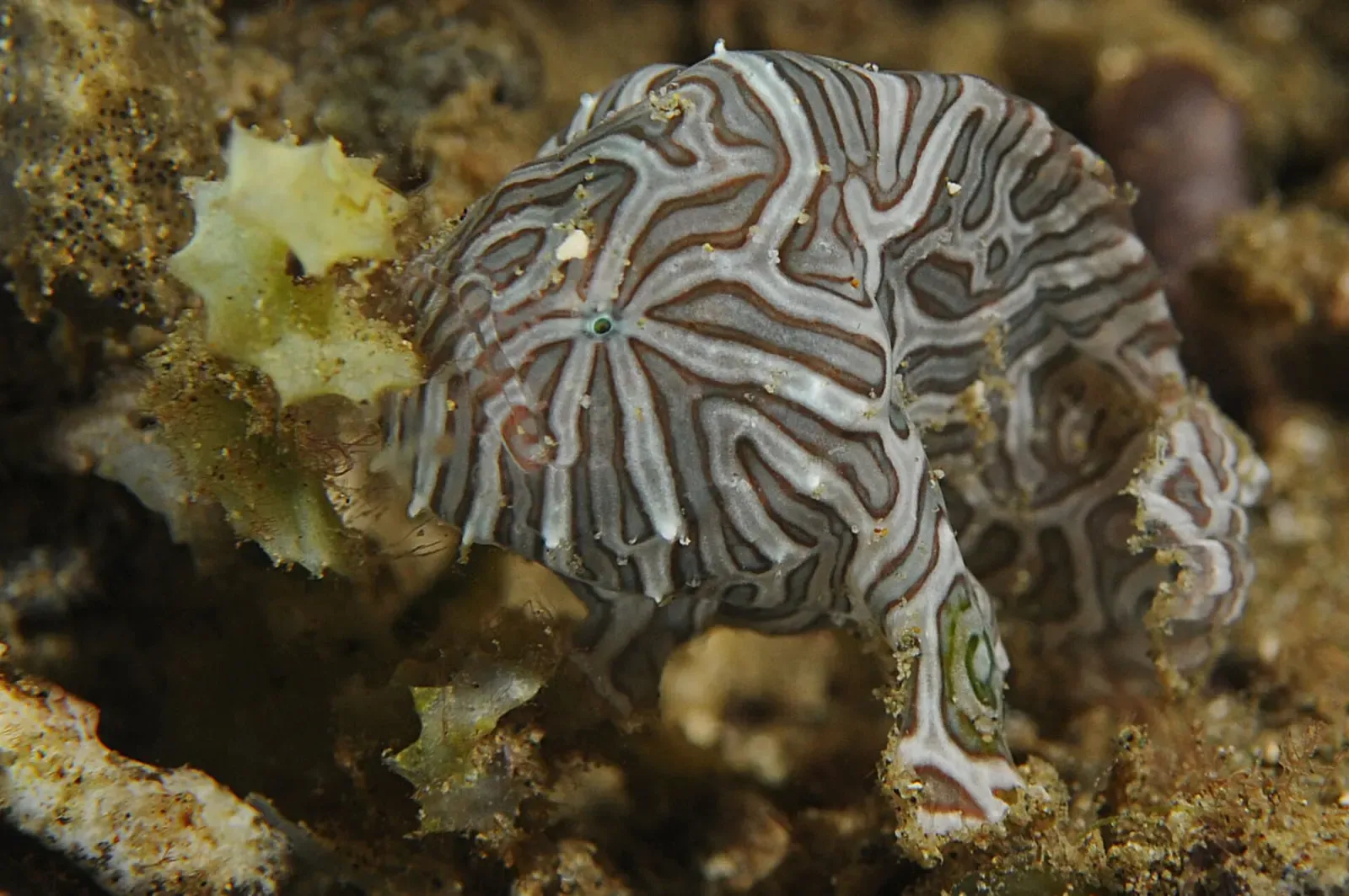
Where the holotype of the psychedelic frogfish was collected in 2008
Wall
A wall past 30 m below the city-gate arch
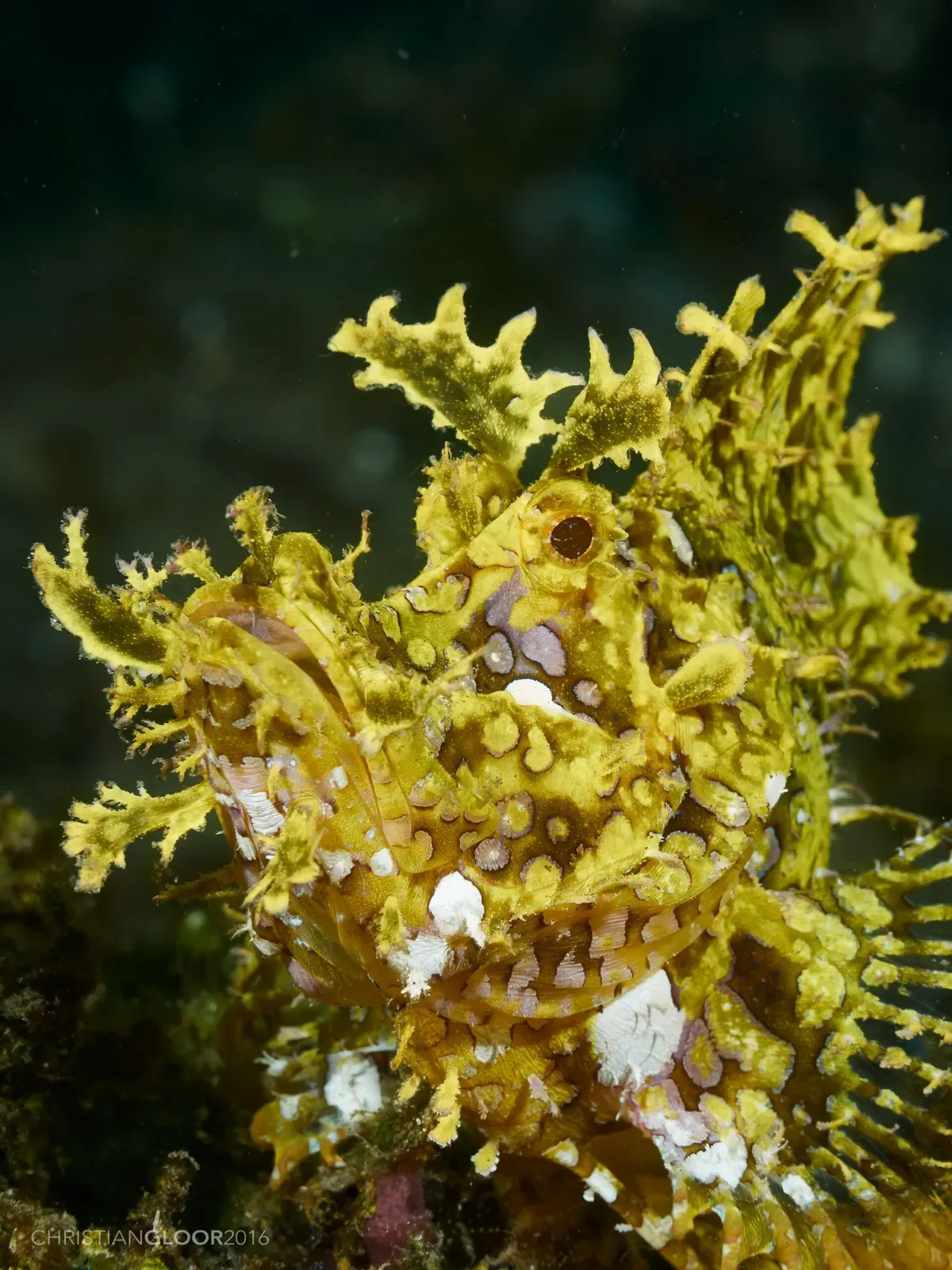
Named for the rhinopias on the sand slope west of Laha
Laha 2
Also called Twilight Zone; rhinopias, ghost pipefish and rare shrimp.
Duive Island
Offshore island with hard coral and the area's best visibility.
How to get to Ambon
Pattimura Airport sits at Laha, on the same shore as the best-known sand slopes, with domestic connections through Jakarta, Makassar and Surabaya. Divers either base at a small resort on the bay, where several sites are shore entries, or stay in Ambon city and go out by boat. Moving between the two means a drive around the inlet, so check where a centre actually sits before booking.
Photos from Ambon
prilfish · CC BY 2.0
prilfish · CC BY 2.0
Arne Kuilman · CC BY 2.0
prilfish · CC BY 2.0
Dive videos
Diving Ambon, Indonesia | Muck Diving & Blackwater Diving [4k] · Chris Underwater on YouTube
CRITTERS OF AMBON - muckdiving in Indonesia (4K / Panasonic Lumix GH5) · Marcel Steuermann on YouTube
Photo credits
- Juvenile psychedelic frogfish with maze-like brown and white skin patterns on the sandy slope by Truite agile, CC BY-SA 4.0, via Wikimedia Commons
- Orange tube anemone with feathery tentacles and tiny anemonefish sheltering at its base by prilfish, CC BY 2.0, via Openverse
- Deep red nudibranch with fine white speckling crawling over encrusted rock by prilfish, CC BY 2.0, via Openverse
- Anker's whip coral shrimp with long antennae perched on the branch of a whip coral by Arne Kuilman, CC BY 2.0, via Wikimedia Commons
- Spotted porcelain crab nestled among the green tentacles of a sea anemone by prilfish, CC BY 2.0, via Openverse
Embed
Run a dive centre, club or blog? Embed this map of 4 dive sites near Ambon on your own page.
In The Logbook
- Frogfish: species, behaviour and where to diveMacro & muck · 12 min read
- What stings you underwater, and how to avoid itBody & health · 8 min read
- Night diving: the best night dives in the worldNight diving · 12 min read
- The best muck diving in the worldMacro & muck · 6 min read
Similar destinations

New species are described from these slopes with unusual regularity
A limestone wall the length of the coast, dived by almost nobody

Soft coral grows so thick on Sahaung's pinnacles the rock disappears


_(8444683306).jpg)
Napaling's resident sardine shoal, and the base for all of Bohol