What a frogfish is
A frogfish is an anglerfish that never left the reef. Its deep-sea relatives dangle glowing lures in the dark; frogfish do the same trick in a few metres of water, sitting on sponge, rubble or a pier piling and fishing with a rod that grows from the top of the head. The family, Antennariidae, holds several dozen species across the world’s tropical and subtropical seas, and a few that reach into temperate water.
To a diver, the first thing that matters is that frogfish rarely look like fish. The body is round and scaleless, the skin is lumpy, hairy or tasselled, and the colour usually matches whatever the animal is sitting on. A frogfish may not move at all while you swim past it. What gives one away is a detail that does not belong: an eye in a sponge, a mouth line too straight for the rock around it, or a thin rod rising from the brow.
The second thing is that they are, for their size, some of the most extreme animals on a reef. They walk on fins that work like arms. They catch prey faster than any camera running at normal speed can record. One species travels the ocean on floating seaweed, another guards its eggs by wrapping them in its own fins, and several can change colour to match a new sponge. None of this is visible on a quick swim past, which is why frogfish reward the slowest divers most.
The frogfish you are likely to meet
Species identification from a frogfish’s colour is a trap: a single species can come in half a dozen colours, and unrelated species can look alike. Shape, skin texture, the lure and where you are in the world narrow it down faster. The table gives the adult length for the species most divers meet, from a specialist species list, and the ocean each one lives in.
| Species | Adult length | Where it lives | What to look for |
|---|---|---|---|
| Giant frogfish (Antennarius commerson) | 30 cm | Indo-Pacific | The frogfish most divers meet first: a large, lumpy body in almost any colour, often wedged against a sponge |
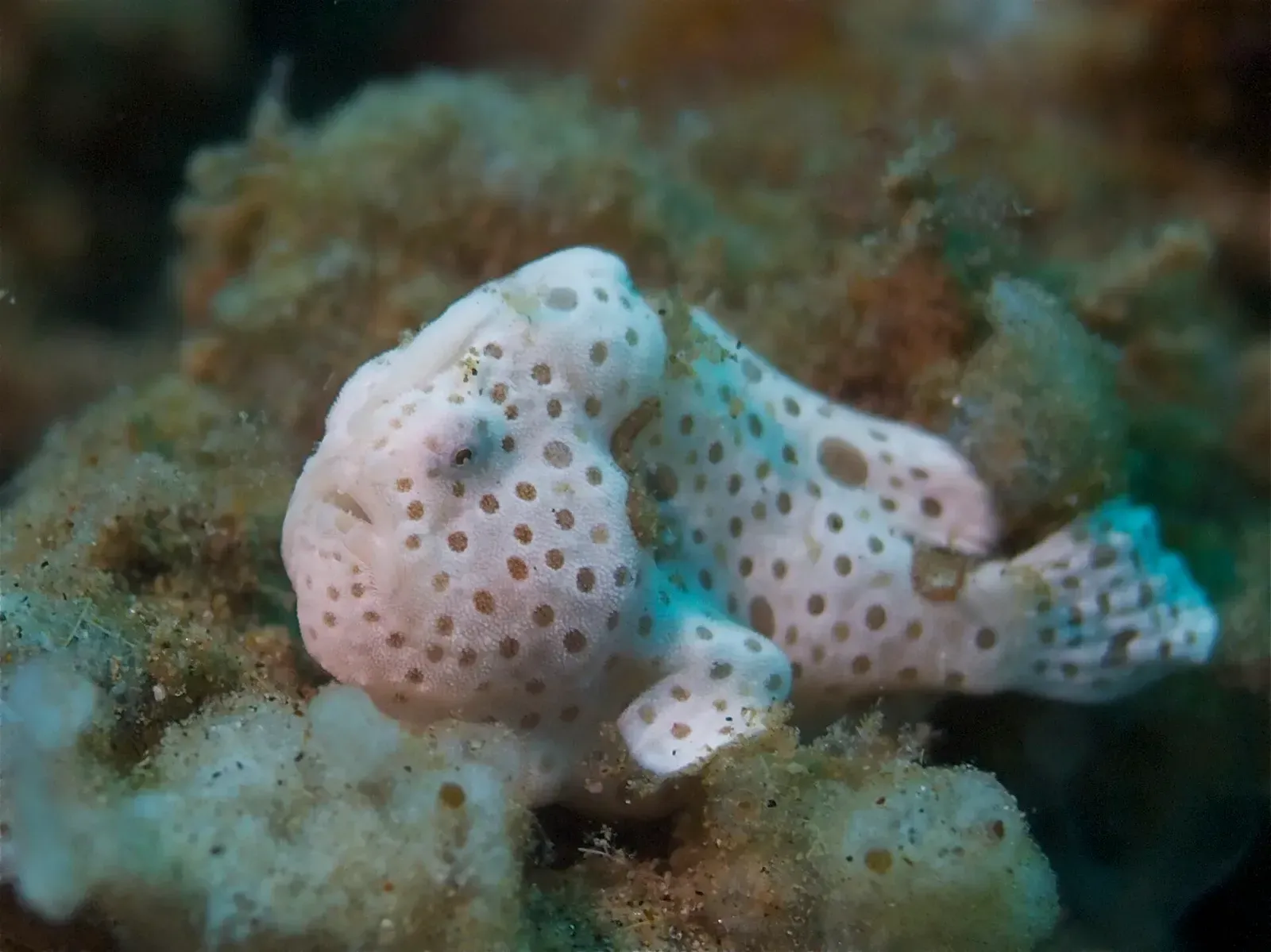
| Painted frogfish (Antennarius pictus) | 10–16 cm | Indo-Pacific | Dark spots or rings on the body; juveniles can be no bigger than a thumbnail |
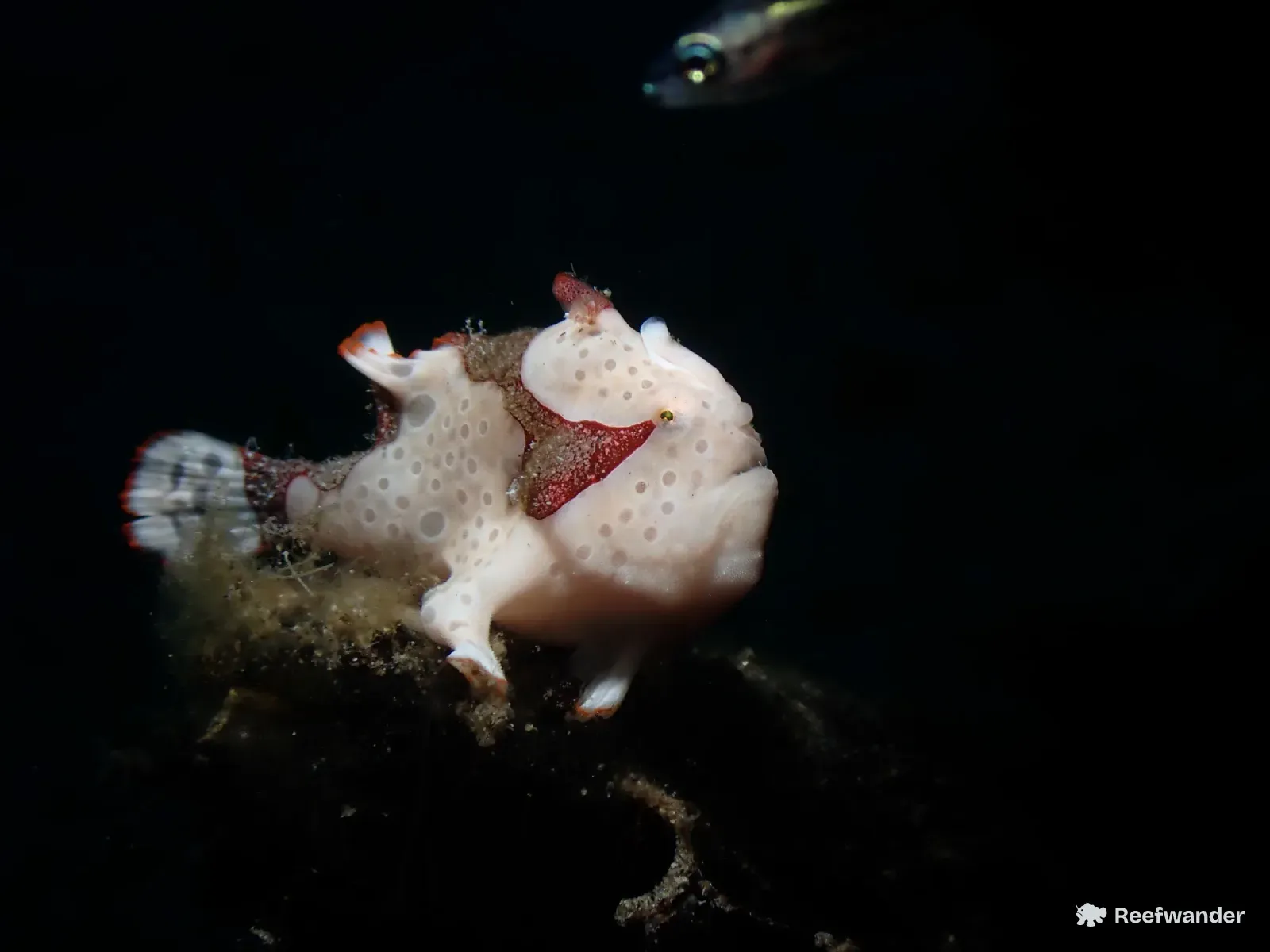
| Warty frogfish (Antennarius maculatus) | 8–10 cm | Indo-Pacific | Skin covered in wart-like bumps; juveniles are the white-and-red “clown frogfish” |
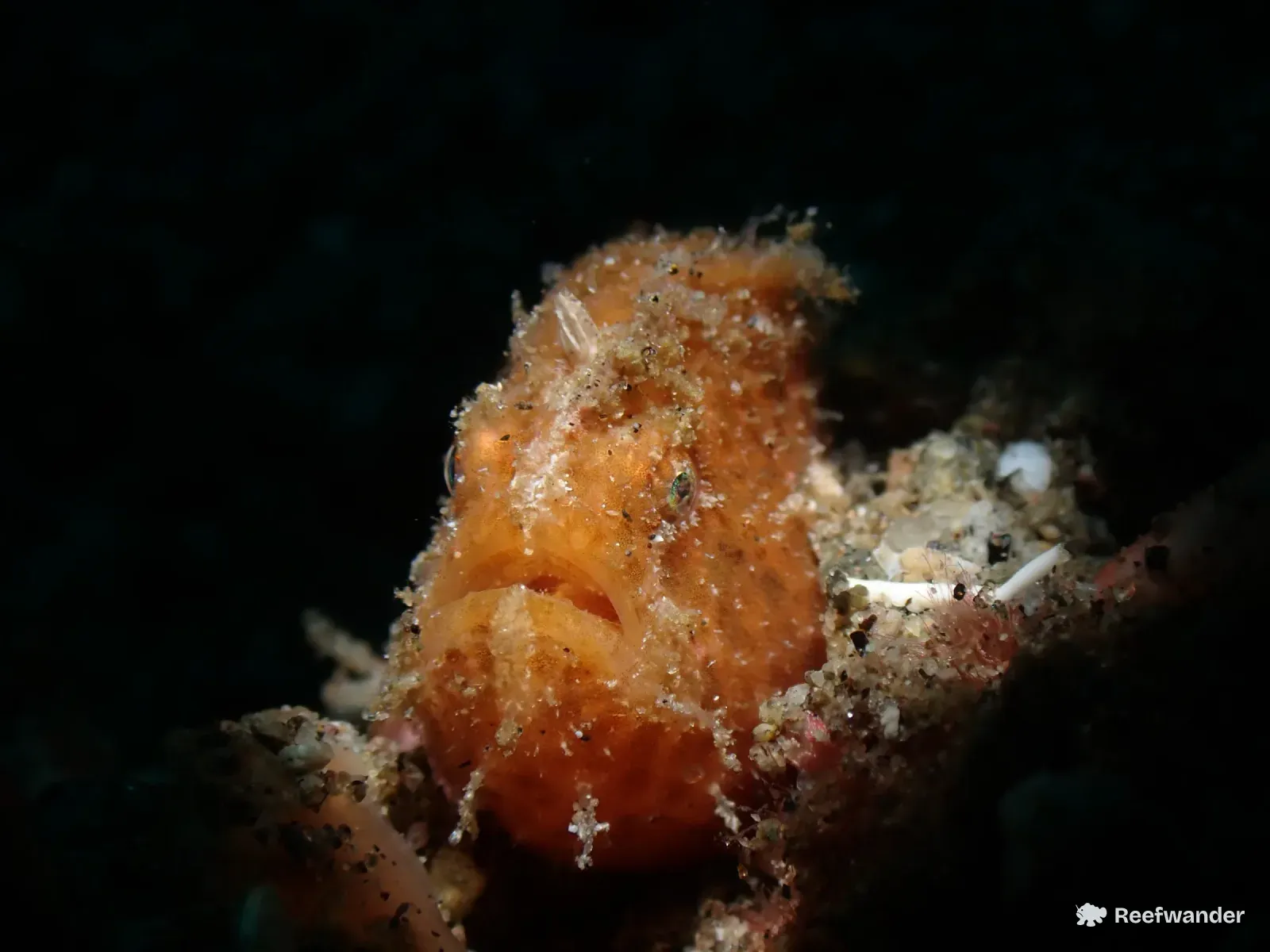
| Hairy frogfish (Antennarius striatus) | 18–22 cm | Indo-Pacific; called striated frogfish in Florida | Thin skin filaments that look like hair, often over stripes |
| Sargassum frogfish (Histrio histrio) | 20 cm | All tropical seas | Lives in floating sargassum weed and climbs through it |
| Longlure frogfish (Antennarius multiocellatus) | 11 cm | Atlantic | A long rod and lure; one of the Atlantic species |
| Ocellated frogfish (Fowlerichthys ocellatus) | 38 cm | Atlantic | The largest on this list; a rare find at Blue Heron Bridge |
| Freckled frogfish (Antennatus coccineus) | 9–13 cm | Indo-Pacific | Often hidden in reef crevices rather than out on sponge |
| Spotfin frogfish (Antennatus nummifer) | 10 cm | Indo-Pacific | A lure that looks like a small shrimp |
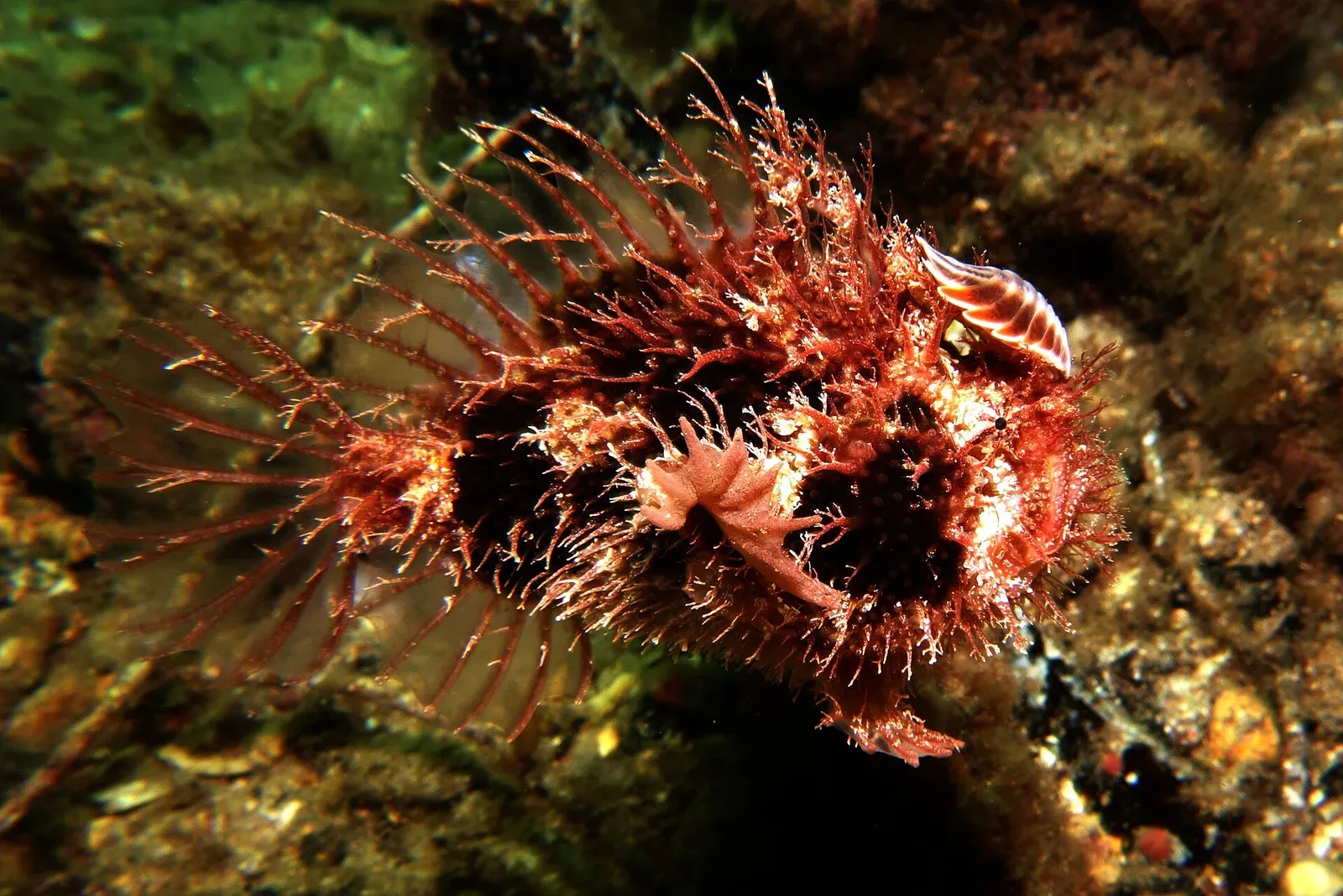
| Tasselled anglerfish (Rhycherus filamentosus) | 23 cm | Southern Australia only | Covered in branching tassels, on kelp-covered rocky reef |
Several names on that list have changed. The freckled and spotfin frogfish have moved from Antennarius to Antennatus, and the ocellated frogfish to Fowlerichthys, so older books and dive-shop boards may still use the old names. Other species turn up on guides’ lists at the richest muck sites, among them Randall’s, hispid, bandfin and, in Florida, dwarf frogfish.
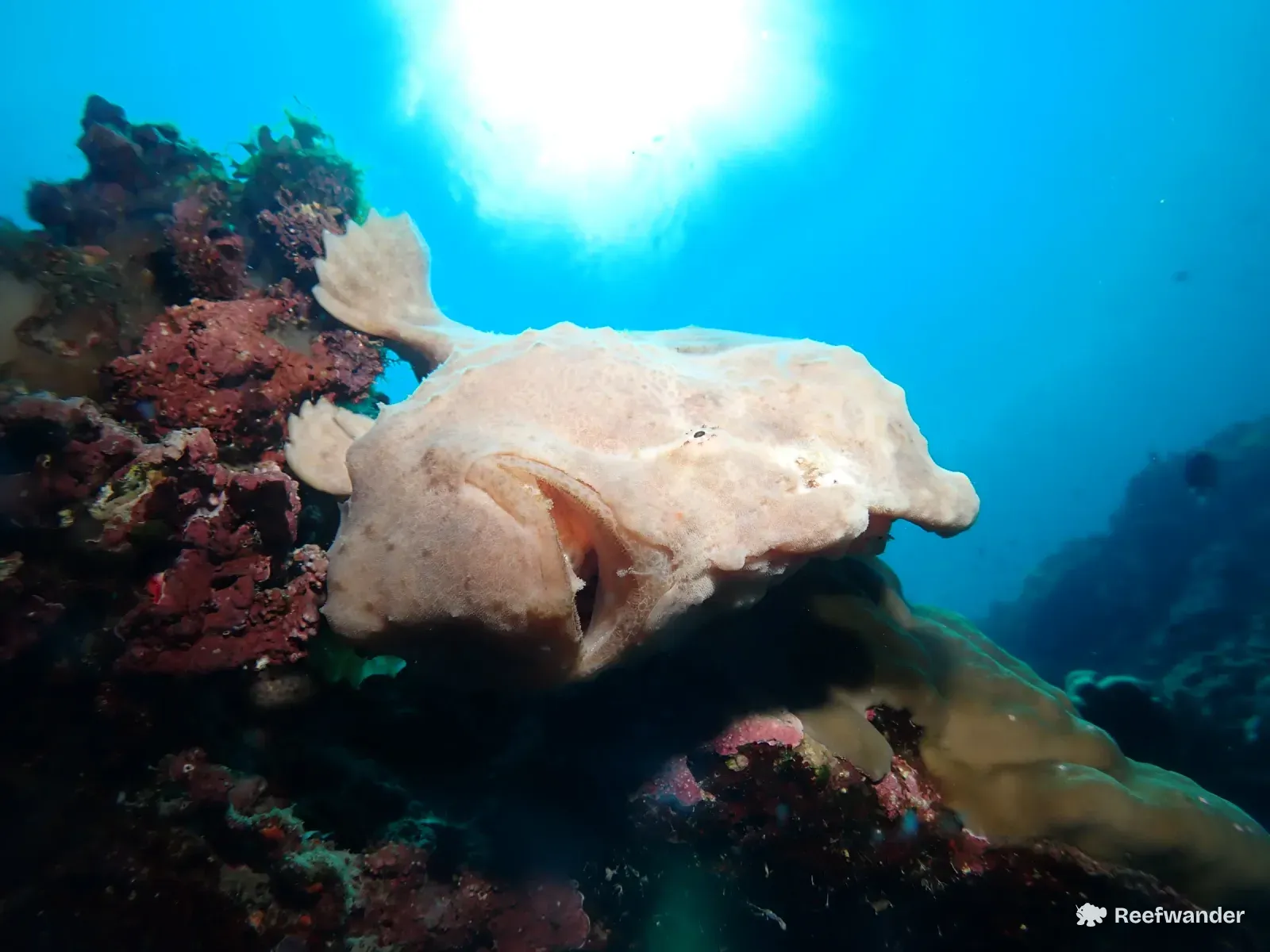
The giant frogfish is the one most divers see first, simply because it is the easiest to see. It sits on open reef, on wrecks and against jetty pilings, and at 30 cm (12 in) it is large enough to notice once your eye has learned the shape. The painted frogfish is the classic muck-dive find: at Kapalai, the site record describes juveniles “no bigger than a thumbnail” sitting on open sand, mimicking small sponges. The hairy frogfish’s filaments collect sand and debris until it disappears into the rubble.
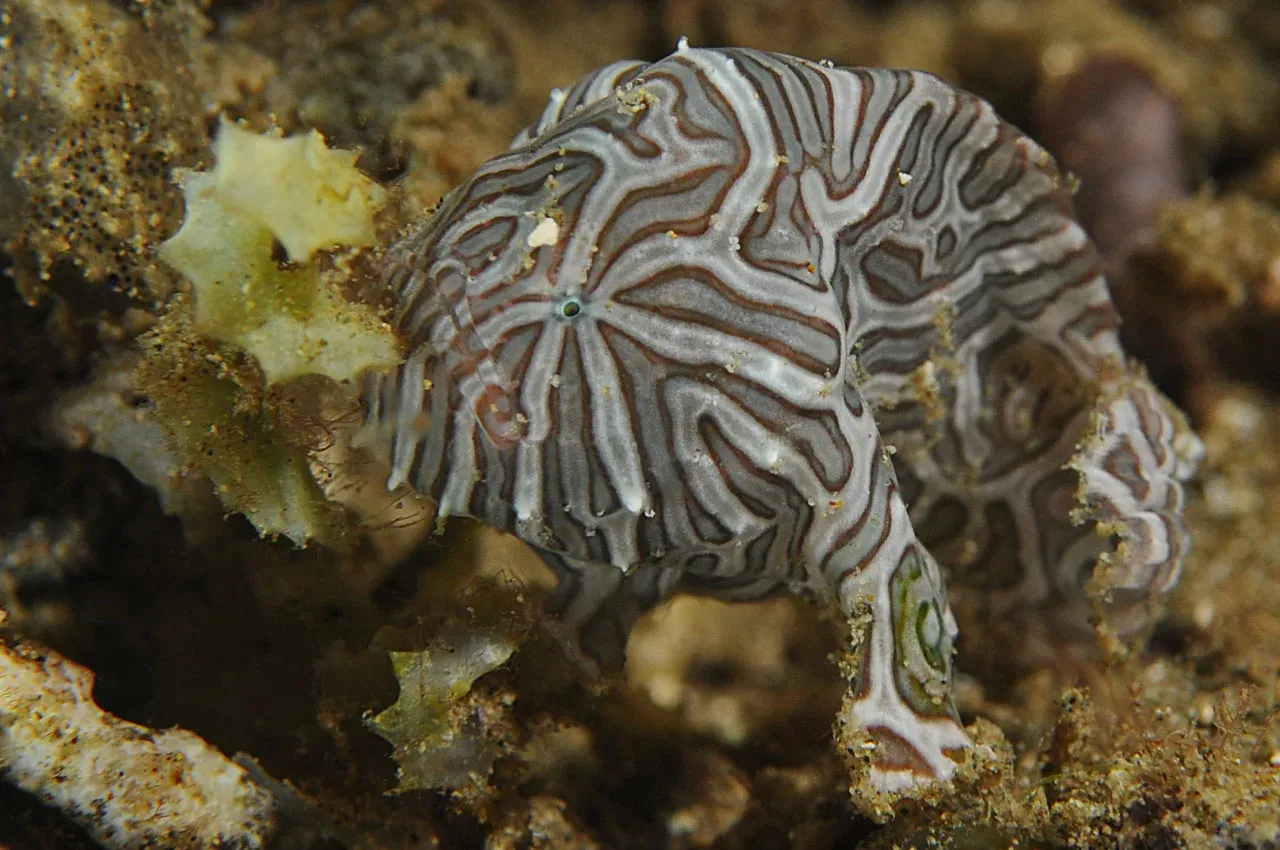
The psychedelic frogfish
Histiophryne psychedelica was described in 2009, from specimens collected in Ambon and Bali, Indonesia. It looks like nothing else in the family: a broad, flat face with forward-facing eyes, and swirling white stripes that radiate from the eyes over a peach or yellow-brown body. The pattern is unique to each fish, like the stripes on a zebra. Unlike many frogfish, it does not change colour.
It also moves differently. The psychedelic frogfish walks on its pectoral fins and pushes itself along by jetting water out through its gill openings, so that it seems to bounce along the bottom. At Laha 1 inside Ambon Bay, a shallow rubble-and-sand slope from 2 to 12 m, the holotype was collected in 2008.
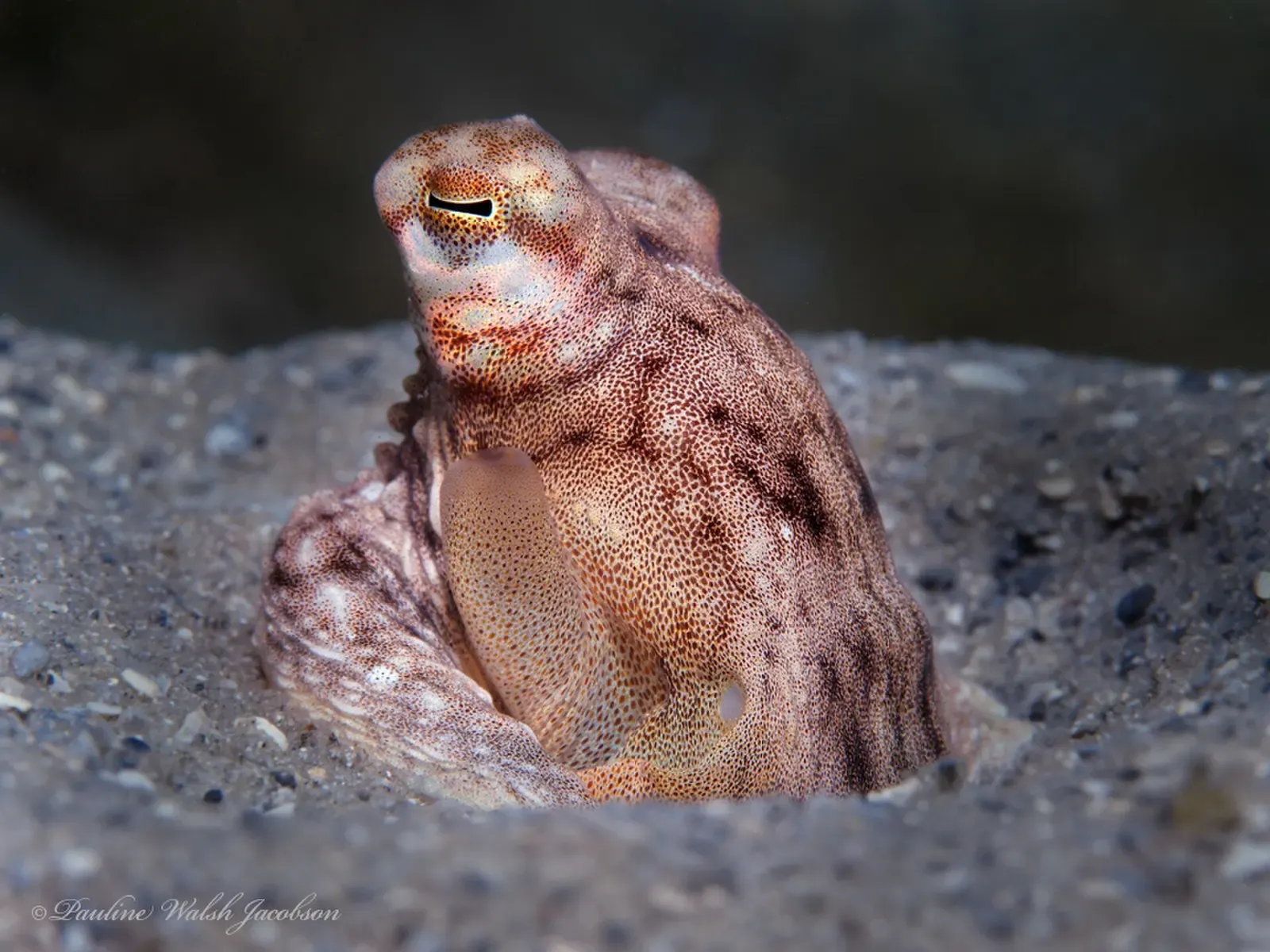
Despite the Bali specimens in the original description, Ambon is the only place the species has been positively identified since. It is not an animal any operator can promise. If it is the reason for a trip, ask local guides what they have seen recently, and treat the rest of Ambon’s muck diving as the reason to go.
The sargassum frogfish
The sargassum frogfish is the one species that left the bottom. It lives in mats of floating sargassum weed, drifting with them across open ocean, and grips the fronds with its fins the way other frogfish grip a sponge. It can even climb out of the water onto a weed mat and stay there for a while. Storms blow the mats inshore, which is how divers meet it: at Blue Heron Bridge it is a warmer-month visitor, and one Dauin resort includes it among that coast’s ten species.
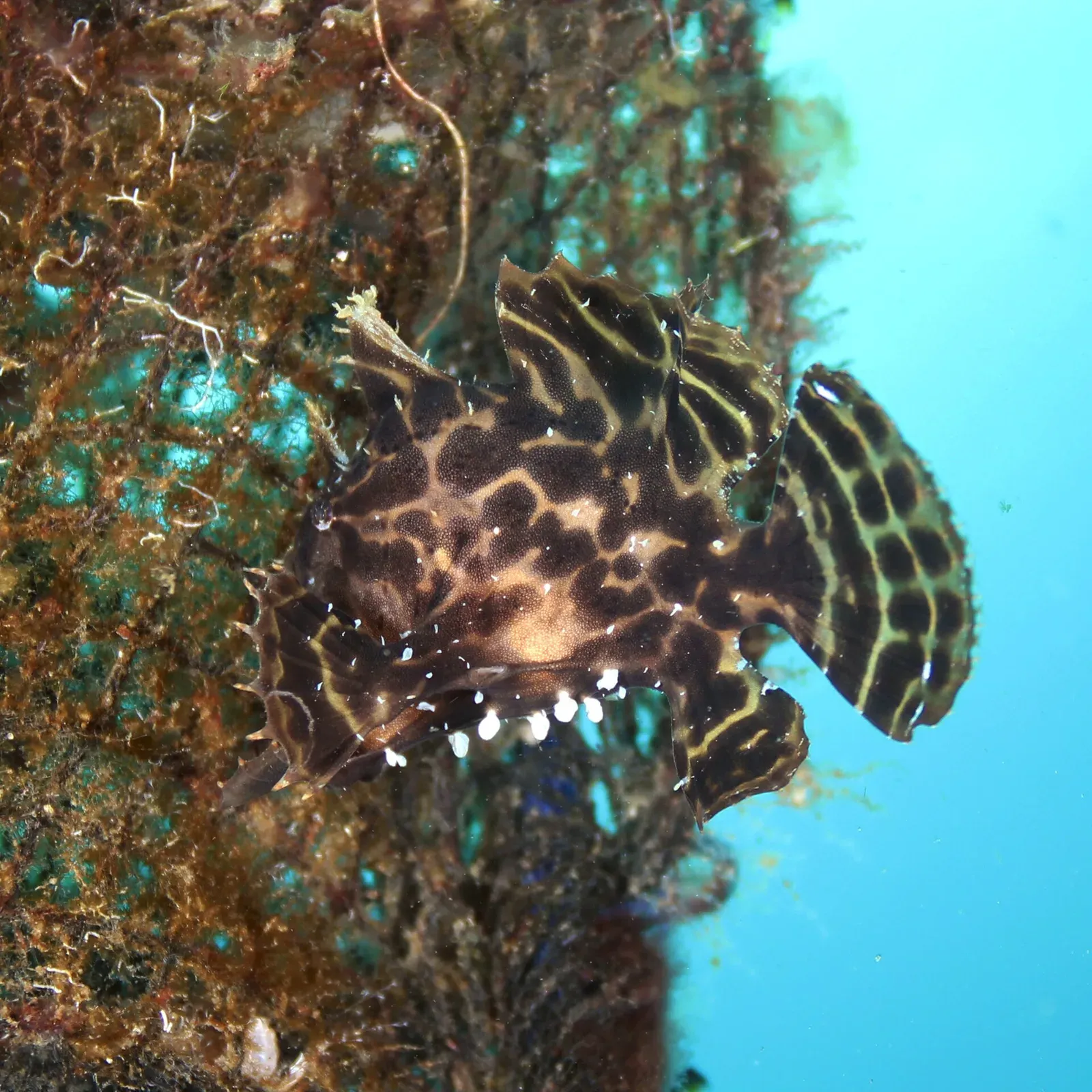
Australia’s tasselled anglerfish
The frogfish family reaches beyond the tropics, and the most striking example lives in cold water. The tasselled anglerfish is found only on kelp-covered rocky reefs from Bass Strait to South Australia. Branching tassels cover its body so thoroughly that it disappears into the weed, and its lure looks like two small worms. At Blairgowrie Pier in Port Phillip, the area record names it under the pier boards alongside weedy seadragons and giant cuttlefish; anglerfish also turn up on the Old Rapid Bay Jetty in South Australia.
How a frogfish hunts
The rod is a modified first dorsal-fin spine called the illicium. The bait at its tip is the esca, and it differs by species. Lures can mimic worms, small shrimp or small fish: the spotfin frogfish’s lure looks like a small shrimp, and the tasselled anglerfish’s like two worms. Each species also moves its rod in its own pattern to catch a passing fish’s attention. A frogfish that loses its lure can grow a new one, but regrowing it takes about four to six months, and the fish may go hungry in the meantime.
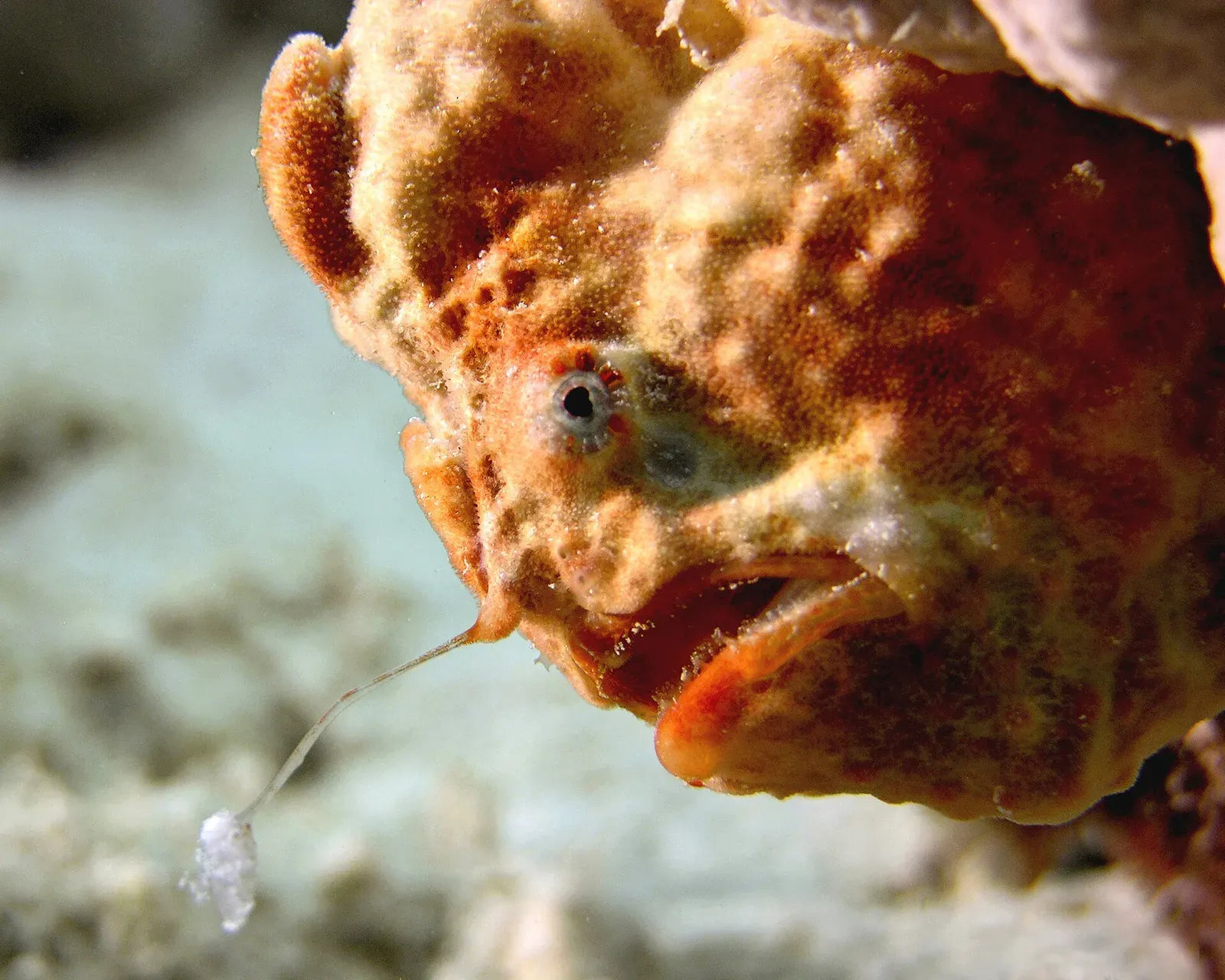
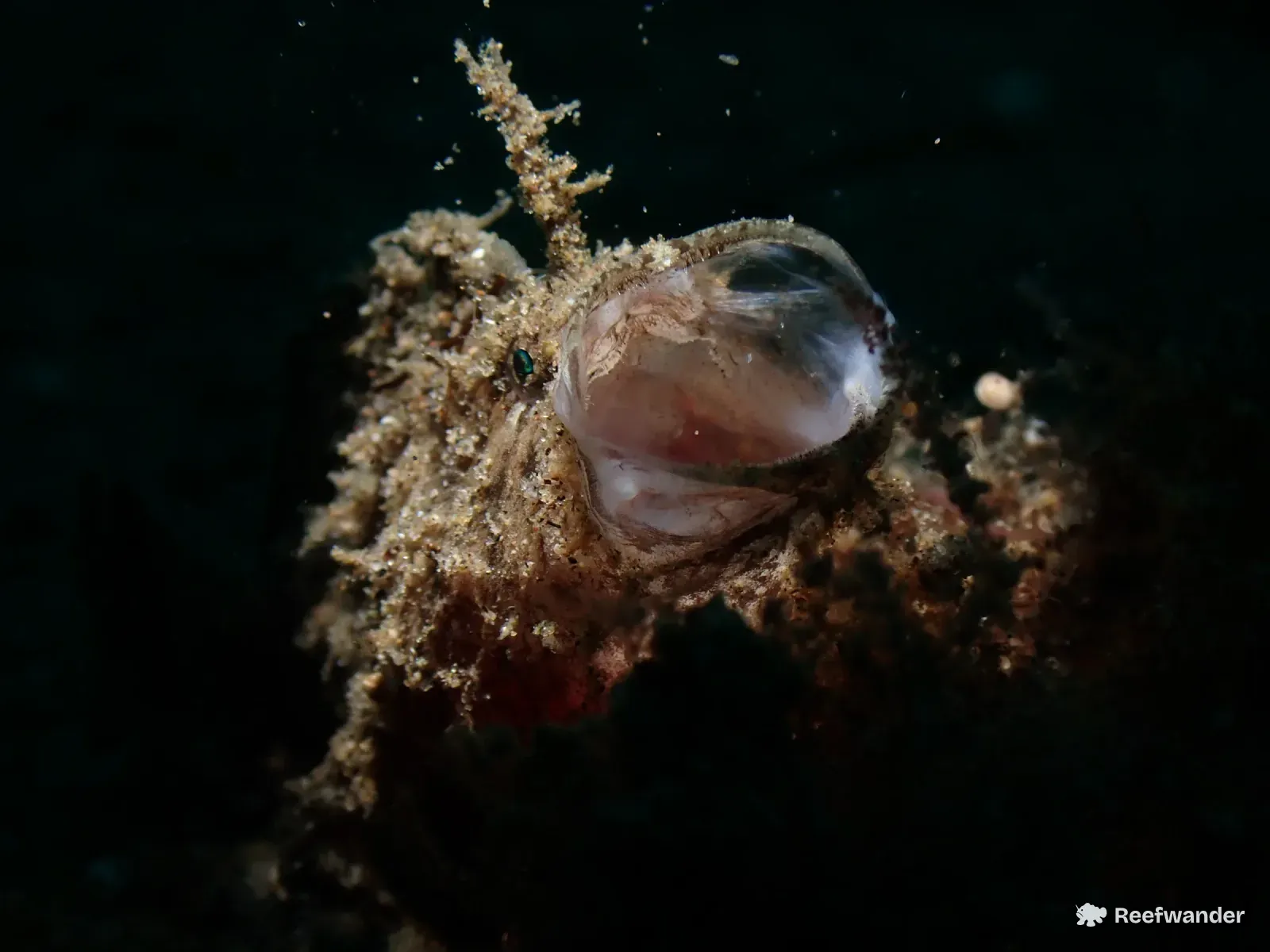
The lure only has to bring prey close. The frogfish is not built to chase anything; its camouflage and stillness let it sit where small fish already feel safe, and the lure does the rest. When prey comes within reach, the frogfish opens its mouth and expands the mouth cavity to as much as twelve times its resting volume, and the rush of water carries the prey in. Grobecker and Pietsch’s high-speed film of antennariid anglerfishes measured the whole movement at about six milliseconds.

Embed this diagram
<figure>
  <img src="https://reefwander.com/og/diagrams/frogfish-strike.svg" alt="A six-millisecond antennariid feeding strike against one frame of 30 fps video." loading="lazy">
  <figcaption>Diagram by Reefwander, licensed under CC BY 4.0.</figcaption>
</figure>
Six milliseconds is too short to see. At 30 frames per second a video frame lasts about 33.3 milliseconds, so the strike fills only about 18 per cent of one frame. Played back at normal speed, a clip shows a frogfish sitting still, then sitting still with a mouthful.
The mouth is also larger than the fish looks. A frogfish can swallow prey up to twice its own size.
Walking on fins
A frogfish’s pectoral fins work like feet. It uses them, with the pelvic fins, to clamber and walk across sponge, rubble and sand rather than swim, and it braces on them while it waits. Seen face on, the effect is of a small animal standing on its arms. Walking is slow, and that is the point: a hunter that only has to shuffle a few centimetres to a better perch never needs to be fast, and a fish that stays still stays hidden.
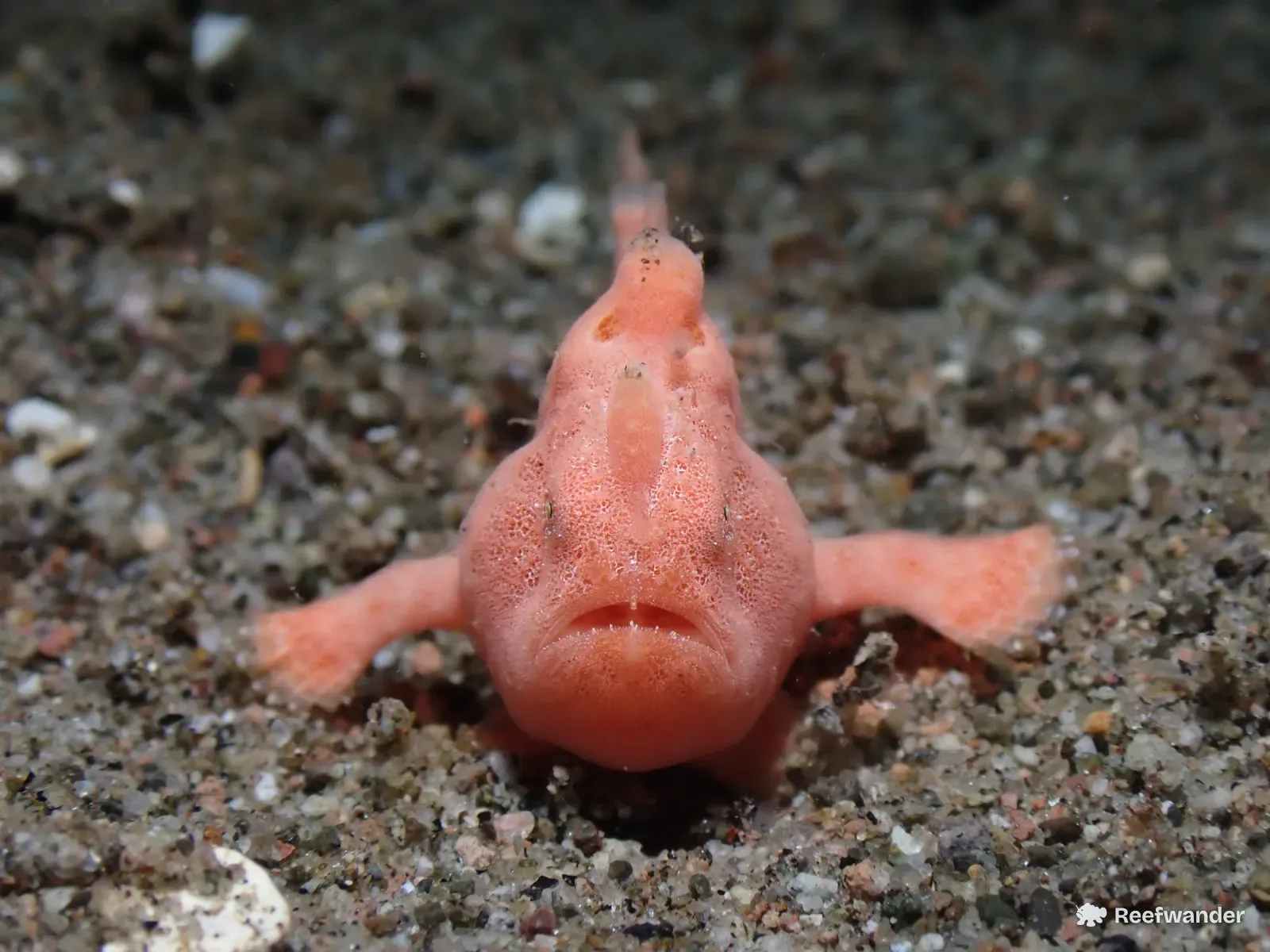
That is also why a disturbed frogfish is a problem for the frogfish. Moved off the sponge it matches, it is suddenly visible to everything that eats it and to nothing it wants to eat. Leave it where it is.
Colour changes
Most frogfish can change colour, but slowly. It usually takes days or weeks: one documented fish went from black with orange spots to brown and then yellow with black spots over a month. Faster changes happen too; one diver photographed a frogfish turning from yellow to reddish in two minutes. Not every species can do it. The Antennatus species, including the freckled and spotfin frogfish, keep their colours, with individuals only a little darker or lighter than others, and the psychedelic frogfish never changes.
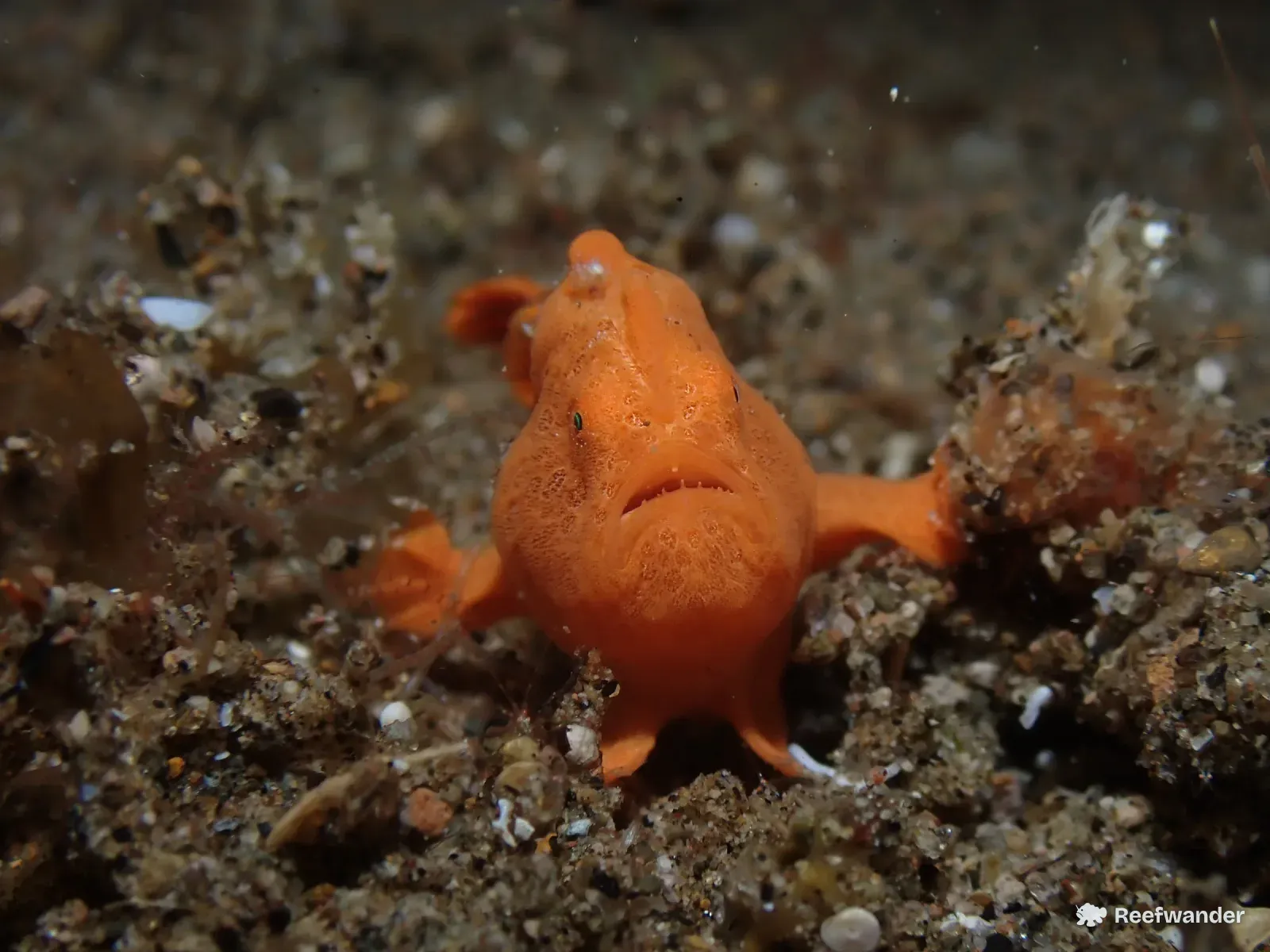
That is why a colour is a clue to the sponge a frogfish has been sitting on, not to its species. A single species, the giant frogfish, comes in green, yellow, red, brown, black, white and pink. A guide who points to “a yellow one and a black one” on the same dive may be showing you the same species twice.
Eggs and young
Most frogfish do not look after their eggs. About 8 to 12 hours before spawning, the female swells with between 40,000 and 180,000 eggs and releases them in a ribbon of buoyant mucus, an egg raft, which drifts for several days and can cross large distances. The larvae spend probably one to two months in the plankton, and even larvae 5 to 10 mm long already carry a lure.
A handful of species do the opposite. Some Histiophryne frogfish fold the pectoral fin and bent tail into a pocket around their eggs; Lophiocharon species carry theirs attached to their bodies until they hatch. One female psychedelic frogfish laid about 220 eggs and wrapped her tail, dorsal and anal fins around the cluster, hiding it from view. The tasselled anglerfish guards her eggs by covering them with her side until the young hatch, after about 30 days.
Where to see frogfish
Frogfish live almost anywhere with warm, sheltered water and something to hide against, so the useful question is not where they occur but where a guide can reliably find several, or where you can see a species that lives nowhere else. The destinations below are drawn from our site records and the guide’s sources. Each card lists the species named for that place, most often seen first.
Many species in one place
Three places stand out for sheer variety. Dauin on Negros in the Philippines has a coast of black sand, artificial reefs and rubble slopes; one Dauin resort lists ten frogfish species for the area. Pyramids is the site built around them, sponge-covered structures between 10 and 20 m where the site record reports three or four colour morphs on a single dive, and Lipayo Point adds hairy and painted frogfish hiding in debris. Most of our own frogfish photos on this page were taken in Dauin. Lembeh Strait in North Sulawesi, Indonesia, has at least nine species on one resort’s list; on Hairball the site record says the question is how many frogfish you will see, not whether.
The third is the surprise. Blue Heron Bridge is a shore dive under a road bridge in Florida, in 1.5 to 6 m of water at West Bridge Span, timed to the high-tide window. Five Atlantic species have been found there: striated frogfish are far and away the commonest, dwarf frogfish second, sargassum frogfish arrive in the warmer months, and longlure and ocellated frogfish are rare.
DauinPhilippines
A Dauin resort lists ten species for this stretch of coast, and the Pyramids record reports three or four colour morphs on a single dive.
- Giant
- Painted
- Warty
- Hairy
- Sargassum
- Freckled
- Spotfin
- Randall's
- Bandfin
Where to look: Pyramids, San Miguel, Lipayo Point, Ginama-an
Lembeh StraitIndonesia
Black volcanic sand and rubble where, on a slope like Hairball, the question is how many frogfish rather than whether.
- Hairy
- Painted
- Giant
- Warty
- Freckled
- Randall's
- Hispid
- Sargassum
Where to look: Hairball, Jahir, Teluk Kambahu, Police Pier
Blue Heron BridgeUnited States
A shallow shore dive under a Florida road bridge with five Atlantic species; striated frogfish are by far the commonest, ocellated the rarest.
- Hairy
- Dwarf
- Sargassum
- Longlure
- Ocellated
Where to look: West Bridge Span, East Bridge Span
One species worth the trip
Two destinations are about a single animal. Ambon is the only place the psychedelic frogfish has been identified since its description. Port Phillip in Victoria, Australia, is a cold-water pier dive where the tasselled anglerfish sits under the boards, a member of the family that divers in the tropics will never see.
AmbonIndonesia
The only place the psychedelic frogfish has been positively identified, and a rare find even here: the holotype came from Laha in 2008.
- Psychedelic
Where to look: Laha 1
Port PhillipAustralia
Temperate water and an Australian endemic: tasselled anglerfish live under the pier boards alongside weedy seadragons and giant cuttlefish.
- Tasselled anglerfish
Where to look: Blairgowrie Pier
A standing find
At these destinations frogfish are a regular part of the dive rather than the reason for it, usually one or two species that local guides know where to find. Secret Bay in Anilao regularly produces hairy frogfish; Mabul has a site named Froggy Lair, inside 10 m. Giant frogfish are the find at Doljo Point on Panglao, on the walls of Menjangan in Bali, at Golden Arches in Kona, where they go by their other name, Commerson’s frogfish, and on Scorpions Secret off Pemba in Tanzania.
AnilaoPhilippines
Secret Bay regularly turns up hairy frogfish; giants sit on the reef at The Cathedral.
- Hairy
- Giant
Where to look: Secret Bay, The Cathedral, Basura, Kirby's Rock
Mabul & KapalaiMalaysia
Froggy Lair is named for them, and juvenile painted frogfish no bigger than a thumbnail sit on the sand at Kapalai.
- Painted
Where to look: Froggy Lair, Eel Garden (Kapalai), Seaventures Jetty
PanglaoPhilippines
Giant frogfish wedge themselves into the sponges at Doljo Point, where a guide who knows the individuals is worth having.
- Giant
Where to look: Doljo Point
MalapascuaPhilippines
Painted frogfish share Gato Island with sea kraits, seahorses and ribbon eels.
- Painted
Where to look: Gato Island
Menjangan & West BaliIndonesia
Giant frogfish sit still and well camouflaged on the coral along the walls.
- Giant
Where to look: Temple Wall, Anchor Wreck
KonaUnited States
Commerson's frogfish, another name for the giant, turn up at Golden Arches often enough to be worth hunting for.
- Giant
Where to look: Golden Arches
Pemba IslandTanzania
A giant frogfish sits on the same slope as the scorpionfish the site is named for.
- Giant
Where to look: Scorpions Secret
Frogfish turn up in plenty of other records without a species name. In the Caribbean, Bonaire’s Something Special and Town Pier and the pilings of St Croix’s Frederiksted Pier all list them, without naming the species. On Bali’s northeast coast, Seraya Secrets is a slow search across open sand with frogfish among the headline animals, and even in the Atlantic off Madeira, the Azul house reef lists them.
When to go
Frogfish do not gather to breed or migrate the way whale sharks or mantas do, so there is no frogfish season to plan around. The timing question is about diving conditions and access: wind, current, visibility, tides and an operator’s schedule decide whether a slope or jetty is diveable on a given day.
| Site | Jan | Feb | Mar | Apr | May | Jun | Jul | Aug | Sep | Oct | Nov | Dec |
|---|---|---|---|---|---|---|---|---|---|---|---|---|
| PyramidsDauin | Fair | Fair | Good | Prime | Prime | Good | Good | Good | Good | Good | Good | Fair |
| HairballLembeh Strait | Good | Good | Good | Good | Good | Good | Prime | Prime | Prime | Prime | Prime | Good |
| West Bridge SpanBlue Heron Bridge | Good | Good | Good | Prime | Prime | Prime | Prime | Prime | Good | Good | Good | Good |
| Laha 1Ambon | Good | Good | Prime | Prime | Fair | Fair | Fair | Fair | Good | Prime | Prime | Good |
| Secret BayAnilao | Prime | Prime | Prime | Prime | Good | Fair | Fair | Fair | Fair | Fair | Good | Prime |
| Froggy LairMabul & Kapalai | Good | Good | Prime | Prime | Prime | Prime | Prime | Prime | Prime | Prime | Good | Good |
| Blairgowrie PierPort Phillip | Good | Good | Good | Good | Prime | Prime | Prime | Good | Good | Good | Good | Good |
| Golden ArchesKona | Prime | Prime | Prime | Prime | Good | Good | Good | Good | Good | Good | Good | Prime |
Every site inherits its area’s rating, and the colours describe conditions such as sea state and access, not an animal forecast. The one seasonal frogfish here is the sargassum frogfish at Blue Heron Bridge, which turns up in the warmer months.
How to find one yourself
Dive slowly, and let the guide lead. Frogfish are found by noticing what looks slightly wrong, not by covering ground. A local guide knows which sponge, piling or patch of rubble has held a frogfish recently. Your first one will almost certainly be pointed out to you; after that, your eye starts to learn the shape.
Look for the face, then the rod. Start with anything shaped like a sponge or an encrusted lump, then look for an eye, the upturned line of a mouth and, if the fish is fishing, the rod rising from the front of the head. A lure is often folded back against the body, so not seeing one proves nothing.
Try a night dive. On muck sites some animals are easier to find after dark: at Manila Channel in Puerto Galera, the site record says cuttlefish and frogfish are easiest to find at night.
Keep your distance from the bottom. Frogfish live on the structure you are searching. Hold steady buoyancy, keep your fins up and off the sand, and leave room for the rest of the group. Never touch, move or prod a frogfish to make it turn, show its lure or open its mouth; a frogfish that is chased off its sponge loses its disguise, and a lure it loses takes months to regrow.
Photograph without chasing. A frogfish that stays still is an easy subject, so there is no need to reposition it. Shoot from the side or low and face on, with the eye sharp. If you are not sure of the species, a clear photo and a local guide’s opinion will usually settle it, and an unidentified frogfish is still a good dive.
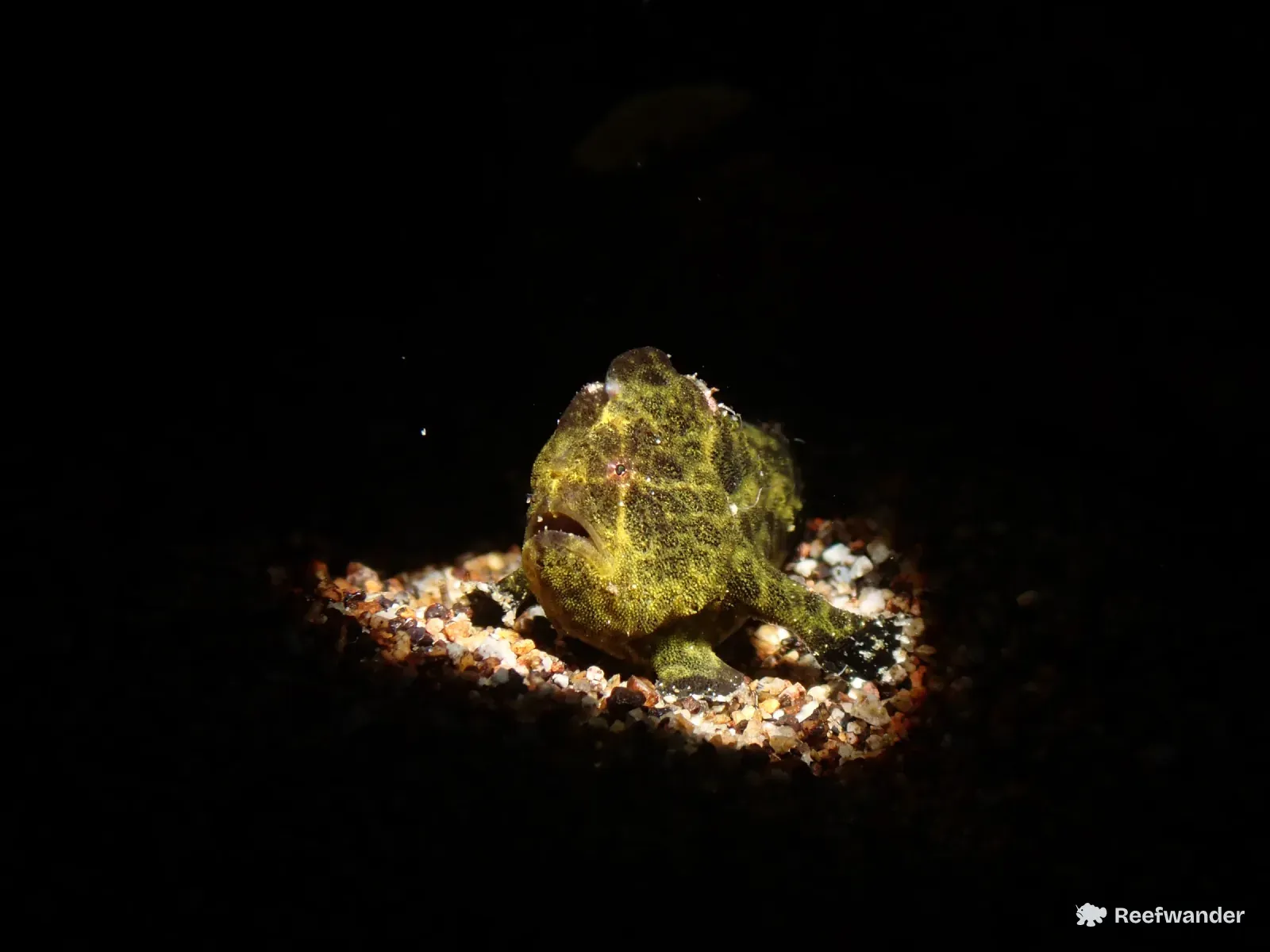
Try a snoot. A snoot is a cone or tube on a strobe or torch that narrows the light to a small circle. Aimed at a frogfish, it lights the fish and a patch of sand and leaves everything else black. The frogfish below was photographed that way on a day dive in Dauin: the black is the snoot, not the night. It separates a camouflaged animal from the background it is built to disappear into, but it takes practice to aim without stirring up the bottom.
Why a frogfish is our mark
Our mark is a frogfish in side profile, walking on its pectoral fins with its rod raised. We chose it because it is an animal that rewards looking twice, and that is the kind of diving we want this site to help with: slow, attentive, and happy to spend a whole dive on one small patch of reef. The photos on this page that carry that mark in the corner are our own: the giant frogfish at the top was photographed off Panglao, and the rest in Dauin.