East Asia · Japan
Okinawa — Cape Maeda & Sunabe
Japan's most-dived site, a limestone cavern lit blue from below
Cape Maeda's Blue Cave is the single most-dived site in Japan: a short limestone cavern where light entering underwater floods the chamber blue, reached by steps down the cliff and busy with divers and snorkellers most days. Twenty minutes south, the Sunabe seawall is the opposite — an unglamorous concrete shore entry that happens to be one of the best macro dives on the island, with mandarinfish, frogfish and nudibranchs. The destroyer USS Emmons lies at 40 m off Kouri.
About diving in Okinawa — Cape Maeda & Sunabe
Diving the main island is a road-trip affair. Shops run minibuses out of Onna and Chatan, and the same site can be dived from shore or off a small boat from a nearby fishing port, which is how operators dodge the worst of the queues. Cape Maeda is best taken early on a weekday, before the tour groups fill the stairway down the cliff. Sunabe works on the opposite logic: parking runs the length of the wall, ladders drop straight in, and divers come and go from dawn until well after dark.
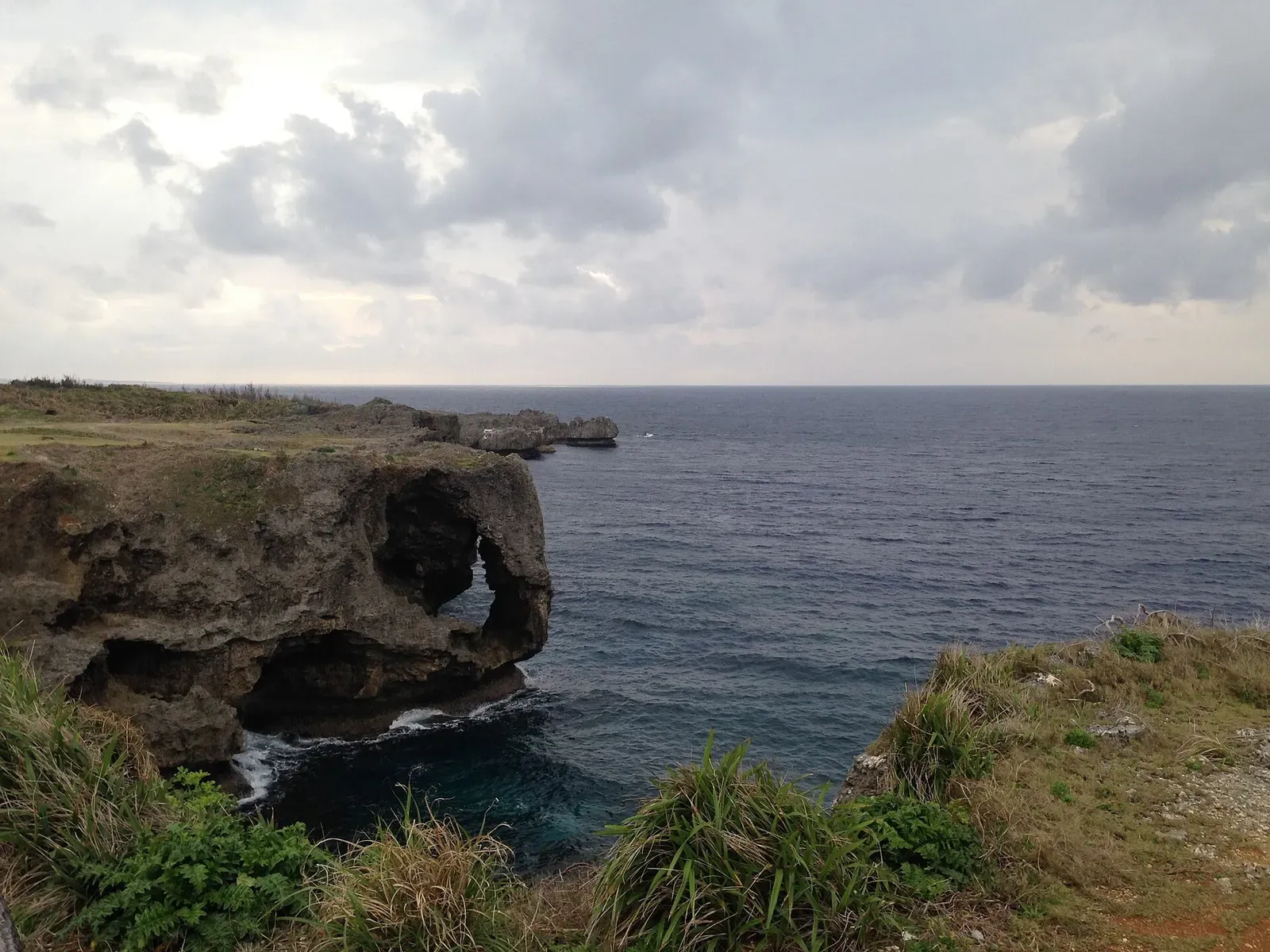
The west coast is raised Ryukyu limestone, and the shoreline carries on underwater as undercuts, cracks and overhangs rather than as reef proper. Maeda is a headland with a shallow shelf that ends in a drop-off, and the cavern is one doorway in that structure rather than the whole of it. Sunabe is the built version of the same idea: seawall rubble, tetrapods and scattered bommies on a gentle slope, and it is exactly that broken ground that makes it hold so much small life.
The range of a single week is the real argument for the island. A cavern in the morning, a slow macro crawl at the seawall in the afternoon and a night dive on the same entry add up to a varied log without chartering anything, while Horseshoe and Onna Point fill the gaps when wind shuts one stretch of coast. The destroyer off Kouri is the exception: struck by kamikaze aircraft in April 1945 and scuttled by American gunfire the following day, it is a dedicated deep charter from the north of the island, booked separately and usually run as a single short dive.
It suits first-timers, families and photographers better than reef purists. Rental gear is everywhere, shops are used to overseas divers, and short drives make it easy to fit diving around a normal holiday; the shallow, low-current sites also forgive anyone coming back after a long lay-off. Divers chasing dense coral or bigger animals will do better on the outer islands, and July through September needs slack in the schedule, since typhoons can shut boats down for days at a stretch.
Best time to dive Okinawa — Cape Maeda & Sunabe
| Jan | Feb | Mar | Apr | May | Jun | Jul | Aug | Sep | Oct | Nov | Dec | |
|---|---|---|---|---|---|---|---|---|---|---|---|---|
| Season | Good | Good | Prime | Prime | Prime | Good | Fair | Fair | Fair | Prime | Prime | Good |
| Sea surface | 22°C72°F | 21°C70°F | 22°C72°F | 23°C73°F | 25°C77°F | 27°C81°F | 29°C84°F | 29°C84°F | 29°C84°F | 27°C81°F | 26°C79°F | 24°C75°F |
| Daytime high | 23°C73°F | 23°C73°F | 23°C73°F | 25°C77°F | 27°C81°F | 29°C84°F | 30°C86°F | 31°C88°F | 30°C86°F | 29°C84°F | 27°C81°F | 24°C75°F |
| Rain | 67 mm2.6 in | 56 mm2.2 in | 87 mm3.4 in | 140 mm5.5 in | 249 mm9.8 in | 295 mm11.6 in | 162 mm6.4 in | 178 mm7.0 in | 146 mm5.7 in | 123 mm4.8 in | 98 mm3.9 in | 74 mm2.9 in |
| Jan | Feb | Mar | Apr | May | Jun |
|---|---|---|---|---|---|
| Good | Good | Prime | Prime | Prime | Good |
| Sea surface | |||||
| 22°C72°F | 21°C70°F | 22°C72°F | 23°C73°F | 25°C77°F | 27°C81°F |
| Daytime high | |||||
| 23°C73°F | 23°C73°F | 23°C73°F | 25°C77°F | 27°C81°F | 29°C84°F |
| Rain | |||||
| 67 mm2.6 in | 56 mm2.2 in | 87 mm3.4 in | 140 mm5.5 in | 249 mm9.8 in | 295 mm11.6 in |
| Jul | Aug | Sep | Oct | Nov | Dec |
|---|---|---|---|---|---|
| Fair | Fair | Fair | Prime | Prime | Good |
| Sea surface | |||||
| 29°C84°F | 29°C84°F | 29°C84°F | 27°C81°F | 26°C79°F | 24°C75°F |
| Daytime high | |||||
| 30°C86°F | 31°C88°F | 30°C86°F | 29°C84°F | 27°C81°F | 24°C75°F |
| Rain | |||||
| 162 mm6.4 in | 178 mm7.0 in | 146 mm5.7 in | 123 mm4.8 in | 98 mm3.9 in | 74 mm2.9 in |
2011–2025 averages. Sea surface: NOAA Coral Reef Watch, measured at the surface, so deeper water can run colder. Daytime high and rain: NASA POWER.
Divable year-round; Mar–Jun and Oct–Nov are calmest, while Jul–Sep is typhoon season and winter northerlies close the west coast.
Best months: March, April, May, October, November
Okinawa water temperature and weather by month
The sea surface runs from 21 °C (70 °F) in February to 29 °C (84 °F) in August. It is 24 °C (75 °F) or warmer from May to December. Most rain falls from April to September, peaking at about 300 mm (12 in) in June; December to February are the driest. Daytime highs reach 31 °C (88 °F) in August and drop to 23 °C (73 °F) in January. The coldest water here is about 21 °C (70 °F), so pack a 5 mm suit.
Dive types & marine life
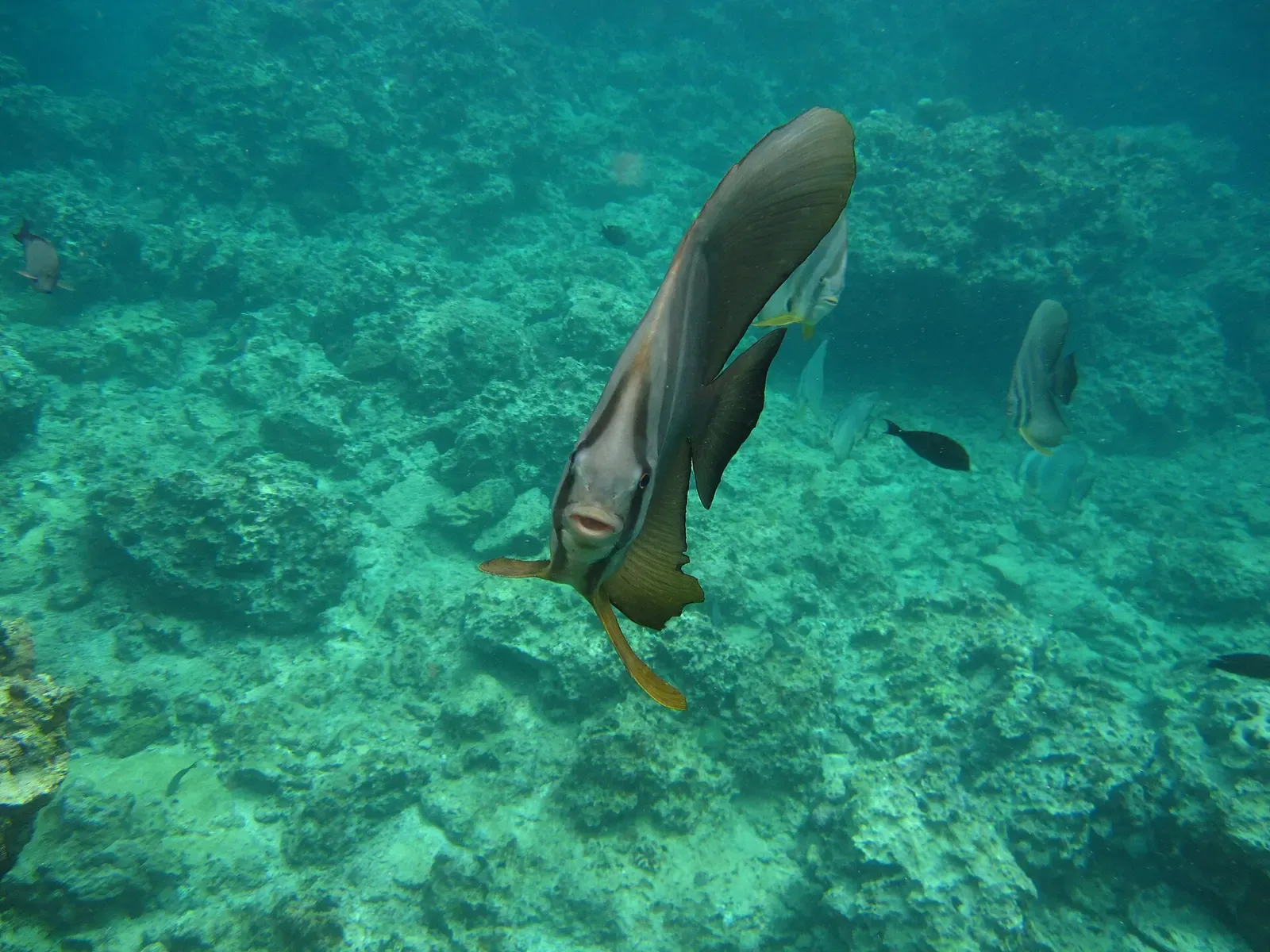
Green turtles feed along the shallow limestone shelf in any month. Nudibranch numbers climb through the cooler winter and spring dives, when Onna Point and the seawall reward a slow pass; frogfish, octopus and cuttlefish are the year-round shore regulars and show best after dark. Pygmy seahorses sit on fans deeper down, easiest in the calm spring and late-autumn windows.
- Cave & cavern
- Reef
- Muck & macro
- Wreck
- Night
- Wall
- Sea turtles
- Nudibranchs
- Macro critters
- Octopus & cuttlefish
- Frogfish
- Mandarinfish
- Reef fish swarms
- Pygmy seahorses
Best dive sites in Okinawa — Cape Maeda & Sunabe
Cave & cavern
A half-flooded limestone tunnel with 5–8 m of water inside
A drop-off from 5 m to 40 m outside the cave everyone queues for
A wall to 40 m off a 5 m reef, with a double arch at 20 m
Channel & pass
A maze of channels and arches running seaward from 3 m
Reef
Stair entries onto soft coral, 5 to 20 m, day and night
Wreck
A 106 m destroyer on her side at 34-46 m, sunk off Kouri in 1945
How to get to Okinawa — Cape Maeda & Sunabe
Naha Airport takes flights from across Japan and much of East Asia, and a rental car is close to essential since the monorail covers only Naha and Urasoe. Most divers base in Onna village for Cape Maeda or in Chatan for the Sunabe wall, both within about an hour up the west coast. Boats leave from small local ports rather than a central marina.
Photos from Okinawa — Cape Maeda & Sunabe
François Michonneau · CC BY 3.0
Patrick Randall · CC BY 2.0
B. P. White · CC BY-SA 4.0
B. P. White · CC BY-SA 4.0
Dive videos
Blue Cave, Nudibranchs and More!・Maeda Point・Okinawa · Okinawa Island Diver on YouTube
Diving the USS Emmons in Okinawa, Japan · Adventure Jim on YouTube
Photo credits
- A grey sea cucumber resting among coral rubble on the reef at Cape Maeda by François Michonneau, CC BY 3.0, via Wikimedia Commons
- A small translucent bottletail squid hovering over dark sand at Maeda Flats by Patrick Randall, CC BY 2.0, via Wikimedia Commons
- A banded sea snake swimming over a coral reef with small fish in the background by B. P. White, CC BY-SA 4.0, via Wikimedia Commons
- A hermit crab with electric-blue banded legs gripping a shell beside a cleaner shrimp by B. P. White, CC BY-SA 4.0, via Wikimedia Commons
Embed
Run a dive centre, club or blog? Embed this map of 6 dive sites near Okinawa on your own page.
In The Logbook
- Deep wreck diving: where recreational stopsWrecks · 8 min read
- Cavern and cenote diving without cave trainingCaves & caverns · 8 min read
- WWII wrecks you can dive, by theatreWrecks · 7 min read
- The best shore dives in the worldShore diving · 8 min read
Similar destinations
East Asia
Amami Ōshima
Japan
Pufferfish sculpt two-metre geometric nests into the sand at 25 m

Shore-entry coral slopes at the warm southern tip of Taiwan

The world's northernmost table coral reef, growing at 33° north


Japan's macro heartland on a sand slope three hours from Tokyo