What makes a great shore dive
A boat dive is organised around the boat: its schedule, its mooring, its briefing, its other divers. A shore dive is organised around you. You choose the time, the pace and the turn-around, you can dive the same reef at dawn and again after dark, and a week of shore diving costs a fraction of a week of boat diving. That freedom is why Bonaire, Dahab and Tulamben have whole dive cultures built on walking in.
The trade is that the sea meets the land somewhere, and that somewhere has to be manageable in twenty kilos of kit. The great shore dives share a few things: an entry that works at most states of tide, a reef or a wreck within a short surface swim, and depth you can choose rather than depth that chooses you. The ones below are the sixty in our guides that best fit that description, grouped by region. Each links to its own page, where the entry is described, the hazards are listed and the sources are given.
Red Sea and Mediterranean
The Sinai town of Dahab is the shore-diving capital of the Red Sea, and its sites are a graded course in what shore diving can be. Eel Garden and The Islands are easy walk-ins onto garden eels and a lagoon full of juvenile barracuda; The Canyon is a fissure that opens at 18 m (60 ft) onto a chamber floor at 30, an overhead dive walked in through a lagoon; and the Blue Hole is the most famous shore dive in the world, a 100 m sinkhole cut into the fringing reef whose Arch at 55 m has a fatality record nobody should add to. Dived along its rim it is a beautiful, easy site; it is the Arch that kills.
Across the gulf, Eilat has a fenced reef reserve you walk into for a small admission fee, the coral canyons of Japanese Gardens running out to a wall that keeps dropping, and a scuttled missile boat, the Satil, at 18 to 24 m. In Jordan, Aqaba has stacked its best dives within a surface swim of the beach: the Cedar Pride lies on her side across two reefs 130 m out, the Japanese Garden slope has black coral below 20 m, and King Abdullah Reef packs fusiliers into the shallows above a gorgonian forest at 21 m. And at Abu Dabbab Bay on the Egyptian coast, two of the seven dugongs known on the Red Sea coast graze the seagrass in a bay entered from the sand.
The Mediterranean’s shore diving is built on limestone. Gozo’s Blue Hole and Inland Sea are both entered on foot at Dwejra, one a collapsed sea cave with an archway to open water, the other a lagoon draining through an 80 m tunnel in the cliff, and Malta’s Um El Faroud is a 115 m tanker at 28 to 35 m reached from the rocks at Wied iż-Żurrieq. Mononaftis puts barracuda over a reef 50 m off a Cretan beach.
| Site | Depth | Level | Best months |
|---|---|---|---|
| Blue Hole Dahab · Egypt | 6–40 m | Advanced | Apr–May |
| The Canyon Dahab · Egypt | 18–30 m | Advanced | Apr–May |
| Eel Garden Dahab · Egypt | 9–18 m | Beginner | Apr–May |
| The Islands Dahab · Egypt | 7–20 m | Beginner | Apr–May |
| Coral Beach Nature Reserve Eilat · Israel | 4–6 m | Beginner | Mar–May |
| Japanese Gardens Eilat · Israel | 8–16 m | Intermediate | Mar–May |
| Satil Eilat · Israel | 18–24 m | Intermediate | Mar–May |
| Cedar Pride Wreck Aqaba · Jordan | 10–27 m | Advanced | May–Sep |
| Japanese Garden Aqaba · Jordan | 2–20 m | Beginner | May–Sep |
| King Abdullah Reef Aqaba · Jordan | 5–23 m | Beginner | May–Sep |
| Abu Dabbab Bay Marsa Alam & Port Ghalib · Egypt | 4–24 m | Beginner | Mar–May |
| Blue Hole & Inland Sea Malta & Gozo · Malta | 10–30 m | Intermediate | Jun–Sep |
| Um El Faroud Malta & Gozo · Malta | 28–35 m | Advanced | Jun–Sep |
| Mononaftis Crete · Greece | 18–28 m | Intermediate | Jun–Oct |
Caribbean and Atlantic
Bonaire is the island that made shore diving a holiday. The whole leeward coast is a marine park, the sites are marked with painted yellow stones on the roadside, and you rent a truck and a tank rack rather than book a boat. 1000 Steps is the postcard: 72 concrete steps down to a reef that tips over into a wall at 9 m, and 72 steps back up with a full set on. Salt Pier is the shallow one, fish schooling in the shade under a working pier, closed whenever a ship is loading. The Hilma Hooker is a 72 m freighter on the sand at 30 m, a surface swim from the road. Curaçao has the same culture in miniature at Playa Kalki and the Tugboat, a sunken tug in 5 m of water straight off the beach.
Grand Cayman’s Eden Rock is a shore dive in the middle of George Town, coral cut through with long tunnels full of tarpon at an average depth of 6 m. On St Croix, Cane Bay Wall is the rare wall you can swim to from a beach: sand chutes run out to a lip at 12 m where the reef ends and the bottom falls past 975 m, and Frederiksted Pier is a 7 m pier dive that photographers run day and night. Dominica’s Champagne Reef is a reef in 4 m of water where volcanic vents send streams of warm bubbles up through the seabed.
Florida’s Blue Heron Bridge is the most-photographed macro site in North America, and it is under a road bridge in 2 to 6 m of water, dived in the hour either side of high tide. In the Canaries, Playa Chica puts a drop-off at 15 to 18 m within reach of a town beach, and Tenerife’s Radazul is a walk-in that reaches 40 m a short swim out.
| Site | Depth | Level | Best months |
|---|---|---|---|
| 1000 Steps Bonaire · Caribbean Netherlands | to 40 m | Advanced | Dec–Apr |
| Salt Pier Bonaire · Caribbean Netherlands | to 18 m | Beginner | Dec–Apr |
| Hilma Hooker Bonaire · Caribbean Netherlands | to 30 m | Advanced | Dec–Apr |
| Playa Kalki Curaçao · Curaçao | 5–30 m | Intermediate | Dec–Apr |
| Tugboat Curaçao · Curaçao | to 5 m | Beginner | Dec–Apr |
| Eden Rock Grand Cayman · Cayman Islands | to 14 m | Beginner | Dec–Apr |
| Cane Bay Wall St. Croix · U.S. Virgin Islands | 8–12 m | Beginner | Dec–May |
| Frederiksted Pier St. Croix · U.S. Virgin Islands | to 7 m | Beginner | Dec–May |
| Champagne Reef Dominica · Dominica | to 4 m | Beginner | Dec–Mar |
| West Bridge Span Blue Heron Bridge · United States | 1.5–6 m | Beginner | Apr–Aug |
| Playa Chica Lanzarote & Museo Atlántico · Spain | 15–21 m | Intermediate | Jun–Oct |
| Radazul Tenerife · Spain | to 40 m | Intermediate | Jun–Oct |
Indo-Pacific
Bali’s USAT Liberty is the best-known shore dive in Asia: a 125 m American cargo ship, torpedoed in 1942 and beached, pushed into the sea by the 1963 eruption of Mount Agung, and now lying broken along a slope from 5 to 30 m about 30 m out from a beach of smooth stones. It gets a hundred divers a day in high season, which is the argument for diving it at dawn, and the Coral Garden a few hundred metres along the shore is where the crowd is not; Seraya Secrets, a black-sand slope at 10 m with mimic octopus and frogfish, is Bali’s answer to Lembeh, walked in from the beach.
The Philippines has the walk-in that produces the single most extraordinary sight in shore diving: at Panagsama on Cebu, a school of more than a million sardines holds against a drop-off 20 to 30 m out from the dive shops, shallow enough that most of it happens above 18 m. Dauin down the coast on Negros is the shore-diving muck capital of the Philippines: a run of black-sand slopes walked into from the resorts, where Pyramids can produce three or four frogfish colour morphs on one dive, Masaplod Muck has mandarinfish spawning in the last light, Dauin Sur holds Coleman shrimp on fire urchins, San Miguel and Atmosphere mix tyre reefs and bommies with the critters, and The Cars puts two sunken cars at 24 to 28 m for the deeper end of a shore day. In Sabah, the Kapalai House Reef has resident turtles around an old wooden wreck on the slope, and Indonesia’s Wakatobi House Reef is the model resort reef: a seagrass flat that ends at a drop-off 80 m off the beach, diveable without limit from the jetty ladder.
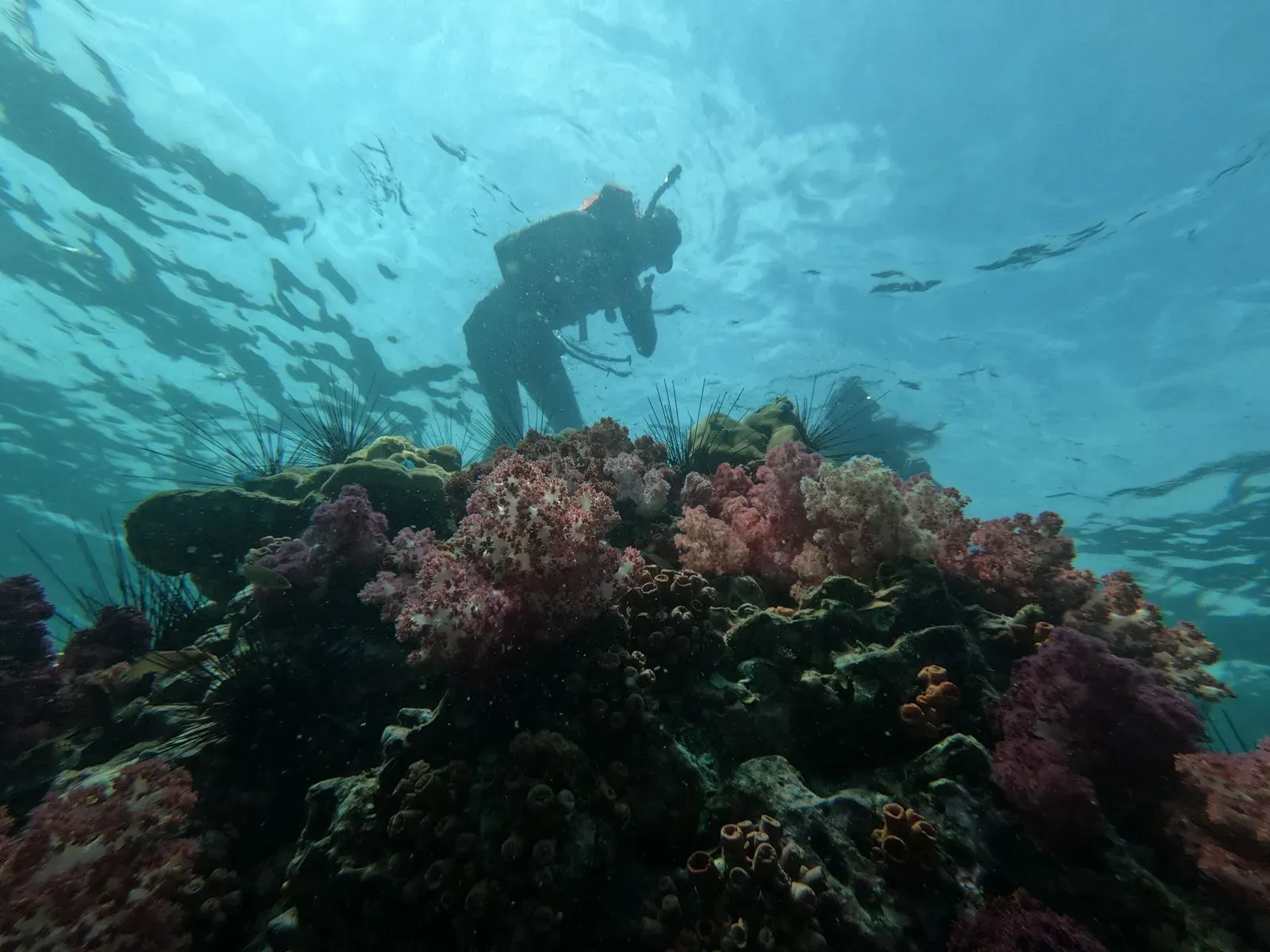
Okinawa’s Blue Cave is a half-flooded limestone tunnel at Cape Maeda with 5 to 8 m of water inside, entered down a public stairway, the drop-off outside the cave at Cape Maeda Point runs from 5 to 40 m, and the Sunabe Seawall has stair entries onto soft coral from 5 to 20 m. Australia’s Navy Pier is a working naval jetty dived on regulated trips, with wobbegongs, grey nurse sharks and whitetips under it in 10 m of murky water; Osprey Bay up the coast is a 3 to 7 m reef with a campground on the dune behind it; and Old Rapid Bay Jetty in South Australia holds a resident population of leafy seadragons under its pylons. Hawai’i’s Two Step is entered down two carved lava steps into turtle canyons. And two of the biggest shipwrecks in the Pacific are shore dives: the bow of the SS President Coolidge in Vanuatu, at 21 m, and Bonegi I on Guadalcanal, a Japanese transport whose bow is a short swim from the sand.
| Site | Depth | Level | Best months |
|---|---|---|---|
| USAT Liberty Wreck Tulamben · Indonesia | 5–30 m | Intermediate | May–Oct |
| Coral Garden Tulamben · Indonesia | 10–25 m | Beginner | May–Oct |
| Seraya Secrets Tulamben · Indonesia | to 10 m | Advanced | May–Oct |
| Panagsama House Reef (Sardine Run) Moalboal · Philippines | to 18 m | Beginner | Apr–Jun |
| Pyramids Dauin · Philippines | 10–20 m | Beginner | Apr–May |
| Masaplod Muck Dauin · Philippines | to 15 m | Beginner | Apr–May |
| Dauin Sur Dauin · Philippines | to 18 m | Beginner | Apr–May |
| San Miguel Dauin · Philippines | to 20 m | Beginner | Apr–May |
| Atmosphere Dauin · Philippines | 8–22 m | Intermediate | Apr–May |
| The Cars Dauin · Philippines | 24–28 m | Intermediate | Apr–May |
| Kapalai House Reef Mabul & Kapalai · Malaysia | 5–16 m | Beginner | Mar–Oct |
| House Reef Wakatobi · Indonesia | 2–40 m | Intermediate | Jul–Sep |
| Blue Cave Okinawa · Japan | 5–15 m | Beginner | Mar–May |
| Cape Maeda Point Okinawa · Japan | 5–40 m | Intermediate | Mar–May |
| Sunabe Seawall Okinawa · Japan | 5–20 m | Beginner | Mar–May |
| Flying Fish Cove Christmas Island · Australia | to 20 m | Beginner | May–Sep |
| Navy Pier Ningaloo Reef · Australia | 0–10 m | Advanced | Apr–Sep |
| Osprey Bay Ningaloo Reef · Australia | 3–7 m | Beginner | Apr–Sep |
| Old Rapid Bay Jetty Rapid Bay · Australia | to 9 m | Intermediate | Dec–Mar |
| Two Step (Honaunau Bay) Kona · United States | 3–12 m | Intermediate | Dec–Apr |
| The Bow Espiritu Santo · Vanuatu | to 21 m | Intermediate | Apr–Nov |
| Bonegi I Iron Bottom Sound · Solomon Islands | to 55 m | Intermediate | Apr–Jun |
| Gab Gab Reef Guam · Guam | 3–37 m | Intermediate | Dec–May |
Cold water
Cold-water shore diving is where the discipline started, and it still has the sites. California’s La Jolla Shores is a protected beach entry onto sand that holds leopard sharks, rays and guitarfish, with a submarine canyon close enough inshore that freedivers use it for depth training; La Jolla Cove next door has sea lions in the kelp. Casino Point Dive Park was the first non-profit underwater park in the United States and is entered down concrete steps. Seattle’s Cove 2 is a straight walk-in onto a slope of logs, pilings and sunken boats decorated with Pacific Northwest life, and Point Lobos — Whalers Cove at Point Lobos is a 77 m wall off a cove boat ramp.
Iceland’s Silfra is a fissure between the North American and Eurasian plates, filled with glacial water filtered through lava for decades and clear past 100 m; you walk 100 m from the car park to a metal staircase and drop into 2 °C water where both walls are within reach at once. Scotland’s Cathedral Rock is a double archway 50 m off the shore at St Abbs, dived at slack high water. In Norway, the destroyer Hermann Künne is a Second World War warship reached from the beach. The Netherlands’ Bergse Diepsluis is where Dutch divers go for spring cuttlefish in water with almost no current. And at the bottom of Africa, Windmill Beach is the easy walk-in into the Cape kelp forest, while Miller's Point has one of the largest known aggregations of sevengill sharks in a sheltered cove.
| Site | Depth | Level | Best months |
|---|---|---|---|
| La Jolla Shores La Jolla Cove & Canyon · United States | to 12 m | Beginner | Jul–Oct |
| La Jolla Cove La Jolla Cove & Canyon · United States | to 14 m | Beginner | Jul–Oct |
| Casino Point Dive Park Catalina Island · United States | to 18 m | Beginner | Jul–Oct |
| Cove 2 Puget Sound · United States | to 40 m | Intermediate | Oct–Feb |
| Point Lobos — Whalers Cove Monterey Bay · United States | 9–21 m | Intermediate | Sep–Oct |
| Silfra Big Crack Silfra · Iceland | 0.5–18 m | Intermediate | May–Sep |
| Cathedral Rock St Abbs & Eyemouth · United Kingdom | 3–18 m | Intermediate | Jun–Sep |
| Hermann Künne Narvik · Norway | 0–40 m | Intermediate | Jun–Aug |
| Bergse Diepsluis Zeeland · Netherlands | to 19 m | Beginner | Apr–Jun |
| Windmill Beach Cape Peninsula Kelp Forests · South Africa | to 8 m | Beginner | Nov–Jun |
| Miller's Point Cape Peninsula Kelp Forests · South Africa | to 8 m | Intermediate | Nov–Jun |
Shore diving, done well
The hazards of shore diving are not the ones that fill the incident reports for boat diving. They are entries and exits, tides, surf and the walk. A few habits cover most of them.
Look at the exit before you commit to the entry. The 72 steps at 1000 Steps are easy going down and long coming up; the lava steps at Two Step are dangerous when a south swell is running over them; Cathedral Rock is a slack-water dive only. If the exit looks marginal before the dive, it will be worse after it, tired and heavier.
Plan around the tide, not around your air. Blue Heron Bridge is a one-hour window either side of high tide; Wakatobi’s outer slope runs hard between slack waters; the Blue Cave at Cape Maeda closes in bad weather and the cape publishes the day’s sea state. Sites with a surface swim are far easier on a rising tide.
Set a turn depth on the beach. Almost every good shore dive has a wall or a slope that keeps going: Cane Bay past 975 m, Bonegi I to 55 m, Cove 2 past 40 m, the Panagsama drop-off to 70. Nothing stops a descent except the decision you made before you got wet.
Carry a flag and a marker. In Florida a divers-down flag is the law; in Dahab and Bonaire it is simply how you avoid the boats.


