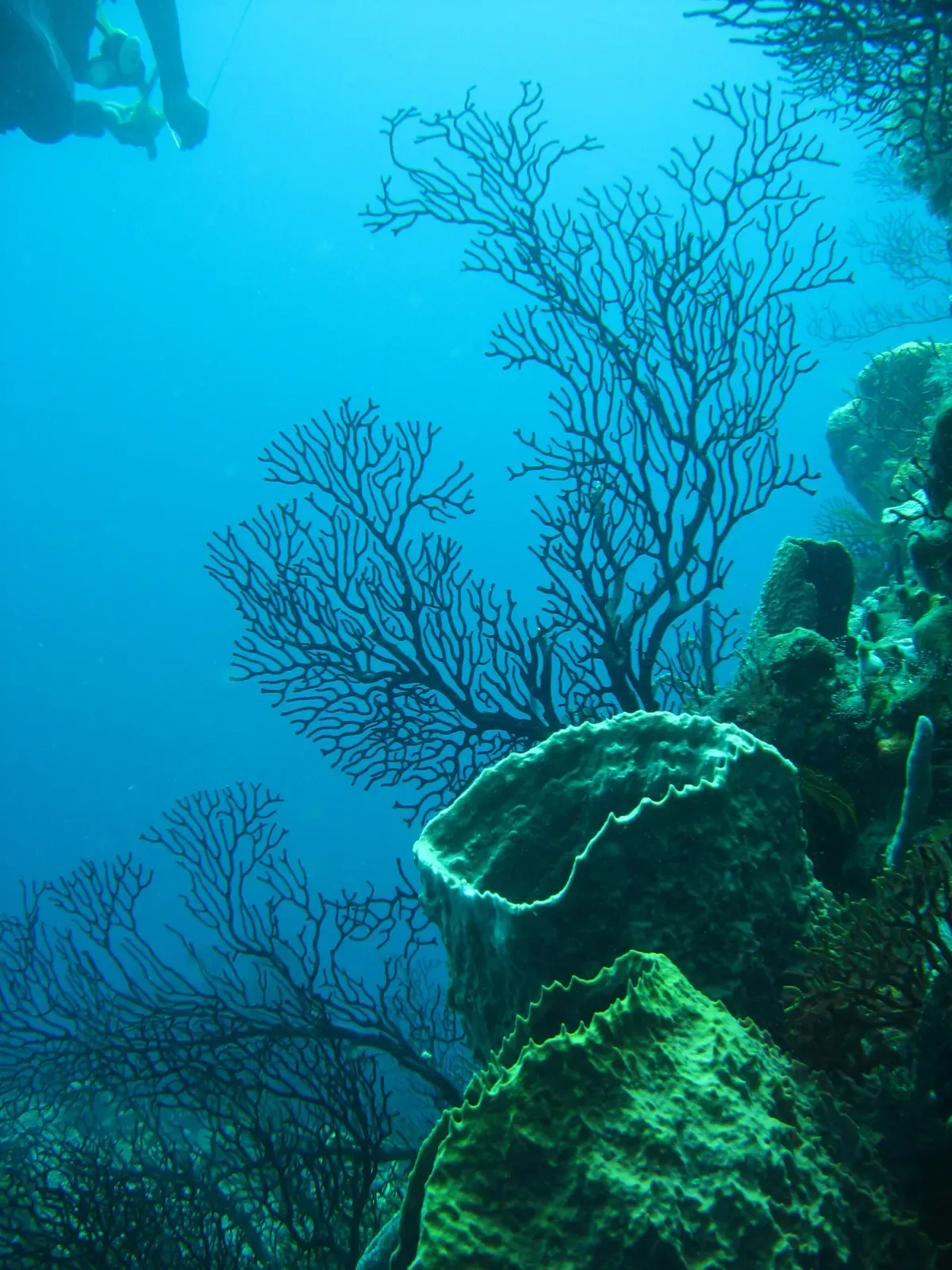
St. Lucia's diving centers on the Piton Marine Reserve, where the volcanic slopes of the Pitons continue underwater as coral-covered walls draped in orange and purple soft corals. Anse Chastanet's house reef starts steps from the beach, and the wreck of the Lesleen M, sunk deliberately as an artificial reef, sits upright in shallow water nearby.
About diving in St. Lucia
Almost all the diving sits on the leeward west coast, and it is boat-led but undemanding: centres work off the waterfront, moorings are minutes away, and two-tank mornings are the standard shape of a day. The Soufriere Marine Management Area zones the southern sites, holds boats on fixed moorings and charges divers a fee collected through the shops. Operators up at Rodney Bay run a long way south to reach the same water, so divers set on the Piton sites usually stay in Soufriere.
The profile underwater is a steep slope rather than a sheer face, with coral and sponge over volcanic rock and sand chutes cutting down between the ridges. Sites separate by how much water moves across them: the bays shelve gently and collect sand, rubble and small subjects, while exposed points are run as one-way passes with the boat following your bubbles. A couple of resort beaches also let you get in without a boat at all.
The strength is shallow colour. Most of the growth sits above thirty metres where light is still strong, which is forgiving for photographers and for divers still working on air consumption. Nothing demands a deep profile, so surface intervals stay short and repetitive diving is easy. That makes it a workable base for training weeks, first dives after certification and mixed-ability groups. Divers travelling for pelagic encounters or a long wreck list will find the menu short.
Best time to dive St. Lucia
| Jan | Feb | Mar | Apr | May | Jun | Jul | Aug | Sep | Oct | Nov | Dec | |
|---|---|---|---|---|---|---|---|---|---|---|---|---|
| Season | Prime | Prime | Prime | Prime | Good | Good | Fair | Fair | Fair | Fair | Fair | Prime |
| Sea surface | 27°C81°F | 27°C81°F | 27°C81°F | 27°C81°F | 28°C82°F | 28°C82°F | 28°C82°F | 29°C84°F | 29°C84°F | 29°C84°F | 29°C84°F | 28°C82°F |
| Daytime high | 28°C82°F | 28°C82°F | 28°C82°F | 29°C84°F | 29°C84°F | 29°C84°F | 30°C86°F | 30°C86°F | 30°C86°F | 30°C86°F | 29°C84°F | 29°C84°F |
| Rain | 41 mm1.6 in | 30 mm1.2 in | 33 mm1.3 in | 63 mm2.5 in | 65 mm2.6 in | 76 mm3.0 in | 87 mm3.4 in | 113 mm4.4 in | 93 mm3.7 in | 109 mm4.3 in | 112 mm4.4 in | 55 mm2.2 in |
| Jan | Feb | Mar | Apr | May | Jun |
|---|---|---|---|---|---|
| Prime | Prime | Prime | Prime | Good | Good |
| Sea surface | |||||
| 27°C81°F | 27°C81°F | 27°C81°F | 27°C81°F | 28°C82°F | 28°C82°F |
| Daytime high | |||||
| 28°C82°F | 28°C82°F | 28°C82°F | 29°C84°F | 29°C84°F | 29°C84°F |
| Rain | |||||
| 41 mm1.6 in | 30 mm1.2 in | 33 mm1.3 in | 63 mm2.5 in | 65 mm2.6 in | 76 mm3.0 in |
| Jul | Aug | Sep | Oct | Nov | Dec |
|---|---|---|---|---|---|
| Fair | Fair | Fair | Fair | Fair | Prime |
| Sea surface | |||||
| 28°C82°F | 29°C84°F | 29°C84°F | 29°C84°F | 29°C84°F | 28°C82°F |
| Daytime high | |||||
| 30°C86°F | 30°C86°F | 30°C86°F | 30°C86°F | 29°C84°F | 29°C84°F |
| Rain | |||||
| 87 mm3.4 in | 113 mm4.4 in | 93 mm3.7 in | 109 mm4.3 in | 112 mm4.4 in | 55 mm2.2 in |
2011–2025 averages. Sea surface: NOAA Coral Reef Watch, measured at the surface, so deeper water can run colder. Daytime high and rain: NASA POWER.
December to May is the dry season, and January to April is the settled heart of it and the island's busiest time for visitors. The water is at its coolest then, averaging about 27 °C in February. May is still dry and quieter. June to November is the wet season, and it overlaps the Atlantic hurricane season, with September and October carrying the greatest storm risk. Storms do reach the island: Beryl caused damage at the end of June 2024. The sea warms through the wet months to about 30 °C in September. Because nearly all the diving is on the sheltered west coast around Soufrière, the calendar changes the odds of a lost day more than the character of the diving.
Best months: January, February, March, April, December
St. Lucia water temperature and weather by month
The sea surface stays between 27 and 29 °C (81–84 °F) all year. Most rain falls from June to November, peaking at about 110 mm (4.3 in) in August; January to March are the driest. Daytime highs sit around 29 °C (84 °F) all year. The coldest water here is about 26 °C (79 °F), so pack a 3 mm full suit.
Dive types & marine life
Turtles and barracuda are the constants, with eagle rays over the sand patches and reef sharks on the deeper slopes now and then rather than reliably. The macro life holds up all year, frogfish included, and it is easiest to work through the settled December-to-April months when the water is at its steadiest.
- Wall
- Reef
- Wreck
- Drift
- Sea turtles
- Eagle rays
- Frogfish
- Macro critters
- Reef sharks
- Barracuda
Best dive sites in St. Lucia
- 1
Anse Chastanet Reef
House reef steps from the beach: a plateau from 5 m falling past 40 m, with over 150 fish species.
- 2
Superman's Flight
Gentle drift along the flank of Petit Piton, named for the Superman II cliffs above and the push of the current.
- 3
Fairyland
Current-swept headland plateau at 12 to 18 m whose sponges and corals stay clean and bright; turtles common.
- 4
Keyhole Pinnacles
Four volcanic peaks rising to within a few feet of the surface, crusted in black and orange gorgonians.
- 5
Coral Gardens
Five-finger coral and juvenile fish from 5 to 27 m at the foot of Gros Piton; good for snorkellers too.
- 6
Piton Wall
A cliff under Petit Piton that keeps falling far below diving depth, hung with sea whips and soft corals.
- 7
Lesleen M
A 51 m freighter sunk on an even keel in 1986, 9 m to the deck and 20 m at the sand; an easy first wreck.
- 8
Turtle Reef
Crescent reef beside turtle-grass beds from 12 m, where hawksbill and green turtles are likely.
Site guides
Coral in 6 m a short swim off the beach, wall to 43 m
From 1.5 m to 18 m over coral, boulders and sand
Reef, boulders, walls and pinnacles inside 12 m
A sloping wall dived between 18 m and 34 m
Reef
Five-finger coral from 5 m down, under Gros Piton
Reef
Drift over a 12 m to 18 m plateau, then the drop
Reef
A shallow terrace running out to a gorgonian wall lip
Wreck
A 1986 artificial-reef freighter lying in 20 m of bay
Finger coral with valleys, a tunnel and a chimney
Wreck
A salvaged sand barge sunk as a reef, 21 m to 30 m
Reef
Crescent reef beside turtle grass, from 12 m down
Reef
Barrel sponges and brain coral under the memorial cross
How to get to St. Lucia
Long-haul flights use Hewanorra at Vieux Fort in the south, roughly an hour from Soufriere by road; regional hops land at George F. L. Charles beside Castries. Soufriere is the base for the Piton sites, reachable by road or water taxi, while Rodney Bay in the north suits divers mixing in other plans. Shore entries and day boats only.
Photos from St. Lucia
Martin Tuchscherer · CC BY-SA 3.0
Don Loarie · CC BY 4.0
James Telford · CC BY 4.0
Shawn from Airdrie, Canada · CC BY-SA 2.0
Dive videos
First Scuba Dives At ANSE CHASTANET In ST LUCIA! · Blue Horizon Diving on YouTube
Wreck Diving The Lesleen M In St Lucia · Blue Horizon Diving on YouTube
Questions divers ask
Where is the best diving in St. Lucia?+
Around Soufrière on the south-west coast, inside the Soufrière Marine Management Area, where the Pitons drop into the sea as walls and slopes. Anse Chastanet, Superman's Flight, Keyhole Pinnacles and Coral Gardens are all there. The north, around Rodney Bay and Pigeon Island, has shallower and simpler sites.
Do divers pay a marine park fee in St. Lucia?+
Yes. Diving inside the Soufrière Marine Management Area carries a daily entrance fee, and dive boats tie up to the reserve's moorings rather than anchoring. The coast is divided into zones, including marine reserves where fishing is banned and activities are regulated.
Is St. Lucia good for beginner divers?+
Yes. Most sites suit Open Water divers, the reef at Anse Chastanet starts a few metres off the beach, and the Lesleen M sits upright in 20 m as an easy first wreck. The Daini Koyomaru, a 75 m dredger on its side at 33 m, is for advanced divers only.
How warm is the sea in St. Lucia?+
Warm all year. Monthly averages run from about 27 °C in February to about 30 °C in September, so the warmest water arrives in the middle of the wet season.
Which airport is closest to the dive sites in St. Lucia?+
Hewanorra International near Vieux Fort, in the south, takes the flights from Europe and North America and is the nearer airport for Soufrière; the northern resort areas are 1 to 1.5 hours from it by road. From Soufrière, water taxis run to Anse Chastanet.
Sources
- Diving in Saint Lucia — Saint Lucia Tourism Authority
- Diving — Scuba St. Lucia
- Diving in the Soufrière marine reserve — EnezGreen
- Saint Lucia — Wikipedia
- Saint Lucia — Wikivoyage
- Soufrière water temperature — World Sea Temperatures
Photo credits
- Petit Piton towering over the palm-lined beach and huts of Anse Chastanet, St. Lucia, seen from the water. by Martin Tuchscherer, CC BY-SA 3.0, via Wikimedia Commons
- A diver's fins beside a black sea fan and barrel sponges on a coral wall near Soufrière, St. Lucia. by WRI Staff, CC BY 2.0, via Wikimedia Commons
- A yellow-striped smallmouth grunt hovering beside a coral head off St. Lucia. by Don Loarie, CC BY 4.0, via Wikimedia Commons
- A furry sea cucumber resting on the sandy seafloor off St. Lucia. by James Telford, CC BY 4.0, via Wikimedia Commons
- A dive boat anchored off the black-sand beach at Anse Chastanet, St. Lucia. by Shawn from Airdrie, Canada, CC BY-SA 2.0, via Wikimedia Commons
Embed
Run a dive centre, club or blog? Embed this map of 12 dive sites near St. Lucia on your own page.
In The Logbook
- Where to dive with sea turtlesBig animals · 15 min read
- Ships sunk on purpose, and where to dive themWrecks · 14 min read
- Bioluminescence: why the sea glows at nightNight diving · 7 min read
- Night diving: the best night dives in the worldNight diving · 12 min read
- Your first wreck dive: what to expect and whereFirst dives · 6 min read
Similar destinations

Lava flows, old wreck sites and night turtles in a marine park

Shore and boat reefs, plus wrecks from a shallow tug to a harbour-mouth hull

Swim off a beach onto a wall that drops past 900 metres


.jpg)
Hand-feed wild stingrays in chest-deep water, then drop over a sheer wall the same day