
Coral Triangle · Philippines
Tubbataha Reefs
Sheer mid-ocean walls hold schooling hammerheads and grey reef sharks.
Tubbataha Reefs Natural Park, a UNESCO World Heritage site in the middle of the Sulu Sea, consists of two atoll-like reef systems roughly 150 kilometers from the nearest inhabited coast, accessible only by liveaboard during a short annual window. Walls plunge from the surface into deep blue water thick with grey reef sharks, schooling hammerheads, and passing manta rays, over some of the clearest, least-fished water remaining in the Philippines. Park rangers live aboard a station in the atoll year-round.
About diving in Tubbataha Reefs
The trip is the dive schedule. Boats board in Puerto Princesa and cross overnight, and from the moment you wake there is nothing on the horizon but reef flat, a stilted ranger station and other liveaboards. Diving runs off tenders that drop groups on the reef and collect them wherever the current has left them, three or four times a day plus a night dive where the park allows one. Nothing is flexible: no shore option, no sites outside the park, no bad-weather plan beyond moving to a lee side.
The park is three separate reefs rather than one. The two atolls each enclose a shallow lagoon behind a rim that is dived from the outside, and the wall changes character as you work around it, sheer and undercut in places, stepped with a shelf before the drop in others, and cut by sandy chutes where turtles settle. Jessie Beazley sits well to the north and is a detour the boat makes only when the crossing and the forecast allow. Corners and points are where the water accelerates and the schools stack up.
Most dives take the same shape: a negative entry through the surface chop, a drop to the reef edge, then a drift with the wall on one shoulder and open water on the other. Much of the dive is spent facing away from the coral, watching the blue. Current decides which sites run on which day, and briefings deal mostly with where to hold position and where to shelter rather than where to swim. Everyone carries an SMB, because the tender collects you wherever you surface.
The window is short. Diving runs from around mid-March to mid-June, when the monsoons trade places and the Sulu Sea settles; March can still be unsettled and June starts to break down, so the middle of the window is what fills first. It is not a place to learn on, either: safety stops hang in blue water with no line and no bottom in sight, and holding depth in moving water is assumed rather than taught.
Best time to dive Tubbataha Reefs
| Jan | Feb | Mar | Apr | May | Jun | Jul | Aug | Sep | Oct | Nov | Dec | |
|---|---|---|---|---|---|---|---|---|---|---|---|---|
| Season | Off-season | Off-season | Fair | Prime | Prime | Good | Off-season | Off-season | Off-season | Off-season | Off-season | Off-season |
| Sea surface | 28°C82°F | 28°C82°F | 28°C82°F | 29°C84°F | 30°C86°F | 30°C86°F | 30°C86°F | 29°C84°F | 30°C86°F | 29°C84°F | 29°C84°F | 29°C84°F |
| Daytime high | 29°C84°F | 28°C82°F | 29°C84°F | 30°C86°F | 30°C86°F | 30°C86°F | 29°C84°F | 29°C84°F | 29°C84°F | 29°C84°F | 30°C86°F | 29°C84°F |
| Rain | 113 mm4.4 in | 64 mm2.5 in | 61 mm2.4 in | 65 mm2.6 in | 128 mm5.0 in | 215 mm8.5 in | 247 mm9.7 in | 199 mm7.8 in | 223 mm8.8 in | 218 mm8.6 in | 169 mm6.7 in | 144 mm5.7 in |
| Jan | Feb | Mar | Apr | May | Jun |
|---|---|---|---|---|---|
| Off-season | Off-season | Fair | Prime | Prime | Good |
| Sea surface | |||||
| 28°C82°F | 28°C82°F | 28°C82°F | 29°C84°F | 30°C86°F | 30°C86°F |
| Daytime high | |||||
| 29°C84°F | 28°C82°F | 29°C84°F | 30°C86°F | 30°C86°F | 30°C86°F |
| Rain | |||||
| 113 mm4.4 in | 64 mm2.5 in | 61 mm2.4 in | 65 mm2.6 in | 128 mm5.0 in | 215 mm8.5 in |
| Jul | Aug | Sep | Oct | Nov | Dec |
|---|---|---|---|---|---|
| Off-season | Off-season | Off-season | Off-season | Off-season | Off-season |
| Sea surface | |||||
| 30°C86°F | 29°C84°F | 30°C86°F | 29°C84°F | 29°C84°F | 29°C84°F |
| Daytime high | |||||
| 29°C84°F | 29°C84°F | 29°C84°F | 29°C84°F | 30°C86°F | 29°C84°F |
| Rain | |||||
| 247 mm9.7 in | 199 mm7.8 in | 223 mm8.8 in | 218 mm8.6 in | 169 mm6.7 in | 144 mm5.7 in |
2011–2025 averages. Sea surface: NOAA Coral Reef Watch, measured at the surface, so deeper water can run colder. Daytime high and rain: NASA POWER.
Park diving is permitted only mid-March through mid-June; closed the rest of the year for monsoon safety and reef recovery.
Tubbataha Reefs water temperature and weather by month
The sea surface stays between 28 and 30 °C (82–86 °F) all year. Most rain falls from June to November, peaking at about 250 mm (9.8 in) in July; February to April are the driest. Daytime highs sit around 29 °C (84 °F) all year. The coldest water here is about 27 °C (81 °F), so pack a 3 mm, or even a 2 mm, suit.
Dive types & marine life
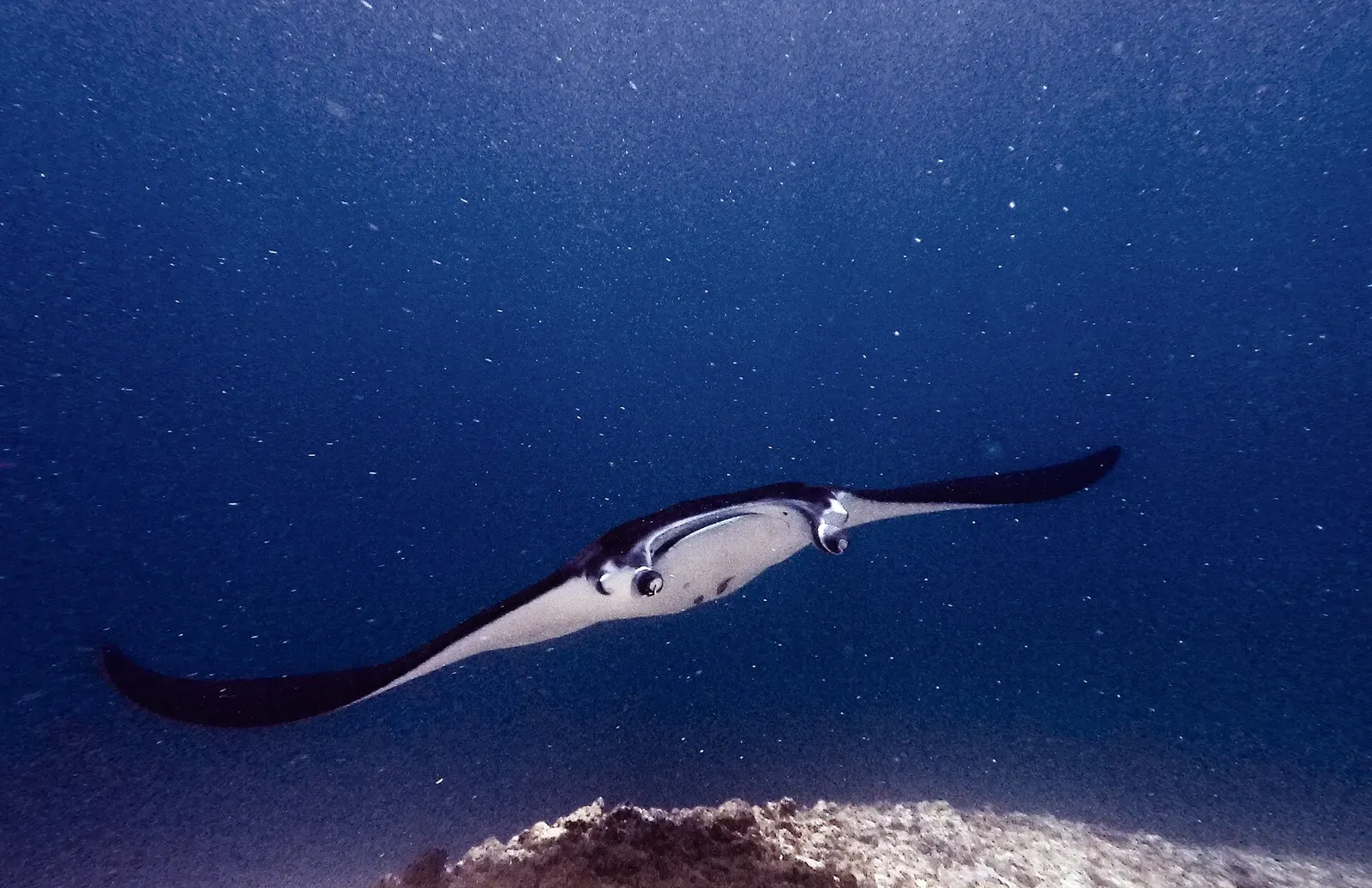
Grey reef and whitetip sharks show on most walls across the short season, with turtles resting in the sandy chutes, napoleon wrasse patrolling the rim, and jacks and tuna stacked at the corners. Mantas pass along the outer edges. Hammerheads are the wild card, reported deep and more often early in the window than late.
- Wall
- Drift
- Pelagic & blue water
- Reef
- Reef sharks
- Hammerheads
- Manta rays
- Sea turtles
- Napoleon wrasse
- Tuna
- Trevally & jacks
Best dive sites in Tubbataha Reefs
Wall
Predators along the wall, and a crevasse to 40 m as current shelter
Pinnacle
A mid-ocean cay dived only when the crossing stays calm
Reef
Several whitetip reef sharks on one terrace at 20 m
Wall
A steep face to 60 m over a 3-5 m coral garden
Amos Rock
Current-swept wall known for schooling hammerheads.
Black Rock
Pinnacle drop-off with grey reef sharks and big schools.
South Atoll Wall
Sheer wall along the southern atoll rim with manta sightings.
How to get to Tubbataha Reefs
Liveaboards board in Puerto Princesa on Palawan and cross overnight; itineraries typically run five to seven nights and there is no way off mid-trip. A park conservation fee is collected per diver on top of the berth, and since the mid-March to mid-June window is the only one there is, popular boats sell out close to a year ahead.
Photos from Tubbataha Reefs
q.phia · CC BY 2.0
q.phia · CC BY 2.0
q.phia · CC BY 2.0
q.phia · CC BY 2.0
Dive videos
TUBBATAHA The Crown Jewel of the Philippines · FinnSnow on YouTube
Diving Philippines' Crown Jewel: Tubbataha Reefs // Life, Uncharted Ch. 01 [Documentary] · Noel Guevara on YouTube
Photo credits
- A diver hangs beside a vast school of black jacks along a wall at Shark Airport, Tubbataha. by q.phia, CC BY 2.0, via Openverse
- Small reef fish scatter over hard coral along a steep drop-off into open blue water. by q.phia, CC BY 2.0, via Openverse
- Mounds of elkhorn and staghorn coral spread across the reef top at Amos Rock. by q.phia, CC BY 2.0, via Openverse
- A hawksbill turtle glides past a diver over the reef at Shark Airport, Tubbataha. by q.phia, CC BY 2.0, via Openverse
- A spotted sweetlips hovers beside a coral bommie at Staghorn Reef, Tubbataha. by q.phia, CC BY 2.0, via Openverse
Embed
Run a dive centre, club or blog? Embed this map of 4 dive sites near Tubbataha Reefs on your own page.
In The Logbook
- Where to see reef sharks on your first divesBig animals · 14 min read
- The best wall dives in the worldWalls & drop-offs · 11 min read
- Where to dive in every month of the yearTrip planning · 14 min read
- What is decompression sickness (the bends)?Body & health · 18 min read
- Why do you pee when diving, and tire after?Body & health · 12 min read
- How long to wait before flying after divingBody & health · 8 min read
Similar destinations

The world's second-largest contiguous coral reef, closed to fishing
Drift dives past sharks and tuna on current-swept seamounts

Step off a jetty into the world's largest lagoon, or cross to open ocean

The world's third-largest atoll, and a wall running the length of Selayar