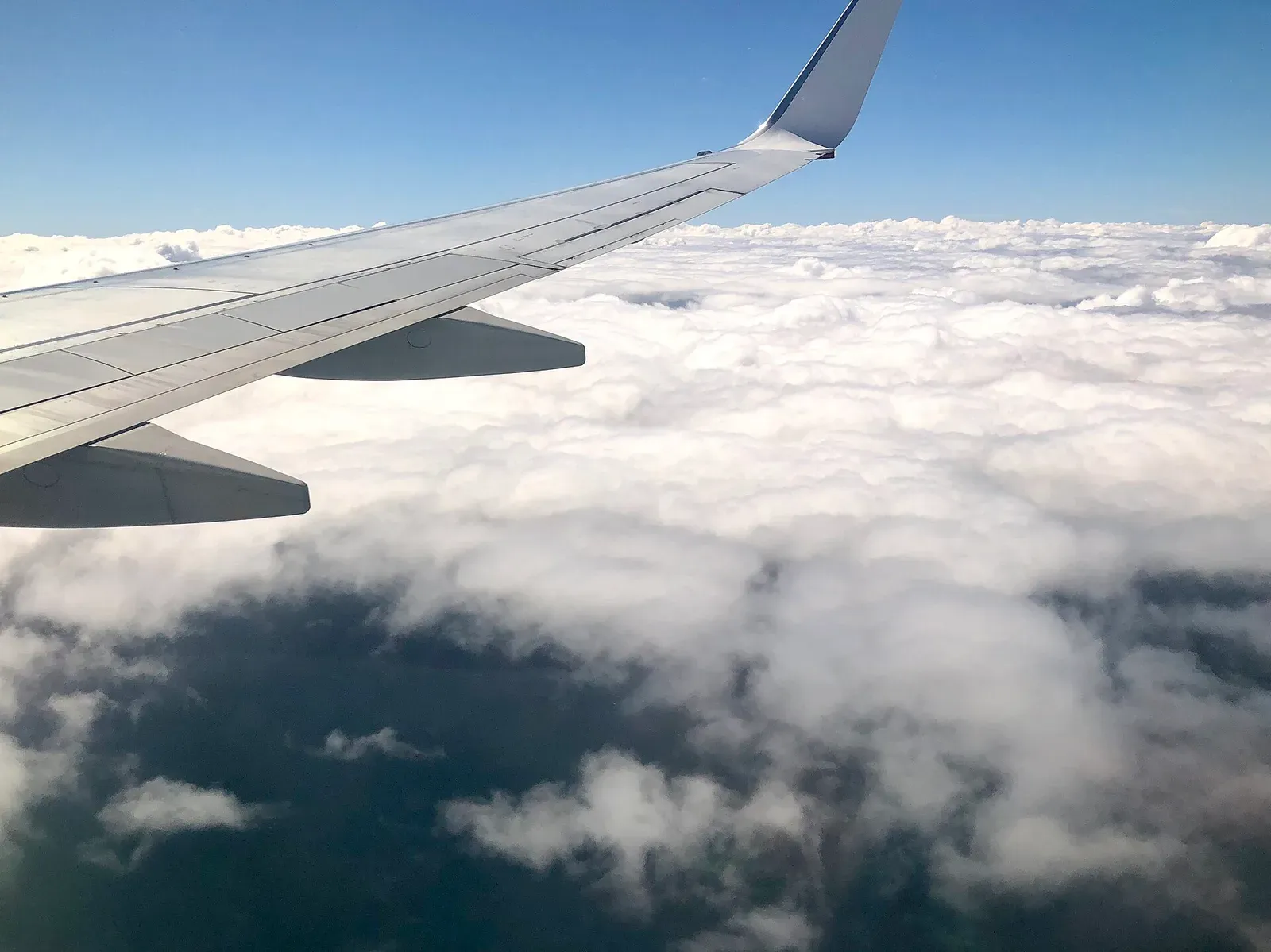
The cabin is a depth, and it is above you
Everything in decompression is a ratio between the gas dissolved in you and the pressure outside you. Surfacing improves that ratio in your favour by one atmosphere and then stops. A flight does not stop there.
Atmospheric pressure falls off with height in a way you can compute exactly, and the standard formula is one line: pressure equals 1.013 bar times one minus 0.0000226 times the height in metres, all raised to the power 5.256. Feed it the numbers that matter to a diver and you get a chart worth knowing by heart.
Commercial aircraft are certified so that the cabin never exceeds 8,000 feet — 2,438 m — at the aircraft’s maximum operating altitude. That is 0.75 bar: a quarter of the atmosphere gone. Most modern flights are gentler, holding around 6,000 feet in the cruise, and a 787 or an A350 sits close to that by design. But the certified ceiling is what you plan against, because you do not choose the aeroplane and the pilot does not consult you.
A quarter of an atmosphere is not an abstraction. It is the same pressure step as the last 2.6 m of a dive, taken a second time, on a body that has already spent the day off-gassing. And it is not only aircraft: the Furka Pass in Switzerland tops out at 2,429 m, within a couple of metres of pressure of a certified cabin ceiling. Driving home over an alpine pass is a flight.
What the reduced pressure does is straightforward and unpleasant. Nitrogen that is still dissolved in you at the end of a dive is in equilibrium with sea-level pressure, more or less. Drop the pressure around it and the gas that was comfortably in solution is no longer comfortably in solution, so bubbles that were too small to matter get bigger and bubbles that had not formed can form. Most of them are silent — the trials that follow divers with Doppler ultrasound find bubbles in people who feel nothing at all — and the ones that are not silent produce the same decompression sickness you would have got by ascending too fast, several hours late and a long way from the nearest chamber.
What the model says, and why it is not the answer
The decompression model that decides whether you may surface can be asked the same question about a cabin. Run a diver’s tissue loadings forwards through the surface interval and ask, minute by minute, what is the shallowest ambient pressure they tolerate — then read that pressure back as a height.
Three trips, all ordinary. One no-stop dive to 18 m (60 ft) for forty minutes. A three-dive day of 28, 20 and 14 m. And day five of a liveaboard: four dives a day for four days, three on the fifth.
The first thing the chart shows is the honest one. At the moment of surfacing, all three divers are below the cabin ceiling — the single-dive diver may go to about 1,870 m and the liveaboard diver only to about 1,320 m, which is lower than the cabin of the aircraft they would be boarding. Straight out of the water, a flight is beyond what the model permits.
The second thing it shows is the awkward one. Every curve crosses the ceiling inside a quarter of an hour. On the raw Bühlmann M-values, the liveaboard diver is clear to fly at 8,000 feet fifteen minutes after surfacing. Force the model to be conservative — gradient factor 0.7, tighter than most divers set their computers — and it stretches to under four hours.
DAN says twelve hours after a single no-stop dive and eighteen after multiple dives or multiple days. The gap between fifteen minutes and eighteen hours is not a rounding error. The guidelines are not derived from the decompression model at all.
Where twelve and eighteen actually come from
The numbers come from putting people in chambers and counting.
Vann and colleagues at Duke ran the trials that produced the current guidance. Dry, resting volunteers made one to three dives in a day at 40, 60 or 100 feet of seawater — profiles near the no-decompression limits of recreational diving — then waited a preflight surface interval of between 3 and 17 hours and were taken to 8,000 feet for four hours, the maximum permitted cabin altitude. Forty cases of decompression sickness occurred in 802 exposures of 495 subjects. Incidence fell as the interval lengthened, repetitive dives needed longer intervals than single ones to reach the same low incidence, and there was no DCS at all in the 52 trials that used the longest interval tested — 17 hours.
That is the entire empirical basis, and it is why the recommendations are shaped the way they are: a minimum of 12 hours after a single no-decompression dive, a minimum of 18 hours after multiple dives per day or multiple days of diving, and substantially longer than 18 hours after any dive requiring decompression stops, where there is too little evidence to give a number at all. They apply to recreational divers making air dives, flying at cabin altitudes between 610 and 2,438 m, with no symptoms of DCS.
A second study is worth knowing about because it shows how much the answer depends on what you are asking. Pollock and colleagues took 102 volunteers through simulated 60-foot, 60-minute air dives followed by three-hour flights at 25,000 feet — parachute-operation altitude, not airliner altitude — with oxygen breathed before and during the flight. Three cases of decompression sickness occurred in 155 exposures, and the rate did not differ between 12-, 18- and 24-hour intervals or from the flight-only controls. Change the exposure, change the protocol, and the sensible surface interval changes with it. The recreational guidance is specific to recreational conditions, which is exactly why it is stated as a flat number rather than a formula.
Two caveats travel with them and are usually dropped. The trials were dry and resting; real divers are immersed and working, which loads them more, so the guidelines may be less conservative in the water than they were in the chamber. And they do not guarantee anything — some people show high-grade bubbles at altitude even after a 24-hour interval.
Which compartment you are actually waiting for
If not the M-values, then what is being waited out? The answer is visible in the tissues themselves.
The 12.5-minute compartment is the most loaded thing in the diver at the moment of surfacing — and it is gone within an hour. It has no opinion about tomorrow’s flight. The 77-minute compartment is effectively empty by six hours. What is still draining at twelve and eighteen hours is the slow end. The five-hour compartment comes out of a week of diving carrying 0.30 bar of excess nitrogen, more than double the 0.13 bar a single dive leaves, and it still has 0.03 bar to lose at the eighteen-hour mark — by which time the 77-minute compartment has been empty for half a day.
That is exactly the distinction DAN’s two numbers draw. Twelve hours for one dive, eighteen for a week, because the difference between one dive and a week is entirely in the compartments that take a day to empty. A repetitive diver has not done anything different to their fast tissues; they have loaded the slow ones dive after dive with surface intervals too short to clear them.
It also explains why the last day of a trip matters more than the last dive. Making the final dive shallow is worth something, but not much: it changes the fast compartments, which were never the problem.
Altitude the rest of the time
Flying is the loud case. The same physics turns up in three quieter ones.
Diving at altitude. Anything above 300 m counts, because your surface is no longer 1 bar and both your tables and your ascent are calculated against the wrong pressure. Rubicon Wall sits at 1,897 m, where the surface itself is at 0.80 bar; the Usipa in Lake Malawi at 468 m, and the pools under the bridge at Lavertezzo at 536 m. Every modern computer handles this automatically if you let it acclimatise; if you are using tables, you need altitude tables. There is a related trap on the way in: the US Navy recommends waiting 12 hours after arriving at altitude before the first dive, because you arrive supersaturated relative to your new surface.
Driving home. A mountain road is an unpressurised cabin with no cabin. It is also the case people forget, because it does not feel like travel in the way an airport does.
Diving after flying. This is not a problem, and it is worth saying plainly. A flight leaves you slightly under-saturated rather than over-saturated; landing and diving is a step in the safe direction. Fatigue and dehydration after a long flight are real arguments for an easy first dive, but decompression is not one of them.
Where the way home is part of the plan
These are the dives at the far end of a journey — remote enough that the flight out is the only way home, and scheduled tightly enough that the surface interval is a real constraint — plus the three sites in our data where the surface itself is above sea level.
| Site | Depth | Level | Best months |
|---|---|---|---|
| Roca Partida Revillagigedo (Socorro) · Mexico | to 40 m | Advanced | Jan–Mar |
| Bajo Alcyone Cocos Island · Costa Rica | to 25 m | Advanced | Jun–Nov |
| Darwin's Arch Galápagos · Ecuador | 18–24 m | Advanced | Jun–Nov |
| Jessie Beazley Reef Tubbataha Reefs · Philippines | 7–50 m | Advanced | Apr–May |
| Clerke Wall Rowley Shoals · Australia | 5–20 m | Intermediate | Sep–Nov |
| Big Brother Island Brothers & Daedalus · Egypt | 10–35 m | Advanced | May–Jun |
| USS Saratoga Bikini Atoll · Marshall Islands | 27–38 m | Advanced | Apr–Nov |
| San Francisco Maru Chuuk Lagoon · Micronesia | 27–64 m | Advanced | Nov–May |
| Deception Island Antarctic Peninsula · Antarctica | to 20 m | Advanced | Dec–Feb |
| Rubicon Wall Lake Tahoe · United States | to 27 m | Advanced | Jul–Sep |
| Ponte dei Salti Verzasca Valley · Switzerland | to 10 m | Intermediate | Jun–Aug |
| Usipa Wreck Lake Malawi · Malawi | to 30 m | Advanced | Sep–Nov |
The model being run against the cabin ceiling here is the one explained in how your dive computer decides, and the compression side of altitude is in buoyancy and weighting.


