What a wall does to a dive
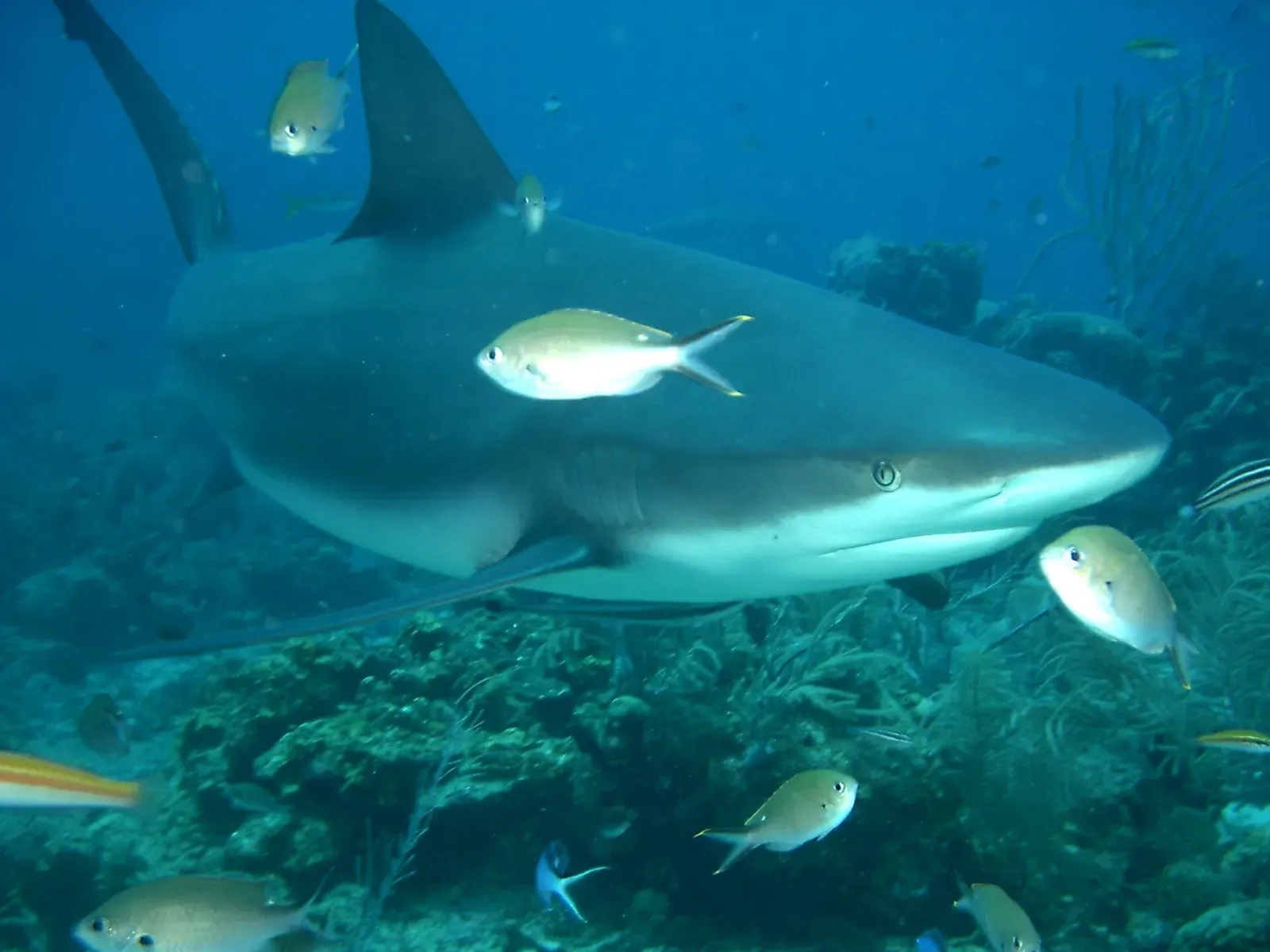
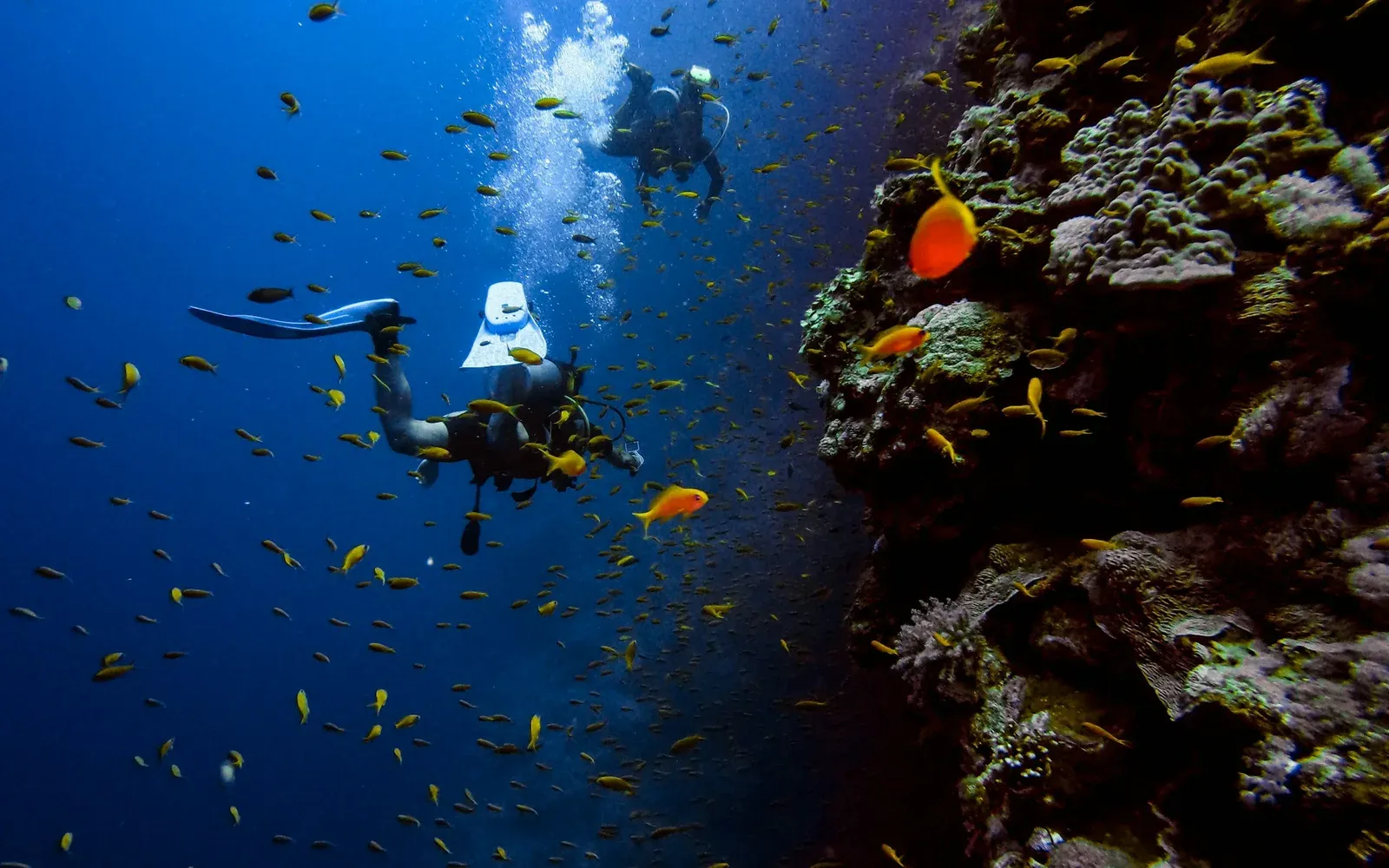
Most reefs slope. You descend onto coral or sand, and whatever depth you reach, the bottom is there to tell you about it. A wall takes that away. The reef runs out to an edge, the rock turns vertical, and from then on the face is on one shoulder and open water on the other, with nothing below you inside any depth you should be at. That is the whole appeal: the life of the reef packed onto a surface you can read from top to bottom in one look, and the pelagic life of the blue a fin-kick away.
It is also the whole hazard. With no floor, nothing stops a slow sink except the diver. The standard description of wall diving puts it plainly: the lack of a depth-limiting bottom within operational range can let a diver go deeper than planned. The face does give you a fixed vertical reference, so a wall is easy to hold a level against once you are looking for it. The danger is the minutes when you are not: watching a turtle, framing a photo, following a shark down the face.
Which brings us to the one number on every wall page that is easy to misread. The depth on a wall’s record is the depth of the dive, not the depth of the wall. Bloody Bay Wall, the wall that gives Little Cayman its reputation, is recorded to 30.5 m. That is where careful divers stop, not where the rock stops. Local claims put the face at 910 m or 1,500 m; the charted 1,000 m contour actually lies about 4 km offshore, so those figures are exaggerated, but the face still runs on past anything recreational. The same is true almost everywhere. Cane Bay on St Croix is recorded at 8 to 12 m, and its face falls past 975 m: the record covers about 1.2 per cent of it.

Embed this diagram
<figure>
  <img src="https://reefwander.com/og/diagrams/wall-drop.svg" alt="The depth in a wall’s record is the dive’s floor, not the wall’s. None of these records goes deeper than 40 m, and on all but Bama Wall the record’s deepest point is less than a tenth of how far the face falls." loading="lazy">
  <figcaption>Diagram by Reefwander, licensed under CC BY 4.0.</figcaption>
</figure>
Two more things set a wall apart from a reef. The first is current. Water moving along a face follows it, so many walls are dived as drifts, and where a wall turns a corner the flow accelerates and can run up or down the face as well as along it. The second is the edge. The top of a wall is where swell meets the reef, and on a rough day the lip can be the most turbulent water on the dive. The best walls below are the ones where all of this is the point: sheer faces that start shallow enough to spend an hour on, and fall far past where anyone should follow them.
Caribbean walls
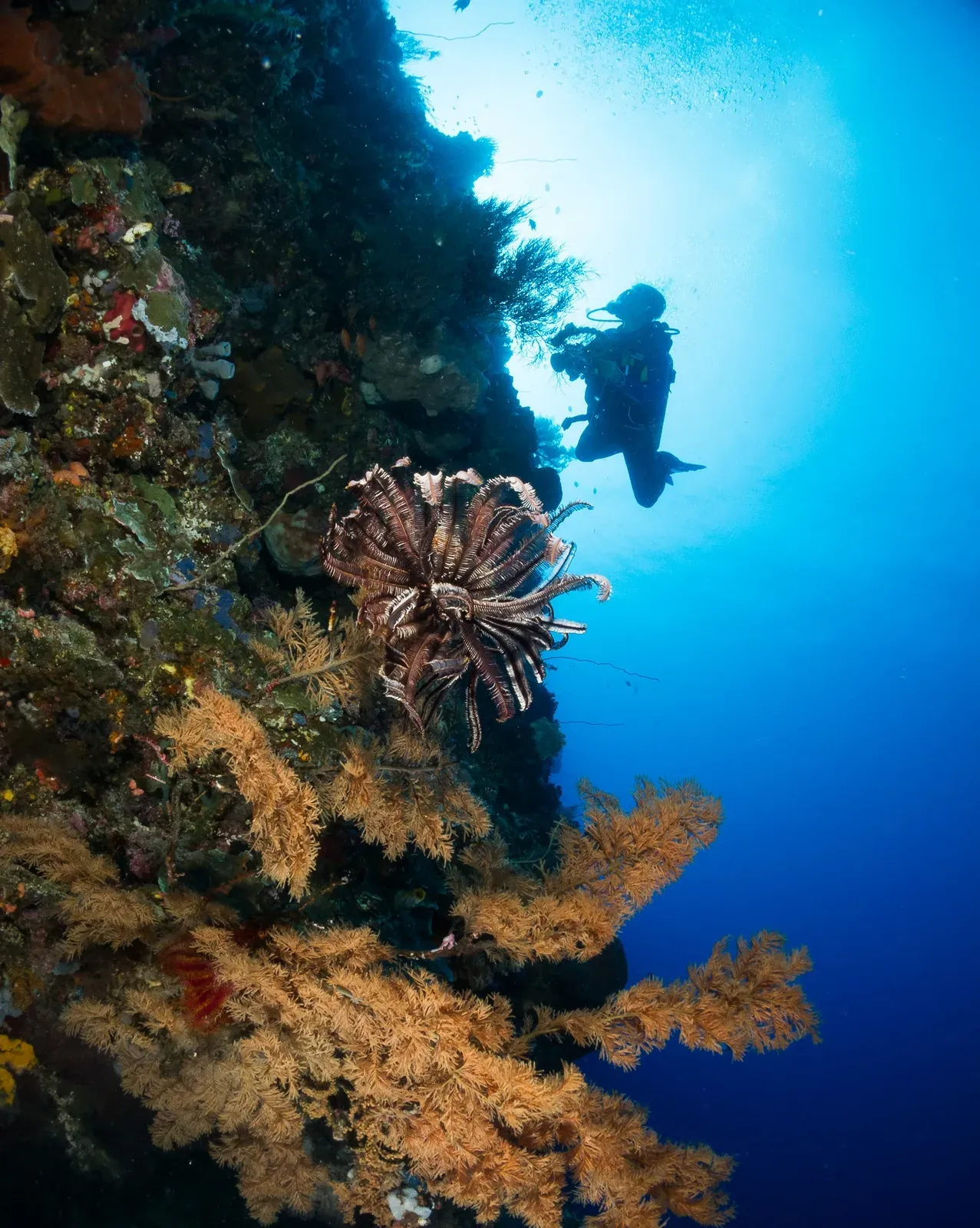
Caribbean walls tend to start shallow, which makes them the easiest in the world to spend a long dive on. Little Cayman’s Bloody Bay Wall begins with a lip at 5.5 m, close enough to the surface that you swim out across the shallow ground inside the reef and simply turn along the edge. Sections of the face are so sheer as to be effectively vertical, which is rarer than the word “wall” suggests, and the stretch called Great Wall West is the most vertical of all: in 1999 a crew of photographers shot it piece by piece to make a single composite image of the face. The shallow lip is also what makes Bloody Bay generous. A planned profile touches a little over 30 m and still returns a long dive, because the back half is spent above the drop. On Grand Cayman’s North Wall, Babylon has its wall top at up to 14 m and a genuinely vertical drop over the edge into the Cayman Trench, around a pinnacle that rises from past 30 m to within 14 m of the surface.
Cozumel’s Santa Rosa Wall is the island’s signature wall and a different animal: it begins at about 15 m, drops straight into the blue for hundreds of feet, and is dived as a drift, the group settling at the guide’s depth and letting the current carry it past immense sponges and overhangs cut with caves and tunnels. The record rates it advanced, and the plan tops out at about 40 m.
The Turks & Caicos have the most forgiving walls on the list. West Caicos Wall is six miles of drop-off with about 25 moorings over it, a reef top at 35 to 45 ft (up to 14 m) and a lip only 100 to 150 m off the beach, which is why its record rates it beginner. Grand Turk Wall is ten minutes by boat from the Cockburn Town beach: a reef in 30 to 40 ft that ends in a drop to thousands of feet, with visibility often past 30 m. And on St Croix, Cane Bay Wall is the wall you can swim to. Sand chutes run out from a buoy in 8 m to a lip at 12 m, and nineteenth-century anchors lie along the face beyond it.
Further west, Half Moon Caye Wall on Lighthouse Reef is entered over sand flats at about 15 m full of garden eels, then through tunnels in the reef onto a face that drops past 914 m, inside Belize’s oldest protected area. In the Bay Islands of Honduras, Half Moon Wall runs from a reef at 5 m to a wall bottoming out around 46 m, and Utila’s CJ's Drop Off is a classic near-vertical face from 9 m to past 42 m, hung with tube sponges, sea fans and black coral. Scott's Head Drop-off at the southern tip of Dominica is a sponge-covered face dived anywhere from 12 to 30 m, and Cuba’s Vicente puts coral gardens at 20 m on top of a vertical wall plated with black coral, with silky sharks and wahoo in the water off it.
| Site | Depth | Current | Level | Best months |
|---|---|---|---|---|
| Bloody Bay Wall Little Cayman · Cayman Islands | 5.5–30.5 m | Moderate | Intermediate | Dec–Apr |
| Great Wall West Little Cayman · Cayman Islands | to 30.5 m | Moderate | Intermediate | Dec–Apr |
| Babylon Grand Cayman · Cayman Islands | 10.7–17 m | Mild | Intermediate | Dec–Apr |
| Santa Rosa Wall Cozumel · Mexico | 15–40 m | Strong | Advanced | Jan–Apr |
| West Caicos Wall Turks & Caicos · Turks & Caicos Islands | 11–14 m | Mild | Beginner | Jan–Apr |
| Grand Turk Wall Turks & Caicos · Turks & Caicos Islands | 9–12 m | Mild | Intermediate | Jan–Apr |
| Cane Bay Wall St. Croix · U.S. Virgin Islands | 8–12 m | Mild | Beginner | Dec–May |
| Half Moon Caye Wall Belize Barrier Reef · Belize | to 15 m | Moderate | Intermediate | Mar–May |
| Half Moon Wall Roatán · Honduras | 5–46 m | Mild | Advanced | Mar–Aug |
| CJ's Drop Off Utila · Honduras | 9–42 m | Moderate | Intermediate | Mar–May |
| Scott's Head Drop-off Dominica · Dominica | 12–30 m | Moderate | Advanced | Dec–May |
| Vicente Jardines de la Reina · Cuba | 20–45 m | Mild | Advanced | Dec–Apr |
Indo-Pacific walls
The Indo-Pacific walls are where current and wall become one dive. Palau’s Peleliu Wall, 27 km south-west of Koror, is a reef falling into open ocean with the tide driving past a corner: you hook on near the top at about 10 m, drop to around 30 along caverns and indentations, and hook on again at Peleliu Corner, in current that is often the strongest anyone meets in Palau. The list of animals seen there runs from grey reef sharks to hammerheads, whale sharks and orcas. Blue Corner is the more famous hook-in: a triangular promontory where you clip onto the lip of the plateau and watch grey reef sharks, barracuda and big-eye trevally hold station off the edge, in currents that can change direction without warning.
The Drop Off is the wall that made Sipadan’s name. The reef ends close enough to the island that it was once rated the best beach dive anywhere, and the rock falls 600 m into open water. The dived profile runs 25 to 40 m in strong current, with hundreds of barracuda turning into a tornado off the face. South Point is the island’s deep, exposed corner, where hammerheads and threshers pass at 40 m and beyond, rarely, and which is exactly where divers get pulled past their plan. Off Sabah’s far north-west, Layang-Layang’s D-Wall falls away from the reef into 2,000 m of water. It is dived between 25 and 40 m, where a ledge breaks the face before it continues down, with pygmy seahorses in the sea fans on the wall and schooling hammerheads in the blue beyond it.
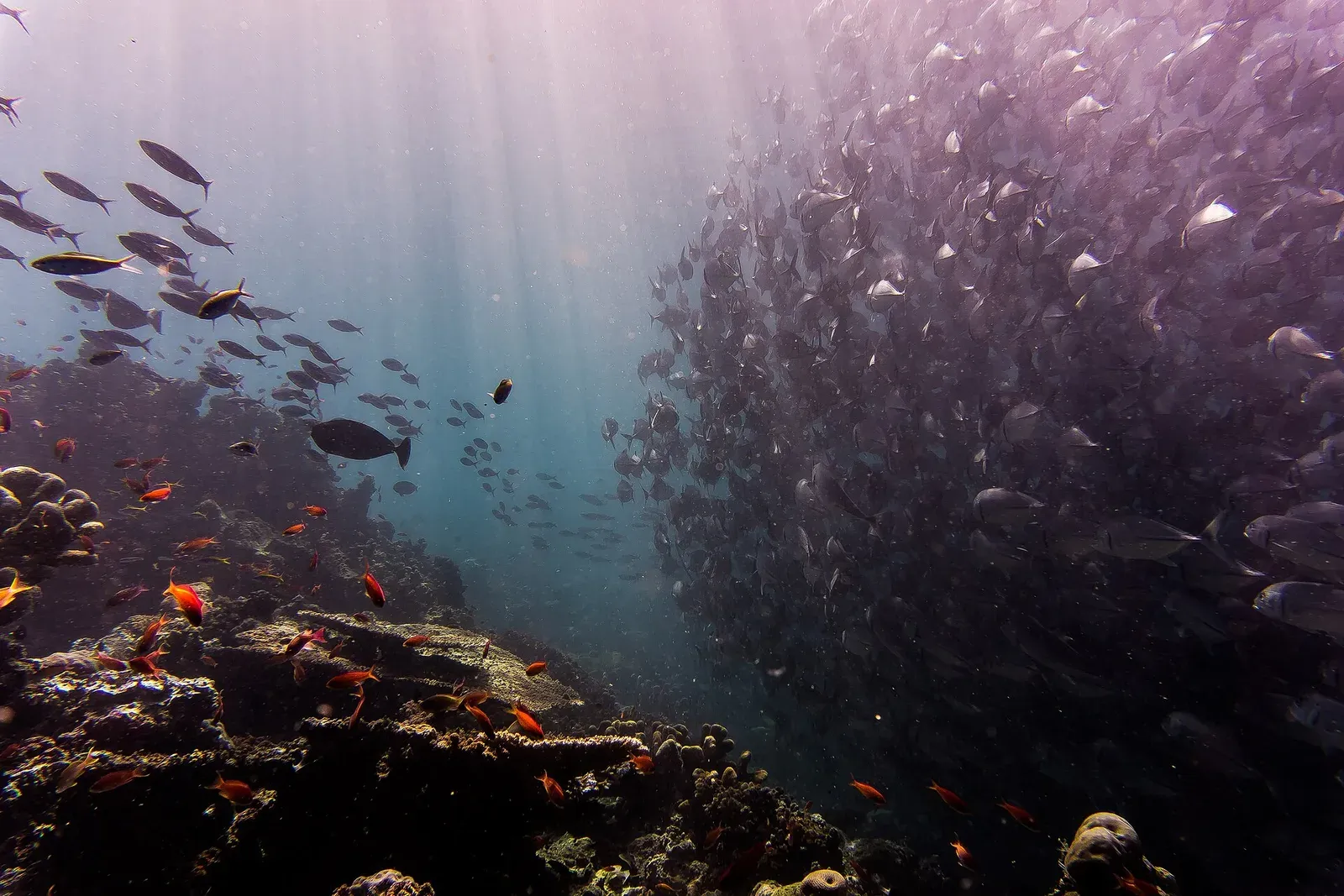
North Sulawesi’s Bunaken is a park of walls. Lekuan I is steep and heavy with coral, massive green stands of black coral among it, and has perhaps ten resident green turtles; Mandolin steps down in ledges and overhangs hung with whip corals, each worth searching for the shrimps living on it. In the Philippines, Moalboal’s Pescador Island is a limestone island whose hard-coral wall drops from a sandy slope at 5 to 10 m to about 40, with an open-top cave, the Cathedral, in its north-west side; Kasai Wall has a cave at its foot too, 140 m long and an overhead environment, not an add-on. And far out in the Sulu Sea, Jessie Beazley Reef is a mushroom-shaped cay that comes up to 7 m and drops past 50, dived only when the crossing is calm.
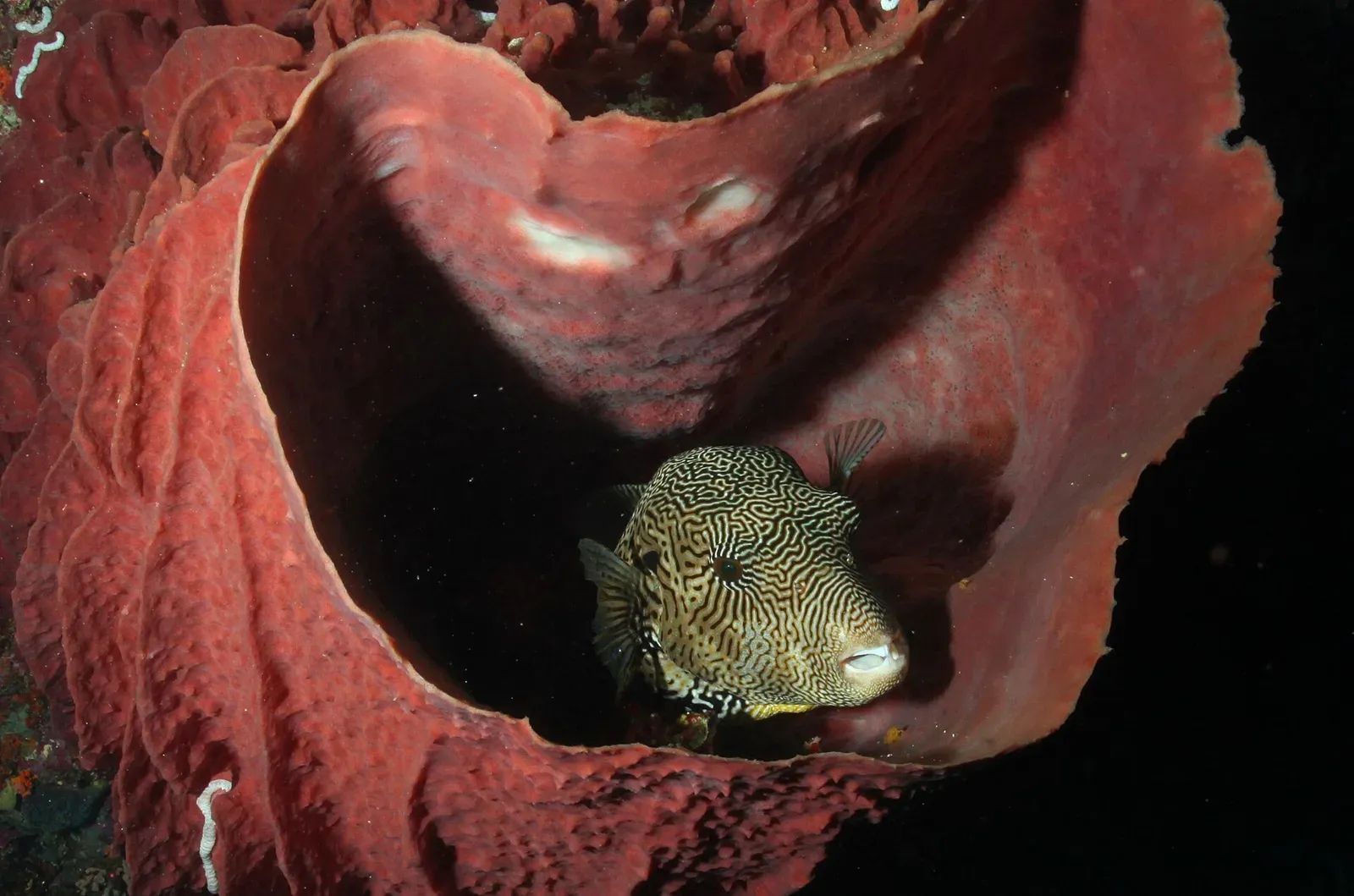
Fiji’s Great White Wall is entered through a short tunnel at 15 m, so your first view is already partway down the face: white coral from 15 m to 65, turning lavender deeper down, which is a reason to look down rather than go down. Alor’s Bama Wall stands directly in the Pantar Strait’s flow, a near-vertical face dense with soft coral that draws in dogtooth tuna and reef sharks. Perpendicular Wall on Christmas Island is a vertical cliff falling past anything visible from it, where the island’s operator names sailfish and whale sharks among the big fish and advises a 30 m cap. And Raja Ampat, a region better known for its slopes, has one of the few true walls in the Dampier Strait at Friwen Wall: soft corals, black coral and gorgonians from 26 m up to 2, usually in current light enough to stop and search the fans.
| Site | Depth | Current | Level | Best months |
|---|---|---|---|---|
| Peleliu Wall Palau · Palau | 10–30 m | Strong | Advanced | Dec–Apr |
| Blue Corner Palau · Palau | 8–30 m | Strong | Advanced | Dec–Apr |
| The Drop Off Sipadan · Malaysia | 25–40 m | Strong | Advanced | Mar–May |
| South Point Sipadan · Malaysia | 25–40 m | Strong | Advanced | Mar–May |
| D-Wall Layang-Layang · Malaysia | 25–40 m | Moderate | Advanced | Closed |
| Lekuan I Bunaken · Indonesia | 10–25 m | Moderate | Intermediate | May–Oct |
| Mandolin Bunaken · Indonesia | to 30 m | Moderate | Intermediate | May–Oct |
| Pescador Island Moalboal · Philippines | 5–40 m | Moderate | Intermediate | Apr–Jun |
| Kasai Wall Moalboal · Philippines | to 40 m | Mild | Intermediate | Apr–Jun |
| Jessie Beazley Reef Tubbataha Reefs · Philippines | 7–50 m | Strong | Advanced | Apr–May |
| Great White Wall Rainbow Reef & Namena · Fiji | 15–25 m | Moderate | Advanced | Jun–Oct |
| Bama Wall Alor · Indonesia | to 40 m | Moderate | Advanced | Jun–Sep |
| Perpendicular Wall Christmas Island · Australia | to 30 m | Strong | Advanced | Oct–Dec |
| Friwen Wall Raja Ampat · Indonesia | 2–26 m | Mild | Intermediate | Nov–Apr |
Red Sea and Indian Ocean walls
The Red Sea’s offshore reefs are walls on every side, because they rise from deep water with no shelf around them. Brothers & Daedalus’s Big Brother Island is a rock in open sea ringed by sheer wall, with a plateau at 10 m, the wrecks of the Numidia and the Aida draped down its flank rather than lying on a seabed, and current running around the island more or less constantly. Oceanic whitetips, grey reef sharks and threshers are the reason boats make the crossing. Daedalus Reef is a seamount climbing from 450 m of water about 100 km off Marsa Alam; its walls drop to 20 m, slope out to 40 and then plunge, and hammerheads gather there particularly in summer.
At the tip of Sinai, Shark Observatory on the Ras Mohammed headland is the exception to the rule this guide opened with. Its record gives 90 m, and that is the face, not a dive: the wall is literally vertical to 90 m before it slopes out at its foot, with glassfish in caves and gorgonian fans under overhangs. It is an advanced site with tricky currents, and nobody on air belongs at the bottom of it. Up the coast at Dahab, The Bells is the shore-entry wall, a chimney through the reef onto a face with no bottom in recreational range, followed south past overhangs at around 30 m into the Blue Hole.
Sudanese Red Sea has the remotest walls in the sea. Sanganeb Atoll is the only atoll in the Red Sea, rising from around 800 m of water so that every side of it is a wall; the dives concentrate on its two plateaus, the north one stepping down to a shelf at 45 m where schooling hammerheads are common, past a normal recreational profile. Shaab Rumi has a drop-off falling towards 700 m and a south plateau where up to twenty grey reef sharks hunt in the current, and the hangar built for the diving saucer of Cousteau’s 1963 Conshelf II experiment still sits on the sand at about 13 m. Across the Indian Ocean, Zanzibar’s Big Wall is a vertical face in open ocean east of Mnemba, from 18 m to 50, cut with caves and overhangs.
| Site | Depth | Current | Level | Best months |
|---|---|---|---|---|
| Big Brother Island Brothers & Daedalus · Egypt | 10–35 m | Strong | Advanced | Jun–Aug |
| Daedalus Reef Brothers & Daedalus · Egypt | 10–40 m | Strong | Advanced | Jun–Aug |
| Shark Observatory Sharm El Sheikh · Egypt | to 90 m | Moderate | Advanced | May–Oct |
| The Bells Dahab · Egypt | to 30 m | Mild | Advanced | Apr–May |
| Sanganeb Atoll Sudanese Red Sea · Sudan | 5–40 m | Moderate | Advanced | Apr–May |
| Shaab Rumi Sudanese Red Sea · Sudan | 5–30 m | Strong | Advanced | Apr–May |
| Big Wall Mnemba Atoll · Tanzania | 18–50 m | Moderate | Advanced | Oct–Feb |
Cold and fresh walls
Walls are not only coral. Lake Tahoe’s Rubicon Wall is a near-vertical granite face on the lake’s west shore, weathered into buttresses and overhangs local divers call sunken castles, dropping for hundreds of feet. Recreational divers keep to about 27 m, and not only for gas: the lake sits at 1,897 m (6,224 ft), and altitude makes every depth a deeper dive than the gauge reads, which our guide to diving at altitude works through. The water is 4 to 10 °C and the entry is a surface swim of about 270 m from Calawee Cove.
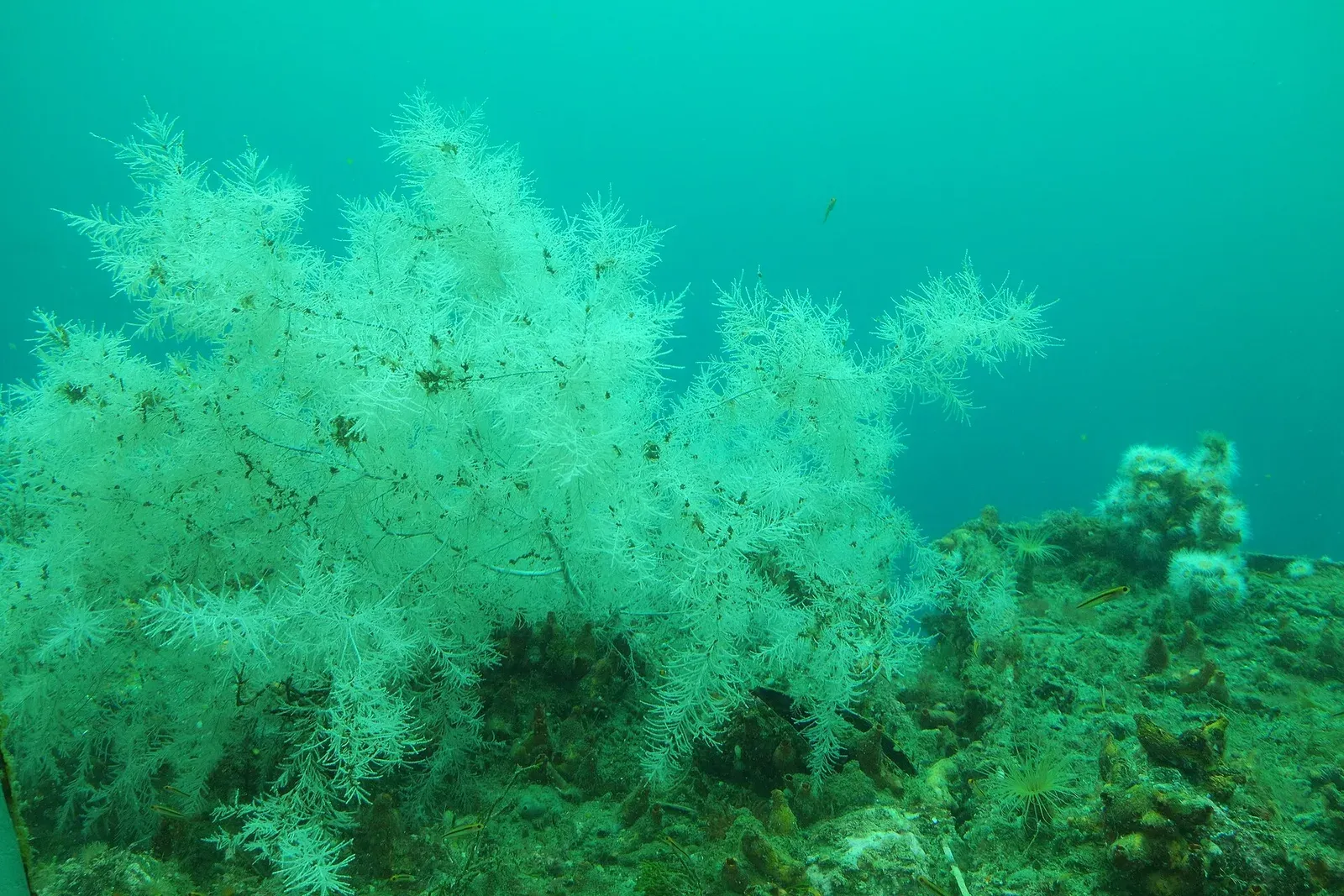
New Zealand’s Milford Sound is a wall under a mountain. The fiord’s rock faces carry straight on below the waterline, a permanent freshwater layer up to 10 m thick sits on top, and the walls above the surface cut out so much light that black coral trees up to 6 m high, of a species otherwise found beyond 100 m, grow within recreational reach. Below about 40 m the tannin-stained water is too dark for most life, so there is little reason to go deeper. At Point Lobos in California, Point Lobos — Whalers Cove is a reminder that a wall can be long rather than tall: Granite Point Wall runs about 77 m at 18 to 20 m, covered in sponges, nudibranchs and soft corals, a shore dive inside the reserve.
| Site | Depth | Current | Level | Best months |
|---|---|---|---|---|
| Rubicon Wall Lake Tahoe · United States | to 27 m | None | Advanced | Jul–Sep |
| Milford Sound (Piopiotahi) Fiordland · New Zealand | to 40 m | Mild | Advanced | Dec–Feb |
| Point Lobos — Whalers Cove Monterey Bay · United States | 9–21 m | Mild | Intermediate | Sep–Nov |
Diving a wall well
A wall asks for one skill more than any other, and it is not courage. It is holding a depth against a surface that gives you no floor. A few habits cover most of it.
Plan the depth before the descent, not on the face. The hazard notes on these walls say it again and again: agree a maximum on the boat, because the wall will not agree one for you. That is why most of the records here go no deeper than 40 m, whatever the rock below them does. If you are unsure where your own limit sits, our guide to how deep you can dive sets the recreational numbers out, and the deep wrecks guide shows what changes past them.
Watch the computer, not the face. On a slope, depth creep shows up as the bottom coming closer. On a wall nothing changes: the face looks the same at 25 m as at 35. Check the computer on a fixed interval, set a depth alarm where your computer has one, and take the deepest part of the dive first so the rest of it steps up the face.
Read the current before you commit to it. Along a straight face the flow usually runs parallel and you drift with it; at corners and points it speeds up and can turn vertical. That is why Blue Corner and Peleliu are advanced sites at 30 m while Bloody Bay, dived to the same depth, is intermediate: the rating is about the water, not the depth. Our drift diving guide covers entries, reef hooks and surfacing away from the reef, and tides and slack water explains why the same corner is calm one hour and wild the next.
Hands off the face. Much of the life on a wall is delicate, and anything knocked off the face has nowhere to fall but down. Where a site needs a hold, as at Blue Corner and Peleliu, a reef hook on dead rock does the job without a glove on the coral. Good trim and a steady level are what let you get close enough to find the pygmy seahorse without touching the fan it lives on, and buoyancy and weighting is where that starts.