Coral Triangle · Papua New Guinea
Tufi
Muck diving in drowned volcanic valleys with rainforest on the walls
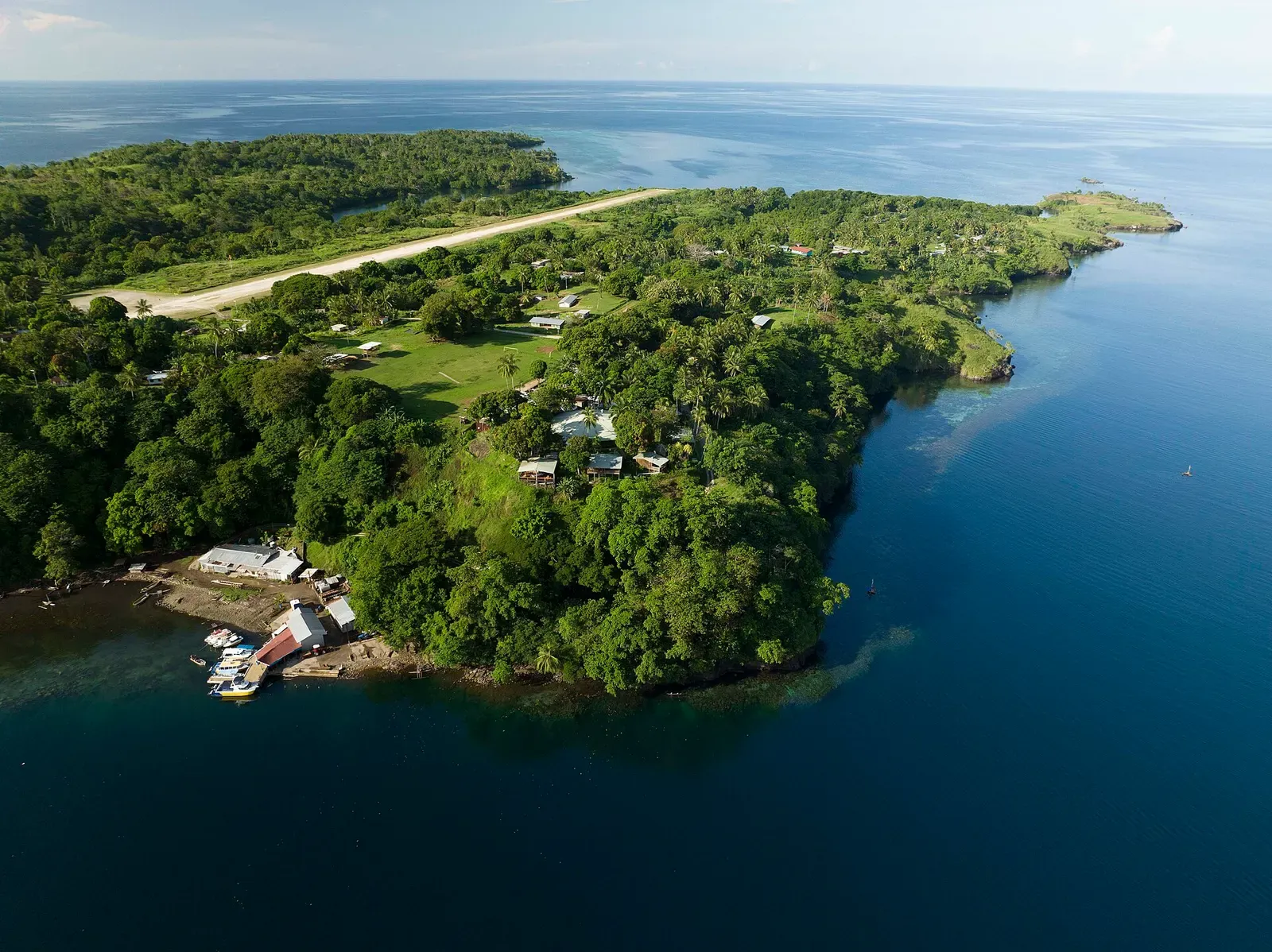
Photo: Larry V. Dumlao · CC BY-SA 4.0
Tufi sits on Cape Nelson, where lava flows from three volcanoes created a coastline of drowned valleys that everyone calls fjords. The rias are silty, sheltered and full of critters — muck diving with rainforest walls above the water — while offshore barrier reefs and seamounts sit in clear blue with hard coral in excellent condition. Wartime wreckage from the New Guinea campaign is scattered through the area, including a B-17 lying almost intact at 45 m.
About diving in Tufi
Diving is run from one place, and the day is shaped by the sea rather than a timetable. Boats leave the jetty below the ridge and either turn into the fjord system a few minutes away or head out past the cape to the offshore reefs, which is a longer run and only happens when conditions allow. The common pattern is two dives outside in the morning while it is flat, something inside in the afternoon, and a night dive at the wharf that needs no boat at all.
The two halves of the diving barely resemble each other. The drowned valleys are narrow and still, their sides dropping from the treeline into dark silt and leaf litter, and they hold what they hold precisely because the bottom is not reef. Outside, seamounts come up from deep water into recreational range and the barrier edge falls into open blue, with fans and whips on the drop-offs and visibility that behaves like ocean rather than estuary. The two sit about twenty minutes apart, which is the unusual part.
Wartime wreckage is part of the picture rather than the daily menu. The shallower freighter is a straightforward dive, eight decades of growth over enough structure to hold attention without a plan built around it. The bomber is a different proposition: it lies well down the coast, so it means a long run in settled water and one planned dive, and most divers do it once or not at all. That aircraft is unusually well documented, but dates and identities attached to the smaller scattered wreckage nearby are less settled, so take what you hear as the working version.
It suits divers who want range in a small area and do not mind a single operator setting the pace, and macro photographers most of all, since the sheltered water inside works on days when the outside does not. The trade is choice: no dive-shop strip, no second boat, no town, and evenings that are the resort and the village. Divers who build a trip around big-animal encounters, or who like moving between operators, will be happier elsewhere in Papua New Guinea.
Best time to dive Tufi
| Jan | Feb | Mar | Apr | May | Jun | Jul | Aug | Sep | Oct | Nov | Dec | |
|---|---|---|---|---|---|---|---|---|---|---|---|---|
| Season | Fair | Fair | Good | Prime | Prime | Prime | Good | Good | Good | Prime | Prime | Good |
| Sea surface | 30°C86°F | 30°C86°F | 30°C86°F | 30°C86°F | 29°C84°F | 29°C84°F | 28°C82°F | 27°C81°F | 28°C82°F | 29°C84°F | 29°C84°F | 30°C86°F |
| Daytime high | 30°C86°F | 30°C86°F | 30°C86°F | 29°C84°F | 29°C84°F | 29°C84°F | 29°C84°F | 29°C84°F | 29°C84°F | 30°C86°F | 30°C86°F | 31°C88°F |
| Rain | 379 mm14.9 in | 273 mm10.7 in | 398 mm15.7 in | 183 mm7.2 in | 177 mm7.0 in | 187 mm7.4 in | 71 mm2.8 in | 109 mm4.3 in | 131 mm5.2 in | 120 mm4.7 in | 89 mm3.5 in | 226 mm8.9 in |
| Jan | Feb | Mar | Apr | May | Jun |
|---|---|---|---|---|---|
| Fair | Fair | Good | Prime | Prime | Prime |
| Sea surface | |||||
| 30°C86°F | 30°C86°F | 30°C86°F | 30°C86°F | 29°C84°F | 29°C84°F |
| Daytime high | |||||
| 30°C86°F | 30°C86°F | 30°C86°F | 29°C84°F | 29°C84°F | 29°C84°F |
| Rain | |||||
| 379 mm14.9 in | 273 mm10.7 in | 398 mm15.7 in | 183 mm7.2 in | 177 mm7.0 in | 187 mm7.4 in |
| Jul | Aug | Sep | Oct | Nov | Dec |
|---|---|---|---|---|---|
| Good | Good | Good | Prime | Prime | Good |
| Sea surface | |||||
| 28°C82°F | 27°C81°F | 28°C82°F | 29°C84°F | 29°C84°F | 30°C86°F |
| Daytime high | |||||
| 29°C84°F | 29°C84°F | 29°C84°F | 30°C86°F | 30°C86°F | 31°C88°F |
| Rain | |||||
| 71 mm2.8 in | 109 mm4.3 in | 131 mm5.2 in | 120 mm4.7 in | 89 mm3.5 in | 226 mm8.9 in |
2011–2025 averages. Sea surface: NOAA Coral Reef Watch, measured at the surface, so deeper water can run colder. Daytime high and rain: NASA POWER.
Apr–Jun and Oct–Dec are calmest for the offshore reefs; the fjords stay divable year-round whatever the weather does.
Best months: April, May, June, October, November
Tufi water temperature and weather by month
The sea surface runs from 27 °C (81 °F) in August to 30 °C (86 °F) in January. Most rain falls from December to March, peaking at about 400 mm (16 in) in March; July and August are the driest. Daytime highs sit around 30 °C (86 °F) all year. The coldest water here is about 27 °C (81 °F), so pack a 3 mm, or even a 2 mm, suit.
Dive types & marine life
The fjord silt and the wharf pilings carry the macro all year: frogfish, nudibranchs, cuttlefish and shrimp, with mandarinfish showing at dusk. Offshore coral holds pygmy seahorses on the fans, dense reef-fish schools and turtles, most reliably reached in the calmer Apr-to-Jun and Oct-to-Dec stretches when boats get out most days.
- Muck & macro
- Reef
- Wall
- Wreck
- Coral garden
- Night
- Macro critters
- Nudibranchs
- Pygmy seahorses
- Frogfish
- Pristine corals
- Reef fish swarms
- Sea turtles
- Mandarinfish
Best dive sites in Tufi
Wreck
A near-intact Flying Fortress on white sand at 45 m
Reef
Walls from 7 m to beyond 40 m under a seabird island
Wreck
A 99 m wartime steamship at 49 m, found in 1986
Muck & macro
Wartime scrap, a dumped Land Rover and mandarinfish under one jetty
Stewart Reef
Barrier reef drop-off in clear blue, with sharks and passing pelagics.
How to get to Tufi
Access is by air from Port Moresby to the airstrip on Cape Nelson, and the diving runs from the single resort on the ridge above the fjord, where boats, shore entries and the wharf night dive all start. Fjord sites are minutes from the jetty; the offshore reefs are a longer run and go only when the sea allows.
Photos from Tufi
National Museum of the U.S. Navy · Public domain
Dive videos
Tufi -Papua New Guinea's Hidden Dive Paradise · RemainingOceansArt on YouTube
Photo credits
- Aerial view of Tufi village on a forested headland between two narrow fjords, airstrip behind by Larry V. Dumlao, CC BY-SA 4.0, via Wikimedia Commons
- 1943 black-and-white aerial photo of a wooden jetty and boats in a steep-sided New Guinea inlet by National Museum of the U.S. Navy, Public domain, via Wikimedia Commons
Embed
Run a dive centre, club or blog? Embed this map of 4 dive sites near Tufi on your own page.
In The Logbook
- Night diving: the best night dives in the worldNight diving · 12 min read
- Do you need a safety stop? What it buys youBody & health · 11 min read
- Deep wreck diving: where recreational stopsWrecks · 8 min read
- The best muck diving in the worldMacro & muck · 6 min read
- WWII wrecks you can dive, by theatreWrecks · 7 min read
Similar destinations

Bali's best walls, sheltered enough to dive in almost any weather

Napaling's resident sardine shoal, and the base for all of Bohol
A limestone wall the length of the coast, dived by almost nobody


.jpg)
Soft coral grows so thick on Sahaung's pinnacles the rock disappears