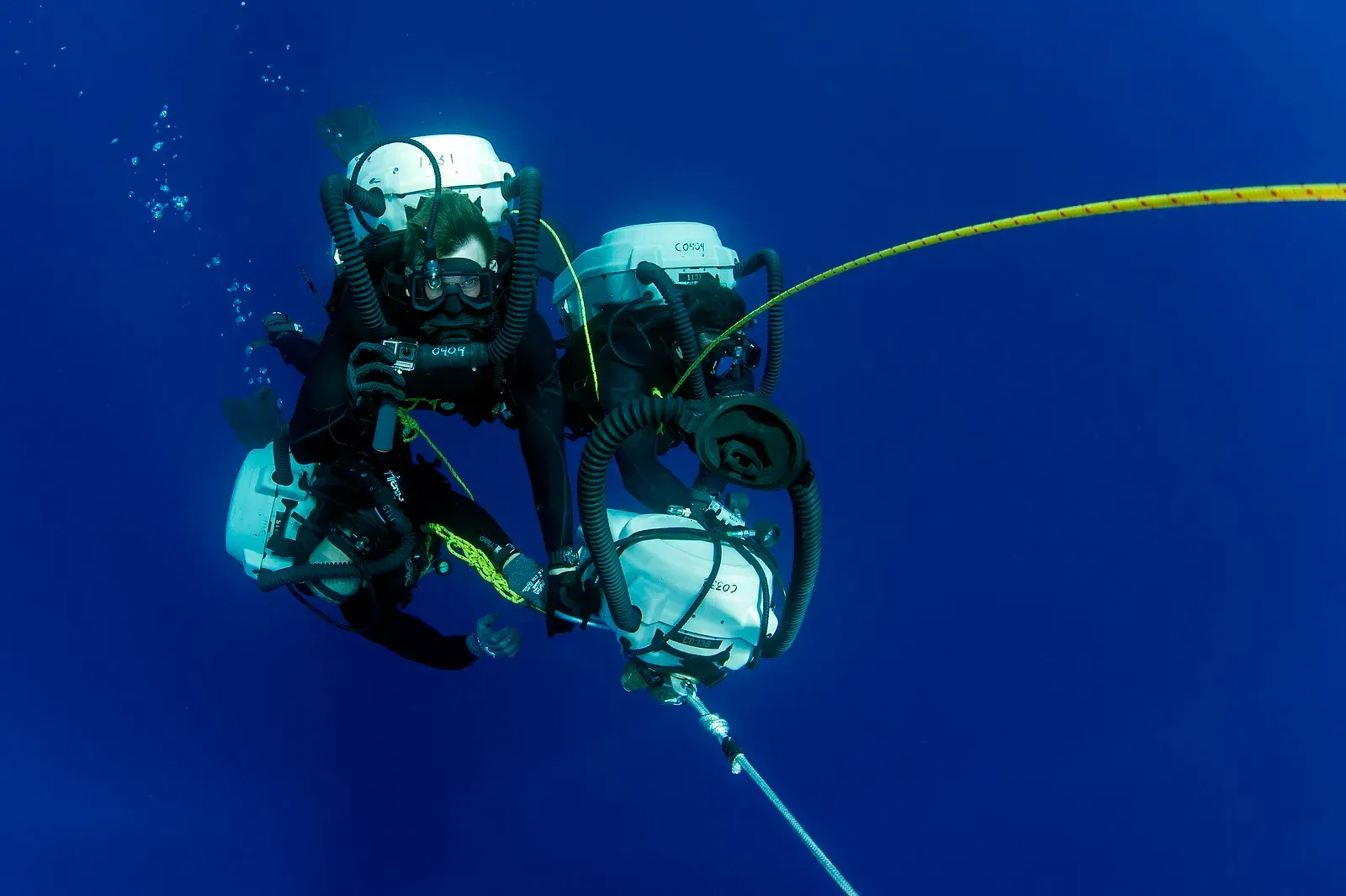
Two ways to surface from the same dive
Forty minutes at 18 metres (60 feet) on air. The Bühlmann ZH-L16C model that draws every decompression diagram on this site — sixteen theoretical tissues, each loading and unloading nitrogen at its own rate, explained properly in how your dive computer decides — gives that dive a no-stop limit of 62 minutes. Nothing about the ascent is mandatory. You may go straight up at 10 metres per minute and the model will not object.
Almost nobody does. What nearly every trained diver does instead is pause at 5 metres, hang there for three minutes, and then surface. The difference between those two endings is not folklore; it is computable to the millibar.
Follow the fastest compartment, the one with the 5-minute half-time. The direct diver breaks the surface carrying 2.00 bar of dissolved nitrogen in it, against an atmosphere of ambient pressure. The stopped diver surfaces three minutes later carrying 1.71 bar in the same tissue. That is what the stop is: not a pause in the ascent but the place where a specific piece of the ascent’s work gets done. At 5 metres the ambient pressure is 1.5 bar, the fast tissues are still far above it, and they unload hard — 0.32 bar out of the 5-minute compartment in three minutes. On the direct ascent, that same offgassing still happens. It just happens at the surface, at 1 bar, with the tissue further above the pressure around it.
Run the chart on for another ten minutes and the two divers’ tissue loadings converge — by the time the kit is rinsed there is nothing between them. What the stop changed is not where you end up an hour later. It is the state in which you cross the surface, and the peak supersaturation your tissues are exposed to there, which is exactly the quantity every bubble study measures and every model polices.
The ledger of the three minutes
The stop is usually described as if the whole diver offgasses during it. The model says something more interesting: the stop is a trade, and every compartment signs a different line of it.
Everything with a half-time under about an hour sheds gas at 5 metres, and the faster the tissue the harder it sheds — 0.32 bar from the 5-minute compartment, 0.21 from the 8-minute, 0.13 from the 12.5. The 77-minute compartment sits within a thousandth of a bar of neutral: 5 metres happens to be almost exactly its break-even depth at the end of this dive. And every compartment slower than that is still taking gas on during the stop. Three extra minutes at 1.5 bar is still uptake for a tissue that spent the whole dive nowhere near equilibrium — about a thousandth or two of a bar, which on this dive is the full price of the stop and a rounding error against what the fast tissues unload.
This is the same mechanism DAN’s gradient-factor explainer describes for technical diving, where a stop held deep “pretty much ensures that inert gas uptake will continue during the stop in the intermediate and slow tissues”. At recreational scale, at 5 metres, the cost side of the ledger is negligible. But the sign of the trade never changes, and it is worth holding onto — it is the entire explanation of the deep-stops story further down.
Where three minutes at five metres came from
The safety stop feels like it must be as old as the tables. It is younger than the aluminium cylinder.
The early researchers tried to solve ascent with speed alone. John Haldane and Leonard Hill experimented with linear ascent rates as slow as 3 to 5 feet per minute, and DAN’s history of the subject notes drily that the rate by itself failed to prevent decompression sickness once exposures got long enough. The number that actually ruled twentieth-century diving was not physiology at all: the 1956 US Navy tables’ 60 feet — 18 metres — per minute was, in DAN’s own account, a compromise between frogmen who wanted out of the water quickly and hardhat divers who could not ascend fast if they tried. It held for decades; the Navy eventually halved it, and its 2008 tables print 30 feet per minute, which is the 9 to 10 metres per minute most Bühlmann-based computers assume today.
The stop itself came from watching bubbles. In the 1970s at the Catalina Marine Science Center, Andrew Pilmanis ran what PADI’s institutional history calls one of the first studies of the safety stop, in 1974, and the finding that a pause near the surface greatly reduces Doppler-detectable bubbles has been passed down ever since — largely through Karl Huggins’ 1992 decompression history rather than a primary paper you can pull off a shelf, which is its own comment on how informally this cornerstone of practice was laid.
Through the 1980s the agencies wrote it into their tables, and none of them wrote the same number. Bassett’s tables asked for 3 to 5 minutes at 3 to 5 metres on any dive past 9 metres. NAUI adopted 3 minutes at 15 feet — 4.6 metres. PADI’s 1984 Open Water manual recommended the stop and the 1988 Recreational Dive Planner printed 3 minutes at 15 feet. Bühlmann’s own tables used 3 metres; BSAC used 6. “Three minutes at five metres” is what that scatter rounds to — a convergence, not a commandment, and no agency’s original number at all.
There is one more honest reason the stop won. When the American Academy of Underwater Sciences convened its Biomechanics of Safe Ascents workshop in 1989 — proceedings published 1990 — the record showed that recreational divers of the era largely could not hold even 60 feet per minute in mid-water without a line or a gauge to watch, while the hardware around them disagreed about the target: constant rates of 33, 40 and 60 feet per minute in different tables, depth-banded rates in the ORCA computers, 50 to 70 in the DCIEM sport tables. A rate is hard to hold. A depth is easy to hold. The stop is, among other things, ascent control repackaged into a form divers can actually perform.
What the stop is worth, in numbers
The model’s way of scoring an ascent is the surfacing gradient factor: how far into the gap between ambient pressure and Bühlmann’s M-value line the worst tissue sits at the moment you surface, where 100 per cent means touching the line the model was fitted against.
Two things in that chart deserve to be read slowly. First, ascent rate is a smaller lever than the training materials imply — for the 18-metre dive, slowing a direct ascent from the old Navy 18 metres per minute to a modern 9 buys about a point and a half of surfacing supersaturation, 78.6 to 77.2 per cent. The stop buys seven. In this dissolved-gas model, a stopped ascent at the old fast Navy rate surfaces a whisker cleaner than a direct crawl at 3 metres per minute — 71.6 against 72.0 per cent, effectively a tie, which is the point: three minutes of stop buys what four extra minutes of crawling buys. Rate still matters — for bubble mechanics the model does not track, and because a fast last few metres is how ears, lungs and buoyancy get hurt — but the arithmetic is clear about where the leverage is.
Second, the stop’s value grows with how loaded you are. The 18-for-40 diver surfaces at 78 per cent direct, 71 with the stop: polish. Take instead a dive to 30 metres for 20 minutes — this model’s no-stop limit almost exactly — and a direct ascent at 10 metres per minute surfaces at 98 per cent of the M-value, grazing the line. The stop turns that into 84. And at the 1956 Navy rate the same dive surfaces at just over 100: the profile every 1960s table called legal, ascended the way the 1960s prescribed, arrives at the surface past the line a modern model draws. The closer to the limit you run, the less the stop is a courtesy and the more it is doing the work of a decompression stop that was never formally owed.
The human evidence points the same way. A master’s thesis at the University of North Carolina Wilmington by Donna Uguccioni — PADI’s history dates it to 1994, the formal citation in circulation says 1984, and we have not been able to settle the year — used Doppler ultrasound to show divers who made safety stops carried fewer venous gas bubbles than divers who did not. A DAN trial reported by Bennett and colleagues in 2007 added stops to a theoretically no-stop 25-metre profile and cut precordial Doppler bubble scores significantly; the follow-up found the optimum was about 2.5 minutes deep plus 3 to 5 minutes shallow, with longer stops at either depth buying nothing further. Bennett’s own gloss was that the pause protects the fast compartments — he pointed to the spinal cord’s roughly 13.5-minute half-time — without meaningfully loading the slow ones, which is our ledger diagram in a sentence.
For scale: recreational diving’s DCS rate runs at roughly 1 to 4 cases per 10,000 dives. DAN’s Nick Bird, writing in 2025, adds the distribution that matters — risk climbs with proximity to the no-stop limit, not just past it, and a diver staying within half the allowable bottom time has a negligible risk on a direct ascent. Which is why some current computers quietly extend the stop from three minutes to five when a diver comes within five minutes of the limit or dives past 30 metres. The model above predicts exactly that behaviour: our 18-metre diver’s stop is good manners; the 30-metre diver’s stop is load-bearing.
The deep-stop detour
If three minutes shallow is good, surely a few minutes deep is better — bubbles are smaller there, squeezed by the pressure. That intuition ran the technical diving world for twenty years, and it is worth telling straight, because how it ended is the best evidence the shallow stop rests on.
It began with fish. Richard Pyle, an ichthyologist collecting specimens on deep dives, noticed he felt fine after some dives and wrecked after others, and worked out the difference: on the good dives he had paused, well below his first required stop, to vent the swim bladders of the fish he had caught. The accidental pauses became “Pyle stops”, the idea became bubble-model computers, and deep first stops became technical orthodoxy.
Then the US Navy Experimental Diving Unit tested it properly. Air dives to 170 feet for 30 minutes, the same total decompression time, allocated two ways: first stop shallow at 40 feet, or first stop deep at 70. In almost 400 man-dives, the shallow schedule produced 3 cases of decompression sickness in 192; the deep schedule produced 11 in 198. The explanation its lead author, David Doolette, gives is the ledger above at full scale: time spent deep suppresses bubbles in the fast tissues while the slow tissues, still far from saturation, keep filling — and that gas must still come out later, shallower, with less time left to do it. Subsequent comparisons — French Navy trials, a 2017 Spisni study — kept finding no advantage: the French Navy trials measured the same or more bubbles from deep-stop schedules, Spisni found that pushing stops deeper still bought nothing further, and technical practice moved its first stops back up; Doolette’s own published preference is a gradient factor pair like 70/85.
None of this touches the recreational safety stop, and the people who buried deep stops said so explicitly. On DAN’s 2010 expert panel, Doolette: “Recreational diving within no-decompression limits conducted with a shallow safety stop has a good safety record. There is insufficient evidence to suggest a deep stop offers any advantage.” Simon Mitchell, on the same panel: divers should mind their ascent rates, and “the imposition of shallow safety stops is still considered beneficial”. The field corrected a twenty-year mistake with a controlled trial and kept the three shallow minutes. That is about as strong an endorsement as an optional practice can earn.
Safety stop, deco stop, and the day you skip it
The two stops look identical in the water and could not be more different in kind. A decompression stop is an obligation: the model’s ceiling is below the surface, and ascending past it is the event the whole algorithm exists to prevent. A safety stop is a precaution layered on top of a profile that already permits direct ascent — margin against a mis-set computer, a sloppier profile than you remember diving, and the plain fact that the model is a population average and you are not. On the Saratoga at Bikini or Blackjack’s B-17 off Tufi, the stops are staged, mandatory decompression; on the reefs this guide is written for, the three minutes at 5 metres are yours to spend or not.
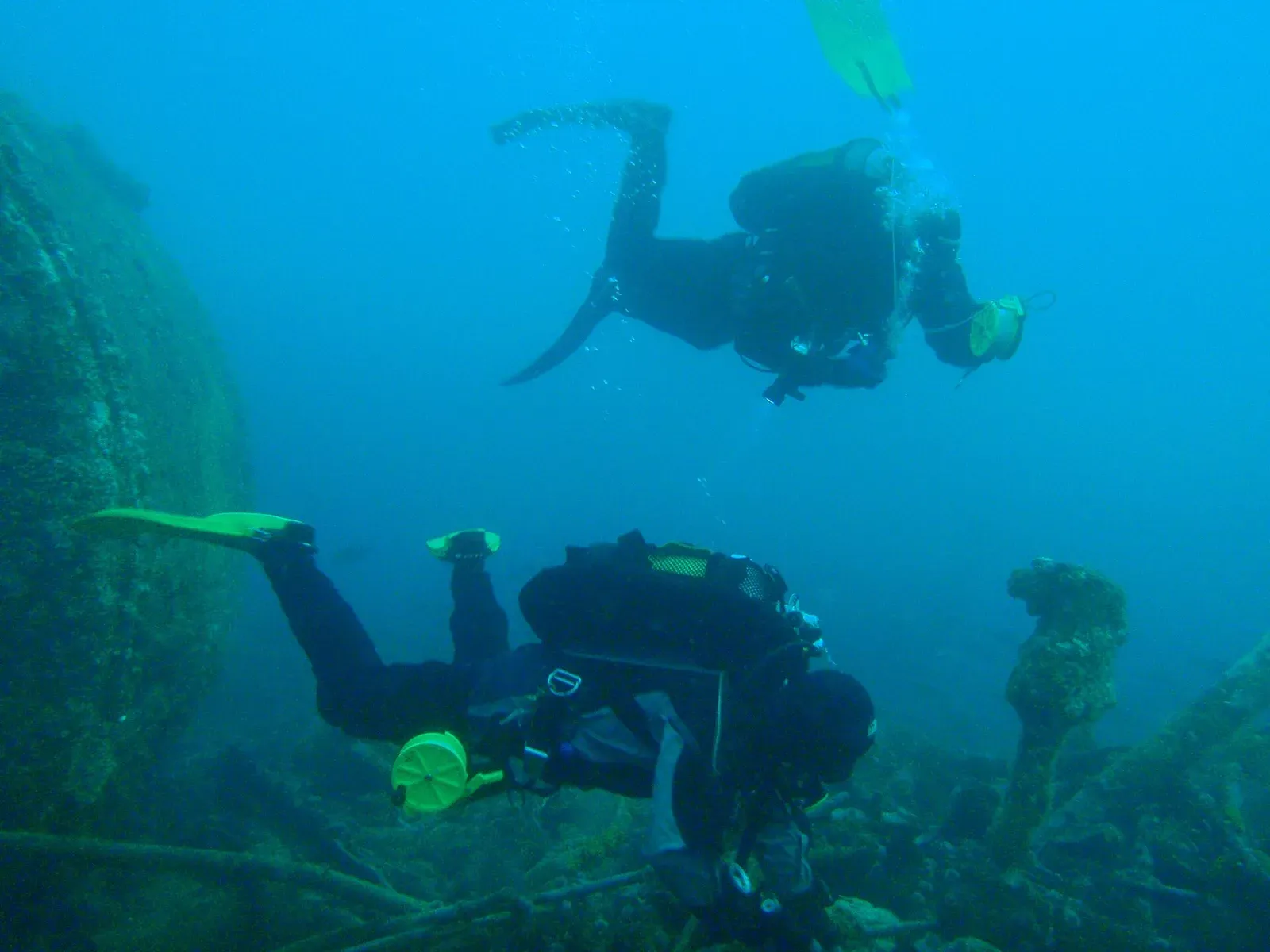
Which is the point of the one rule about skipping it. If you arrive at 5 metres with a gas emergency, a distressed buddy, boat traffic overhead or a medical problem, the stop loses to the surface, every time, without negotiation. The risk arithmetic is lopsided: in DAN’s analysis of 964 diving fatalities, 288 involved an emergency ascent, the most common trigger was simply running out of breathing gas, and of those emergency-ascent deaths, 54 per cent were arterial gas embolism and 18 per cent drowning — decompression sickness accounted for 5. A missed safety stop on a no-stop dive is a slightly elevated bubble score; it is treatable on the rare day it becomes anything at all. The things people have died of while trying to stay down are not. Surface at a controlled rate, breathing out, and skip the ceremony.
Where the stop is part of the dive
The best argument for the stop was never the model; it is that three minutes at 5 metres is prime reef. These are sites from our data where the stop is written into how the dive is run — a volcano venting bubbles at exactly stop depth, mast tips rigged at 5 metres, barracuda stacked over a wreck, a drift that carries the stop through a pass.
| Site | Depth | Level | Best months |
|---|---|---|---|
| Champagne Reef Dominica · Dominica | to 4 m | Beginner | Dec–Mar |
| Tiputa Pass Rangiroa · French Polynesia | to 35 m | Advanced | Dec–Apr |
| Sankisan Maru Chuuk Lagoon · Micronesia | 5–30 m | Intermediate | Nov–May |
| El Faro Jardines de la Reina · Cuba | 6–30 m | Intermediate | Dec–Apr |
| Rose Wall Cocos (Keeling) Islands · Australia | 7–30 m | Intermediate | Apr–Jun |
| Fly Point Nelson Bay · Australia | 5–25 m | Intermediate | Apr–Aug |
| The Crow's Nest SS Yongala · Australia | 16–30 m | Advanced | Jun–Sep |
| Trinity Caves Grand Cayman · Cayman Islands | 15–30 m | Advanced | Dec–Apr |
| Cod Hole Great Barrier Reef · Australia | 10–25 m | Intermediate | Jun–Sep |
| Anemone Reef Phi Phi & the King Cruiser · Thailand | 4–30 m | Intermediate | Nov–Apr |
A BUBBLING REEF? Scuba Diving Champagne Reef In Dominica - Ep 123 · Blue Horizon Diving on YouTube
The model doing the arithmetic in this guide is unpacked in how your dive computer decides, and what happens to the slow compartments after you surface — the ones the stop quietly topped up — is the subject of flying after diving, because the 18-hour rule is the same ledger read out over a longer clock.


