Twenty-five times faster
The NOAA Diving Manual puts it in one sentence: “Body heat is lost 25 times faster in water than in air of the same temperature.” Then it makes the sentence concrete — four hours in 21 °C water is, as an exposure, the equivalent of standing unclothed in 21 °C air for a hundred hours. Nobody would call either environment cold on land. In the water, the same number on the thermometer is a different physical fact.
Two properties do it. The first is conductivity: still water conducts heat at about 0.6 watts per metre-kelvin against still air’s 0.026 — water moves your heat away 23 times faster through simple contact. The second is capacity, and it is the one that matters at the scale of a sea. A cubic metre of water absorbs about 4.18 megajoules per degree it warms; a cubic metre of air absorbs 1.21 kilojoules — a ratio of roughly 3,500. Around a radiator, air warms quickly and stays; the film of water your body warms holds three and a half thousand times more of your heat per degree, and the ocean behind it is effectively infinite. You will never warm your surroundings underwater. The gradient that drives the loss on the first minute of the dive is still there, undiminished, on the last.
Kilogram for kilogram the two substances are less different — 4,184 joules per kilogram-kelvin for water against about 1,005 for air — but you do not meet water by the kilogram. You meet it by the cubic metre, endlessly replaced.
Still water is the kindest water
Those conduction numbers are for water that holds still, and water rarely does. As soon as it moves, convection replaces the warmed film against your skin with fresh cold, and the loss multiplies. This is why a swimmer generating heat by finning can still lose the exchange: the physiology sources are blunt that for an unprotected person, the extra heat made by moving is outweighed by the extra heat carried off by the water moving over them.
It is also the entire argument for a wetsuit that fits. The suit’s job is to trap a millimetres-thin layer of water and keep it — a loose suit pumps that warmed layer out through the neck and cuffs with every kick and replaces it with sea, a process the diving literature calls flushing, and a flushing suit is closer to no suit than to a sealed one. The cold-water guide covers the kit choices; the physics here only insists on one spec: whatever you wear must stop the water moving.
The bill for every breath
There is a heat loss no suit can touch, because it happens inside your chest. Gas from a cylinder is bone dry, and it arrives cold — the pressure drop across the regulator chills it below water temperature, commonly below freezing at the mouth. Your airways return it at close to core temperature, saturated with water vapour, about 44 milligrams of it per litre, and every gram of that vapour costs some 2,400 joules to evaporate. None of this heat comes back. It leaves with the bubbles.
The two halves of the bill behave differently, and the difference is the point. Wetting the gas costs a flat 32 watts at our 18 litres a minute, at every depth — vapour content is set by body temperature, not pressure. But warming the gas depends on how many grams each litre holds, and gas gains roughly another surface-worth of density every ten metres. Ten watts at the surface becomes 49 at 40 metres (130 feet); past about 22 metres the warming overtakes the wetting, and the total bill nearly doubles from 42 watts to 81 across the first four atmospheres — charitably assuming the gas only arrives at water temperature, when a hard-working first stage delivers it colder. Push the inputs to a hard dive — a working diver’s 25 litres a minute in 4 °C water at 30 metres — and breathing alone drains more than 110 watts, roughly the entire resting heat output of a human body, spent on conditioning air you immediately throw away. Deep cold dives chill from the inside; commercial diving takes this to its logical end, heating the gas itself — NOAA notes that below about 150 metres, breathing gas must be warmed to avoid hypothermia, helium mixes being the worst case since helium conducts heat about six times as well as air.
There is a sting in the same arithmetic: the diver breathing hardest to stay warm is also emptying the cylinder fastest. Cold does not only end dives through fingers. It ends them through the gauge.
Your wetsuit is thinner down there
The insulation in a wetsuit is not the rubber; it is the nitrogen foamed through the rubber, thousands of trapped bubbles doing what trapped gas does. Uncompressed foam neoprene conducts about 0.054 W/m·K — a tenth of water’s rate. But trapped gas obeys pressure, and this site has already measured what depth does to it: the hydrostatic compression published by Bardy, Mollendorf and Pendergast takes about 30 per cent of the foam’s volume by 10 metres. The suit covers the same skin at every depth, so lost volume is lost thickness.
Read the amber curve as a shop rack: the 5 mm suit you bought is a 3.5 mm suit at 10 metres, a 3.2 at 20, a 2.9 at 30 — 58 per cent of its surface insulation left where the water is coldest. And the chart is the kind version, because it holds the foam’s conductivity constant while the real material, squeezed denser, conducts better as it thins — the wetsuit literature reckons a foam that has lost half its thickness conducts about 50 per cent better, passing heat at roughly three times the surface rate, a point different neoprenes reach at very different depths. Buoyancy and warmth are the same failure with two invoices: the compression that strips lift from the suit strips insulation in the same breath, and neither loss can be added back with an inflator.
The dives themselves stack. NOAA’s wetsuit-versus-drysuit table has a wetsuit delivering 80 per cent of its needed protection on the first dive in 10 °C water, 70 on the second, 50 on the third — cold carried across surface intervals compounds like residual nitrogen does, and by dive three the suit is writing cheques the day cannot cash.
The drysuit line
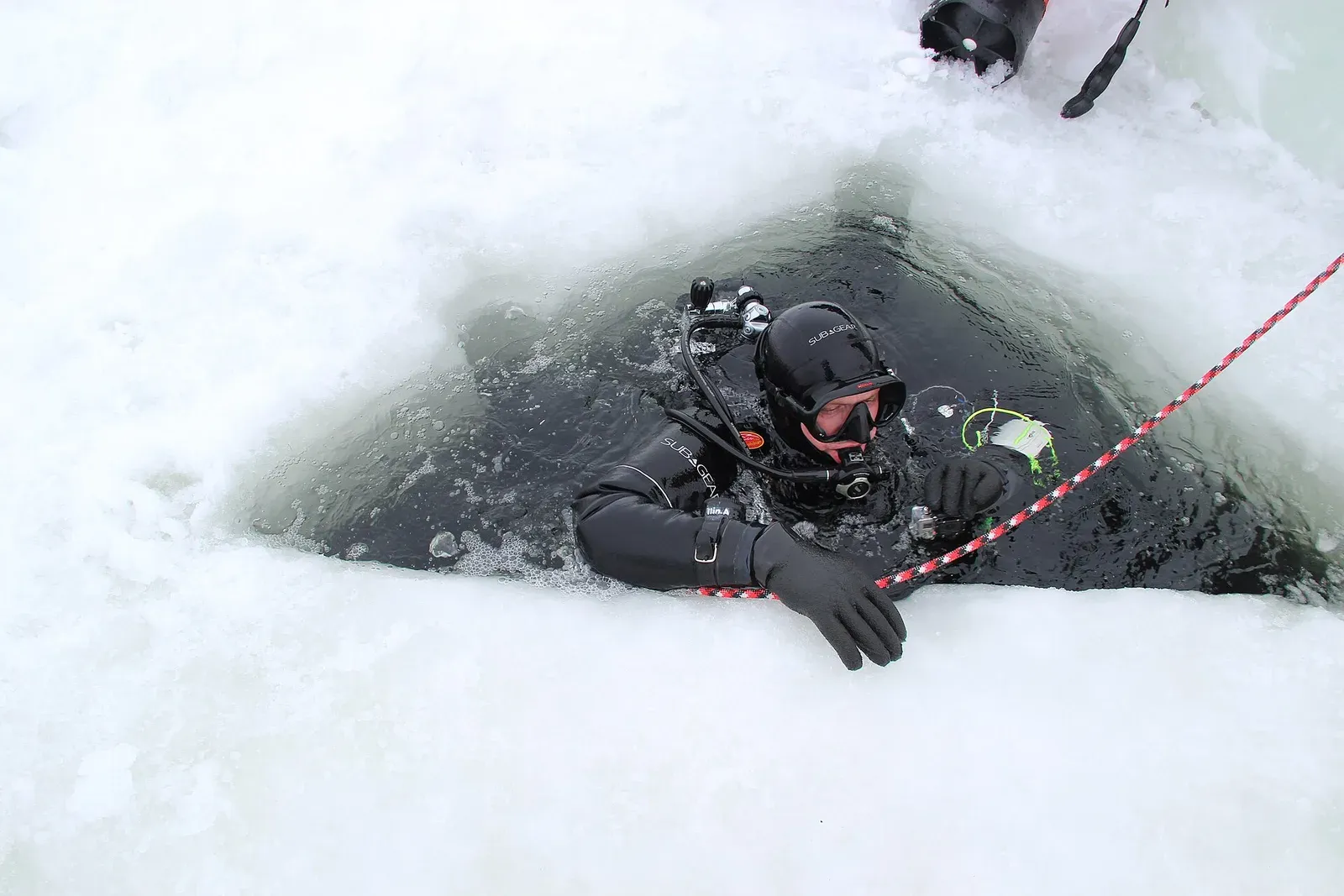
Follow the compression maths down and it ends at a simple verdict: below some temperature, foam that thins with depth cannot win. NOAA draws the line at about 15 °C — wetsuits are most effective above it, and in colder water a drysuit is generally recommended. The drysuit’s trick is that its insulation is not a material at all but a gas layer you control. The suit keeps the water off your skin entirely; undergarments loft a blanket of air; and because you add gas on descent — the same squeeze-management the buoyancy guide walks through — the insulating layer is restored at depth instead of surrendered to it. A shell suit at 30 metres insulates like a shell suit at the surface, which no foam can say. (Foam-neoprene drysuits are the halfway case: dry, but still compressible.)
One aside for the gadget-minded: inflating the suit with argon instead of air — the gas is 32 per cent less conductive — is a real physical effect that a controlled trial could not turn into a measurably warmer diver. The layering underneath matters; the boutique gas, against plain air, apparently does not. (Keeping a helium-based breathing mix out of the suit is a different and much better argument.)
When cold is the dive plan
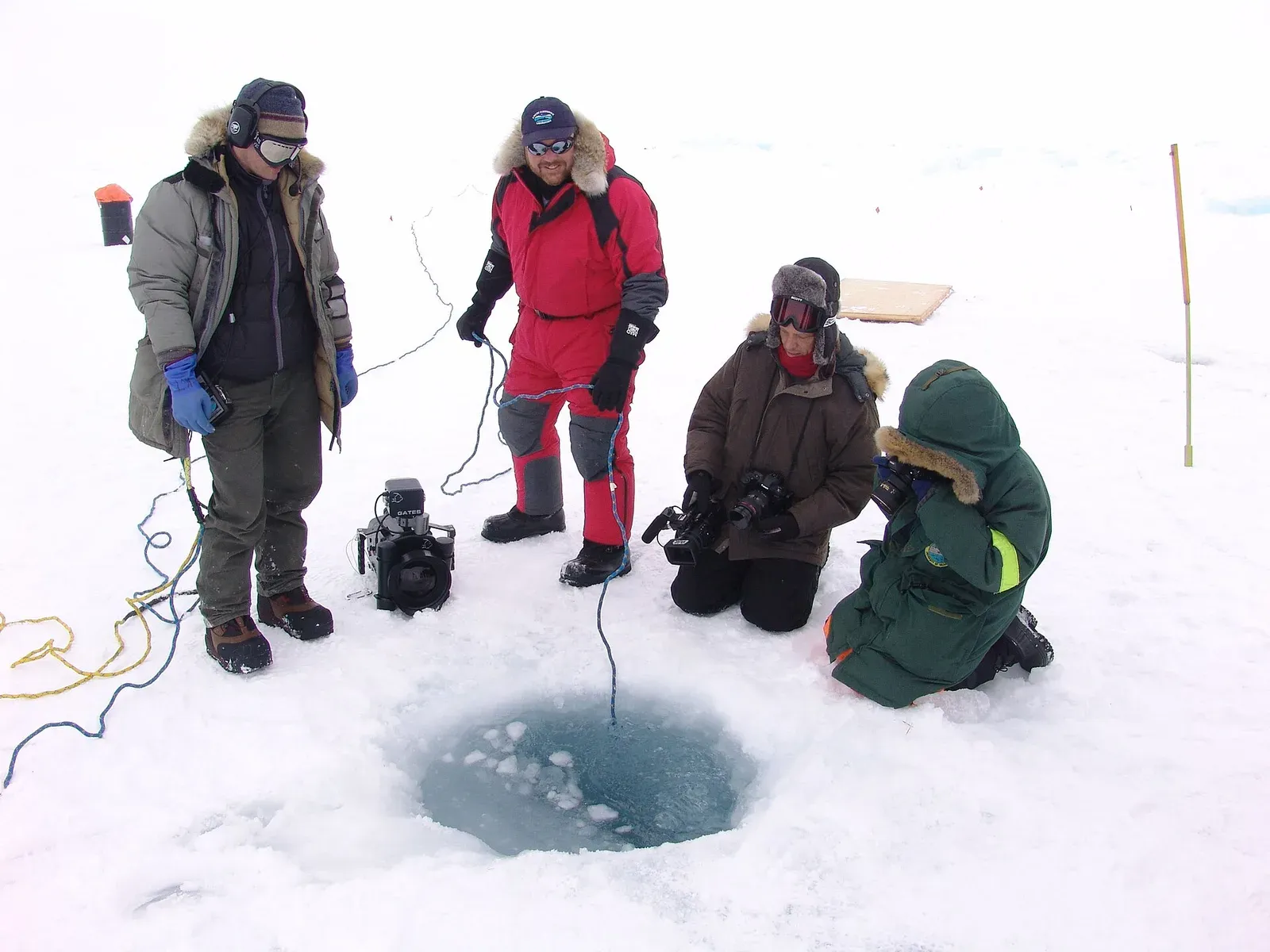
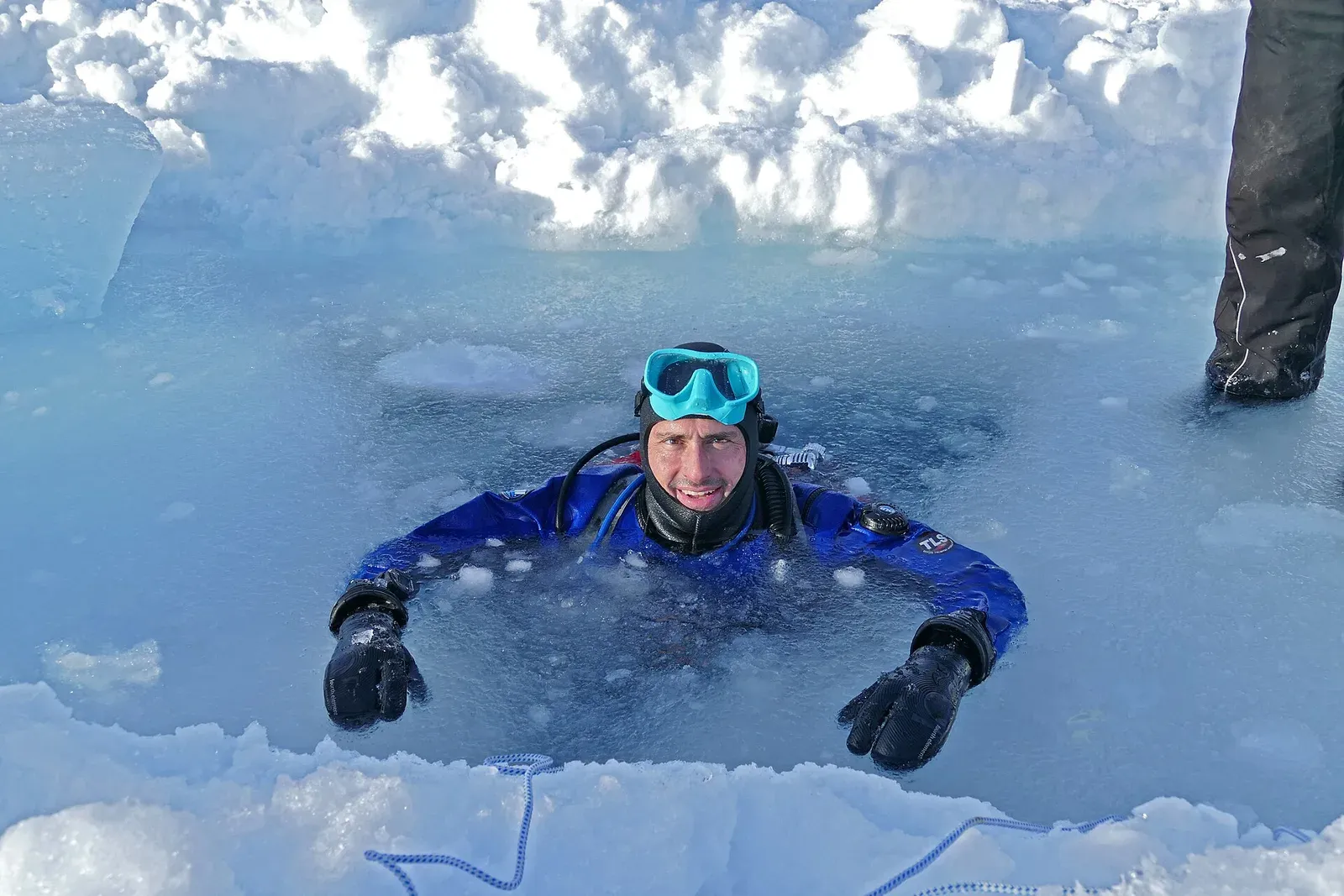
Honesty section, sourced from the people who treat it. Clinical hypothermia is a core temperature below 35 °C, and divers almost never get there in the water — what they get is the long approach to it, and the approach is where the danger lives. DAN’s field guide calls the first stage “the umbles”: fumbling, mumbling, grumbling — fine motor control going first, then judgement, exactly the two things a diver spends. NOAA’s manual gives the operational version, a terminate-the-dive list rather than a slogan: loss of dexterity or grip, difficulty with routine tasks or repeating them, intermittent shivering, or behavioural change in a buddy. Hands are usually the clock — below about 15 °C of hand temperature, strength and dexterity fall off — which is why experienced cold-water divers say, accurately, that dives end on fingers. In the Verzasca’s 7-to-10-degree pools the local pattern is several short immersions with long warm-ups on the rocks between, which is the checklist applied in advance.
Two traps deserve naming. Cold shock is the first: sudden immersion below about 15 °C triggers a gasp reflex and cuts breath-hold ability from a minute or more to seconds — the argument for flooding your hood and seals gradually at the surface rather than striding into the Silfra crack like it’s Bonaire. Warm-water hypothermia is the second: NOAA documents slow cooling on long, repeated dives in water as warm as 27 to 33 °C — the tropics on a liveaboard week are a mild version of the same ledger. And the ledger reaches into decompression: getting cold in the late dive slows the perfusion that offgassing depends on, so the chilled diver is loading a model that assumes a warmer body. Cold is not a comfort problem with a safety footnote. It is a safety problem that announces itself as discomfort.
Where the cold water is
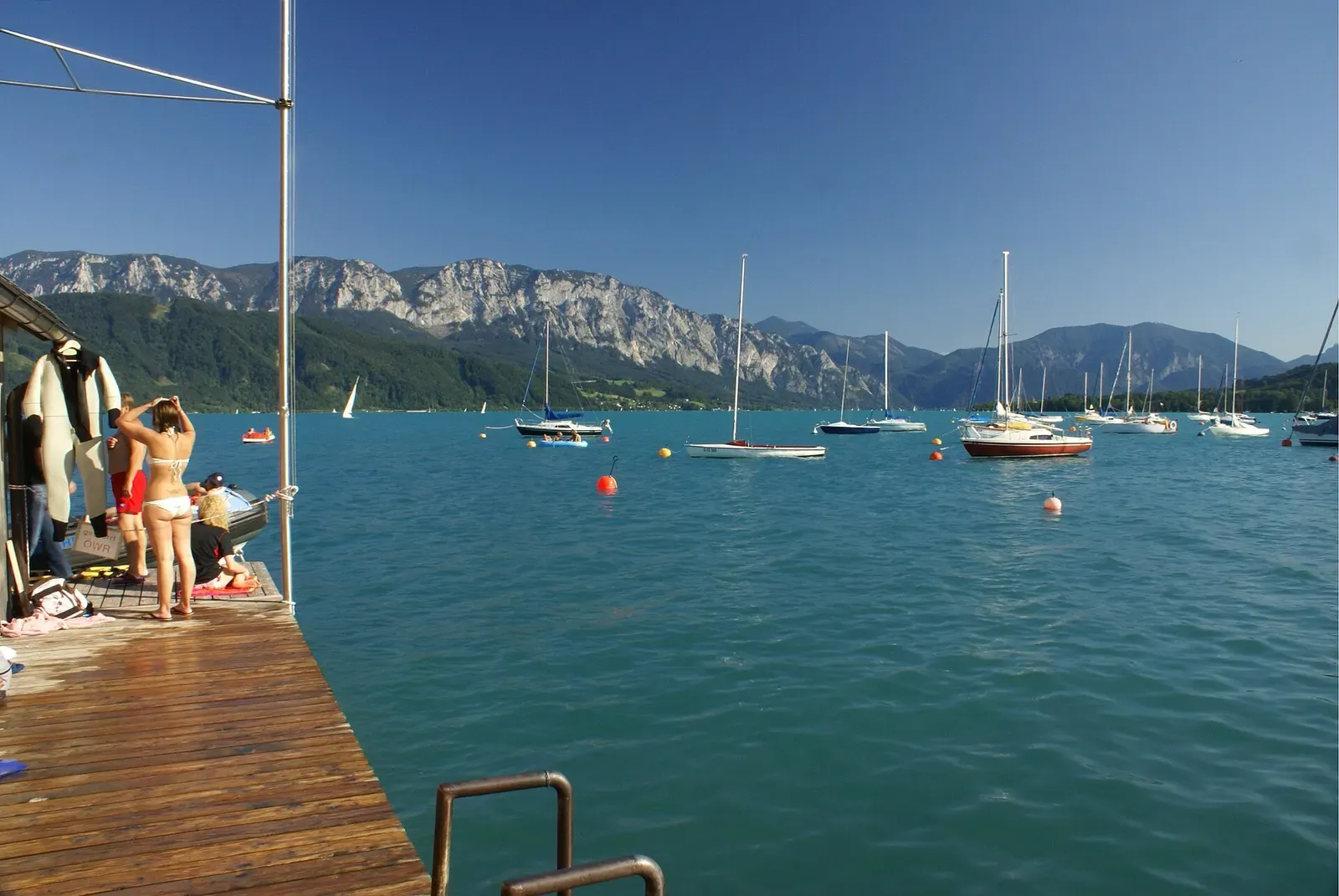
The places worth being cold for, from our own records: Silfra’s 2–4 °C glacial filtrate between the continents, Scapa Flow’s High Seas Fleet, Bell Island’s torpedoed ore carriers in iceberg water, the Attersee’s alpine walls, Paradise Harbour at the freezing point of the sea itself — and one glorious inversion: Strýtan, a hydrothermal chimney in a cold Icelandic fjord venting water at 72 to 75 °C, the only dive on this list where the hazard brief includes too much heat.
| Site | Depth | Level | Best months |
|---|---|---|---|
| Silfra Big Crack Silfra · Iceland | 0.5–18 m | Intermediate | May–Sep |
| Silfra Cathedral Silfra · Iceland | to 18 m | Intermediate | May–Sep |
| Strýtan Strýtan · Iceland | 15–30 m | Advanced | May–Aug |
| SMS Köln Scapa Flow · United Kingdom | 22–36 m | Advanced | Jun–Aug |
| SMS Markgraf Scapa Flow · United Kingdom | 25–45 m | Advanced | Jun–Aug |
| SS Saganaga Bell Island & Conception Bay · Canada | 18–26 m | Intermediate | Jun–Aug |
| Paradise Harbour Antarctic Peninsula · Antarctica | to 20 m | Advanced | Dec–Feb |
| Deception Island Antarctic Peninsula · Antarctica | to 20 m | Advanced | Dec–Feb |
| Sund Rock Puget Sound · United States | 21–24 m | Intermediate | Oct–Feb |
| Schwarze Brücke Attersee · Austria | to 40 m | Advanced | Dec–Feb |
| Ponte dei Salti Verzasca Valley · Switzerland | to 10 m | Intermediate | Jun–Aug |
| Rubicon Wall Lake Tahoe · United States | to 27 m | Advanced | Jul–Sep |
Strýtan in Northern Iceland - The only hydrothermal chimney you can scuba dive at · The Jetlagged Underwater Films & Ocean Adventures on YouTube
The suit-compression arithmetic continues in buoyancy and weighting; the gas-density curve behind the breathing bill is in gas density and narcosis; and what cold water is actually like to dive — the kit, the fauna, the discipline — is the subject of the cold-water guide.