
Pacific Islands · Marshall Islands
Bikini Atoll
Sunken WWII battleships and a US carrier lie deep in a former nuclear test lagoon.
Photo: Unknown author · Public domain
Bikini Atoll's lagoon holds the fleet sunk during the 1946 Operation Crossroads nuclear tests, including the Japanese battleship Nagato, the German cruiser Prinz Eugen, and the US carrier Saratoga, whose flight deck and hangar bay sit largely intact. These are deep, often decompression wrecks in open, current-free water with excellent visibility, reached only by long-range liveaboard. Marine life has rebounded across decades without fishing pressure, and grey reef sharks and oceanic whitetips patrol the surrounding reef.
About diving in Bikini Atoll
Nothing about this is casual. Diving is by liveaboard on a long charter, and the day is built around one or two dives with serious decompression rather than a rotation of tanks. Descents run down a shot line, teams stay together with an agreed plan for the part of the ship they intend to see, and ascents typically finish hanging on a bar with gas staged for the stops. Between dives there is very little to do and nowhere to go, which is a real part of what the trip feels like.
Scale is what catches people out. These are capital ships, and the water never shows you a whole hull, so a single dive covers a deck, a turret or a stretch of hangar and nothing more. Several are capsized or resting on their superstructure, so orientation has to be worked out in the water rather than assumed from a plan; the carrier settled upright hours after the underwater shot, while one battleship stayed afloat for days before going down inverted. Growth is light for the depth and the years, and the steel still reads as machinery.
The draw is swimming through recent history that was destroyed deliberately and in public: guns still trained where the crews left them before the ships were abandoned as targets, ladders and hatches and fittings intact, an operation filmed and photographed from every angle at the time. Read the rest of it first. The atoll's people were moved off in 1946, a resettlement in the 1970s was reversed after radiological testing, and the islands stay uninhabited apart from an intermittent caretaker presence, so boats provision entirely from outside.
It suits experienced deep divers comfortable with staged decompression, long hangs, a rigid plan and being a very long way from a chamber. Charters run the calmer April-to-November months and have started and stopped over the years as operators and permissions change, so confirm a trip is genuinely sailing before booking flights across the Pacific. Radiation questions come up constantly; the standing view is that a short visit spent mostly in the water is low exposure, with locally grown food the concern rather than the lagoon.
Best time to dive Bikini Atoll
| Jan | Feb | Mar | Apr | May | Jun | Jul | Aug | Sep | Oct | Nov | Dec | |
|---|---|---|---|---|---|---|---|---|---|---|---|---|
| Season | Fair | Fair | Fair | Good | Good | Good | Good | Good | Good | Good | Good | Fair |
| Sea surface | 28°C82°F | 27°C81°F | 28°C82°F | 28°C82°F | 28°C82°F | 29°C84°F | 29°C84°F | 29°C84°F | 30°C86°F | 29°C84°F | 29°C84°F | 28°C82°F |
| Daytime high | 28°C82°F | 28°C82°F | 28°C82°F | 28°C82°F | 29°C84°F | 29°C84°F | 29°C84°F | 29°C84°F | 30°C86°F | 29°C84°F | 29°C84°F | 29°C84°F |
| Rain | 24 mm0.9 in | 31 mm1.2 in | 45 mm1.8 in | 55 mm2.2 in | 74 mm2.9 in | 77 mm3.0 in | 118 mm4.6 in | 128 mm5.0 in | 139 mm5.5 in | 167 mm6.6 in | 103 mm4.1 in | 35 mm1.4 in |
| Jan | Feb | Mar | Apr | May | Jun |
|---|---|---|---|---|---|
| Fair | Fair | Fair | Good | Good | Good |
| Sea surface | |||||
| 28°C82°F | 27°C81°F | 28°C82°F | 28°C82°F | 28°C82°F | 29°C84°F |
| Daytime high | |||||
| 28°C82°F | 28°C82°F | 28°C82°F | 28°C82°F | 29°C84°F | 29°C84°F |
| Rain | |||||
| 24 mm0.9 in | 31 mm1.2 in | 45 mm1.8 in | 55 mm2.2 in | 74 mm2.9 in | 77 mm3.0 in |
| Jul | Aug | Sep | Oct | Nov | Dec |
|---|---|---|---|---|---|
| Good | Good | Good | Good | Good | Fair |
| Sea surface | |||||
| 29°C84°F | 29°C84°F | 30°C86°F | 29°C84°F | 29°C84°F | 28°C82°F |
| Daytime high | |||||
| 29°C84°F | 29°C84°F | 30°C86°F | 29°C84°F | 29°C84°F | 29°C84°F |
| Rain | |||||
| 118 mm4.6 in | 128 mm5.0 in | 139 mm5.5 in | 167 mm6.6 in | 103 mm4.1 in | 35 mm1.4 in |
2011–2025 averages. Sea surface: NOAA Coral Reef Watch, measured at the surface, so deeper water can run colder. Daytime high and rain: NASA POWER.
Charters run in the calmer Apr-Nov window; remote crossing logistics and permit scheduling limit trips outside this period. Residual radiation is monitored and considered low for dive visits.
Best months: April, May, June, July, August, September, October, November
Bikini Atoll water temperature and weather by month
The sea surface runs from 27 °C (81 °F) in February to 30 °C (86 °F) in September. Most rain falls from July to November, peaking at about 170 mm (6.7 in) in October; it stays largely dry from December to March. Daytime highs sit around 29 °C (84 °F) all year. The coldest water here is about 27 °C (81 °F), so pack a 3 mm, or even a 2 mm, suit.
Dive types & marine life
Reef sharks meet the boat and often stay through the decompression hangs, which is most of what makes the long stops pass. Jacks, barracuda, big grouper and napoleon wrasse hold on the wrecks and along the reef, with turtles over the shallows, and oceanic whitetips are reported out in the blue. None of it is seasonal, so the animals are the same whenever charters are sailing.
- Wreck
- Pelagic & blue water
- Reef
- Reef sharks
- Oceanic whitetips
- Napoleon wrasse
- Barracuda
- Trevally & jacks
- Groupers
- Sea turtles
Best dive sites in Bikini Atoll
Wreck
Four battleship propellers, upside down at 33.5 m
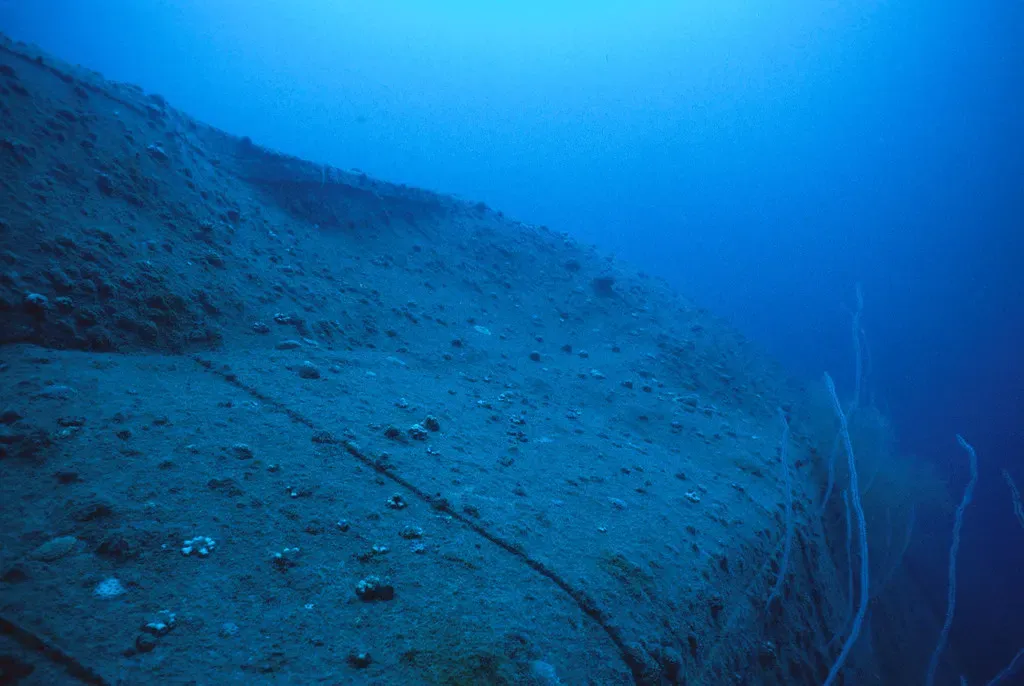
A 1911 battleship, inverted at 55 m by an atomic shock wave
Wreck
Helldivers still parked in the hangar of a sunken carrier
How to get to Bikini Atoll
Access is through the Marshall Islands, with Majuro the usual gateway on the island-hopper routing, and the atoll is an open-ocean crossing of a night or more from wherever the charter starts. Departure ports have varied between operators, so confirm the itinerary. Permits are arranged by the charter rather than by individuals.
Dive videos
Bikini Atoll Wreck Diving · Insider Divers on YouTube
The Nuclear Ghost Fleet Of Bikini Atoll PART 2: World Class Wreck Diving · Divers Ready on YouTube
Photo credits
- Aerial view of USS Saratoga's flight deck breaking the surface as she sinks in Bikini Atoll lagoon, 1946 by Unknown author, Public domain, via Wikimedia Commons
Embed
Run a dive centre, club or blog? Embed this map of 1 dive sites near Bikini Atoll on your own page.
In The Logbook
- What is decompression sickness (the bends)?Body & health · 18 min read
- Why is 1.4 bar the oxygen limit in diving?Body & health · 13 min read
- Do you need a safety stop? What it buys youBody & health · 11 min read
- How long to wait before flying after divingBody & health · 8 min read
- Deep wreck diving: where recreational stopsWrecks · 8 min read
- Air, nitrox or trimix: which gas, and when?Gear & kit · 15 min read
- DPV diving: what an underwater scooter changesGear & kit · 10 min read
Similar destinations

Hooked onto the reef at Blue Corner as schools and grey reef sharks pour past
Up to 100 bull sharks on one dive inside Fiji's first National Marine Park
Pacific Islands
A pinnacle rising 900 m from the seabed to within metres of the surface

_sinking_in_Bikini_Atoll_lagoon_on_25_July_1946_(SC_259372).jpg)
Hundreds of grey reef sharks pack South Pass during the June grouper spawn.