The shark that comes up to be cleaned
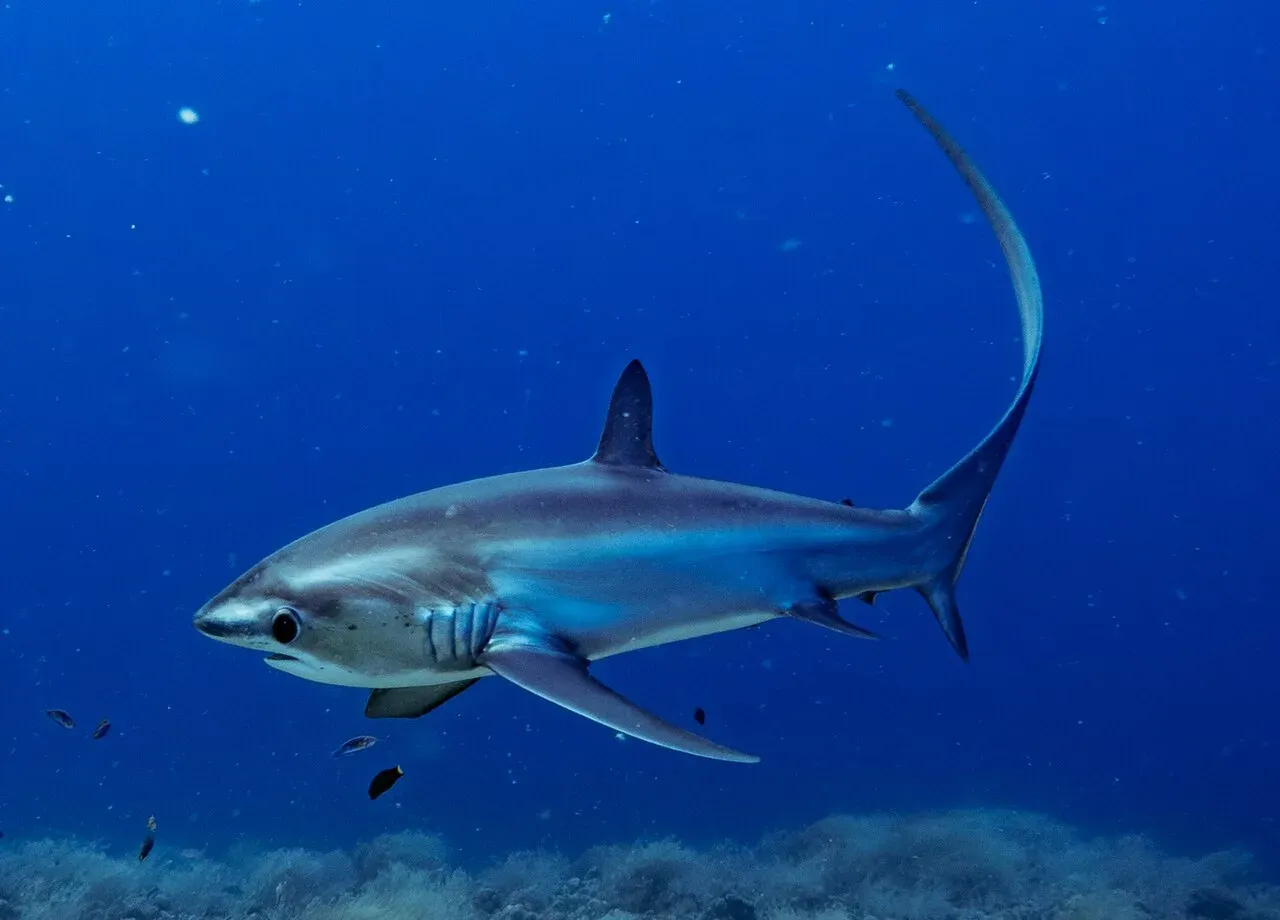
Half of a thresher shark is tail. The pelagic thresher — the species divers actually meet — is the smallest of the three threshers, around three metres and up to 3.8, and the upper lobe of its caudal fin is about as long as the rest of the animal. The field marks are a deep blue back, a large round eye, a small mouth, long straight pectorals, and dark colour running down over the pectoral-fin bases, which is what separates it from its two relatives. It is an open-ocean shark that spends most of its life in the top 150 metres over deep water, and the genus has been recorded far deeper — past the 500 metres long assumed to be its floor, on ROV footage. No thresher species is considered a threat to humans; divers who have met them describe the opposite of aggression. The jaws are small for the body, and the animal’s response to a diver who moves too fast is to leave.
None of which explains why you can meet one at 18 metres (60 feet), on a plateau, on purpose. The answer is hygiene. Threshers carry parasites, and at a handful of seamounts they rise out of deep water to have cleaner wrasse pick them over. Between July 2005 and December 2009 the Thresher Shark Research and Conservation Project ran more than 1,200 hours of remote video at Monad Shoal — the original station, eight kilometres east of Malapascua — and analysed 97 of these cleaning events for a paper in PLOS ONE. The detail is wonderfully unglamorous: the wrasse concentrate about a third of their inspections on the shark’s pelvic region, with the pectoral fins and that famous tail next, and the sharks slow into a stylised circling posture — the researchers call it circular-stance-swimming — to make themselves easier to work on. That behaviour is the entire dive industry of one small Philippine island. The shark does not come up for divers, or for food. It comes up for a service, and it keeps appointments.
The dive that moved
For two decades the appointment was at Monad Shoal: a sunken seamount eight kilometres east of Malapascua, a 6am departure, a thirty-minute crossing in the dark, and a descent onto a flat top at 20 to 24 metres to wait at cleaning stations along the rim of a 200-metre drop. It was dawn-only and dim, and it was the one place on earth where a thresher shark was a reliable daily sighting rather than a stroke of luck.
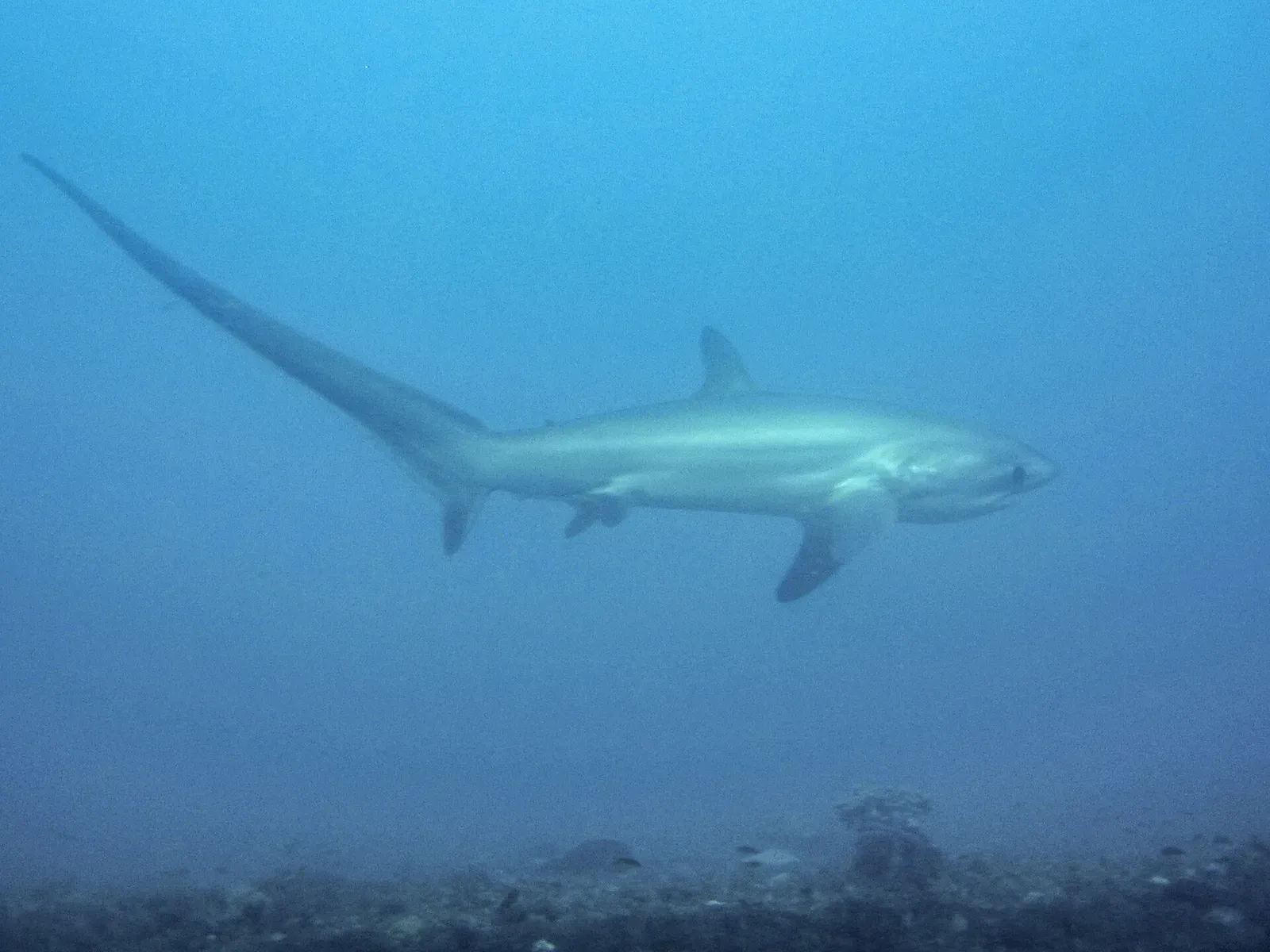
In September 2022 it stopped. Sightings at Monad dwindled over a few short weeks and then ended, and the sharks turned out to have moved their cleaning to Kimud Shoal, another sunken island about fifteen kilometres southeast of Malapascua in Leyte waters, near Tabango. The early boats followed them, and the move has held ever since.
Nobody can tell you why with any authority, and it is worth being precise about who claims what. Alert Diver, DAN’s magazine, states the theory most plainly: tiger sharks — more aggressive predators, several links higher on the food chain — began patrolling Monad Shoal at the same time, and the threshers likely moved away for self-preservation. Dive The World reports a different culprit: hammerheads, present at Monad particularly from January to April, to which the threshers gave up the territory. And Evolution Diving Resort, one of the operators that dives these shoals daily, declines to pick, saying only that the threshers moved “for reasons unknown (but speculated by many)”. No peer-reviewed explanation has been published. Three sources, three answers, and the honest summary is that the sharks left and nobody was consulted.
What matters for a diver is that this was a change of address, not an ending — and that a lot of the internet has not caught up. Older articles, and Wikipedia’s Malapascua page, still describe Monad Shoal in the present tense as the place to see threshers. It is not. Monad Shoal is still dived, now for the tiger sharks that may have started all this, for hammerheads reported from January to April, and for mobula, manta and eagle rays — random encounters rather than scheduled ones, on a site rated advanced. The daily thresher dive is Kimud, and Malapascua remains what it has been for twenty years: the only place on earth where seeing this animal is the reasonable expectation for a morning’s diving rather than the hope.
How the Kimud dive is run
The move made the dive better. Monad’s plateau sat at 20 to 24 metres and its window closed at sunrise; Kimud rises from more than 200 metres to a flattish top at 12 to 14 metres, with cleaning stations along it at roughly 18 to 22. That is shallower water, which means ambient light for the eye and the camera, generous no-stop time, and viewing that runs from first light through the morning rather than ending when the sun clears the horizon. The operators who run the dive daily report their best sightings in more than twenty years — an operator claim rather than an audited statistic, but a consistent one across the island.
The logistics still favour the committed. Outrigger boats leave Bounty Beach between about 4:30 and 5:30am, mostly because the crossing now takes 45 to 60 minutes against the old thirty. Threshers use Kimud year-round with no month closed, but they are never a certainty on any single morning, so the standard advice is to plan several mornings rather than one. November to February’s northeast monsoon can delay or cancel the longer crossing; April and May give the calmest water. Certification gating is gentler than you might expect for a shark dive of this reputation: the site is rated intermediate, Open Water works with an instructor, and Advanced Open Water is recommended for group dives — gentler than most of the sites in this guide.
Threshers in Kimod Shoal Malapascua · emysy on YouTube
The briefing is where this dive differs most from other big-animal diving, because everything about it is built around not spooking a shy animal off its own appointment. Camera strobes and flashes are not allowed — that is the operators’ wording, not a paraphrase. Divers settle back from the cleaning stations, low and behind the group line, facing outward, and wait. Alert Diver’s guidance adds the fine grain: stay almost stationary, hover horizontally or pivot on your fins rather than swimming, and breathe softly and regularly, because bubble noise disturbs the sharks. Never swim after an animal; a thresher that is followed simply leaves, and it takes everyone else’s sighting with it.
The shoals have formal protection of long standing on the Monad side: Monad was declared a marine protected area in 2002, and in mid-2015 it became, together with Gato Island, the Philippines’ first shark and ray sanctuary — 1.8 square kilometres with a 500-metre buffer. That status did not spare it a ship grounding in June 2016 that damaged three hectares of the reef. The operators say Kimud has since been given marine-park protection of its own; we have not found the government ordinance to cite, so treat that as an operator statement.
Fuvahmulah, the second reliable site
There is exactly one other place where thresher encounters are regular enough to plan a trip around, and it is an ocean away: Fuvahmulah, the lone open-ocean island of the Maldives’ deep south. The island has several relatively shallow cleaning stations at 12 to 15 metres that pelagic threshers use, most consistently between April and November. That is the reliable thresher work — shallow, seasonal, station-based, recognisably the same behaviour as Kimud.
Thresher Shark sighting in Farikede, Fuvahmulah. · Extreme Dive Fuvahmulah on YouTube
Farikede, the island’s tagged thresher site in our dataset, is a different and harder proposition: a short, powerful drift at a maximum of 30 metres over a plateau that itself lies at 40 to 60, current strong, rated advanced, with threshers listed among the regular sightings but as one name on a long pelagic bill alongside hammerheads, silvertips, whale sharks, oceanic mantas and mola mola. Know which of the two dives you are being sold.
Two honesty notes before you book. First, Fuvahmulah is a tiger shark island — tigers are the daily, year-round headline act — and threshers are the secondary draw; it is best understood as a tiger trip that also, in season, carries the world’s second-best thresher odds. Second, the island’s calendars point in opposite directions: sea conditions are at their calmest and the site ratings at their best from December to April, while the thresher window runs April to November. A trip timed for the easiest boat diving is timed for the thinner end of the thresher season, and the matrix below cannot show you that on its own.
| Site | Jan | Feb | Mar | Apr | May | Jun | Jul | Aug | Sep | Oct | Nov | Dec |
|---|---|---|---|---|---|---|---|---|---|---|---|---|
| Kimud ShoalMalapascua | Fair | Fair | Good | Prime | Prime | Good | Good | Good | Good | Good | Fair | Fair |
| FarikedeFuvahmulah | Prime | Prime | Prime | Prime | Good | Good | Good | Good | Good | Fair | Fair | Prime |
| Big Brother IslandBrothers & Daedalus | Off-season | Off-season | Fair | Good | Prime | Prime | Good | Fair | Prime | Prime | Good | Off-season |
| Little Brother IslandBrothers & Daedalus | Off-season | Off-season | Fair | Good | Prime | Prime | Good | Fair | Prime | Prime | Good | Off-season |
| Numidia WreckBrothers & Daedalus | Off-season | Off-season | Fair | Good | Prime | Prime | Good | Fair | Prime | Prime | Good | Off-season |
| Gota KebirSt John's Reefs | Fair | Fair | Good | Prime | Prime | Prime | Good | Good | Prime | Prime | Good | Fair |
| South PointSipadan | Good | Good | Prime | Prime | Prime | Prime | Prime | Prime | Prime | Good | Fair | Fair |
| Pulau AiBanda Islands | Fair | Fair | Good | Good | Good | Fair | Fair | Fair | Good | Prime | Prime | Fair |
| Pamilacan WallPamilacan | Prime | Prime | Prime | Prime | Prime | Good | Fair | Fair | Fair | Good | Prime | Prime |
| CanyonsPuerto Galera | Prime | Prime | Prime | Prime | Good | Fair | Fair | Fair | Fair | Fair | Good | Good |
Everywhere else, if you’re lucky
Beyond those two, every thresher sighting in our dataset is a bonus, and the sites’ own notes say so in so many words. In the Red Sea, the Brothers — Big Brother, Little Brother and the Numidia on Big Brother’s north wall — carry threshers as occasional visitors that the area’s own wildlife notes do not even headline, and Gota Kebir at St John’s is the same story further south. A caution for Red Sea hopefuls: whichever species is passing, no thresher here keeps recreational-depth appointments — these are chance encounters at the deep edges of the dive. South Point at Sipadan logs threshers at 40-plus metres in the early morning, rated in its own notes as rare rather than routine. Pulau Ai in the Banda Sea has them sighted occasionally off its deep walls, threshers turn up occasionally off Pamilacan Wall, and at the Canyons off Puerto Galera they are one entry on a list of pelagics that have all been seen, which is a different thing from being seen next Tuesday.
One place deserves a different kind of sentence. In Alor, Indonesia, the Pantar Strait is a core thresher habitat where the sharks are commonly seen by residents and tourists in shallow water, and a partnership between Oceanic Society, local operators and the research NGO Thresher Shark Indonesia has been working since 2022 to replace the local thresher fishery with dive tourism. There is no named site, published season or reliability claim yet — so it is not a trip you can book against these standards — but it is the one spot on this map where the story is still being written, and worth watching.
| Site | Depth | Current | Level | Best months |
|---|---|---|---|---|
| Kimud Shoal Malapascua · Philippines | 12–22 m | Moderate | Intermediate | Apr–May |
| Farikede Fuvahmulah · Maldives | to 30 m | Strong | Advanced | Dec–Apr |
| Big Brother Island Brothers & Daedalus · Egypt | 10–35 m | Strong | Advanced | May–Jun |
| Little Brother Island Brothers & Daedalus · Egypt | 10–40 m | Strong | Advanced | May–Jun |
| Numidia Wreck Brothers & Daedalus · Egypt | 8–40 m | Strong | Advanced | May–Jun |
| Gota Kebir St John's Reefs · Egypt | 15–30 m | Moderate | Intermediate | Apr–Jun |
| South Point Sipadan · Malaysia | 25–40 m | Strong | Advanced | Mar–Sep |
| Pulau Ai Banda Islands · Indonesia | to 55 m | Strong | Advanced | Oct–Nov |
| Pamilacan Wall Pamilacan · Philippines | to 40 m | Moderate | Advanced | Nov–May |
| Canyons Puerto Galera · Philippines | 12–32 m | Strong | Advanced | Jan–Apr |
The tail is the weapon
The tail is not ornamental, and the proof was filmed in the Philippines — though not at Malapascua. In 2013 the same research group published a second PLOS ONE paper, built on handheld video shot between June and October 2010 at Pescador Island near Moalboal, on the far side of Cebu from the thresher shoals. The two locations get conflated constantly; keep them apart. Malapascua is where threshers are cleaned. Pescador is where they were caught hunting.
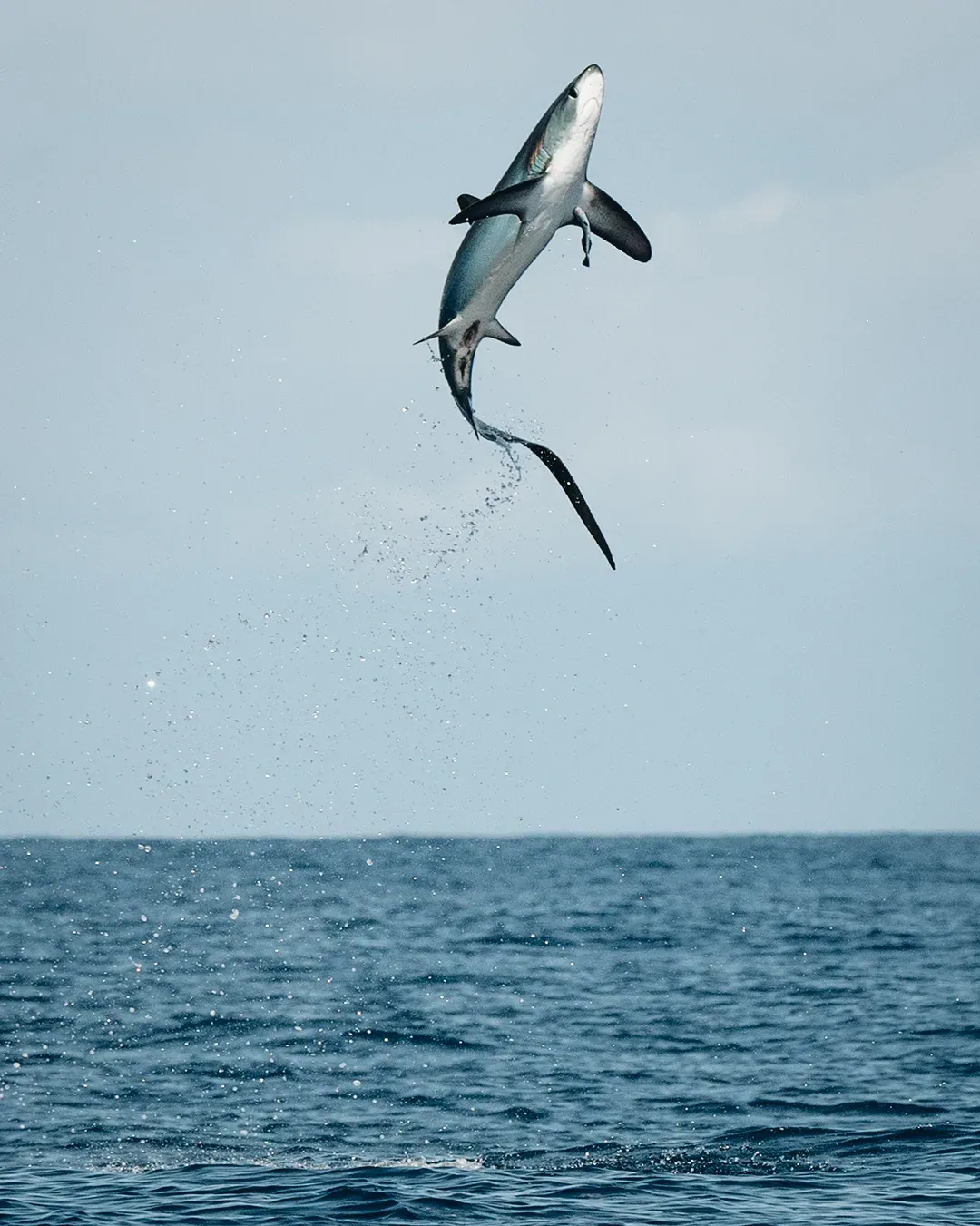
From 61 observations, the researchers analysed 25 hunting events and described a four-phase sequence: preparation, strike, wind-down recovery and prey collection, with the preparation — the wind-up — lasting significantly longer than the rest. The shark pulls its pectoral fins inward, pitching the body so the tail end lifts and the approach stalls, and then whips the upper lobe over the top at prey. The strikes are forceful enough that the paper suggests they may drive dissolved gas out of solution in the water, and a single slap can take more than one sardine. The authors’ conclusion is nearly a shrug of vindication: the evidence is now clear — thresher sharks really do hunt with their tails.
The same weapon is a liability. Threshers strike at longline baits with the tail and get hooked by it, tail-first, which makes an animal that hunts this way disproportionately easy for industrial fisheries to kill.
Three species, three statuses
There are three thresher species, and it pays not to blur them, because they carry three different conservation verdicts. The pelagic thresher — the Malapascua and Fuvahmulah animal — is assessed as Endangered on the IUCN Red List (2019). The bigeye thresher, named for enormous eyes adapted to hunting in low light, is the deep specialist of the family, recorded past 500 metres by satellite tag, with a heat-exchanging rete around the eyes and brain to buffer them on those excursions; it is Vulnerable (2019). The common thresher is the giant, up to 6.1 metres and over 500 kilograms, a coastal shark of California, South Africa and the Mediterranean, the one the sport-fishing world knows and the one dive tourism essentially never sees; it is Vulnerable, reassessed in 2022. Only the common thresher is meaningfully warm-bodied, with heat-generating red muscle and a proper trunk rete — the pelagic thresher lacks that anatomy, so resist the pub fact that all threshers are warm; only the eyes and brain get that treatment, and modestly.
The genus was first flagged Vulnerable across the board in 2007, and in 2016 CITES CoP17 voted all three species onto Appendix II, effective 4 October 2017, putting international trade in their fins and meat under permit. For a diver the arithmetic is the same as for every threatened shark, but rarely this concrete: one shoal off one small island is the only place on the planet where this Endangered animal reliably shows up for paying visitors every morning. What that daily appointment is worth to Malapascua is the strongest argument its sharks have.
Where this overlaps with the rest of the Logbook
Fuvahmulah’s Farikede does double duty in our month-by-month hammerhead guide, and the hammerhead connection runs deeper here than a shared site: by Dive The World’s account, hammerheads are the reason the threshers left Monad Shoal in the first place, and Monad’s own January-to-April hammerhead season is part of what the shoal offers now. If your trip is built around one of these species, that guide tells you what the same water does for the other.
The Red Sea’s occasional tier overlaps almost site-for-site with our oceanic whitetip guide — Big Brother, Little Brother and the Numidia carry both animals, with the whitetip the one an autumn liveaboard is actually there to see and the thresher the long-odds bonus off the wall. And if the Kimud briefing’s discipline appeals to you — animals that come to you, provided you can hold still and breathe quietly — that guide’s mid-water etiquette is the same skill set applied to a much more forward shark.


