
Australia & New Zealand · New Zealand
Fiordland
Tannin-darkened water tricks deep-water black coral into growing at diveable depths.
Photo: Bernard Spragg. NZ · CC0
Fiordland's deep, steep-sided sounds on New Zealand's South Island are capped by a layer of tannin-stained freshwater runoff that blocks sunlight from the saltwater below, tricking deep-water black coral trees into growing at recreational diving depths. Milford and Doubtful Sounds are the most accessible, reached by day boat, while multi-day charters push further south to the remote Dusky and Breaksea Sounds for resident dolphins and Fiordland crested penguins.
About diving in Fiordland
Nothing is dived from shore. At Milford the boats leave the wharf and are on site within minutes, and the walls block the ocean swell well enough that diving can go ahead in weather that would stop a charter on the open coast; the limiting factor is often the mountain road in, which closes for snow and avalanche risk. Doubtful and the fiords south of it are worked as overnight or multi-day charters, with divers living aboard and the running order set by the weather.
The rock walls carry straight on below the waterline, so you drop in against a vertical face and follow it down. The top few metres are the freshwater layer: dark, tea-coloured and blurred where it meets the salt water, and it takes a moment for the view to settle once you are through it. Below it the water is clearer but dim, and torches stay on from the start. Silt and boulder slopes collect at the foot of the walls, and heavy rain pushes the surface layer deeper and darker.
The black coral is the reason to come, and it is not black: living colonies are white, standing off the rock in fans and bushes, with red snake stars wound tight around the branches. Around them the walls carry sea pens, anemones, brachiopods and nudibranchs. It is quiet diving, the interest lying in working slowly along a few metres of wall rather than watching open water, and the colonies are slow-growing and easily broken, so buoyancy counts for more here than depth experience.
Cold, dark and remote, it suits divers who already own a drysuit and use it regularly; hood and gloves are not optional at 8-16C. It is a poor pick for a first cold-water trip, or for anyone who needs the week to go to plan, since rain falls in every month, sandflies are relentless ashore and charters lose days to weather. Divers who like terrain and unusual invertebrates get something they will not easily find elsewhere.
Best time to dive Fiordland
| Jan | Feb | Mar | Apr | May | Jun | Jul | Aug | Sep | Oct | Nov | Dec | |
|---|---|---|---|---|---|---|---|---|---|---|---|---|
| Season | Prime | Prime | Good | Good | Fair | Fair | Fair | Fair | Good | Good | Good | Prime |
| Sea surface | 16°C61°F | 17°C63°F | 16°C61°F | 16°C61°F | 14°C57°F | 13°C55°F | 12°C54°F | 12°C54°F | 12°C54°F | 13°C55°F | 13°C55°F | 15°C59°F |
| Daytime high | 20°C68°F | 20°C68°F | 19°C66°F | 17°C63°F | 14°C57°F | 11°C52°F | 10°C50°F | 11°C52°F | 13°C55°F | 15°C59°F | 17°C63°F | 20°C68°F |
| Rain | 197 mm7.8 in | 164 mm6.5 in | 161 mm6.3 in | 166 mm6.5 in | 194 mm7.6 in | 157 mm6.2 in | 186 mm7.3 in | 161 mm6.3 in | 204 mm8.0 in | 231 mm9.1 in | 185 mm7.3 in | 188 mm7.4 in |
| Jan | Feb | Mar | Apr | May | Jun |
|---|---|---|---|---|---|
| Prime | Prime | Good | Good | Fair | Fair |
| Sea surface | |||||
| 16°C61°F | 17°C63°F | 16°C61°F | 16°C61°F | 14°C57°F | 13°C55°F |
| Daytime high | |||||
| 20°C68°F | 20°C68°F | 19°C66°F | 17°C63°F | 14°C57°F | 11°C52°F |
| Rain | |||||
| 197 mm7.8 in | 164 mm6.5 in | 161 mm6.3 in | 166 mm6.5 in | 194 mm7.6 in | 157 mm6.2 in |
| Jul | Aug | Sep | Oct | Nov | Dec |
|---|---|---|---|---|---|
| Fair | Fair | Good | Good | Good | Prime |
| Sea surface | |||||
| 12°C54°F | 12°C54°F | 12°C54°F | 13°C55°F | 13°C55°F | 15°C59°F |
| Daytime high | |||||
| 10°C50°F | 11°C52°F | 13°C55°F | 15°C59°F | 17°C63°F | 20°C68°F |
| Rain | |||||
| 186 mm7.3 in | 161 mm6.3 in | 204 mm8.0 in | 231 mm9.1 in | 185 mm7.3 in | 188 mm7.4 in |
2011–2025 averages. Sea surface: NOAA Coral Reef Watch, measured at the surface, so deeper water can run colder. Daytime high and rain: NASA POWER.
Summer (Dec–Feb) brings the most stable weather windows; Fiordland's high year-round rainfall can disrupt trips in any month.
Best months: January, February, December
Fiordland water temperature and weather by month
The sea surface runs from 12 °C (54 °F) in August to 17 °C (63 °F) in February. Rain falls through the year, about 180 mm (7.1 in) a month on average, with October the wettest. Daytime highs reach 20 °C (68 °F) in February and drop to 10 °C (50 °F) in July. Below the surface the water can drop to about 8 °C (46 °F), so pack a drysuit.
Dive types & marine life
Fur seals are around all year and often come to the boat. Doubtful's bottlenose dolphins are resident rather than migratory, so an encounter is possible in any month, usually from the surface. Tawaki, the Fiordland crested penguin, nest ashore from roughly July to November, spanning the months rated lowest here and the improving spring. Wall life holds steady in every month.
- Wall
- Reef
- Drift
- Dolphins
- Seals & sea lions
- Penguins
- Pristine corals
- Macro critters
- Nudibranchs
Best dive sites in Fiordland
Black coral from beyond 100 m, growing at recreational depth
Doubtful Sound (Patea)
Larger, quieter fiord with resident bottlenose dolphins.
Dusky Sound
Remote southern fiord reached by multi-day charter.
Breaksea Sound
Adjoining remote fiord known for pristine, rarely dived walls.
How to get to Fiordland
Te Anau and Manapouri are the bases. Milford is roughly a two-hour drive from Te Anau over the Homer Tunnel, with boats leaving from the wharf there; Doubtful is reached by launch across Lake Manapouri and then a bus over Wilmot Pass, so nothing about getting there is quick. Fills and charters are arranged from town, and the southern fiords run as multi-day trips only.
Photos from Fiordland
Anderson Aguirre · CC0
Bernard Spragg. NZ · CC0
Bob Linsdell · CC BY 3.0
Robert Linsdell · CC BY 2.0
Dive videos
Milford Sound Diving | New Zealand Travel Guide · My Life's Odyssey on YouTube
Diving Milford Sound, NZ · Courtney Miller on YouTube
Photo credits
- Snow-capped Mitre Peak rising above the calm waters of Milford Sound by Bernard Spragg. NZ, CC0, via Wikimedia Commons
- Clouds parting over the steep fjord walls of Milford Sound, Fiordland by Anderson Aguirre, CC0, via Wikimedia Commons
- Boat wake crossing Milford Sound beneath mist-wrapped fjord peaks by Bernard Spragg. NZ, CC0, via Wikimedia Commons
- Cloud-wrapped peak reflected in the still waters of Milford Sound by Bob Linsdell, CC BY 3.0, via Wikimedia Commons
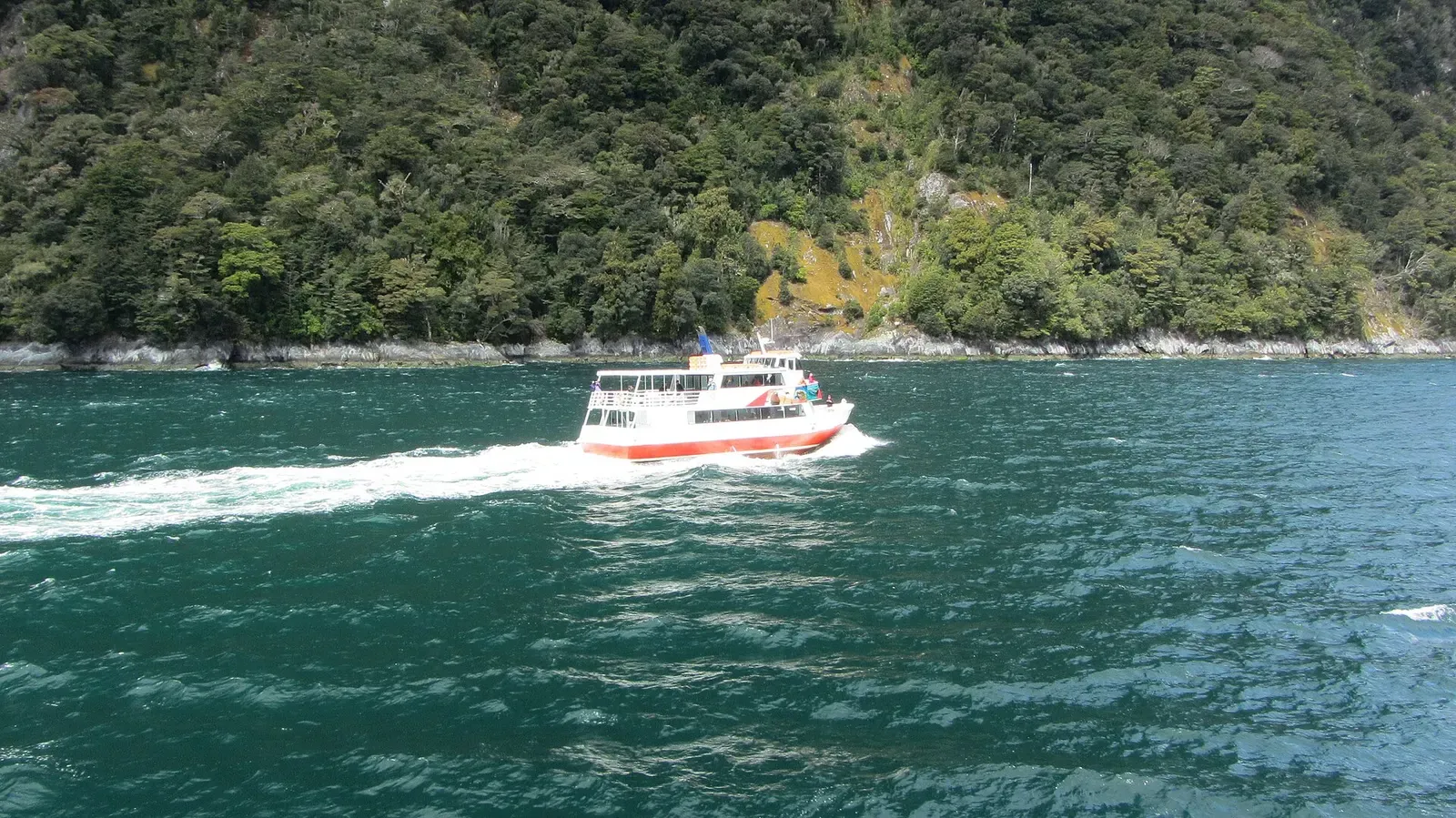
- Day boat cruising turquoise waters beneath the cliffs of Milford Sound by Robert Linsdell, CC BY 2.0, via Wikimedia Commons
Embed
Run a dive centre, club or blog? Embed this map of 1 dive sites near Fiordland on your own page.
In The Logbook
- The best wall dives in the worldWalls & drop-offs · 11 min read
- How far you can see underwaterOcean science · 12 min read
- Where to dive with seals and sea lionsBig animals · 17 min read
- What are thermoclines and haloclines?Ocean science · 8 min read
- Why is some sea green instead of blue?Ocean science · 8 min read
- Cold-water diving: is it worth the drysuit?Cold water · 8 min read
Similar destinations

Giant Queensland grouper at Cod Hole and dwarf minke whales in winter.

The world's southernmost coral reef, with advanced diving at Balls Pyramid offshore.

A thousand fur seals, and the juveniles come out to play with divers

.jpg)
.jpg)
.jpg)
.jpg)
_(9485468932).jpg)
Thousands of spider crabs mass under a Melbourne pier each winter