The desert was the easy case
The blue guide ended on a confession: everything in it was computed for pure water, “the best the ocean can manage”, and real seawater always has something in it. This is the article about the something.
The something is mostly phytoplankton — single-celled algae, the grass of the sea — and its optics are the optics of every leaf on land. Chlorophyll absorbs hardest in the blue and the red and poorly in between: the measured absorption spectrum of ocean phytoplankton has a tall peak near 440 nanometres, a second one near 675, and a valley around 570 where the pigment takes almost nothing. So a sea filling with plankton does not add green, any more than water adds blue. It subtracts. Water eats the red end; life eats the blue end; and green is simply the last part of the spectrum with nobody assigned to eating it.
That is the entire mechanism. What makes it worth an article is that it can be computed — the bio-optics community has spent decades fitting exactly how much each unit of chlorophyll costs each wavelength, and Morel and Maritorena’s Case-1 model turns one number, milligrams of chlorophyll per cubic metre, into the full attenuation spectrum of a living sea. Feed that through the same colour arithmetic as the blue guide and you can dial the ocean from desert to soup and watch what happens.
Seven seas, one dial
The swatches are the sea’s own colour — the fraction of daylight the water sends back up, which is what your eye receives from a boat or a mask at the surface — computed across the honest range of the ocean. The subtropical gyres sit near 0.01 mg/m³; oceanographers call them ocean deserts, and their water is the deep violet-blue of the Sargasso, where visibility can reach 60 metres. Temperate shelves run around 0.5 to 2. Past 5 mg/m³ the literature starts calling it a bloom, and a spring bloom in full swing can pass 30. The hue barely moves for the first two rungs — the ladder is logarithmic, and the sea forgives the first traces of life — then swings through teal around 2 mg/m³ and lands in olive.
Underneath the swatches is the price. The sunlit zone — the layer holding one per cent or more of the surface daylight — is 124 metres deep in gyre water and 10 metres in the thick bloom. Nothing about the sun changed; the water simply spent the light faster. Morel and Maritorena’s own cruises measured sunlit depths of 124 to 130 metres in the South Pacific gyre, which is a strange and lovely thought for a diver: in the clearest ocean, the bottom of the light is deeper than double your certification, while in a bloom you can visit it on a single-cylinder no-stop dive. In green coastal water at 3 mg/m³ the one-per-cent line sits near 30 metres (100 feet) — a deep recreational dive in the North Atlantic in June goes to the bottom of the photic zone, which is why it gets so dark down there while the surface still looks like day.
The window walks
The blue guide’s central image was a window: water is transparent at the blue end and opaque at the red end, so blue is what survives. Chlorophyll closes that window from the blue side — its 440-nanometre peak lands almost exactly on pure water’s point of greatest transparency, which is either a coincidence or four billion years of natural selection aiming the antenna at the light that penetrates. As the concentration rises, the transparency window walks: 430 nanometres in gyre water, 490 on the shelf, 540 in coastal water, 580 in a bloom — out of the blue and into the green.
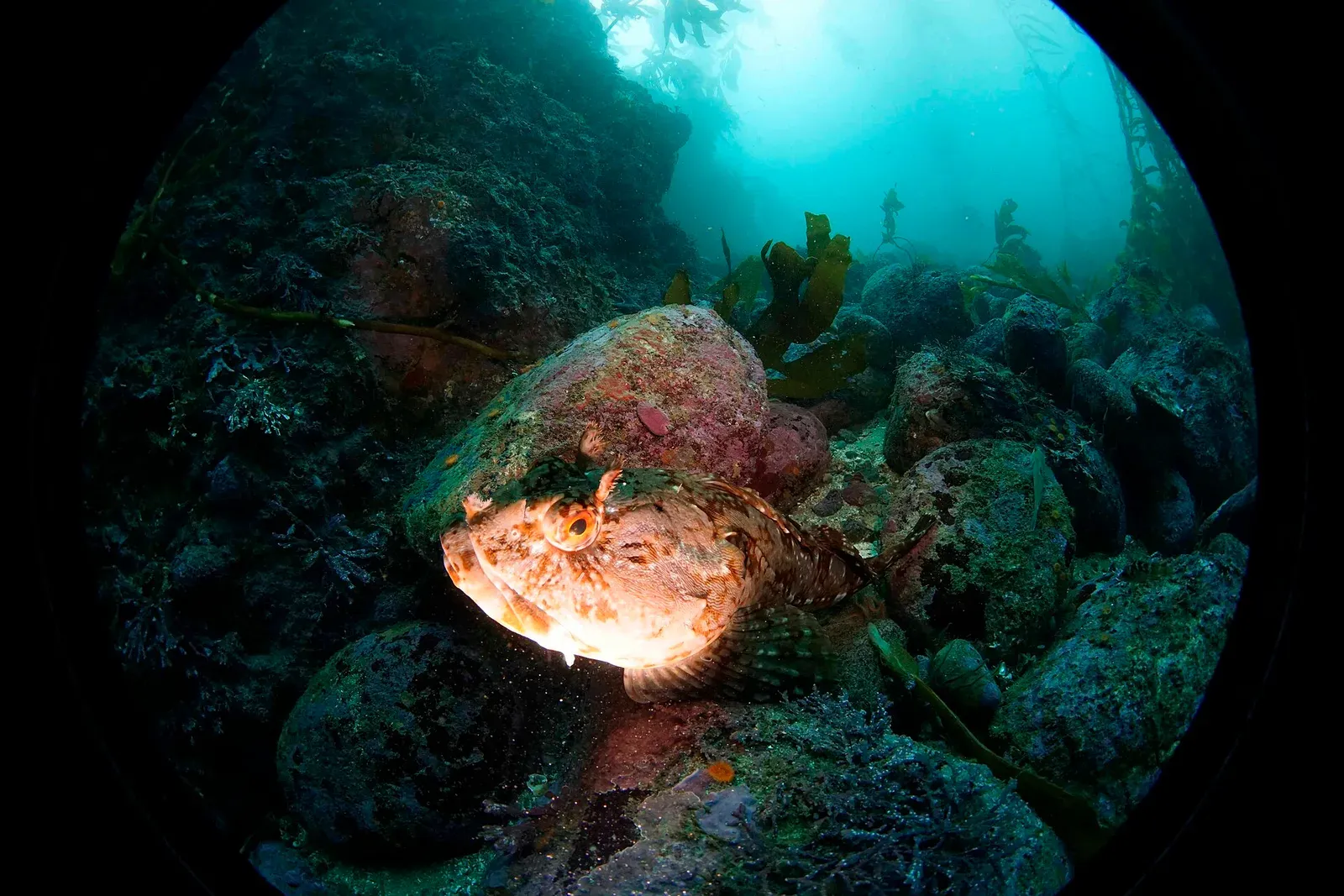
The numbers underneath are brutal for the blue. Light at 440 nanometres that reached 239 metres at the chart’s cleanest rung is down to its one per cent by 4 metres in a thick bloom — a demotion of nearly sixtyfold — while green at 560 still manages 11. Meanwhile the red end of the chart barely moves, because red never depended on the plankton: water itself eats it, exactly as before. Which resolves a thing divers notice and rarely name: in green water the colour rules change at both ends. Red still dies in the first metres — the parent guide’s grid applies unchanged — but now blue dies young too, and the ambient light converges on a green-grey that flattens everything. Photographs get worse faster; the fix is the same and more so. A torch is not an accessory in green water; it is the only red and blue on the dive.
Tea, not soup
Not all green-brown water is alive. The second ingredient is dissolved — coloured dissolved organic matter, gelbstoff, the tannins and humic acids of decayed vegetation — and it is optically the mirror image of water itself: an absorption that rises exponentially toward the blue, with a canonical slope that doubles the absorption every 50 nanometres. At the blue peak it absorbs some twenty times harder than at the red end. Water passes blue and eats red; tea passes red and eats blue; mix them and very little of anything gets through, which is why heavily stained water is not green but brown-dark.
Divers meet the pure form of this in fresh water — the tannin lakes and blackwater rivers the freshwater guide visits, where the Rio Negro’s water is, in Wikipedia’s phrase, the colour of strong tea. The saltwater form has made two of diving’s strangest places. At Milford Sound, rain running off the fiord walls floats a permanent tea-stained freshwater lid, centimetres to ten metres thick, over the sea — and the twilight it casts pulls deep-water species like black coral up into recreational depths: an entire dark-water ecosystem built by CDOM. And the brackish Baltic, fed by rivers and ringed by farmland, runs dark and blooms hard — a 2010 satellite pass measured a single algal bloom covering 377,000 square kilometres — so its wreck dives, like the 1771 Vrouw Maria, are torch dives at depths that would still be daylit in the Caribbean. (The Baltic’s famous preservation of wooden ships is its own separate gift of chemistry and shipworm-free brackish water; the darkness just sets the mood.)
The bio-optics trade keeps these cases in separate ledgers: Case 1 waters, where phytoplankton and everything that covaries with it set the optics and one chlorophyll number rules the model above; and Case 2, where river-borne CDOM and stirred sediment answer to nobody’s chlorophyll. Most temperate shore diving is somewhere between the two — which is why the ladder in our charts is a spine to reason along, not a promise about your local quarry.
Green means food
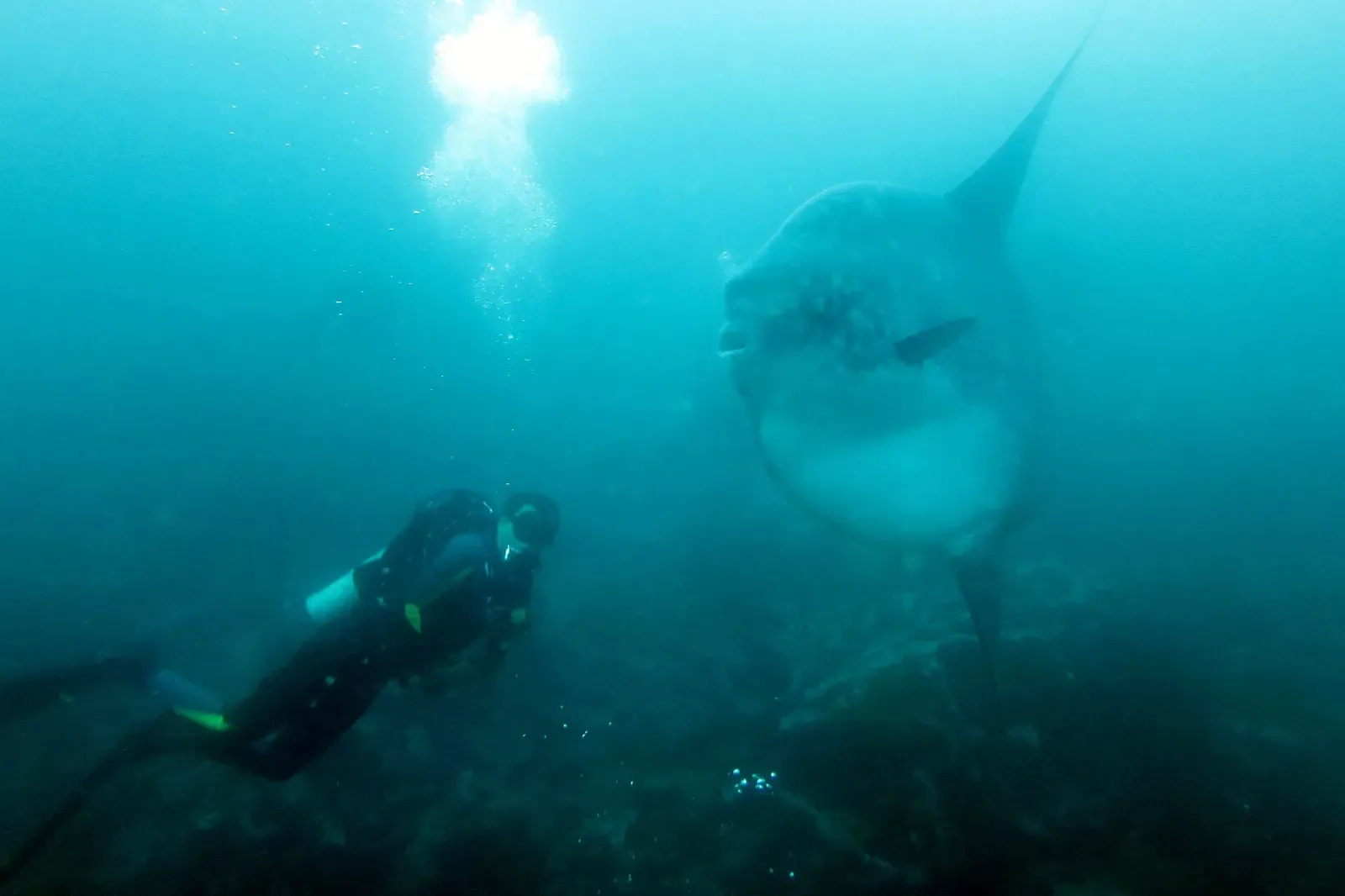
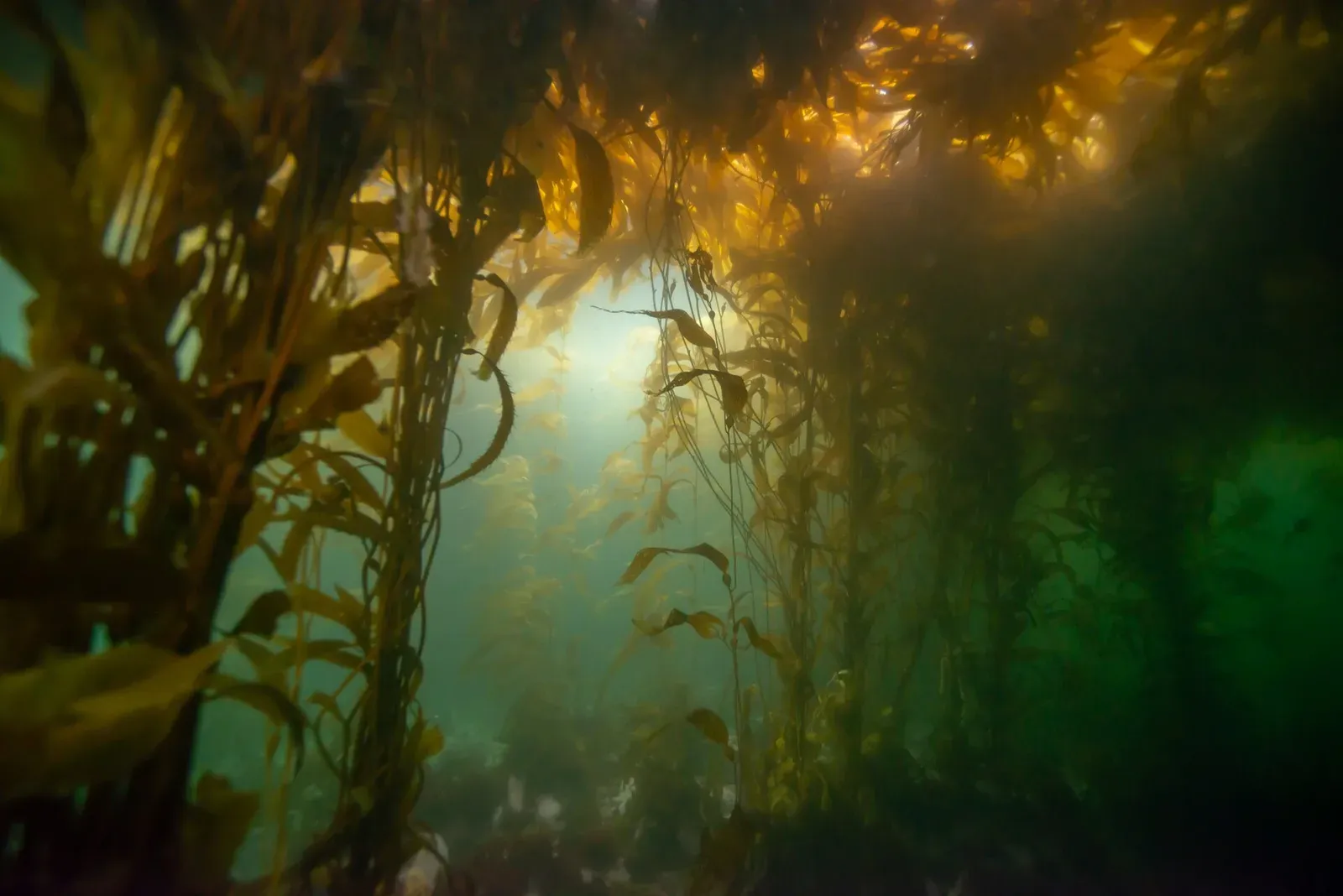
Here is the reframe the brochures never make. The chlorophyll dial is a productivity dial: those swatches are, left to right, a desert becoming a farm. The green upwelling systems — the Benguela, the California Current, the Humboldt, the Canary, the Somali — cover about 5 per cent of the ocean and land roughly 25 per cent of the world’s marine fish catch; coastal upwelling zones account for around half of all marine productivity. Every link in the chain that divers cross oceans for is bolted to that green: the sardine run is green-water economics in motion, a temperate shoal following cool, plankton-rich water up a subtropical coast; the kelp cathedrals of False Bay, Monterey and La Jolla stand in upwelling water; Manta Alley’s mantas hold station precisely where cold, nutrient-rich water funnels through and blooms; Punta Vicente Roca’s molas ride the Cromwell Current’s upwelling; and Djibouti’s juvenile whale sharks arrive for a winter plankton bloom. When the visibility briefing says “green water, stay close”, it is describing the same fact as the wildlife briefing that says “everything is here this month”. You generally do not get mantas and gin-clear blue on the same dive, and the physics is why.
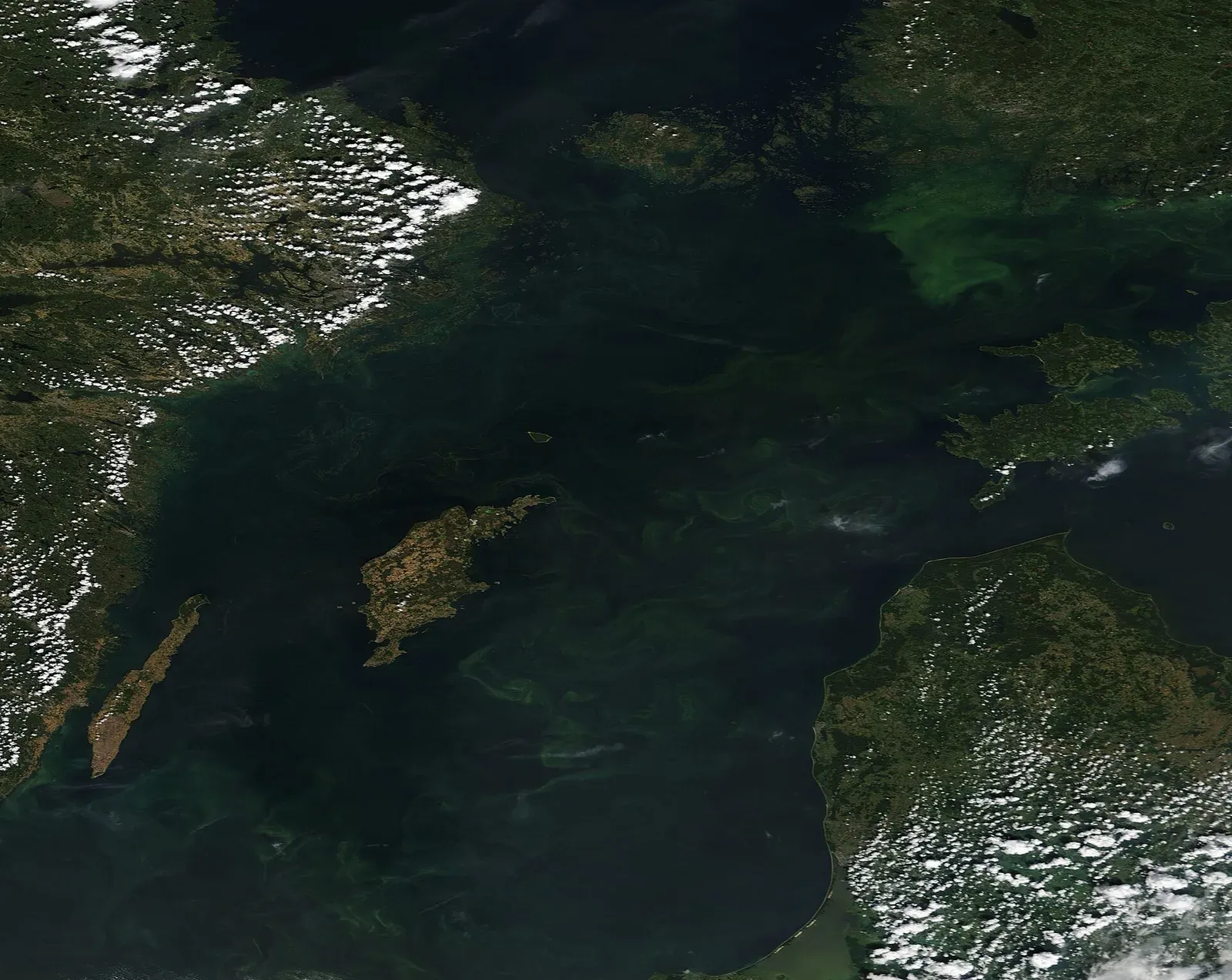
The green is even how we know where the food is. Satellite ocean-colour instruments estimate chlorophyll from the blue-to-green ratio of the light the sea reflects — the working premise, in NASA’s phrasing, being that the more phytoplankton in the water, the greener it is. The idea was first demonstrated in 1970 from an aircraft over Georges Bank, and it is this article’s arithmetic run backwards: we computed colour from chlorophyll; the satellites read chlorophyll from colour, bloom by bloom, for the whole planet. They have also noticed something at the decadal scale: analyses of twenty years of ocean-colour data report the low-latitude ocean measurably greening — the palette above is not just a map, it is a trend line. And for the diver who wants to meet the soup itself, there is a genre for that: the open-ocean blackwater night dives at Kona drift you through the plankton in the dark, when its daily vertical migration brings the animals up to torch depth.
Where the water is alive
| Site | Depth | Level | Best months |
|---|---|---|---|
| Milford Sound (Piopiotahi) Fiordland · New Zealand | to 40 m | Advanced | Dec–Feb |
| Port St Johns Wild Coast Sardine Run · South Africa | to 10 m | Advanced | Jun–Jul |
| Coffee Bay Wild Coast Sardine Run · South Africa | to 10 m | Advanced | Jun–Jul |
| Tacoma wreck Dakar & Ngor · Senegal | 13–14 m | Intermediate | Oct–Nov |
| Miller's Point Cape Peninsula Kelp Forests · South Africa | to 8 m | Intermediate | Nov–Jun |
| Point Lobos — Whalers Cove Monterey Bay · United States | 9–21 m | Intermediate | Sep–Oct |
| La Jolla Cove La Jolla Cove & Canyon · United States | to 14 m | Beginner | Jul–Oct |
| Keystone Jetty Puget Sound · United States | to 21 m | Advanced | Oct–Feb |
| Punta Vicente Roca Galápagos West (Isabela & Fernandina) · Ecuador | 12–27 m | Advanced | Jan–Apr |
| Manta Alley Komodo · Indonesia | 10–25 m | Advanced | Jun–Oct |
| Manta Sandy Raja Ampat · Indonesia | 8–15 m | Beginner | Nov–Mar |
| Arta Beach Whale Shark Grounds Djibouti · Djibouti | to 5 m | Beginner | Nov–Feb |
| Kona Blackwater Dive Kona · United States | to 15 m | Advanced | Dec–Apr |
| Vrouw Maria Gulf of Finland · Finland | to 41 m | Advanced | Jun–Aug |
| Den Osse Zeeland · Netherlands | to 30 m | Intermediate | Apr–Jun |
Milford sound marine reserve (Piopiotahi) dive · Zachary Penman on YouTube
The pure-water half of this physics — why the empty ocean is blue and what the missing red does to your photographs — is in the parent guide; the tannin lakes are in freshwater diving; and the animals the green water feeds have guides of their own, from mantas to whale sharks.