Eastern Pacific · Ecuador
Galápagos West (Isabela & Fernandina)
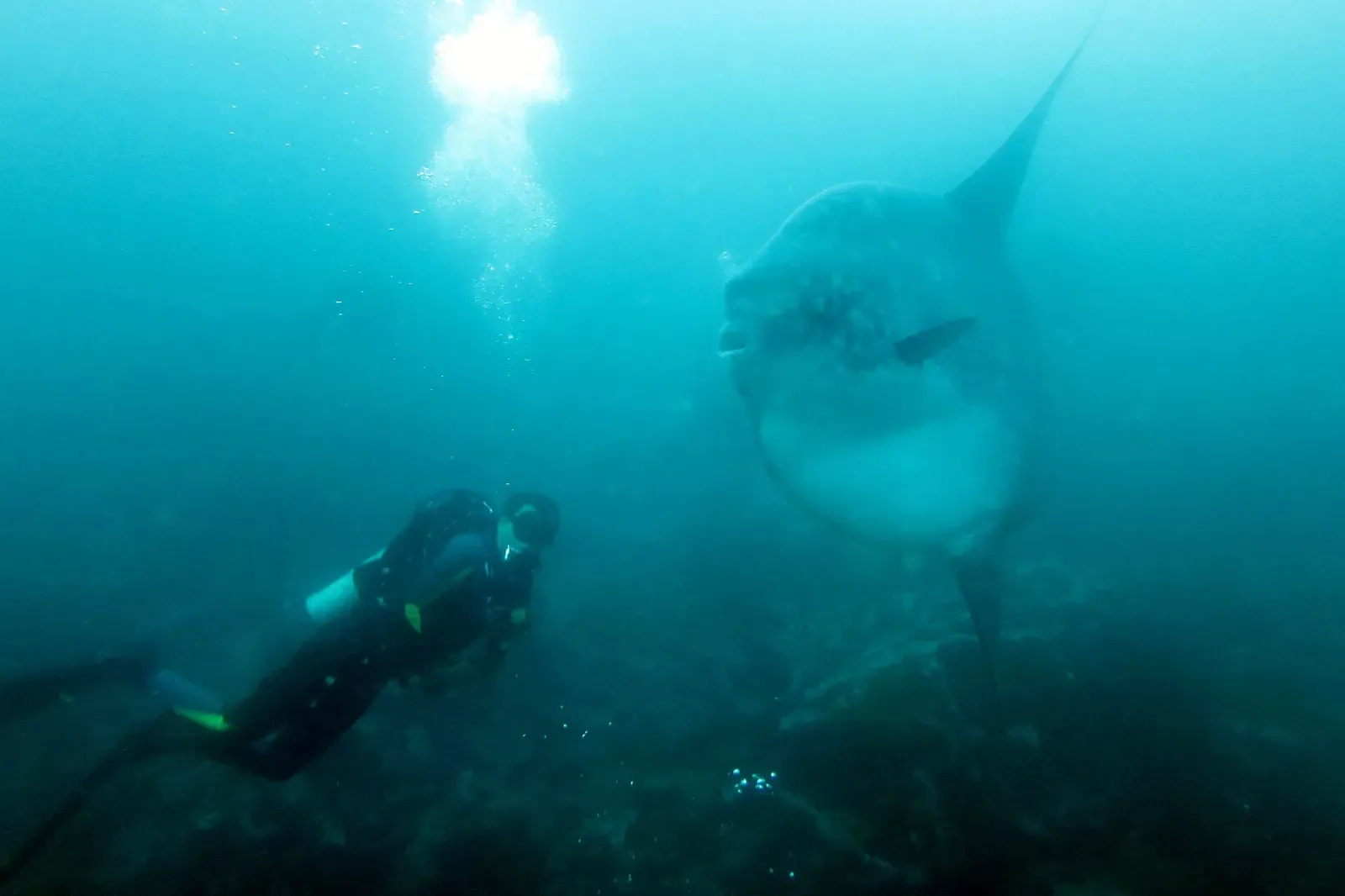
Cold Cromwell Current upwelling brings mola mola, penguins and marine iguanas
Photo: Edgard Dias Magalhães · CC BY-SA 3.0
West of the central islands, the coasts of Isabela and Fernandina sit directly in the cold, nutrient-rich Cromwell Current, producing diving with almost nothing in common with the shark schools of Darwin and Wolf. Water can fall into the mid-teens Celsius on the equator, and the upwelling it drives sustains marine iguanas, flightless cormorants, roughly ninety percent of the world's Galápagos penguins, and sightings of mola mola, red-lipped batfish and manta rays at a cleaning station. It is usually dived as the other half of the same liveaboard week that runs the northern islands.
About diving in Galápagos West (Isabela & Fernandina)
The west is usually the other half of the same liveaboard week that runs Darwin and Wolf, worked in before or after the long crossing to the north. Punta Vicente Roca sits at the base of Isabela's collapsed Ecuador Volcano, on the seahorse-shaped island's northwestern point; Cabo Marshall lies on its northeastern coast, in the lee of the still-active Wolf Volcano. Neither site permits a land visit — pangas drop divers straight onto the wall or plateau, usually with a fast negative descent, and the boat holds station offshore between dives rather than anchoring anywhere divers can walk ashore.
What makes both sites unrecognisable as Galápagos diving is the Cromwell Current, an equatorial undercurrent that wells up against Isabela and Fernandina and barely lets up. It drops the water into the mid-teens Celsius even on the equator, and that cold, nutrient-rich upwelling is what the whole west-side food web runs on: it is why roughly ninety percent of the world's Galápagos penguins live on Fernandina and western Isabela, why the flightless cormorant survives nowhere else on earth, and why marine iguanas here dive deeper and longer than anywhere else in the islands to graze submerged algae.
Conditions test kit more than nerve at either site. Visibility swings within a single dive as the thermocline moves — divers report anything from a few metres of green murk to open, clear water later in the same session — and the cold is real enough that most liveaboards recommend a 7mm wetsuit or a drysuit, plus hood and gloves. Both sites still call for an Advanced Open Water certification and comfort with drift diving, though the current itself runs gentler here than the surge at Darwin and Wolf.
When to dive Galápagos West (Isabela & Fernandina)
| Jan | Feb | Mar | Apr | May | Jun | Jul | Aug | Sep | Oct | Nov | Dec |
|---|---|---|---|---|---|---|---|---|---|---|---|
| Prime | Prime | Prime | Prime | Good | Fair | Fair | Fair | Fair | Fair | Fair | Good |
Dec-Apr's warmer, calmer water is the easiest diving; the colder, current-driven upwelling of Jun-Nov cuts visibility and deepens the thermocline but is when mola mola and penguins are most active.
Dive types & marine life
Mola mola turn up year-round but sporadically, basking more in cool upwelling months, though operators tout June-November as the stronger window. Roughly 90% of Galápagos penguins live on Fernandina and western Isabela, the only place a penguin breeds north of the equator, and the flightless cormorant is restricted to those coasts. Mantas work Cabo Marshall's station year-round, not a season.
- Wall
- Pelagic & blue water
- Drift
- Muck & macro
- Mola mola
- Penguins
- Seals & sea lions
- Manta rays
- Hammerheads
- Eagle rays
- Tuna
- Barracuda
- Frogfish
- Reef fish swarms
- Macro critters
Notable dive sites in Galápagos West (Isabela & Fernandina)
Wall
A manta cleaning station on Isabela's shoreline, current gentler than Darwin or Wolf
The archipelago's most reliable mola mola wall, in some of its coldest water
Las Marielas
Islet cluster on Isabela's west coast where Galápagos penguins hunt among shallow lava shelves and marine iguanas graze
Roca Redonda
Volcanic islet west of Isabela with underwater fumaroles, strong surge and passing hammerheads
Punta Espinosa
Fernandina's marine iguana colony and flightless cormorant nesting site, visited by panga rather than dived
Getting there
Route in through Quito or Guayaquil for the transit control card, then fly to Baltra or San Cristóbal to board; western-circuit cabins fill on the same schedule as the northern ones, since it is usually one itinerary. Puerto Villamil on Isabela runs its own day-boat diving to closer sites, but Punta Vicente Roca and Cabo Marshall are liveaboard-only stops.
Photos from Galápagos West (Isabela & Fernandina)
Sodacan · CC BY-SA 4.0
Judy Gallagher · CC BY 2.0
Dan · CC BY-SA 2.0
Photo credits
- A diver hovers beside a huge grey mola mola sunfish hanging in murky blue-green water off a rocky wall. by Edgard Dias Magalhães, CC BY-SA 3.0, via Wikimedia Commons
- A dark marine iguana grips an algae-covered rock underwater, grazing while a sea lion and a small striped fish pass close by. by Sodacan, CC BY-SA 4.0, via Wikimedia Commons
- Two Galápagos penguins stand together on lava rock, with a volcanic coastline and open ocean behind them. by Judy Gallagher, CC BY 2.0, via Wikimedia Commons
- A flightless cormorant stands on dark volcanic rock with its stubby, ragged wings spread to dry against the water. by Dan, CC BY-SA 2.0, via Wikimedia Commons
In The Logbook
- Diving with seals and sea lionsBig animals · 17 min read
- The layered sea: thermoclines and haloclinesOcean science · 8 min read
- Why some seas are greenOcean science · 8 min read
- Mola mola: where to dive with sunfishBig animals · 11 min read
Similar destinations

Massive hammerhead schools and giant whale sharks patrol Darwin's submerged pillars

Scalloped hammerhead schools circle Bajo Alcyone's cleaning station in the current
Hammerhead schools of 200-plus circle La Nevera's cold-water cleaning station


_feeding_underwater_off_Fernandina_Island,_Gal%C3%A1pagos_Islands.jpg)
.jpg)

Hannibal Bank rises from 400 m and pulls in billfish and tuna