
Eastern Pacific · Ecuador
Galápagos — Darwin & Wolf
Schooling hammerheads over the rocky walls and slopes of Wolf and Darwin
Photo: Kai Squires · CC BY 4.0
Darwin and Wolf, the northern islands of the Galápagos, are reached only by liveaboard and form the centrepiece of most Galápagos dive cruises. The diving is about sharks: schooling hammerheads at Wolf's Landslide and Shark Bay, Galápagos, silky and blacktip sharks around Darwin, and whale sharks in the cooler months, with bottlenose dolphins, eagle rays and sea lions in the same water. Strong currents run over the walls and slopes, which keeps the pair for experienced divers.
About diving in Galápagos — Darwin & Wolf
Current sets the plan for every dive, and dinghies run divers from the anchored liveaboard to the sites. Darwin is dived from one starting point near the arch, and the conditions decide which of three profiles follows: pulling along a rocky slope to hold at 18–24 m (59–79 ft) as hammerheads pass, sheltering on the Darwin Theatre, a plateau atop a wall out of the strong flow over the reef, or settling on a sandy flat when the current drops. Most dives end by letting go of the rock and riding the current up to the safety stop.
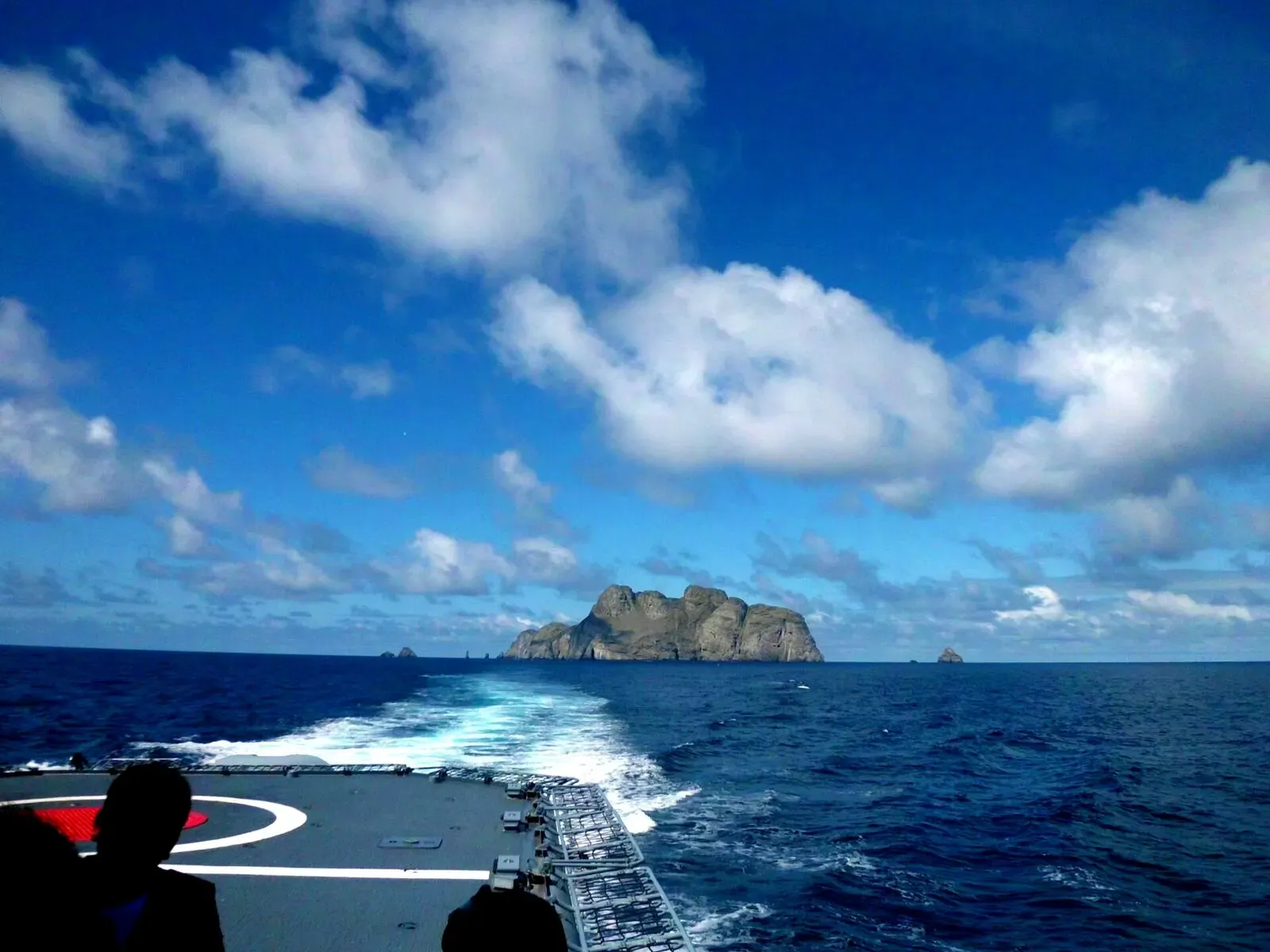
Underwater the islands are rock: boulder slopes, rubble, walls and swim-throughs, with sandy patches between the outcrops. Hammerheads school here, joined by Galápagos sharks, whitetip reef sharks and green turtles, and sharks and turtles are a given at every Wolf site. Eagle rays are a Wolf speciality, bottlenose dolphins are around the island in large numbers, sea lions play in the Shark Bay shallows, and manta rays, jacks and tuna also pass in the blue.
Darwin and Wolf are not an area for beginners. Currents, choppy seas with surge and jagged, barnacle-covered rocks make the conditions, and much of each dive is spent holding position on the rock or drifting off the reef. The islands suit divers with good buoyancy who are at ease in the water and have dived in differing conditions. Certification courses run on Santa Cruz and San Cristobal, and the Galápagos has several relatively beginner-friendly sites for divers still building that experience.
Best time to dive Galápagos — Darwin & Wolf
| Jan | Feb | Mar | Apr | May | Jun | Jul | Aug | Sep | Oct | Nov | Dec | |
|---|---|---|---|---|---|---|---|---|---|---|---|---|
| Season | Good | Good | Good | Good | Good | Good | Prime | Prime | Prime | Prime | Prime | Good |
| Sea surface | 26°C79°F | 28°C82°F | 28°C82°F | 27°C81°F | 27°C81°F | 26°C79°F | 25°C77°F | 25°C77°F | 25°C77°F | 25°C77°F | 25°C77°F | 25°C77°F |
| Daytime high | 27°C81°F | 28°C82°F | 28°C82°F | 28°C82°F | 27°C81°F | 26°C79°F | 25°C77°F | 25°C77°F | 25°C77°F | 25°C77°F | 25°C77°F | 25°C77°F |
| Rain | 64 mm2.5 in | 73 mm2.9 in | 70 mm2.8 in | 53 mm2.1 in | 34 mm1.3 in | 24 mm0.9 in | 15 mm0.6 in | 14 mm0.6 in | 23 mm0.9 in | 30 mm1.2 in | 25 mm1.0 in | 35 mm1.4 in |
| Jan | Feb | Mar | Apr | May | Jun |
|---|---|---|---|---|---|
| Good | Good | Good | Good | Good | Good |
| Sea surface | |||||
| 26°C79°F | 28°C82°F | 28°C82°F | 27°C81°F | 27°C81°F | 26°C79°F |
| Daytime high | |||||
| 27°C81°F | 28°C82°F | 28°C82°F | 28°C82°F | 27°C81°F | 26°C79°F |
| Rain | |||||
| 64 mm2.5 in | 73 mm2.9 in | 70 mm2.8 in | 53 mm2.1 in | 34 mm1.3 in | 24 mm0.9 in |
| Jul | Aug | Sep | Oct | Nov | Dec |
|---|---|---|---|---|---|
| Prime | Prime | Prime | Prime | Prime | Good |
| Sea surface | |||||
| 25°C77°F | 25°C77°F | 25°C77°F | 25°C77°F | 25°C77°F | 25°C77°F |
| Daytime high | |||||
| 25°C77°F | 25°C77°F | 25°C77°F | 25°C77°F | 25°C77°F | 25°C77°F |
| Rain | |||||
| 15 mm0.6 in | 14 mm0.6 in | 23 mm0.9 in | 30 mm1.2 in | 25 mm1.0 in | 35 mm1.4 in |
2011–2025 averages. Sea surface: NOAA Coral Reef Watch, measured at the surface, so deeper water can run colder. Daytime high and rain: NASA POWER.
The hot, rainy season runs from December to June, and from December to May the sea is calmer, the water warmer and the visibility better. The cooler season follows from June to November: whale sharks arrive in June, with sightings at sites such as Darwin's Pillars, and July to November is the divers' peak season. Choosing a month is a trade between the two halves: calmer, clearer water in the first half of the year, the chance of a whale shark in the second.
Best months: July, August, September, October, November
Galápagos water temperature and weather by month
The sea surface runs from 25 °C (77 °F) in September to 28 °C (82 °F) in March. Most rain falls from January to April, peaking at about 70 mm (2.8 in) in February; July to September are the driest. Daytime highs sit around 26 °C (79 °F) all year. Below the surface the water can drop to about 16 °C (61 °F), so pack a 7 mm suit with a hood, or a semi-dry.
Dive types & marine life
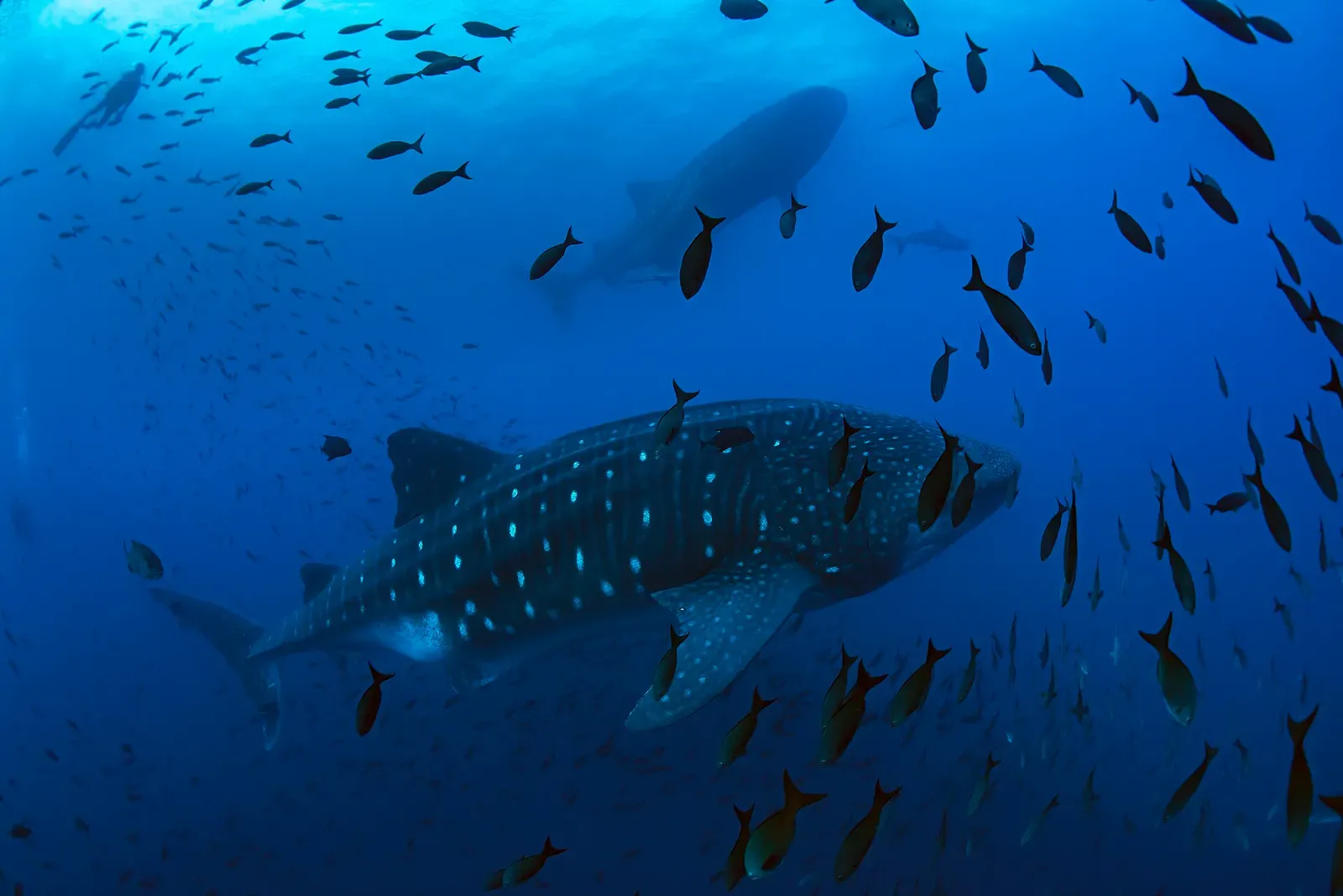
Whale sharks visit Darwin from June to November. At Darwin a succession of hammerheads usually passes divers holding on the slope; at Landslide a few cruise close to the rocks, and schools show in the blue when the current runs. Schools of eagle rays are common at Wolf, often coming close against the current.
- Wall
- Drift
- Pelagic & blue water
- Hammerheads
- Whale sharks
- Reef sharks
- Eagle rays
- Dolphins
- Sea turtles
- Seals & sea lions
- Manta rays
Best dive sites in Galápagos — Darwin & Wolf
- 1
Darwin's Arch
Rock pillars left by the arch's 2021 collapse, on a submerged plateau off Darwin, with scalloped hammerheads
- 2
Shark Bay
Wolf site that drops from 8–10 m (26–33 ft) shallows to a sandy patch near 25 m (82 ft)
- 3
The Cave
Wolf site of swim-throughs, a soft-coral cave and a boulder-strewn wall at 15–20 m (49–65 ft)
- 4
Landslide
Boulder-and-rubble slope at Wolf, with a short excursion into the blue when current eases
Site guides
Hold position at 18–24 m while hammerhead schools pass the plateau
Reef
Shallow rocky entry at 8 m, hammerheads scanned from 25 m
Cave & cavern
Two swim-throughs, then a fast drift off a wall thick with fish
How to get to Galápagos — Darwin & Wolf
Flights leave Quito and Guayaquil daily for Seymour Airport on Isla Baltra. Darwin and Wolf lie about 350 km (215 mi) from San Cristobal, and liveaboards usually reach Wolf first, after an overnight steam from the south.
Photos from Galápagos — Darwin & Wolf
Kai Squires · CC BY 4.0
Kai Squires · CC BY 4.0
Kai Squires · CC BY 4.0
Dive videos
Galapagos - Wolf and Darwin Islands - Humboldt Explorer Liveaboard - December 2024 · Kris N Chris Henry on YouTube
Hammerheads and Whale Sharks! | Darwin & Wolf, Galapagos Islands | Scuba Diving · Omni Reef on YouTube
Questions divers ask
What do dive boats ask of divers heading to Darwin and Wolf?+
Most operators require a minimum number of logged dives and recent diving experience. Many also require a surface marker and a dive computer, and some a GPS device, for safety in the strong currents.
Can divers go ashore on Darwin or Wolf?+
No. Wolf is uninhabited and cannot be visited on foot, and Darwin Island is not open to visits by land, so the liveaboards anchor offshore.
How much is the Galápagos National Park entry fee?+
Since August 1, 2024 foreign tourists pay $200 per adult and $100 per child under 12.
Sources
- Galapagos Islands — Wikivoyage
- Diving Sites Galapagos - Darwin & Wolf Island — Dive The World
- Wolf Island — Wikipedia
- Darwin Island — Wikipedia
- Darwin's Arch — Wikipedia
- Galapagos Sky — Galapagos Sky
Photo credits
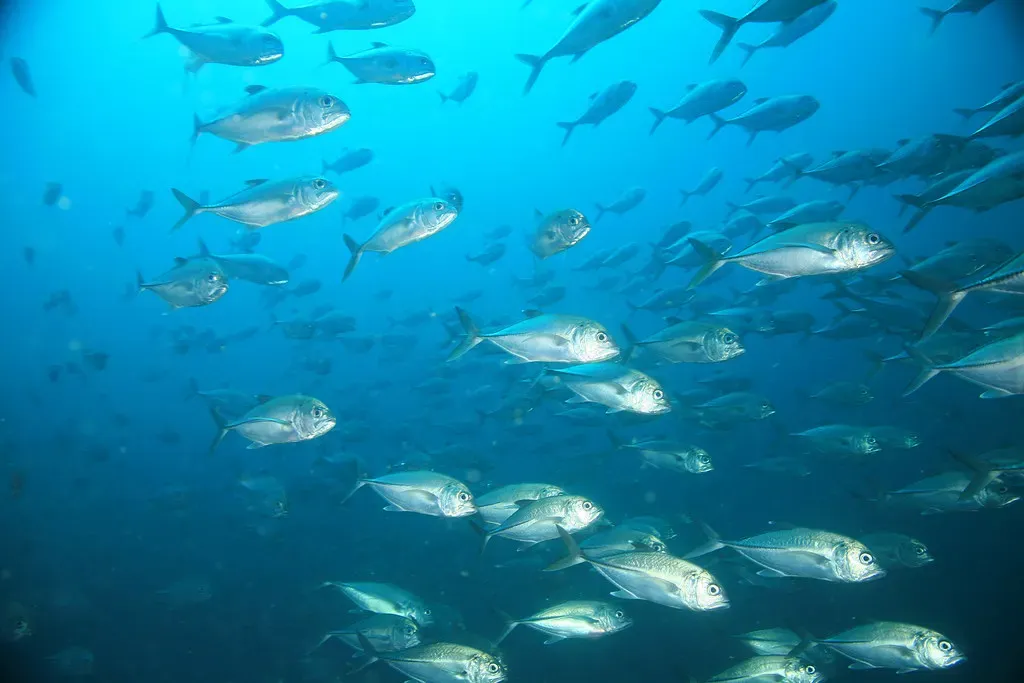
- A dense school of silvery steel pompano fills the blue water near Wolf Island, Galápagos. by Kai Squires, CC BY 4.0, via Wikimedia Commons
- Steel pompano swim just beneath the sunlit surface off Wolf Island. by Kai Squires, CC BY 4.0, via Wikimedia Commons
- A small group of steel pompano swims under the rippled ocean surface. by Kai Squires, CC BY 4.0, via Wikimedia Commons
- A large school of steel pompano scatters light near the water's surface. by Kai Squires, CC BY 4.0, via Wikimedia Commons
Embed
Run a dive centre, club or blog? Embed this map of 3 dive sites near Galápagos on your own page.
In The Logbook
- Where to dive in every month of the yearTrip planning · 14 min read
- What is decompression sickness (the bends)?Body & health · 18 min read
- Where to dive with seals and sea lionsBig animals · 17 min read
- How long to wait before flying after divingBody & health · 8 min read
- Where to dive with whale sharks, month by monthBig animals · 16 min read
- When and where to dive with hammerheadsBig animals · 16 min read
- Liveaboard vs resort diving: which suits you?Trip planning · 6 min read
Similar destinations

Hundreds of scalloped hammerheads overhead on the Bajo Alcyone seamount
Hammerhead schools of 200-plus circle La Nevera's cold-water cleaning station
Humpback whale song carries underwater during the mid-year migration season


Cold Cromwell Current upwelling brings mola mola, penguins and marine iguanas