The whole thing in one paragraph
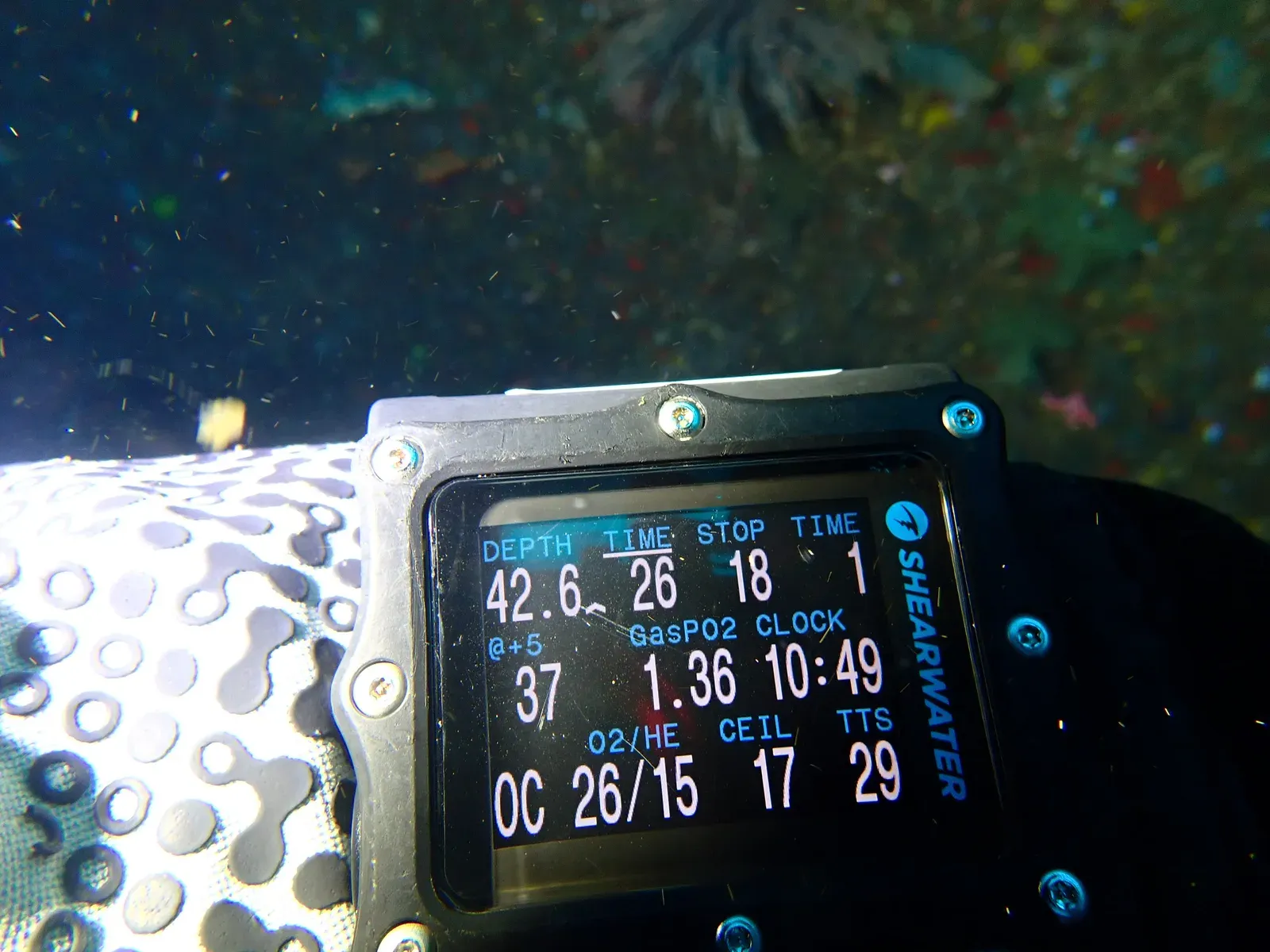
Your computer knows two things about the dive: how deep you are, and for how long. Everything else it tells you is the output of a model it is running of a diver who is not quite you. That model is sixteen imaginary tissues, each absorbing and releasing nitrogen at its own fixed rate, and each carrying a limit — the most nitrogen it will tolerate before the model says you are in trouble. Every few seconds the computer updates all sixteen, asks which of them is closest to its limit, and converts the answer into the shallowest depth you are currently allowed to be at. That number is the ceiling. No-stop time is how long until the ceiling leaves the surface. Time to surface is how long it will take to walk the ceiling up. There is nothing else in there.
Every diagram below is drawn by running that model live — a Bühlmann ZH-L16C implementation written for this guide — rather than sketched by hand. The curves are the arithmetic your computer is doing on your wrist.
Sixteen imaginary tissues
The compartments are not organs. They are a spread of rates chosen to bracket the range of real human tissue, from blood-rich and fast to fatty and slow. In ZH-L16C the fastest halves its gap to the surrounding pressure every 5 minutes and the slowest every 635 minutes, with fourteen more in between.
Half-time is the whole idea. Take a diver at 30 m (100 ft) breathing air. The nitrogen arriving at the alveoli sits at about 3.1 bar, against the 0.75 bar they carry at the surface. Each compartment closes half the remaining gap in one half-time, half of what is left in the next, and so on: after six half-times it is effectively full. So the 5-minute compartment is near enough saturated 30 minutes into the dive, and the 635-minute compartment has barely registered that the dive happened.
Read the top panel as the dive and the bottom panel as what it does to you. The 5-minute compartment sprints to 3.1 bar and then dumps almost all of it in the hour after surfacing. The 27-minute one gets halfway and clears slowly. The 635-minute one moves from 0.751 to 0.817 bar and is still holding most of that at the end of the chart — which is exactly why the dive you did this morning shortens the dive you can do this afternoon.
Which compartment matters depends entirely on the shape of the dive. Short and deep, the fast ones lead and the dive is over before the slow ones notice. Long and shallow, the fast ones equilibrate early and the slow ones take over. A computer does not choose: it tracks all sixteen and listens to whichever is loudest.
The line you must not cross
A tissue can hold more gas than the surrounding pressure and be perfectly fine. That state is supersaturation, and diving would be impossible without it — every safe ascent you have ever made was supersaturated. The question the model answers is: how much is too much?
Bühlmann’s answer is a straight line. For each compartment there are two numbers, a and b, and the most inert gas it tolerates is a + ambient pressure / b. That is the M-value line. Below it, the model says you are fine. Above it, it says you are bent. Rearrange the same line and you get the number your computer actually shows you: given what is dissolved in you now, the shallowest pressure you may go to.
This is the graph worth carrying around in your head. Depth runs along the bottom, nitrogen in the tissue up the side. Descending moves you right and then up. Ascending moves you left, towards the line — which is the single most counter-intuitive thing about decompression. Nothing bad happens on the bottom. The risk is created entirely by the move towards the surface, and the last few metres are the steepest part of it, because that is where ambient pressure changes fastest in proportional terms.
Both dives on that chart went to the same depth. The 15-minute one arrives at the surface with room to spare. The 30-minute one runs into the line 1.9 m down, and those two metres are the difference between a dive with a safety stop and a dive with an obligation.
No-stop time is just that clock running
A no-stop limit is not a safety rule handed down by an agency. It is a prediction: the number of minutes before the ceiling lifts off the surface, assuming you start up now and ascend at a normal rate. Watch it fall as you go deeper and you are watching the fast compartments fill faster because the gradient driving them is bigger.
The shape of that curve explains most of recreational diving’s rules of thumb. From 18 m to 30 m — not even double the depth — the model’s no-stop time falls from about an hour to about twenty minutes. By 40 m it is ten. Depth does not cost you time linearly; it costs you time catastrophically.
It also explains why enriched air exists. Take the nitrogen fraction down and the whole curve lifts: EAN32 buys about sixty per cent more time at 30 m, right up until its own oxygen ceiling ends the argument at 33 m. That trade is covered properly in our guide to breathing gases.
In practice this is what shapes a dive plan on real sites. The Thistlegorm sits with its holds at 30 m and its deck shallower, so the dive is normally run as two: the deep hold first, the shallow structure second, precisely because the clock at 30 m is short. The Hilma Hooker lies at 30 m on a shore-diving island where the temptation is a third and fourth dive that day. Shinkoku Maru in Chuuk runs to 38 m, where twenty minutes has become ten.
Gradient factors: conservatism you can see
Raw M-values are a cliff edge: acceptable right up to the line, catastrophic one centimetre past it. Real physiology is not like that, and Bühlmann’s limits were derived from a fit to data rather than handed down from physics. So modern computers let you sit somewhere short of the line, expressed as a percentage of the way from ambient pressure to the M-value. That percentage is a gradient factor.
There are two of them because the model wants different amounts of caution at different points in an ascent. GF Low applies at your first stop and therefore sets how deep that stop is. GF High applies at the surface and sets how loaded you are allowed to be when you climb out. Between the two the computer slides linearly from one to the other as you come up, which is why a setting is written as a pair — 40/85 means start cautious and finish only moderately so.
One diver, one loading, four settings. At GF 100 they may come up to 8 m. At GF 85, 10. At GF 40, 18. At GF 0 — no supersaturation permitted at all — they would have to hang at 28 m and would never surface. That is the whole trade: lower numbers keep you deeper for longer, and in exchange the model gives away less of its margin.
Typical settings run from 45/95 at the liberal end through the widely used 40/85 and 30/70 to genuinely conservative choices for cold, hard-worked or older divers. If your computer arrived set to something like 100/100 out of the box, that is the raw model with nothing held back, and almost nobody dives it deliberately.
The third dive of the day
Nothing resets when you climb the ladder. The fast compartments clear quickly on the surface, which is why the second dive feels almost as generous as the first, but the slow ones only ratchet upwards over a day of diving.
By the time this diver starts their third dive, the 27-minute compartment has come back to within a whisker of where it started — 0.79 against a surface value of 0.75 — while the 187-minute compartment is at 0.94, a quarter above baseline and climbing. That gap is what a dive computer means by residual nitrogen, and it is why the third dive is shorter than the first even when it is shallower.
The old rules follow from the picture. Deepest dive first, because a deep dive on top of a loaded slow compartment is the worst combination. Longer surface intervals buy back more than you think, but with diminishing returns. Multi-day diving accumulates: by day five of a liveaboard, the slow compartments never come all the way down between days, which is why sensible operators put the deep dives early in the week and why flying home wants a day of margin. DAN’s guidance is a minimum of 12 hours before flying after a single no-stop dive, 18 hours after repetitive or multi-day diving, and longer after any dive that required stops.
Ascent rate, safety stops and the deep-stop argument
The model assumes you ascend at a particular rate, so ascent rate is not advice, it is an input. Most modern computers and tables are built around 10 m per minute, and every one of them treats a faster ascent as a violation because it moves your ceiling towards you faster than the model expects.
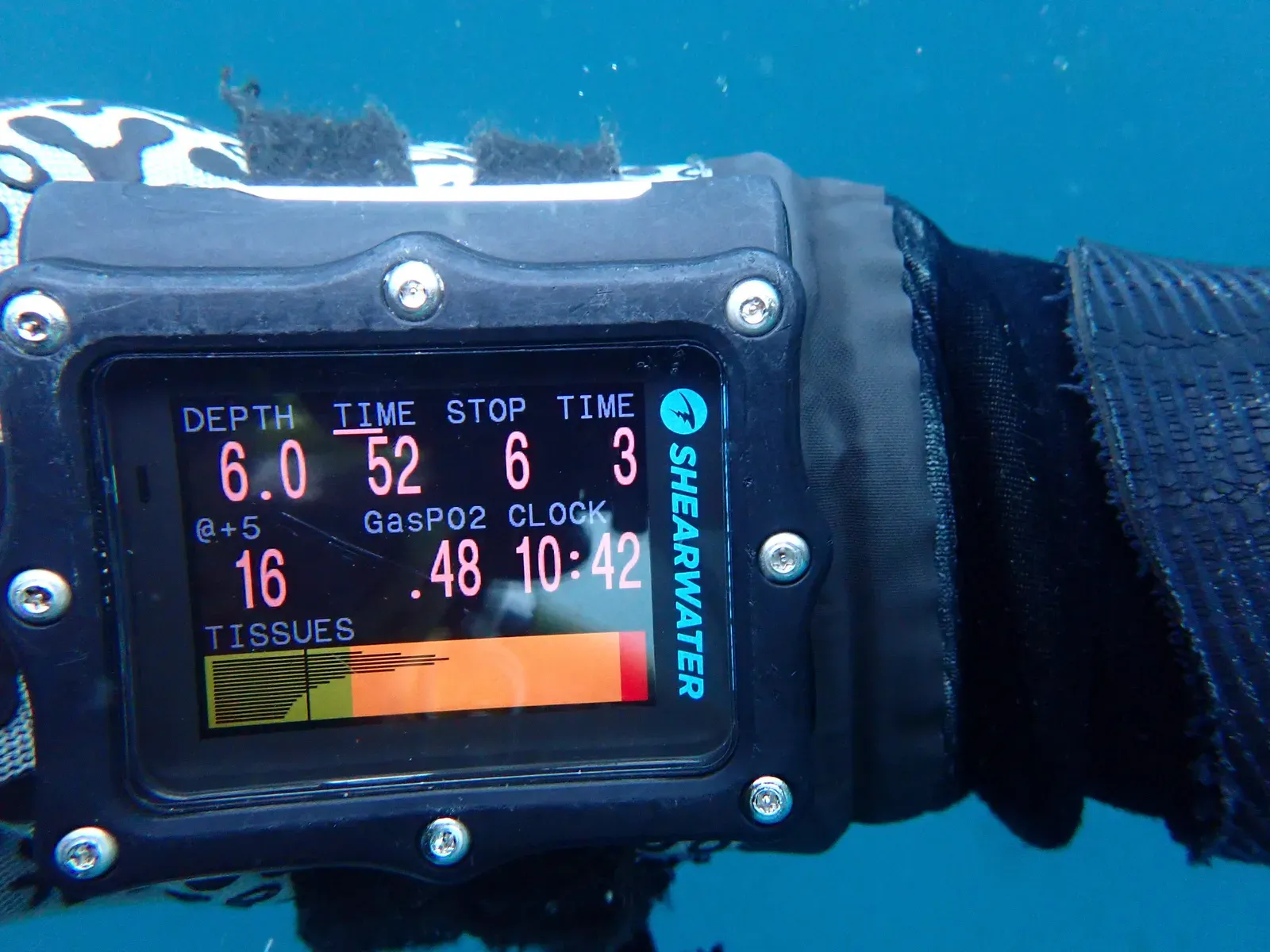
The safety stop is a different thing from a decompression stop: three minutes at 5 m that the model does not require. It is worth doing anyway. It costs nothing, it slows down the steepest part of the pressure change, and the studies that look for bubbles with Doppler find fewer of them after divers make one.
Deep stops are the interesting argument. The idea, which came from technical divers in the 1990s, was that pausing much deeper than the model demanded would suppress bubble growth early and leave you cleaner. Bubble-model computers were built around it. Then the US Navy Experimental Diving Unit ran a controlled comparison of two schedules with the same total stop time, one weighted deep and one weighted shallow, and the deep-stop schedule produced more decompression sickness, not less. The explanation offered is that at those depths you are still taking gas on in the slower compartments while congratulating yourself on the bubbles you are not growing. The practical outcome is that the field has moved back towards spending the time shallow, and the modern equivalent is a gradient factor setting rather than an extra stop invented on the way up.
What the model does not know
It does not know you. The coefficients were fitted to dive data from a population, and you are one person with your own perfusion, fat distribution, hydration, age and fitness. It does not know that a quarter of the population has a patent foramen ovale, a small flap between the atria that can let venous bubbles cross into the arterial side. It does not know you spent the dive finning hard into current, or that you were cold, or that the last three days were four dives each.
It also does not measure a single thing about your tissues. There is no sensor for dissolved nitrogen. There is a depth transducer, a clock, and arithmetic.
So the honest way to read the screen is as a well-calibrated bet rather than a promise. Divers get bent inside no-stop limits, and divers get away with things the model says they should not. What the model gives you is a consistent, conservative accounting of the one thing that is definitely true: pressure went up, gas went in, and it has to come out slowly.
Where the clock, not the site, ends the dive
These are the sites in our data where a computer, not the reef, decides how long the dive lasts — deep enough that no-stop time is measured in minutes, shallow enough that most of them are still recreational dives.
| Site | Depth | Level | Best months |
|---|---|---|---|
| SS Thistlegorm Sharm El Sheikh · Egypt | 16–30 m | Advanced | May–Oct |
| Hilma Hooker Bonaire · Caribbean Netherlands | to 30 m | Advanced | Dec–Apr |
| Alma Jane Wreck Puerto Galera · Philippines | to 30 m | Advanced | Jan–Apr |
| NRP Hermenegildo Capelo Algarve · Portugal | to 30 m | Advanced | Jun–Sep |
| Habagat Wreck Panglao · Philippines | to 37 m | Advanced | Nov–May |
| Punta Sur Cozumel · Mexico | 24–38 m | Advanced | Jan–Apr |
| Shinkoku Maru Chuuk Lagoon · Micronesia | to 38 m | Advanced | Nov–May |
| USNS Vandenberg Key West · United States | 12–45 m | Advanced | Apr–May |
| SMS Markgraf Scapa Flow · United Kingdom | 25–45 m | Advanced | Jun–Aug |
| Rosalie Moller Abu Nuhas & Gubal Strait · Egypt | 18–50 m | Advanced | Apr–Jun |
| Le Donator Port-Cros & Îles d'Hyères · France | 35–51 m | Advanced | Jun–Sep |
| San Francisco Maru Chuuk Lagoon · Micronesia | 27–64 m | Advanced | Nov–May |
| HMS Hermes Trincomalee & Kalpitiya · Sri Lanka | to 53 m | Advanced | Apr–Aug |


