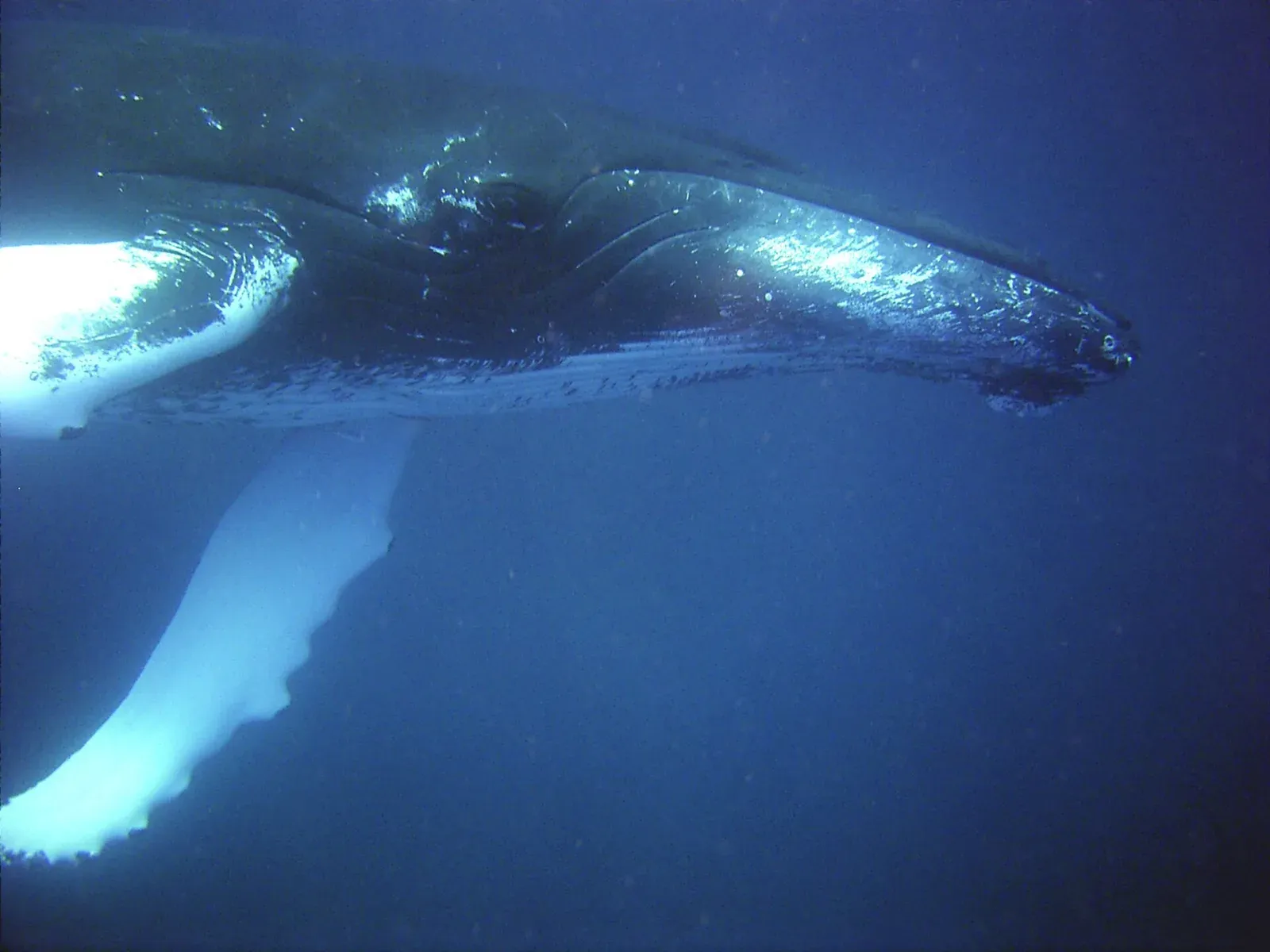
The permit is the product
Thirty-two sites in our dataset carry whales on their marine life lists, and not one of them is a place you go to swim with whales. They are reef dives, walls and pinnacles — Steve’s Bommie on the Ribbon Reefs, Swami Rock below the Koneswaram temple, Molokini Crater in the Maui channel — where a whale is something that passes in the blue, or more often a song that arrives long before any animal does. That is what a whale is to a scuba diver almost everywhere on earth: audible, occasionally visible, never the plan.
The places where a whale is the plan work completely differently, and the difference is legal before it is practical. In-water whale encounters are permit-and-rules products: a government decides that in one defined patch of sea, for a defined season, a defined number of licensed boats may put a defined number of swimmers near whales under written conditions — and everywhere else it stays prohibited. Perhaps six or seven such programs in the world are both legal and seriously managed. All of them are snorkelling, not diving: partly law, partly the plain fact that regulator noise and a column of bubbles is exactly the disturbance the rules exist to prevent.
So this is a survey of a very short list of regulatory regimes — who issues the permits, what the rules say, how well they hold up — followed by an equally important list of the places people assume they can swim with whales and cannot.
Tonga wrote the playbook, and the data tests it
Vava’u has run commercial humpback swims since the 1990s, and Tonga’s rules are the template most other programs echo: a maximum of four swimmers and one guide in the water at a time, no closer than 10 m to a whale group without a calf and 50 m to a group with one. The season is July to October, when humpbacks breed and calve in the sheltered channels of the Vava’u archipelago, and the swims run from small licensed day boats — the one liveaboard working the season is described as booking years ahead. When a whale is settled, a swim can last the better part of an hour.
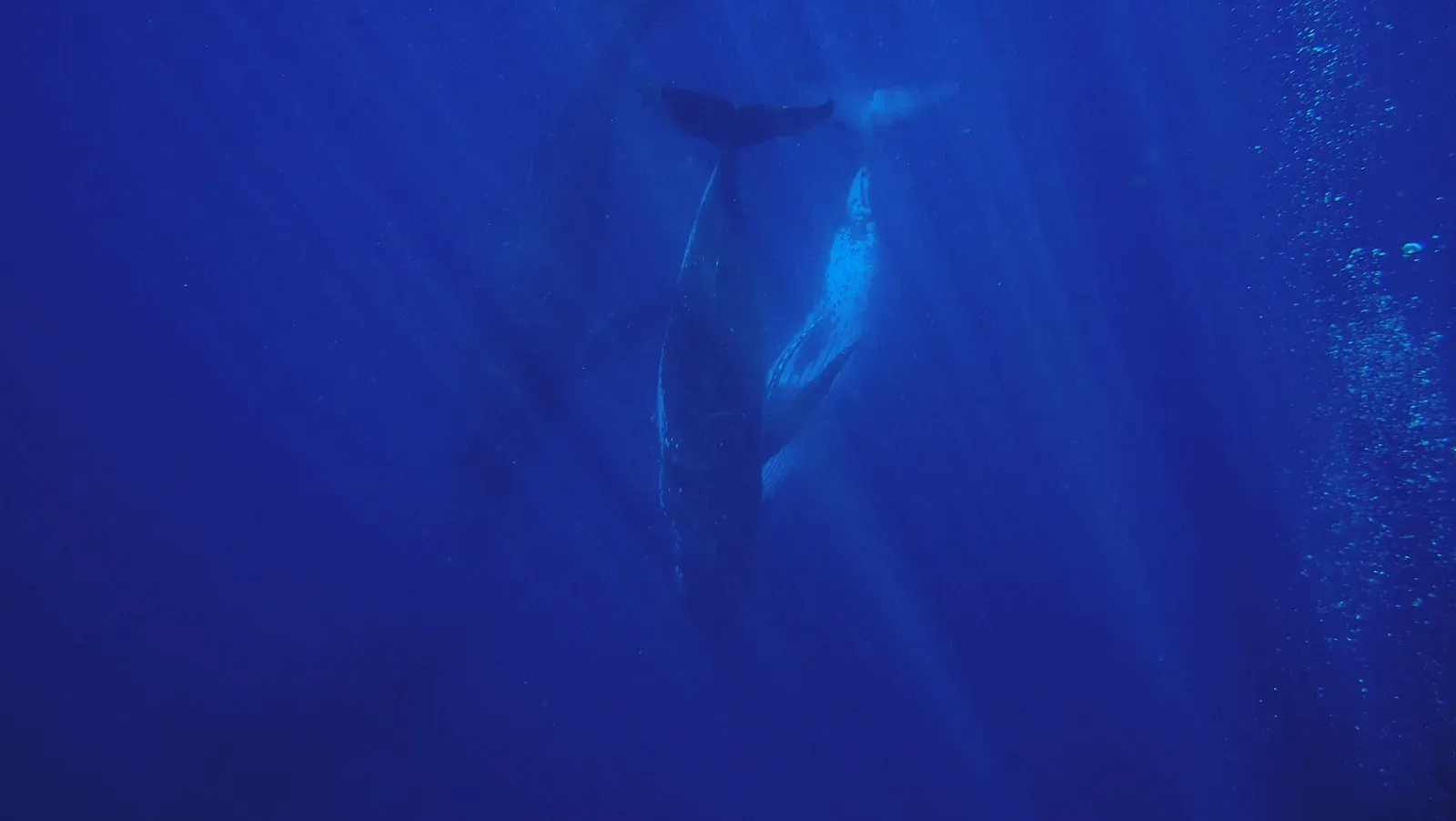
Tonga is also the program we know the most uncomfortable amount about, because researchers spent the 2016 and 2017 seasons on the water counting. The peer-reviewed result, published in PLOS ONE in 2019, found more than the permitted number of swimmers in the water in 11.7 per cent of 162 observed swims — once, ten people at a time — the minimum distance breached in 13.1 per cent of documented cases, and the mandated rest period between boat interactions violated 38.4 per cent of the time. Across 56 survey days, the team never once saw an enforcement vessel watching the industry. The same study measured the whales’ side: mother-and-calf pairs spent significantly more time diving when swimmers were active, and a third of tour-vessel approaches drew an avoidance response.
None of that makes Tonga a scam — the rules are real, most operators follow them, and the encounters are among the best on the planet. But it is the honest baseline for everything below: even the world’s oldest swim-with-whale program runs on rules only as good as the operator’s own discipline. Choose the boat accordingly. The neighbouring version is worth a line too: on Niue, humpbacks pass close enough to hear through every July-to-October dive, and encounters are snorkel-only and opportunistic — a whale-rich island rather than a licensed swim industry on Tonga’s scale.
Silver Bank: three boats, and that’s the point
The tightest version of the playbook sits on a drowned bank roughly 70 to 80 miles north of the Dominican Republic. Silver Bank is a shallow carbonate platform where thousands of North Atlantic humpbacks — operator estimates run to 3,000–5,000 — gather each winter to breed and calve, protected since 1986 as what became the Sanctuary for the Marine Mammals of the Dominican Republic. The whole season runs on three vessel permits. Three boats, fewer than 60 guests a week, roughly 540 people in an entire season.
The trip is a liveaboard week by necessity: an overnight crossing, then five days moored inside the reef, with tenders going out morning and afternoon to find resting or socialising whales and slip snorkellers quietly in. Everything is built around the whale’s consent — the operators’ phrase is passive, whale-initiated encounters. Scuba is banned outright in the sanctuary, with exceptions generally reserved for researchers and film crews, and professional photographers reportedly have to register separately with Dominican authorities. It is the most tightly capped in-water whale program in the world, and the model everyone else points at.
Dominica: sperm whales, and rules still being written
Across the water, Dominica offers the one thing no humpback destination can: residency. The sperm whales off the island’s sheltered west coast live there year-round — more than thirty family units that the Dominica Sperm Whale Project has followed since 2005, with named family units its researchers have known for two decades — the Group of Seven, the Utensils (whose members carry names like Knife, Fork and Canopener), and the Atwood Collective, led by a matriarch called Lady Oracle. The calmest seas and best sightings run November to May, but this is not a migration window — the animals are simply home.
The legal picture is genuinely in motion, and it is worth stating plainly. In November 2023 Dominica announced a sperm whale reserve of roughly 800 square kilometres along its west coast — reported as the first of its kind in the world. The implementing legislation, the Sperm Whale Reserve Act, passed Dominica’s parliament on 14 October 2025, and by mid-2026 implementation was underway — a Reserve board and marine ranger positions appointed, operator consultations held. The regime is new enough that details are still settling, so confirm the current rules with the island’s authorities before booking. What the emerging framework describes is strict: encounters capped at ten minutes, only one group at a time with sleeping whales, an outright ban on dropping swimmers near nursing calves, a cap on boats, a marine ranger aboard every whale boat, three permit classes — recreational, media, research — and, unusually, a prohibition on operators publishing footage of swimmers and whales together. Swimming already requires a government permit under existing law; a recreational permit reportedly runs to US$6,000, and operators describe permits issued in five-day blocks. The problem the Act exists to fix is also on record: DAN describes as many as ten boats circling a single whale under the looser current regime.
For a diver the island is a double bill. The whale encounter is a permitted snorkel from a boat; the diving underneath is Champagne Reef’s volcanic bubbles and the sponge-covered wall at Scott’s Head, some of the easiest good diving in the eastern Caribbean.
Norway: orcas on a handshake
The Arctic outlier is Skjervøy, in northern Troms, where overwintering herring draw orca and humpback pods into the fjords from November into January and drysuited snorkellers slip in to watch carousel feeding at close range in 4–13 °C water.
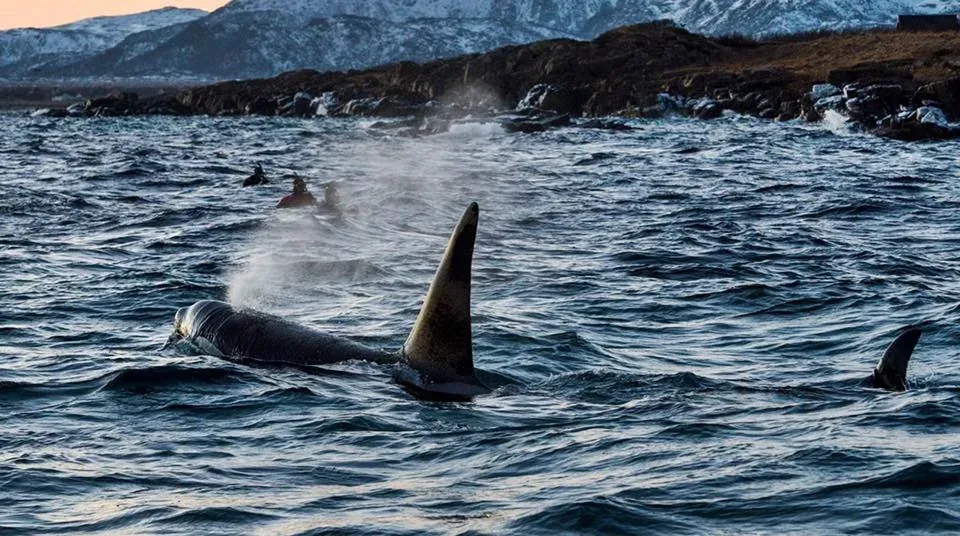
Here is the thing most brochures do not say: this is the least formally regulated entry on the whole list. There is no permit system and no whale-swim statute — the industry runs on the voluntary NorWhale national guidelines, which are nonetheless specific and worth knowing before you choose a boat: one boat per orca group in the snorkelling zone at a time, a maximum of six snorkellers in the water per boat, boats approaching from the side at 4–5 knots, entries slipped rather than jumped, swimmers holding at least 20 m from the whales, encounters of five to ten minutes unless nobody else is waiting. Norwegian authorities have reportedly signalled an intent to introduce formal rules after crowding incidents, and some Norwegian conservation groups discourage in-water cetacean activity altogether. Until that changes, the code is only as good as your operator’s willingness to follow it — ask directly whether they run to the NorWhale guidelines, and treat the answer as the product. Sightings, as our own area page puts it, are not guaranteed on any single outing; the concentration of animals in the peak window is simply among the highest anywhere.
Moorea: swims got closer, boats got fewer
French Polynesia declared its entire five-million-square-kilometre exclusive economic zone a marine mammal sanctuary in 2002, and Moorea is where its humpback swim industry concentrates, August to October, when breeding whales arrive off the island’s outer reef.
The 2024 rule changes are widely described as a tightening, and the reality is more interesting. The swimmer approach distance actually came down, from 30 m to 15 m — a change some researchers publicly called too close. What tightened was the traffic: no more than three boats near a whale at once, each company limited to one boat, and private or unpermitted boats held at least 300 m off. The pressure behind the crackdown was growth — reporting put tour boats at around 60 in 2023 and 90 in 2024 — and the same reporting describes enforcement as patchy, including accounts of operators baiting whales toward boats. Operators are authorised season by season, so book a permitted one and be openly suspicious of guarantees. Between swims, the diving is the lagoon and outer-reef circuit — Eden Park and its reef sharks among it.
Ningaloo: the trial that became an industry
Western Australia is the clearest case of a government building a whale-swim industry deliberately, in public, with paperwork. State law makes it illegal for anyone to swim within 100 m of a whale in WA waters. In November 2015 the environment minister announced a trial exception on the Ningaloo coast, and from mid-2016 the fifteen operators already licensed for whale-shark swims — boats that already carried electronic monitoring — were offered humpback tours under the Conservation and Land Management Act. The trial was reviewed annually for four seasons, went through public comment, and transitioned to a permanent licensed industry by 2024, with licences reallocated competitively into a smaller pool. It remains the only place in WA waters where licensed in-water humpback interaction is permitted.
The season is July to October, riding the humpback migration along the reef edge, and it stacks onto the world’s most established whale-shark swim industry, March to July — same boats, same monitoring, same snorkel-only logic. The scuba between swims is genuinely good: the regulated single-operator Navy Pier and the current-swept ledges of the Muiron Islands, inside the same managed waters as the whale program.
The Reef’s minkes: hold the line
The strangest and most protocol-driven entry is the dwarf minke whale season on the northern Great Barrier Reef. In June and July, minkes seek out the liveaboards working the Ribbon Reefs out of Cairns — the same trips that dive Cod Hole — and the encounter runs under special endorsements administered by the Great Barrier Reef Marine Park Authority, held by a limited number of vessels. Endorsed operators work to a mandatory code of practice, may place swimmers between 30 and 100 m of the whales — a formal exemption from Australia’s standard 100 m approach guideline — and file a sighting sheet for every encounter, which James Cook University researchers analyse and feed back into the program each season.
In practice the whole thing runs on a rope. Swimmers hold a line trailed from the stern — typically around ten people strung along it — and the whales do the approaching, circling closer over an encounter that can run for hours. Nobody chases anything; the protocol is built on the fact that dwarf minkes initiate. It is the only program on this list where the whales quite literally come to the dive boat, which makes the minke season the easiest legal swim to fold into an actual diving holiday.
Baja is hands, not fins
Mexico’s grey-whale lagoons get lumped into swim-with-whales lists and do not belong there. At San Ignacio and the neighbouring Baja lagoons the encounter is boat-based: a limited number of pangas — sixteen at a time at San Ignacio — under federal permits, and the famous touching happens only when a whale brings itself alongside. Swimming, snorkelling or jumping in is prohibited across the lagoons. It is one of the great whale encounters on earth, and it is not an in-water one. One note to avoid a booking error: our Magdalena Bay area is the offshore striped-marlin baitball grounds, an entirely different product from the grey-whale lagoon inside the bay.
Where the answer is no
The list of places people assume you can swim with whales is longer than the list of places you can, and getting this wrong funds exactly the operators the good programs exist to replace.
Hawaii. Flatly illegal. Humpbacks fill the Maui channel December to April and their song carries through every dive at Molokini — and approach rules prohibit swimming with them, full stop, with a publicised enforcement crackdown in recent seasons. Watch from the boat.
The Azores. Sperm whales live off Pico and Faial year-round and the whale watching is world-class, but swimming with whales is prohibited in Azorean waters — in-water activity is limited to separately regulated dolphin encounters. Older articles claiming permits exist are out of date; the current, location-specific sources are unambiguous. Go for the boat watching and the blue water over Princess Alice Bank instead.
Sri Lanka. The murkiest case, so here it is plainly: being in the water with a whale without a government permit is against the law — swim-with tourism was banned in 2012 — and an industry openly ignores it. Field reporting in DIVE Magazine describes unlicensed boats crowding whales off Mirissa and Trincomalee, and a 2024 case study reportedly found around three-quarters of operators offering illegal in-water encounters. The rare legal permits go to researchers and professional photographers. If a boat offers to put you in the water with a blue whale, it is offering to break the law with your money.
Réunion and Madagascar. Both are humpback-rich July-to-October coasts, and both have chosen watching over swimming. Réunion’s conservation framework explicitly discourages in-water approaches — the responsible-observation guidance is shore-based — backed by on-water patrols and, per the local monitoring group, a compliance trend heading the wrong way. On Sainte-Marie off Madagascar, in-water approaches are prohibited and boat watching runs under a guided charter. Neither belongs on a swim itinerary.
Kaikōura. New Zealand’s sperm-whale town is a watching destination; the in-water products are the seal and dusky dolphin snorkels. The whales above Kaikōura Canyon stay a boat-length story.
Why it’s never scuba
Every legal program above is snorkel or breath-hold, and this is not squeamishness — it is written into the products and in places into the rules. The Silver Bank bans scuba outright except by special research and film permits. Western Australia’s whale-shark licence conditions require that only snorkelling occurs during in-water interactions, with no compressed-air diving — and the humpback program grew directly out of those licences, under the same regulator’s logic. Tonga’s swims, Moorea’s, Norway’s, the minke line: all surface work.
The reasons stack. Regulator noise and bubbles are a disturbance to animals whose whole sensory world is acoustic. A snorkeller is faster, quieter and easier to marshal than a diver, and can be back aboard in seconds when a boat needs to move. And the encounters happen where the whales are — at the surface, where resting, nursing and socialising animals spend their time. We found no mainstream commercial program anywhere that permits recreational scuba with whales; where scuba happens at all, it is research and film crews under separate permits.
What the science says about even the good ones
Two open-access studies are worth reading before you book, because they measure the two levers every rulebook pulls: proximity and noise.
The Tonga study covered above is the proximity evidence — behavioural change in mother-calf pairs even inside a regulated program. The noise evidence comes from controlled playback experiments on resting humpback mothers off northwest Australia, in exactly the waters Ningaloo’s industry works, published in eLife in 2020: at the loudest vessel-noise level tested, mothers’ resting time fell by 30 per cent, their breathing rate doubled and their swim speed rose 37 per cent. The authors’ conclusion — that noise, not just distance, drives disturbance, and that noise standards belong in whale-watching regulation — is quietly radical, because almost every rule in this guide is written in metres, not decibels.
Read together, the honest conclusion: the difference between a good program and a bad one is not whether the whales notice you. They notice. It is whether the rules, the caps and the boat’s behaviour keep the disturbance small, brief and rare enough that the population shrugs it off.
Booking one, honestly
Six practical points, then the calendars.
- Book the permit, not the promise. Every legal program is capacity-capped, and named, permitted operators sell out far ahead — the Silver Bank’s entire annual capacity is roughly 540 people.
- Expect snorkelling, and train for it. Comfortable, quiet surface swimming in open water — in a drysuit for Norway — decides whether your encounter is any good.
- Sightings are odds, not guarantees. Every serious operator says so out loud. Distrust any that don’t.
- The whale ends the encounter. A boat that chases, repositions aggressively or drops swimmers on travelling whales is telling you what its licence is worth.
- Season is set by biology. July–October in Tonga, Niue and Ningaloo, August–October in Moorea, June–July for minkes, November–January in Norway, late January–early April on the Silver Bank, November–May for Dominica’s calm-season sightings.
- The diving is the other half of the trip. Every destination here except the Silver Bank has genuine scuba around the swim program — that is what the table below is for.
| Site | Jan | Feb | Mar | Apr | May | Jun | Jul | Aug | Sep | Oct | Nov | Dec |
|---|---|---|---|---|---|---|---|---|---|---|---|---|
| Lua Tofua'aVava'u | Fair | Fair | Fair | Good | Good | Good | Prime | Prime | Prime | Prime | Good | Fair |
| Scott's Head Drop-offDominica | Prime | Prime | Prime | Good | Good | Fair | Fair | Fair | Fair | Fair | Good | Prime |
| Eden ParkMoorea | Fair | Fair | Fair | Good | Good | Good | Good | Prime | Prime | Prime | Good | Fair |
| Muiron IslandsNingaloo Reef | Fair | Fair | Good | Prime | Prime | Prime | Prime | Prime | Prime | Good | Good | Fair |
| Cod HoleGreat Barrier Reef | Fair | Fair | Fair | Good | Good | Prime | Prime | Prime | Prime | Good | Good | Fair |
| Kaikōura CanyonKaikōura | Prime | Prime | Prime | Good | Good | Fair | Fair | Fair | Good | Good | Prime | Prime |
| Princess Alice BankAzores | Off-season | Off-season | Off-season | Off-season | Off-season | Off-season | Prime | Prime | Prime | Fair | Off-season | Off-season |
| Swami RockTrincomalee & Kalpitiya | Good | Good | Good | Prime | Prime | Prime | Prime | Prime | Good | Fair | Good | Good |
| Molokini CraterMaui, Molokini & Lānaʻi | Prime | Prime | Prime | Good | Good | Prime | Prime | Prime | Good | Good | Good | Prime |
| Site | Depth | Current | Level | Best months |
|---|---|---|---|---|
| Lua Tofua'a Vava'u · Tonga | 2–8 m | Mild | Beginner | Jul–Oct |
| Coral Gardens Vava'u · Tonga | 2–15 m | Mild | Beginner | Jul–Oct |
| Champagne Reef Dominica · Dominica | to 4 m | Mild | Beginner | Dec–Mar |
| Scott's Head Drop-off Dominica · Dominica | 12–30 m | Moderate | Advanced | Dec–Mar |
| Eden Park Moorea · French Polynesia | to 29 m | Mild | Intermediate | Aug–Oct |
| Muiron Islands Ningaloo Reef · Australia | to 18 m | Strong | Advanced | Apr–Sep |
| Navy Pier Ningaloo Reef · Australia | 0–10 m | None | Advanced | Apr–Sep |
| Cod Hole Great Barrier Reef · Australia | 10–25 m | Mild | Intermediate | Jun–Sep |
| Steve's Bommie Great Barrier Reef · Australia | 5–30 m | Mild | Intermediate | Jun–Sep |
| Kaikōura Canyon Kaikōura · New Zealand | to 30 m | Moderate | Advanced | Nov–Mar |
| Princess Alice Bank Azores · Portugal | to 35 m | Moderate | Advanced | Jul–Sep |
| Condor Seamount Azores · Portugal | to 10 m | Moderate | Advanced | Jun–Sep |
| Swami Rock Trincomalee & Kalpitiya · Sri Lanka | 5–24 m | Mild | Intermediate | Apr–Aug |
| Molokini Crater Maui, Molokini & Lānaʻi · United States | 6–15 m | Mild | Beginner | Dec–Mar |
| Snake Gully Niue · Niue | 5–30 m | Mild | Intermediate | Jul–Sep |
Where this connects in the Logbook
The nearest relative to this guide is our month-by-month whale shark guide — Ningaloo’s whale-shark swims run under the very licences the humpback program was built on, and the two seasons meet in July. The Silver Bank’s week at sea is the purest case of the trade-offs in our liveaboard-or-resort guide — except there, uniquely, the boat is the only option and nobody dives at all. And Norway’s drysuit snorkelling is a gentler entry into the world of our cold-water diving guide — same exposure protection, no regulator to freeze. On the destination side, Vava’u, Dominica, Moorea, Ningaloo, the Ribbon Reefs, Silver Bank and Skjervøy carry the full season, access and condition detail on their own pages.


