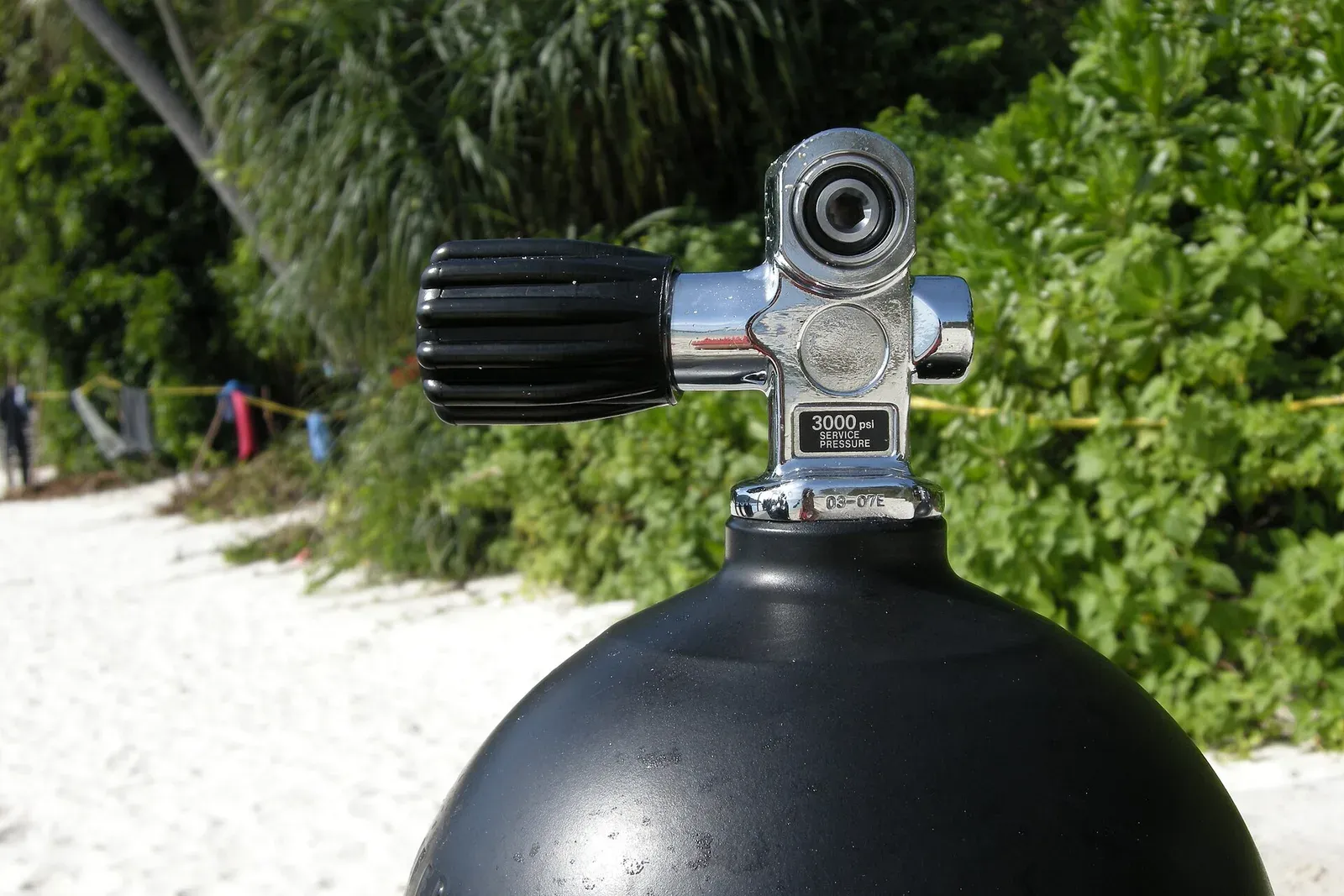
Three numbers, and one of them is you
A cylinder is a box of gas measured twice: once by its own size, and once by the pressure you have squeezed into it. An aluminium 80 — the rental cylinder of the warm world — holds 11.1 litres of water and is filled to 207 bar, so it contains about 2,300 litres of air measured at the surface. A European steel 12 at 232 bar holds around 2,800. A steel 15, the cold-water single, about 3,500.
Underwater you do not breathe litres of surface air. You breathe litres of air at the pressure you happen to be sitting in, and at 30 m (100 ft) that is four times as dense. Every breath costs four times what it costs on the boat. That is the whole of the depth problem, and it is why a dive that felt generous at 12 m turns into twenty minutes at 30.
The third number is you. Your RMV — respiratory minute volume — is how many litres a minute you would breathe at the surface. A relaxed, well-weighted diver doing nothing much runs about 12 litres a minute. A normal recreational dive with some finning is nearer 18. Cold, current, or a new diver still fighting their buoyancy is 25 and upwards. The gap between the first and the last of those is not a detail; it is the difference between a 25-minute dive and a 12-minute one on the same cylinder at the same depth.
Finding your own number
You cannot plan gas with somebody else’s lungs. Fortunately your own number falls out of any dive you have already done.
Take a dive that sat at a reasonably constant depth. Say you left the shot line with 200 bar, surfaced with 90, and spent 40 minutes at an average of 15 m. You used 110 bar. In an 11.1-litre cylinder that is 110 × 11.1 = 1,221 litres, or about 30 litres a minute at depth. At 15 m you were breathing at 2.5 bar, so your surface rate was 30 ÷ 2.5 = 12 litres a minute. That is a good number; most people’s first honest measurement is worse, and that is fine — it is a number to improve, not a grade.
Two words get used for this and they are not interchangeable. SAC is usually quoted in bar per minute, which is easy to read off a gauge but useless the moment you change cylinder: 2 bar a minute out of an 11-litre cylinder and 2 bar a minute out of a 15 mean completely different amounts of gas. RMV in litres per minute belongs to you and travels with you. Work in litres.
What depth does to it
Once you know your rate, bottom time is division. Litres you may spend, divided by litres a minute at that depth.
The curves are the same shape as everything else in diving: not a slope but a cliff. Our average diver at 18 litres a minute has half an hour at 18 m, seventeen minutes at 30, and nine at 40 — and that is with the reserve already set aside, which we will come to in a moment. The relaxed diver has 25 minutes at 30 m where the working diver has 12. Same boat, same cylinder, same reef; one of them is still taking photographs while the other is on the line.
This is also the honest answer to the question every dive shop is asked: how long does a tank last? About an hour on a shallow reef, about twenty minutes if you take it deep, and it depends far more on the diver than on the cylinder.
The part of the cylinder that is not yours
Here is where recreational training tends to hand you a rule instead of a reason. The rule is to surface with 50 bar. The reason nobody explains is what that 50 bar is for: it is the gas that gets two divers to the surface from wherever the trouble happens, breathing hard, sharing one cylinder, without skipping the ascent.
Work that out rather than assuming it and the number is unpleasant. Two divers, both breathing 30 litres a minute because something has gone wrong, spend a minute at depth sorting themselves out, ascend at 9 m a minute to a three-minute stop at 5 m, then climb the last five metres slowly.
At 30 m that is 1,100 litres — 99 bar of an aluminium 80, very nearly half the fill. At 40 m it is 1,461 litres, or 132 bar: two thirds of the cylinder is not yours to breathe. Even at 10 m, where nothing feels serious, it is 52 bar.
Which means the 50-bar rule is roughly correct for a 10 m dive and quietly wrong for everything deeper. It is a good habit that stops being enough at about the depth where people start to feel like proper divers. Run the number for the depth you are actually diving, mark it on the gauge, and treat it the way a pilot treats fuel: not a target to land on, a floor you never touch.
The reason this matters more than it should is that gas is not a rare cause of trouble. In DAN’s review of 68 recreational diving fatalities in the US and Canada in 2014, the two most common identifiable triggers were natural disease at 18 per cent and running low on or out of air at 9 per cent — and in most of the remaining cases no trigger could be established at all.
Which runs out first, the gas or the model
Divers talk about no-stop time as if it were the thing that ends dives. Put the two limits on the same axes and it usually is not.
For a diver breathing 18 litres a minute on a single aluminium 80, the gas is the binding limit down to about 26 m; below that the computer takes over. For the efficient 12-litre-a-minute diver the handover is at 19 m. For the heavy breather at 25 litres a minute it never happens at all: at every depth on that chart the cylinder empties first, and their no-stop time is a number they will never see counted down.
Two useful things follow. The first is that on a single cylinder, most recreational dives are gas-limited, and the way to a longer dive is a lower breathing rate, not a more liberal computer setting. The second is what a bigger cylinder actually buys: the same diver at 30 m gets 16 minutes from an aluminium 80 and 33 from a steel 15, which is not more dive so much as a different dive — the deco model starts mattering, and that is the doorway to the conversation in how your dive computer decides and to enriched air, covered in our guide to breathing gases.
Thirds, turn pressures and the dive you can actually do
Once you have a floor, the plan is simple arithmetic performed before you get wet.
On an open-water dive that goes out and comes back — a wall you swim along, a wreck you circle — you need a turn pressure: the point at which you head back. Take the starting pressure, subtract minimum gas for the depth, halve what is left, and turn when you have used that. From 207 bar at 30 m that is 207 − 99 = 108 bar of usable gas, so you turn at about 153 bar, roughly a quarter of the way through your fill. It looks absurdly early until the first time you swim back into a current.
Where there is a ceiling over your head — the cave line past the daylight zone at Peacock Springs, the holds of a wreck, the deep galleries of a system you cannot swim straight up out of — the rule hardens into thirds: a third to go in, a third to come out, a third untouched for the diver whose day has gone wrong. From a 207-bar fill that is a turn at 138 bar. Thirds is not a conservative version of the recreational rule; it is a different rule for a place where the surface is not directly above you.
There is a third case, which is the one that catches recreational divers out: a dive with no ceiling but a hard floor to the plan. Angelita is an open shaft with a hydrogen sulphide layer at about 27 m and 55 m of water underneath it; nothing stops you going deeper except the number you agreed on the surface, and the gas you would need to come back from it grows faster than the depth does.
And there is the drift case, which is where most recreational gas plans quietly fail. A dive at Blue Corner or Castle Rock costs more gas than the same depth on a calm reef, because you are working, because you are excited, and because the current decides when the dive is over rather than you. Budget a higher rate than your logbook average, not a lower one.
How to breathe less
Nothing on this list is a trick, and one apparent trick is dangerous.
Weight yourself properly and trim yourself flat. Most over-breathing is a buoyancy problem in disguise: a diver who is two kilos heavy is finning to stay off the bottom for the whole dive, and finning is expensive. Slow down — drag rises with the square of speed, so swimming at half the pace costs a quarter as much per metre. Stay warm, because being cold makes you work. Service the regulator that is free-flowing slightly and the inflator that is bubbling: a leak you can hear is gas you paid for.
Then relax, which is the only real answer. Divers with low consumption are not holding anything back; they are simply not doing very much. What they are emphatically not doing is skip-breathing — holding each breath a moment longer to make the gauge move slower. It works on the gauge and it does not work on you: it raises carbon dioxide, which brings on headaches and, at depth, the kind of panicked over-breathing that empties a cylinder far faster than honest breathing ever would.
Where the gas plan is the dive plan
These are the sites in our data where the arithmetic above is the dive briefing: deep enough, far enough or busy enough that gas — not the reef, and often not the computer — decides how long you stay.
| Site | Depth | Current | Level | Best months |
|---|---|---|---|---|
| Hilma Hooker Bonaire · Caribbean Netherlands | to 30 m | Mild | Advanced | Dec–Apr |
| Punta Sur Cozumel · Mexico | 24–38 m | Moderate | Advanced | Jan–Apr |
| SS Thistlegorm Sharm El Sheikh · Egypt | 16–30 m | Moderate | Advanced | May–Oct |
| Blue Corner Palau · Palau | 8–30 m | Strong | Advanced | Dec–Mar |
| Castle Rock Komodo · Indonesia | 10–25 m | Strong | Advanced | Jun–Oct |
| Hin Daeng Wall Hin Daeng & Hin Muang · Thailand | 25–40 m | Strong | Advanced | Dec–Apr |
| Njao Gap Pemba Island · Tanzania | 5–40 m | Strong | Advanced | Oct–Feb |
| Bianca C Grenada · Grenada | 28–40 m | Moderate | Advanced | Jan–Apr |
| Roca Partida Revillagigedo (Socorro) · Mexico | to 40 m | Moderate | Advanced | Jan–Mar |
| Northern Pinnacle Protea Banks · South Africa | 32–40 m | Strong | Advanced | Feb–Apr |
| Angelita Riviera Maya Cenotes · Mexico | to 27 m | None | Advanced | Nov–Apr |
| Peacock Springs North Florida Springs · United States | 6–20 m | Mild | Advanced | Nov–Apr |
| SMS Markgraf Scapa Flow · United Kingdom | 25–45 m | Mild | Advanced | Jun–Aug |
| San Francisco Maru Chuuk Lagoon · Micronesia | 27–64 m | Mild | Advanced | Nov–May |


