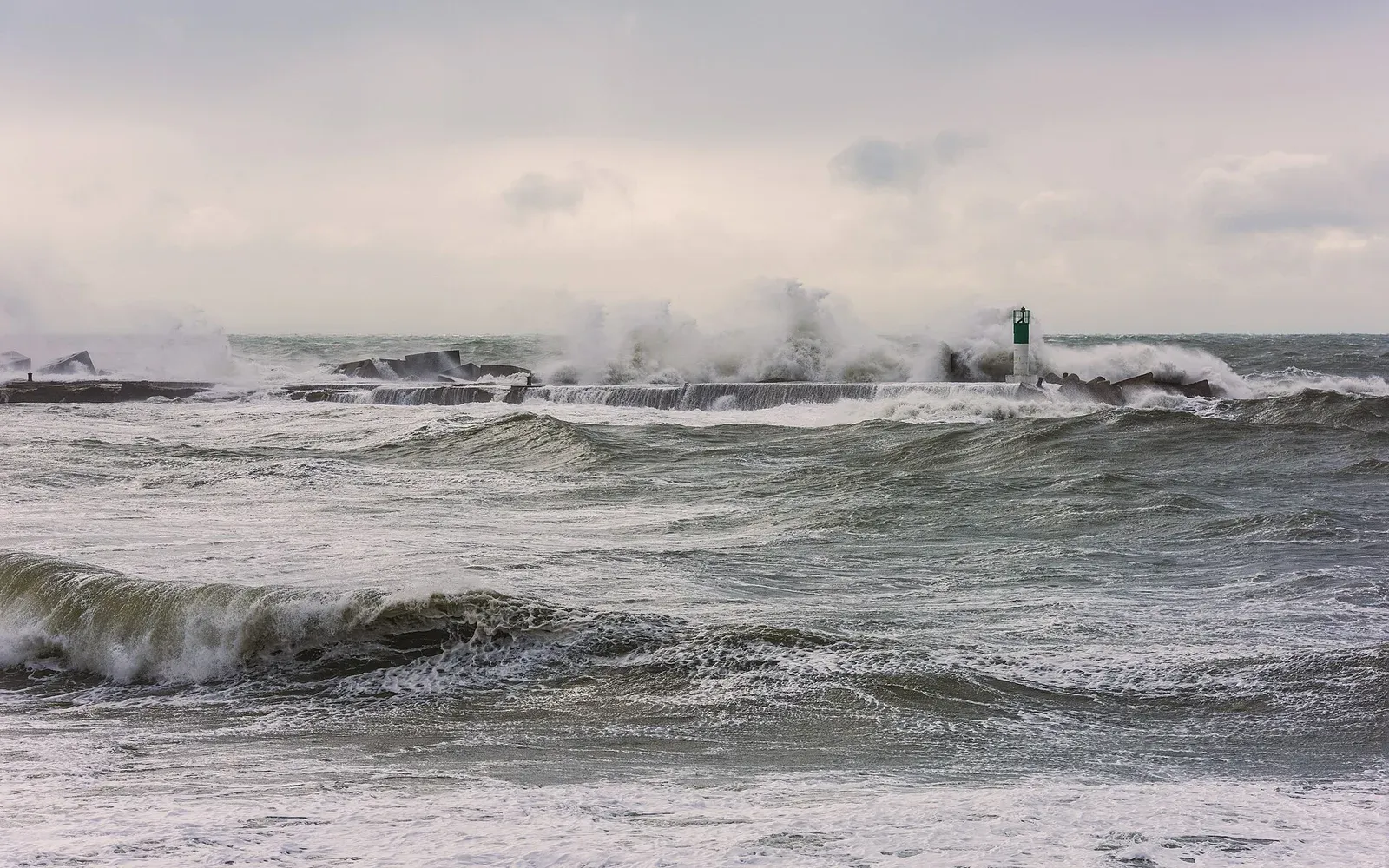
A wave is not water going somewhere
Watch a gull sitting outside the break: the wave passes and the gull stays, riding a small polite circle — up, forward, down, back. That circle is the whole secret. In a surface wave, the water is not travelling with the wave; each parcel of it moves in a closed orbit and returns, while the shape races on without it. Linear wave theory — worked out by George Biddell Airy in the 1840s and still a workhorse of coastal engineering — makes the orbits circles in deep water, and gives the machine one governing dial: the period, the seconds between crests.
Period sets wavelength by a hard rule. A deep-water wave moves at a speed fixed by its length, and length equals speed times period; run the two together and you get L = gT²/2π — wavelength grows with the square of the period. Wind chop at 3½ seconds is a 19-metre wave. An 8-second swell is a 100-metre wave. A 14-second groundswell from a storm a thousand miles away is a 306-metre wave, and none of these look very different from a boat.
Underwater they could not be more different, because the orbits shrink with depth exponentially, on a scale set by the wavelength: every wavelength-worth of depth costs a factor of more than five hundred, and by half a wavelength down the motion is at e^−π — about 4 per cent — of its surface value. Geologists call that depth the wave base. For chop it is 10 metres. For the groundswell it is 153.
Period is the reach
Put real numbers through the model and the diver’s version falls out. Take three honest, illustrative sea states: half-metre wind chop at 3½ seconds, a 1.5-metre swell at 8 seconds, a 2-metre groundswell at 14. At the surface, all three swing the water at a similar 45 to 60 centimetres per second — which is why the boat ride tells you nothing. The chop’s motion is dead by 7 metres; descend through it and the ocean simply switches off. The 8-second swell fades steadily and is a whisper at 40. The 14-second swell reaches 40 metres (130 feet) still moving the water at 20 centimetres per second — from the same surface speed as the chop. Same height would tell you nothing either: reach is period, compounded through that L = gT²/2π square law.
The energy books balance the same way. Wave power scales with height squared times period — the standard formula makes our chop worth about 0.4 kilowatts per metre of crest, the groundswell 27 kW per metre, sixty-odd times more, arriving as smooth blue lines you could mistake for a calm day. Swell is chop that left home: NOAA’s forecasters describe wind waves outrunning their storm, lengthening and organising into the groups we call sets. What arrives at your dive site is the storm’s energy with the chaos filtered out — tidier, and far deeper-reaching.
Surge is an orbit with nowhere to go
All of the above assumes water deeper than half a wavelength, and a 306-metre wave stops finding that long before your reef does. Over a shallow seabed the circles have no room: they flatten into ellipses, the decay almost stops, and at the bottom the vertical motion vanishes entirely, leaving a pure horizontal shuttle. Drawn to scale for our groundswell over a 15-metre seabed, the bed-level water sweeps through 3.2 metres at up to 0.7 metres per second — faster than most divers can sustain against it. That shuttle has a name. Every diver who has held a rock in the Cape Town kelp knows it: surge.
Two practical truths follow from the ellipse. First, surge is oscillation, not current — it takes back everything it gives, so the winning technique is the one the training columns teach: swim with the push, hold position through the pull, and make progress in pulses rather than fighting a metronome that outweighs you. Second, because the motion is horizontal and coherent over metres, constriction amplifies it — the same water shoved through a narrower gap must go faster, the venturi logic Scuba Diving magazine’s surge tips lean on: it accelerates between rocks, through wreck openings, in gullies. In the Faroes there is a site that puts the power on display: Rinkusteinar, two boulders in the shallows that the Atlantic’s swell has rocked for as long as anyone has watched — one still moves, and divers get under its overhang to hear it.
Caverns and swim-throughs turn the dial furthest, which is why the honest cave-diving advice is about geometry: pick the wide gap, hug the side of a narrow one where the flow is slower, and treat any overhead passage in a running swell as a pipe the ocean is breathing through. At the Rhone’s Painted Walls, the local rule for the final archway is the sensible one: on a calm day swim it, with surge running look through it and stay out. The cavern guide is the fuller treatment of overhead judgement; this article only adds the physics of why the water in the door is faster than the water outside it.
The worst room in the house is at five metres
Read the first chart again with a diver’s eye and the grim joke emerges: for both swells, the water at safety-stop depth is still moving at about 40 centimetres per second — most of what it had at the surface — while the bottom of the same dive may be still. The stop is three minutes you spend for real decompression reasons parked in the layer where the wave still owns the water, with nothing to hold and a boat pitching overhead.
The physics also writes the technique. You cannot hold five metres by eye against water that is itself orbiting; watch your depth, not the particles, accept the metre of sway the orbit imposes, and average the stop rather than chasing the needle. Deploy the DSMB before the layer gets rough, from ten metres or deeper, so the reel is done before the sea starts shaking the workbench — and mind that the line above you is now moving with a surface that may be two metres of swell; let the reel breathe instead of clipping yourself rigidly to a yo-yo. In a real seaway many crews prefer a drifting stop under a bag to a pitching granny line for exactly this reason.
The shore entry ledger
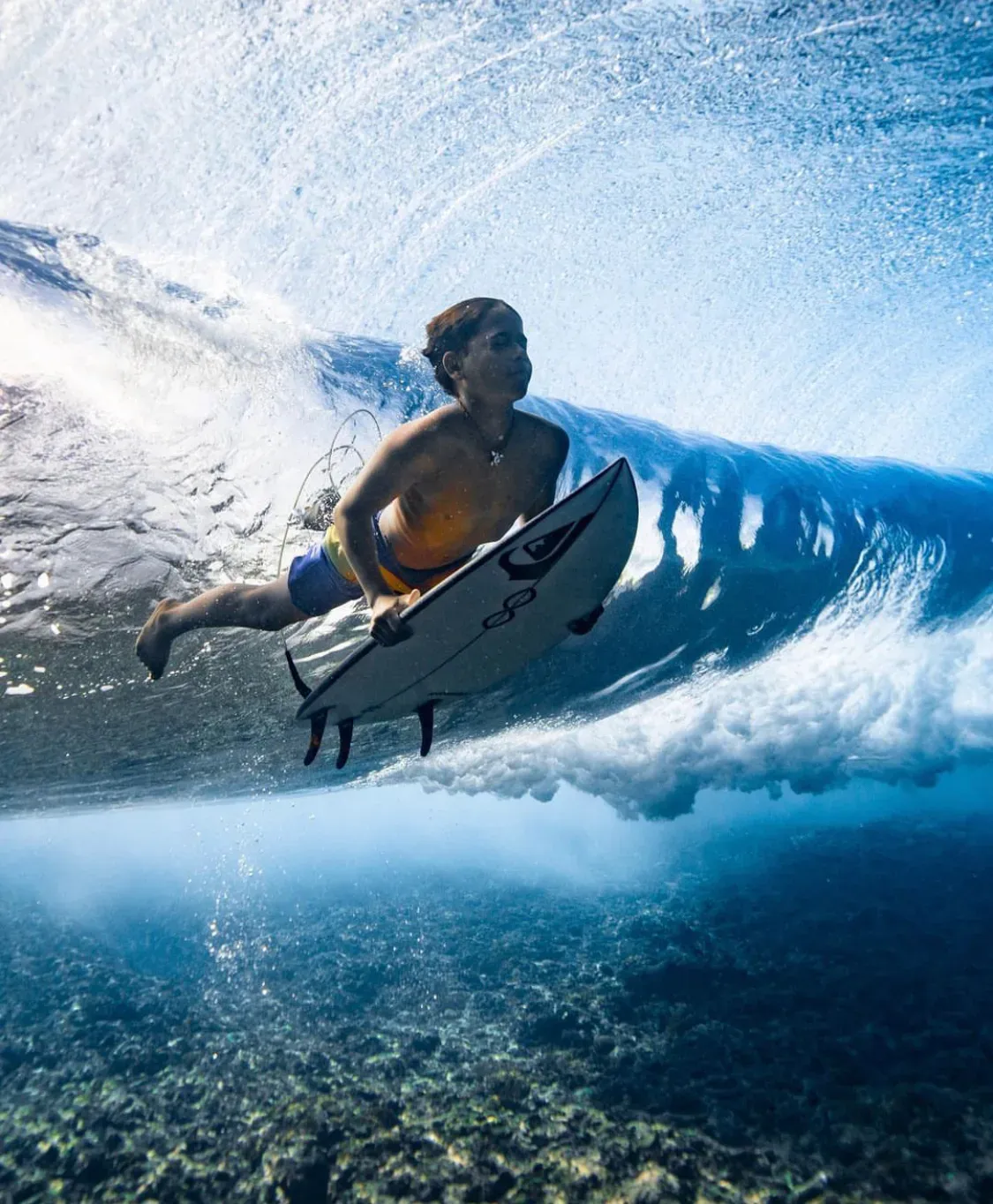
Breaking waves are the one place this article’s maths turns violent. A wave breaks when the water shallows to roughly its own height — the coastal-engineering rule of thumb is that height exceeding about 0.8 of the depth does it — so the metre-or-less shore break of a diveable day detonates in roughly a metre of water: waist-to-chest deep, exactly the strip you wade across, while a genuine 2-metre sea saves its violence for water you would have to swim in. That strip is the danger zone of every surf entry — deep enough that the water owns your footing, shallow enough to take the full release of energy — and the working advice from the shore-diving literature follows directly: gear checked and streamlined before the water’s edge, cross the strip without pausing, duck under what you cannot hop over, and get to depth or get out.
Timing is the other half, and the ocean provides it, because swell arrives in sets with lulls between them — wave groups, in the physics; seven or so waves per group near the storm, twenty and more in old swell from far away. Sit and count before you commit; the local brief for the Karwela’s shore-exit ladders puts it in one sentence — time the climb between sets and pass kit up rather than wearing it — and the Blue Hole’s famous entry pool carries the same clause about checking the swell before committing to the climb back out. One number from the forecast deserves its own caution here: reported wave height is significant wave height, the average of the biggest third, and individual waves can run to roughly double it. The set that closes your exit is not a freak; it is the statistic. The shore-diving guide lists the easy entries; this is the arithmetic for the other kind.
Reading the forecast like a diver
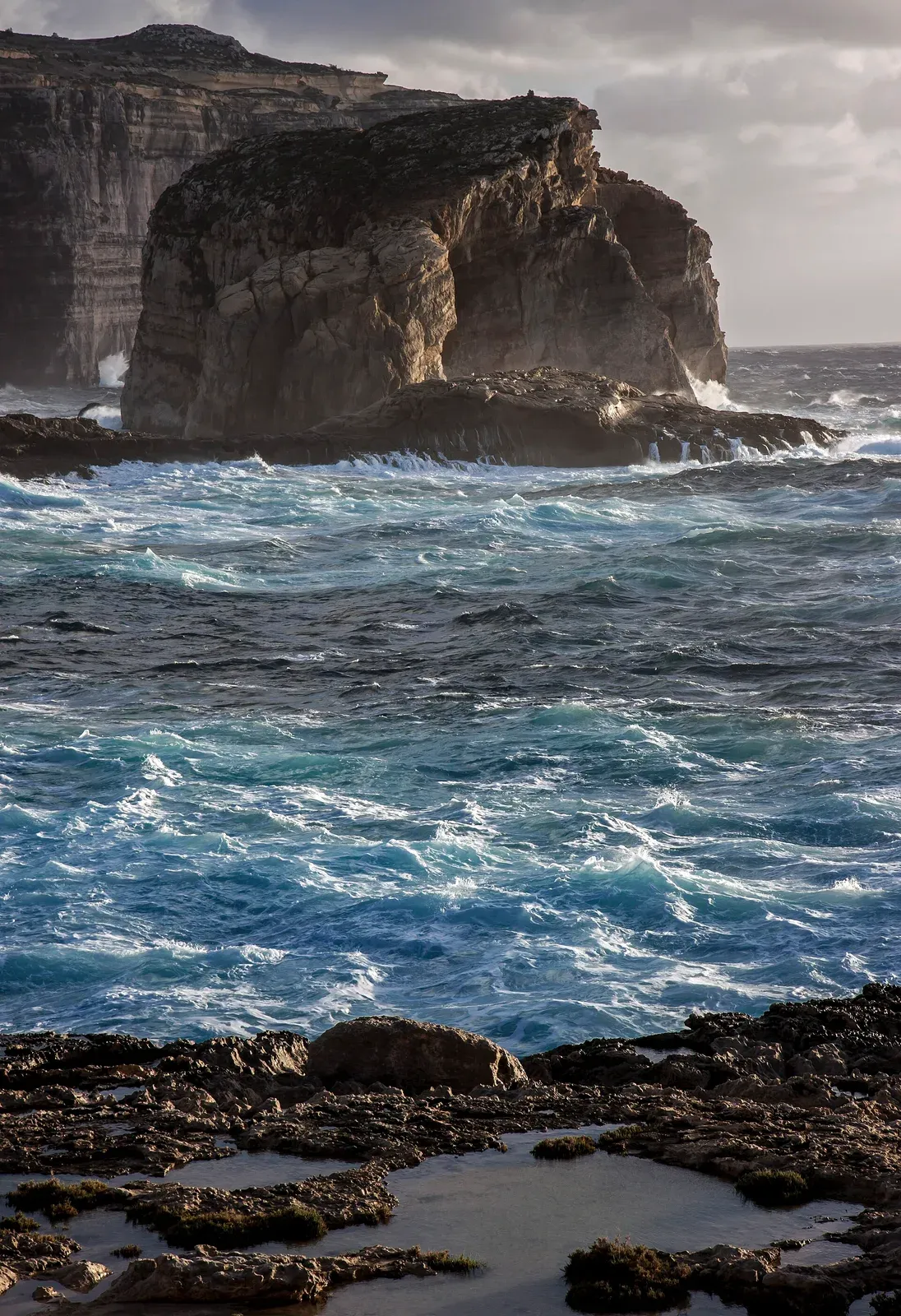
A marine forecast gives you height, period and direction, and divers habitually read it in the wrong order. Height first is surfer thinking. For what the water will be doing at depth, run the checklist the physics wrote: period first — under about six seconds is chop that vanishes a few metres down, ten is a real swell that reaches sport-diving depths, fourteen-plus reaches everything and rocks boulders; direction second — a site in the lee of your swell may be flat while the chart says storm, the whole argument of Cathedral Rock’s slack-and-settled rule and of Monteagudo’s exposed west face; height last, doubled once for the set of the day. Some sites are simply owned by the number: Malin Head’s wrecks open on settled days between May and September and Atlantic swell closes them for weeks.
Where the sea keeps the metronome
| Site | Depth | Level | Best months |
|---|---|---|---|
| Blue Hole & Inland Sea Malta & Gozo · Malta | 10–30 m | Intermediate | Jun–Sep |
| MV Karwela Malta & Gozo · Malta | 30–42 m | Advanced | Jun–Sep |
| Cathedral Rock St Abbs & Eyemouth · United Kingdom | 3–18 m | Intermediate | Jun–Sep |
| Alfred Erlandsen St Abbs & Eyemouth · United Kingdom | 7–15 m | Intermediate | Jun–Sep |
| The Rocking Stones in Oyndarfjørður Faroe Islands · Faroe Islands | to 8 m | Intermediate | Jun–Aug |
| Shores at Tjørnuvík Faroe Islands · Faroe Islands | 3–12 m | Intermediate | Jun–Aug |
| Castle Rocks Cape Peninsula Kelp Forests · South Africa | to 18 m | Intermediate | Nov–Jun |
| Partridge Point Cape Peninsula Kelp Forests · South Africa | to 26 m | Intermediate | Nov–Jun |
| Cane Bay Wall St. Croix · U.S. Virgin Islands | 8–12 m | Beginner | Dec–May |
| SS Winfield Scott Channel Islands · United States | 8–9 m | Intermediate | Sep–Nov |
| Yonaguni Monument Yonaguni · Japan | 5–20 m | Advanced | Dec–Mar |
| Illa de Monteagudo Illas Cíes & Ría de Vigo · Spain | to 18 m | Intermediate | Jun–Aug |
| HMS Audacious Malin Head · Ireland | 58–68 m | Advanced | Jun–Aug |
| The Cathedral Crete · Greece | 14–21 m | Intermediate | Jun–Oct |
| Painted Walls RMS Rhone & Salt Island · British Virgin Islands | to 12 m | Beginner | Dec–Apr |
| Secca della Colombara Ustica · Italy | 5–40 m | Advanced | Jun–Sep |
StAbbs Cathedral Rock · kropaganda on YouTube
The three minutes this article keeps worrying about are explained in what a safety stop does; the easy entries are catalogued in best shore dives; and when the water is going somewhere rather than swinging in place, that is a different physics problem and a different guide.


